
AI-Driven Fraud Prevention: 2026 Merchant Security Guide
Published:

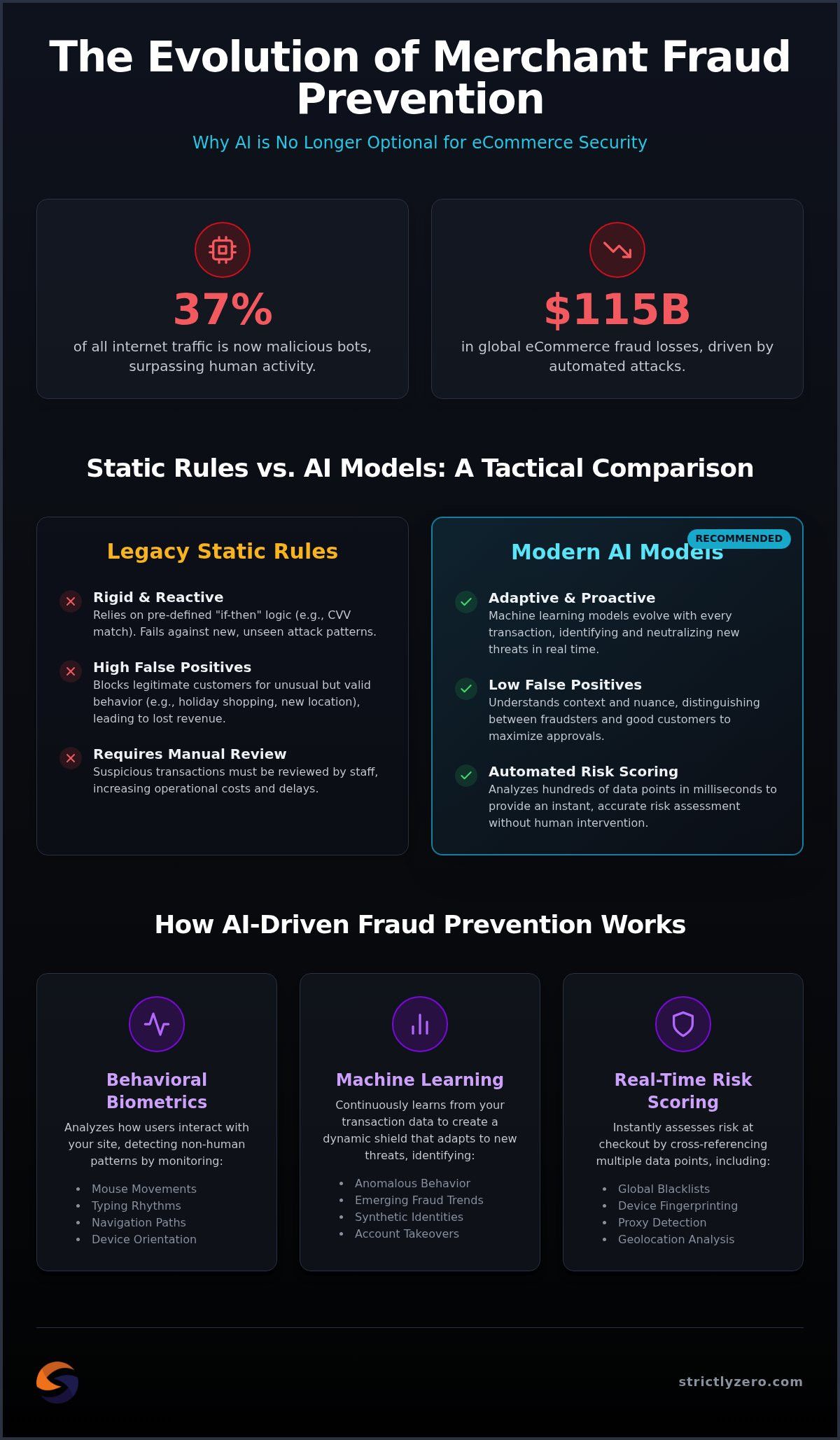
Did you know that malicious bots now account for 37% of all internet traffic, surpassing human activity for the first time? This massive shift has helped drive global eCommerce fraud losses to a staggering $115 billion, leaving many businesses caught between rising chargeback rates and the high costs of legacy security tools. You’ve likely felt the sting of “false positives” where legitimate customers are declined by rigid filters, costing you both revenue and trust. Adopting modern ai driven fraud prevention for merchants is the only way to stay ahead of these automated threats while keeping your operations lean and profitable.
It’s exhausting to manage a business when you’re constantly worried that a zero-fee processing model might leave you vulnerable to sophisticated synthetic identity theft. You need a security layer that integrates seamlessly with your pricing strategy rather than working against it. In this guide, you’ll discover how to slash your chargeback ratios and use automated risk scoring to eliminate the need for constant manual reviews. We’ll preview the 2026 Nacha mandates and show you how a unified, AI-powered platform ensures your revenue stays exactly where it belongs: in your pocket.
Key Takeaways
- Learn why traditional static rules are no longer enough to stop sophisticated AI-powered bot attacks and synthetic identity fraud.
- Discover how ai driven fraud prevention for merchants uses behavioral biometrics to analyze user navigation patterns in real time.
- Understand the difference between manual review burdens and automated risk scoring that protects your revenue without declining good customers.
- See how a unified security layer supports compliant surcharge and dual pricing programs, ensuring your zero-fee model stays secure.
- Get actionable steps for auditing your current fraud landscape and transitioning to an omni-channel processor with native AI protection.
Table of Contents
- The Evolution of Merchant Fraud: Why 2026 Requires AI
- How AI-Driven Fraud Prevention Works for Merchants
- Static Rules vs. AI Models: A Tactical Comparison
- Implementing AI Fraud Detection: Best Practices
- Strictly’s Unified Approach: Secure, AI-Driven, Zero-Fee
The Evolution of Merchant Fraud: Why 2026 Requires AI
As we move through 2026, the digital storefront has become a primary target for sophisticated, automated attacks. Modern ai driven fraud prevention for merchants is no longer an optional upgrade; it’s a fundamental requirement for survival. Unlike traditional security that relies on rigid, pre-defined lists, these modern systems use machine learning to analyze behavioral data in real time. This means the software learns what “normal” looks like for your specific business, allowing it to spot anomalies that a human or a basic script would miss. It’s about moving from a reactive stance to a proactive defense.
The urgency stems from a massive surge in AI-powered attacks. Malicious bots now account for 37% of internet traffic, and they’ve evolved to mimic human browsing patterns, mouse movements, and even typing speeds to bypass detection. If your ecommerce payment processing setup still relies on simple “if-then” logic, you’re essentially leaving the back door unlocked for these high-speed intruders. Using AI in fraud detection allows you to fight fire with fire, using automated intelligence to neutralize threats before they reach your checkout page.
Maintaining a zero fee credit card processing model depends entirely on your ability to minimize risk. High fraud rates lead to increased overhead and potential processor penalties, which can quickly erode the savings of a surcharge program. By implementing ai driven fraud prevention for merchants, you create a secure environment where zero-fee programs can thrive without the constant threat of revenue leakage or account instability.
The Death of Static Fraud Rules
In the past, checking for a Zip Code match or a CVV was considered “good enough.” In 2026, these are baseline requirements that fraudsters easily bypass using generative AI to create synthetic identities. While bad actors use these tools for deception, legitimate brands are using an AI advertising production studio to create high-quality, authentic content at scale. Rigid thresholds often backfire by creating “false positives,” where legitimate holiday shoppers are blocked because they’re ordering from a new location or spending more than usual. AI models adapt to these seasonal shifts, ensuring you don’t lose a sale just because a customer doesn’t fit a narrow, outdated profile. This adaptability is the difference between a growing business and one that’s stagnant due to over-zealous security.
The Cost of Inaction: Chargebacks and Reputation
Ignoring the evolution of fraud carries a heavy price tag. Beyond the immediate loss of inventory, chargebacks come with processing fees and administrative headaches that drain your resources. If your dispute ratio climbs too high, you risk losing your merchant account entirely. Friendly fraud is a specific type of dispute where a customer makes a legitimate purchase but then claims the charge was unauthorized to get their money back. AI helps identify these patterns by analyzing historical data and customer intent before the transaction is even finalized, protecting both your bottom line and your professional reputation.
How AI-Driven Fraud Prevention Works for Merchants
Modern ai driven fraud prevention for merchants functions like a digital immune system. It doesn’t just block a bad actor and move on; it uses Machine Learning (ML) to study the context of every transaction. The system analyzes historical data and current trends to identify patterns that are invisible to the human eye. It gets smarter with every transaction you process, creating a dynamic shield that evolves faster than the criminals trying to bypass it. This continuous learning cycle ensures that your security isn’t just a static wall, but a living intelligence that adapts to new threats.
One of the most effective tools in this arsenal is behavioral biometrics. Instead of just looking at the credit card number, the AI analyzes how a user interacts with your site. It monitors mouse movements, typing rhythms, and navigation paths. Because bots and human fraudsters have distinct, non-natural patterns, the AI can flag them before they even complete a purchase. This level of scrutiny is vital as AI-driven financial scams become more convincing and harder to detect with traditional methods.
Real-time risk scoring happens in milliseconds. As a customer clicks “pay,” the AI pulls from global blacklists and uses device fingerprinting to verify their identity. It checks for proxies, VPNs, and suspicious geolocations while simultaneously cross-referencing the transaction against a network of cross-merchant intelligence. If a card was used for testing at another store minutes ago, the system knows. This speed is essential for maintaining a frictionless checkout experience while ensuring that only legitimate transactions move forward.
From Data Points to Risk Scores
The process starts with deep data enrichment. The system analyzes device metadata such as the operating system, browser version, and even battery level to ensure the device is exactly what it claims to be. This data culminates in a “Trust Score.” High-scoring, loyal customers are rewarded with a friction-free experience, while high-risk attempts are met with automated challenges or instant declines. By prioritizing ai driven fraud prevention for merchants, you can automate these complex decisions and stop wasting hours on manual order reviews.
Reducing False Positives
For many small businesses, the “False Decline” epidemic is more damaging than actual fraud. Losing a legitimate customer because a rigid rule blocked their transaction is a double loss. You lose the immediate sale and the customer’s future loyalty. AI distinguishes between a legitimate traveler in a new city and a stolen card by analyzing hundreds of subtle variables in real time. These sophisticated models increase authorization rates for legitimate users by accurately identifying genuine buying behavior. If you want to protect your bottom line, choosing trustworthy payment processing with built-in AI security is the most effective way to grow safely.
Static Rules vs. AI Models: A Tactical Comparison
Choosing between legacy systems and ai driven fraud prevention for merchants is a choice between a static shield and a dynamic one. Static rules operate on a rigid “if-then” basis. If an order exceeds $500 and comes from a specific IP range, it’s flagged. This worked well enough in 2010, but the future of online fraud detection relies on deep nuance. AI doesn’t just look at the price; it looks at the intent, the device health, and historical behavior. It allows your business to respond to a viral bot attack or a new “fraud wave” in seconds, whereas manual rules might take days of analysis to update.
Scalability becomes an impossible hurdle without automation. A business processing 100 transactions a month might manage with manual reviews, but when that volume jumps to 10,000, the manual burden becomes a bottleneck. Modern ai driven fraud prevention for merchants scales effortlessly, ensuring that your credit card processing for small business setup remains efficient as you grow. You shouldn’t have to hire a fleet of security analysts just because your sales are increasing.
The Efficiency Gap
Every minute your staff spends investigating a “suspicious” order is a minute they aren’t growing the business. Legacy systems require constant manual tuning to keep up with new threats. AI self-optimizes, learning from every approval and decline without human intervention. This shift significantly improves the ROI of your credit card processing services by slashing labor costs and reducing human error. High-volume ISOs and growing retailers find that this automation isn’t just a luxury; it’s the core of a profitable, lean operation.
Precision in 2026 Payments
Card Not Present (CNP) transactions are the lifeblood of modern commerce, but they’re also the highest risk. Rule-based systems often use “Velocity Checks” to block fraud, which can accidentally penalize loyal customers who are buying multiple items in quick succession. AI handles these scenarios with surgical precision. It recognizes the difference between a bot-driven attack and a human repeat buyer in milliseconds. While rule-based detection speeds are limited by the complexity of the logic tree, AI processes thousands of variables simultaneously. This delivers an instant decision that keeps your checkout line moving without compromising on security.
Implementing AI Fraud Detection: Best Practices
Before you activate a new security layer, you must audit your current fraud landscape. Identifying where your biggest losses occur is the first step toward recovery. If you’re losing more to false positives than to actual theft, your current filters are likely too rigid. Modern ai driven fraud prevention for merchants allows you to fine-tune your Risk Appetite with precision. You can set the balance to favor high conversion for trusted customers while maintaining a digital fortress against high-risk behavior. It’s about finding the sweet spot where security doesn’t stifle your growth.
Selecting an omni-channel processor that includes AI security as a native feature simplifies your operations. You don’t want a patchwork of third-party plugins that fail to communicate. A unified platform ensures that data from your virtual terminal, invoicing, and online store all feed into the same intelligence engine. This holistic view is essential for catching sophisticated fraudsters who test cards across different channels. Monitoring your performance via analytics dashboards allows you to iterate and improve your defense strategy over time as new threats emerge.
The Role of PCI DSS Compliance
AI tools do more than just block bad actors; they help you stay compliant. By using tokenization, these systems ensure you never handle raw card data directly within your environment. This significantly reduces your PCI DSS scope and protects sensitive information from potential breaches. As we face stricter data privacy regulations in 2026, having an ai driven fraud prevention for merchants setup ensures your security practices remain ahead of the legal curve while protecting your customers’ digital identities. Complementing these external defenses with secure internal communication, such as a p2p encrypted messenger, ensures that your team’s strategy for managing fraud risks remains confidential.
Training Your AI Model
Your AI shouldn’t work in a vacuum; it needs your input to reach peak performance. Providing consistent feedback on any chargebacks that slip through helps the model learn the specific nuances of your business. You can also set custom triggers for high-ticket items or specific geographic regions that historically present higher risk. Integrating this fraud data with your customer relationship management (CRM) tools allows you to build a comprehensive profile of your best customers. This synergy ensures you reward loyal buyers with a friction-free experience while automatically flagging suspicious outliers. If you’re ready to secure your revenue, you can partner with a processor that prioritizes trust and automated protection.
Strictly’s Unified Approach: Secure, AI-Driven, Zero-Fee
For many businesses, the transition into 2026 means reevaluating the foundation of their payment partnerships. Strictly positions itself as a trust-first processor, moving beyond the role of a simple utility provider to become a strategic security ally. Our platform integrates ai driven fraud prevention for merchants directly into the core processing architecture. This isn’t a separate, costly add-on that you have to manage; it’s the essential gatekeeper for our Smart Pricing Engine. By automatically identifying and neutralizing high-risk transactions, our AI ensures that your surcharge and dual pricing programs remain compliant and insulated from the volatility of fraudulent chargebacks.
The synergy between our security layer and our omni-channel platform creates a unique advantage for modern retailers. Whether you’re processing through a virtual terminal or an integrated online storefront, the same intelligence engine protects your revenue. This API-first approach is ideal for both independent merchants and ISO partners who need a secure, scalable environment that doesn’t sacrifice speed for safety. We’ve built a system where advanced ai driven fraud prevention for merchants acts as a silent partner, allowing you to focus on growth while the software handles the complexities of risk management.
Security That Pays for Itself
Most competitors treat fraud prevention as a profit center, layering extra fees on top of standard processing costs. We believe this model is fundamentally flawed. By eliminating traditional processing fees through our surcharge and dual pricing programs, you effectively unlock the budget needed for superior AI security. This unified platform reduces integration friction, as you no longer need to stitch together disparate tools from multiple vendors. The result is a more stable merchant account and a more predictable bottom line, proving that “Trust as a Processor” is a tangible asset for your business’s long-term health.
Next Steps for 2026 Merchants
Switching to a processor that prioritizes automated security is the most effective way to future-proof your operations. You’ll gain access to a unified dashboard where your payments, surcharging data, and real-time fraud alerts live in a single view. This transparency allows you to monitor your “Trust Score” and adjust your risk appetite as your business evolves. Don’t let outdated security rules or high processing fees hold your business back from its full potential. Secure your revenue with Strictly’s AI-driven platform today and join the new standard of merchant security.
Future-Proof Your Revenue with Intelligent Security
The digital environment of 2026 demands more than just basic filters; it requires a proactive defense that evolves alongside digital threats. By moving away from rigid manual reviews and embracing ai driven fraud prevention for merchants, you protect your bottom line from the rising tide of synthetic identity theft and automated bot attacks. You’ve seen how behavioral biometrics and real-time risk scoring can turn security from a bottleneck into a competitive advantage. This technology doesn’t just block fraud; it increases your authorization rates and builds lasting trust with your legitimate customers.
Strictly offers a unique path forward by making advanced security a core platform feature rather than a costly add-on. Our unified omni-channel dashboard and compliant surcharge engine allow you to eliminate processing fees without compromising on protection. You don’t have to choose between profitability and safety. It’s time to reclaim your revenue and focus on what you do best: growing your business. Start Processing with Zero Fees and AI-Driven Security today. Your secure, fee-free future is ready when you are.
Frequently Asked Questions
What is AI-driven fraud prevention for merchants?
It is a security system that uses machine learning to analyze transaction data and user behavior in real time. Unlike static rules, it identifies complex fraud patterns by learning from every approval or decline. This technology creates a dynamic trust score for each customer, allowing businesses to automate risk management across all sales channels without needing constant manual intervention or oversight.
How does AI fraud detection reduce chargebacks?
It reduces chargebacks by blocking high-risk transactions before they are ever authorized. The system identifies stolen cards and synthetic identities by cross-referencing global blacklists and deep device fingerprinting. By catching these threats at the point of sale, you avoid the inventory loss and administrative penalties associated with disputed charges, keeping your merchant account in good standing with your processor.
Will AI-driven fraud prevention slow down my checkout process?
No, the analysis happens in milliseconds and is virtually invisible to the customer. Modern ai driven fraud prevention for merchants is designed to facilitate a frictionless experience for legitimate buyers. By automating the decision-making process, you actually speed up checkout for trusted users while only introducing friction for high-risk attempts that require further verification or a secondary challenge.
Is AI fraud detection better than traditional rule-based systems?
Yes, because it adapts to new threats without requiring manual updates from your team. Traditional rules are rigid and often lead to false declines of good customers who don’t fit a narrow profile. AI models analyze hundreds of subtle variables simultaneously, providing a level of precision that static “if-then” logic simply cannot match in the face of evolving cybercrime.
Can AI-driven fraud prevention stop ‘friendly fraud’?
It can significantly mitigate friendly fraud by identifying patterns of repeat behavior and verifying customer intent. The system tracks historical data and device consistency to spot individuals who frequently dispute legitimate purchases. While no system is perfect, AI provides the evidentiary data needed to challenge these disputes more effectively and prevent future occurrences from the same suspicious accounts or devices.
How much does AI-driven fraud prevention cost for small businesses?
Costs vary depending on your payment processor and the volume of transactions you handle. Some providers offer these tools as a premium add-on with per-transaction fees, while others integrate them as a core component of their platform. You should check with your specific provider to see how their security features align with your current pricing model and monthly transaction volume.
Does AI fraud detection help with PCI DSS compliance?
Yes, it supports compliance by reducing the need for merchants to interact with sensitive raw card data directly. Through advanced tokenization and secure data handling, these systems minimize your compliance scope and overall liability. This ensures that your ai driven fraud prevention for merchants setup meets the latest security standards while protecting your business from the devastating impact of data breaches.
What happens if the AI incorrectly flags a legitimate transaction?
Most systems allow you to review flagged orders manually or adjust your risk sensitivity settings to match your business needs. If an error occurs, you can provide feedback to the model so it learns to recognize that specific customer or behavior as safe in the future. This continuous feedback loop ensures the system becomes more accurate for your specific business over time.