
What Is a Payment Facilitator (PayFac)? A Guide
Published:

What if the company that helps a customer pay also handles much of the merchant’s onboarding? If you’re asking what is a payment facilitator (PayFac), that overlap is what makes the model easy to confuse with payment processors, independent sales organizations (ISOs), and merchant accounts. A PayFac brings merchant onboarding and payment coordination together in a platform-led arrangement.
It’s understandable to wonder who approves merchants, manages risk, and handles transaction funds. These responsibilities can involve several participants, including the PayFac, its acquiring bank, and a payment processor. In a typical PayFac model, businesses join as submerchants under the PayFac’s master merchant account. This creates a different onboarding path from setting up a standalone merchant account.
This guide explains the main participants and follows the flow from merchant onboarding to payment processing. You’ll also see how a PayFac differs from a processor or ISO, what to consider when assessing the model for a platform or its merchants, and how payment infrastructure fits into the picture. That context can help you evaluate options such as an API-first, omnichannel platform without confusing payment processing infrastructure with the PayFac role.
Key Takeaways
- Understand what is a payment facilitator (PayFac) and how a platform-led model enables businesses to accept payments as submerchants.
- Trace the basic payment flow and see where the platform, processor, acquiring bank, and card networks may take part.
- Compare PayFacs with processors, ISOs, and merchant accounts by their roles and relationships with merchants.
- Assess whether the model fits your platform by considering merchant onboarding, payment control, risk oversight, integration, and ongoing support.
- Learn how payment infrastructure can support integrated payment experiences without making a platform a PayFac.
Table of Contents
- What Is a Payment Facilitator (PayFac)? The Model in Plain English
- How the PayFac Model Works: From Merchant Onboarding to Payment
- PayFac vs. Payment Processor, ISO, and Merchant Account
- When Does a PayFac Model Make Sense for a Platform?
- How PayFacs Fit into the Wider Payment Infrastructure
What Is a Payment Facilitator (PayFac)? The Model in Plain English
A payment facilitator (PayFac) enables businesses to accept payments through a platform-led arrangement, commonly onboarding those businesses as submerchants. The platform makes payment acceptance part of its service, so a business can take payments through the platform’s setup instead of arranging every part of the payment relationship independently.
If you’re asking “what is a payment facilitator (PayFac),” the key distinction is that PayFac describes a role and operating model, not just a payment gateway. A gateway generally transmits payment information. A PayFac model also involves enabling businesses to accept payments and may include onboarding them. The precise division of responsibilities depends on the PayFac’s acquiring and processing arrangements.
What does a payment facilitator do?
A PayFac’s platform can give businesses a path to apply, complete onboarding, and begin accepting payments. It coordinates payment acceptance as part of the platform experience, while other participants may handle processing and acquiring functions. For merchants, this can make payment access feel like a built-in part of the platform rather than a separate setup.
Payment enablement doesn’t mean the PayFac takes over the merchant’s business. The merchant remains responsible for its own sales, product or service delivery, fulfillment, and customer service. For comparison, a traditional merchant account is an account used to accept and process payments. The PayFac model organizes payment access around a platform and its submerchants.
Who are the submerchants in a PayFac model?
Submerchants are individual businesses that accept payments through a PayFac-supported platform. They remain distinct businesses, even though their payment setup is connected to the platform’s PayFac arrangement.
For example, imagine software built for independent fitness studios. If the platform uses a PayFac model, each studio could sign up through the software and accept customer payments as a submerchant. The platform makes payment acceptance available within its service, while each studio continues to run its own business and serve its customers.
This is one possible arrangement, not a rule for every software company or payment provider. A platform can integrate payment processing without operating as a PayFac, and onboarding responsibilities can vary by setup. Look beyond a seamless checkout or payment screen to identify who enables the merchant relationship and how the payment arrangement is structured.
How the PayFac Model Works: From Merchant Onboarding to Payment
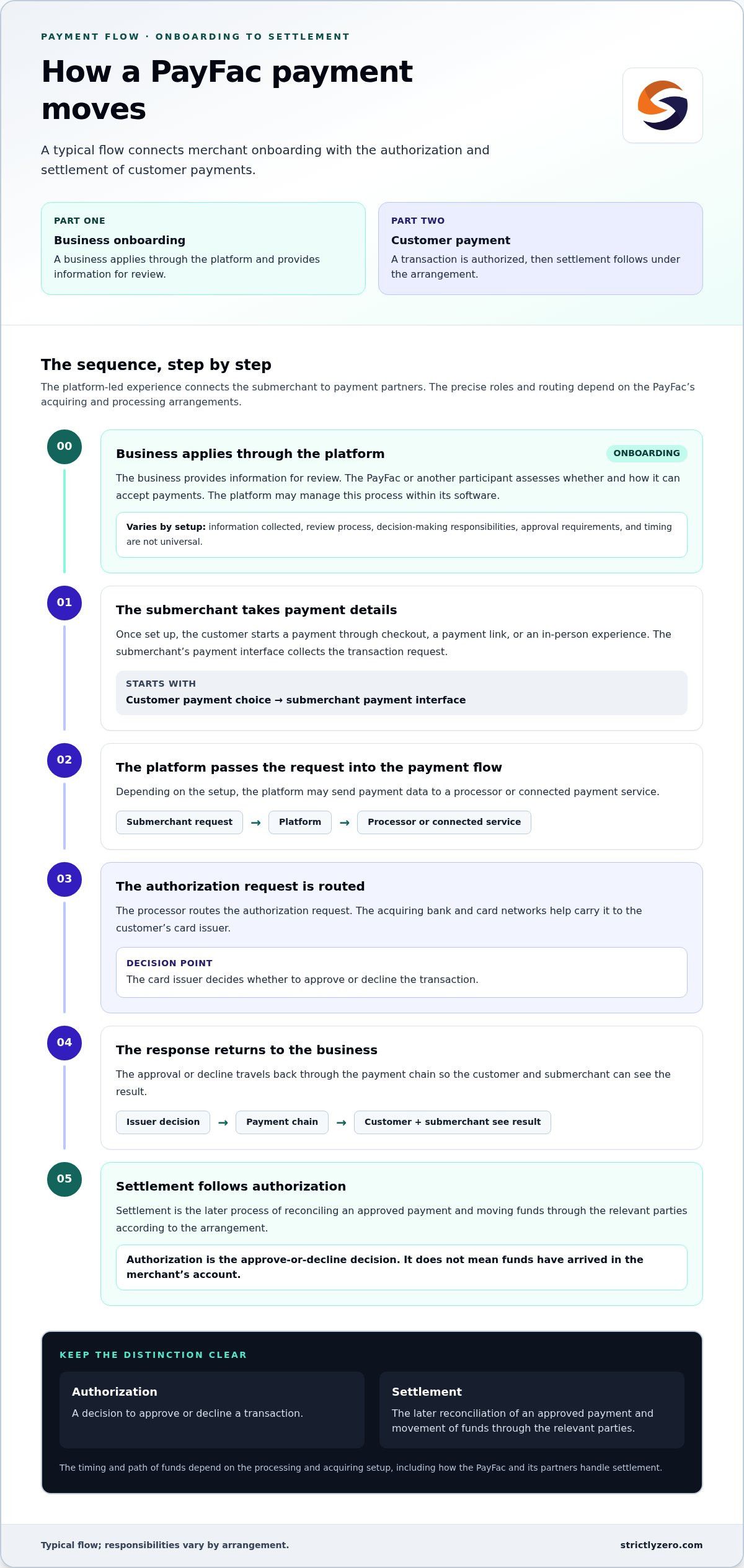
A PayFac payment flow has two connected parts: onboarding a business to accept payments, then authorizing and settling each customer transaction. In a typical flow, the platform and submerchant initiate and manage the payment experience, while a processor, acquiring bank, and card networks help route and handle the transaction. The sequence and division of duties depend on the PayFac’s acquiring and processing arrangements.
How does a business get onboarded?
Onboarding usually starts when a business applies through the platform and provides information for review. The PayFac or another participant assesses whether and how the business can accept payments. The platform may manage this process in its own software, making payment setup part of the merchant experience. The information collected, review process, and decision-making responsibilities vary by arrangement, so approval requirements and timing aren’t universal.
What happens when a customer pays?
Once the business is set up, a customer starts a payment through checkout, a payment link, or an in-person experience. Here’s the basic flow:
- The submerchant takes payment details. The customer chooses to pay, and the submerchant’s checkout or payment interface collects the transaction request.
- The platform passes the request into the payment flow. Depending on the setup, the platform may send payment data to a processor or connected payment service.
- The processor routes the authorization request. The acquiring bank and card networks help carry the request to the customer’s card issuer, which decides whether to approve or decline it.
- The response returns to the business. The approval or decline travels back through the payment chain, so the customer and submerchant can see the result.
- Settlement follows authorization. Authorization is the decision to approve or decline a transaction. Settlement is the later process of reconciling the approved payment and moving funds through the relevant parties according to the arrangement.
Authorization isn’t the same as money arriving in a merchant’s account. The timing and path of funds depend on the processing and acquiring setup, including how the PayFac and its partners handle settlement. The U.S. Treasury report on fintech offers broader context on how technology is changing financial services, including payment experiences. For a related look at the infrastructure behind connected payment experiences, explore API-first omnichannel payment processing.
PayFac vs. Payment Processor, ISO, and Merchant Account
Payment terms can describe different parts of the same setup, rather than competing options. If you’re clarifying what is a payment facilitator (PayFac), focus on the role: a PayFac model combines payment processing arrangements with a platform’s role in enabling merchants. A processor, ISO, and merchant account refer to other functions or parts of the relationship.
| Term | Primary role | Relationship to merchants | Typical platform involvement |
|---|---|---|---|
| Payment facilitator | Enables businesses to accept payments through a platform-led arrangement. | Businesses may be onboarded as submerchants within the PayFac’s arrangement. | Often central to the payment experience and merchant enablement. |
| Payment processor | Performs payment-processing functions, such as routing transaction information. | May support a merchant directly or work within a broader PayFac arrangement. | Can connect with platform software, but processing alone doesn’t make a platform a PayFac. |
| ISO | Acts as a sales or service partner in the payments ecosystem. | May help merchants access payment services or provide related support. | Can introduce or serve platform businesses; duties depend on its agreement. |
| Merchant account | Provides an account arrangement used to accept and settle card payments. | A business may have its own account or participate in another structure, depending on the setup. | May be part of a platform’s payment arrangement, but doesn’t by itself define the platform’s role. |
Is a PayFac the same as a payment processor?
No. The terms describe different roles, though one payment arrangement can involve both. A processor handles payment-processing functions. A PayFac model adds platform-led merchant enablement, which may include onboarding and managing the submerchant relationship. The parties’ exact duties vary, and industry terminology isn’t always used identically across providers.
How does a PayFac differ from an ISO or merchant account?
An ISO is generally a partner in the sales or service relationship, while a PayFac centers payment access around a platform and its merchants. An ISO may work with a PayFac, processor, or acquiring organization, but its precise responsibilities are set by the relevant agreement.
A merchant account is an account arrangement, not a description of who sells or manages payment services. Businesses may have different contractual setups across providers. The label alone doesn’t determine who handles onboarding, processing, or merchant support. Those responsibilities depend on the contracts and operating arrangements between the merchant, platform, processor, ISO, PayFac, and acquiring bank.
When Does a PayFac Model Make Sense for a Platform?
A PayFac model may suit a platform that serves independent businesses and wants payment acceptance to feel like part of its software. The practical question isn’t only what is a payment facilitator (PayFac), but whether the platform wants to shape the merchant onboarding and payment experience and has the resources to support that role.
With embedded payments, a merchant may apply and manage payments within the platform’s interface. A business using a standalone provider relationship may arrange payment services separately from the software it uses to run its operations. The first approach can give the platform more influence over the experience, but that control can bring added operational work. Neither structure is automatically the better fit.
What should a platform evaluate before choosing a model?
Start with your merchant base and the experience you want to own. Consider how frequently new businesses need onboarding, where payment setup creates friction, and whether integrated payments support your platform’s core value. Then assess the capabilities needed to operate the experience reliably:
- Integration: Can your technical team connect payment functions to the platform and maintain the integration?
- Operations: Are reporting, payment inquiries, and issue resolution built into your workflows?
- Risk oversight: Who reviews merchant activity, responds to concerns, and decides when an issue needs escalation?
- Ongoing support: Which team answers merchant questions about setup, transactions, and payment status?
A platform can offer integrated payment processing without adopting the PayFac role. An API-first, omnichannel platform, for example, can connect online, in-person, and mobile payment experiences. The platform’s role still depends on how its provider relationships and agreements are structured.
What questions reveal the operational trade-offs?
Before implementation, map ownership rather than relying on labels. Identify which party collects applications, conducts reviews, monitors transactions, handles merchant support, manages settlement questions, and communicates decisions. Clarify how an issue moves between the platform and its payment partners, including who owns each response and when it should be escalated.
Greater control can help create a more cohesive merchant experience, but it may also require stronger processes, technical capacity, and ongoing coordination. Document responsibilities, handoffs, and escalation paths in the governing agreements and operating plans. The right model depends on business goals, internal capabilities, and the terms that define each party’s role, not simply the desire to add payments.
Explore omnichannel payment processing to see how integrated payment infrastructure can support online, in-person, and mobile acceptance.
How PayFacs Fit into the Wider Payment Infrastructure
A PayFac operates within a larger system, not in place of every other payment provider. The platform presents payment capabilities within a business workflow, while processors handle transaction processing, acquiring banks connect to card networks, and the networks route card payment messages. The PayFac model adds a platform-led way to enable merchants within that wider arrangement. The organization responsible for each task depends on its agreements and operating setup.
Where do payment platforms and partners fit?
Think of the platform as the merchant-facing layer. It may bring payment features into software a business already uses, while other participants provide processing, acquiring, or partner services behind the scenes. An ISO may contribute sales or service support; an MSP may provide managed services; and developers may build integrations between platform software and payment capabilities. These roles can overlap, but they aren’t interchangeable. The relevant arrangement defines each partner’s part.
This distinction helps answer what is a payment facilitator (PayFac) without treating every integrated payment experience as PayFac-led. A platform can connect merchants to payment processing and offer a consistent interface without taking on the PayFac role. The key is how merchant enablement is structured, not simply whether payments appear inside the software.
Strictly provides API-first, omnichannel payment processing infrastructure for online, in-person, and mobile payments, along with tools for partners. Its platform includes a virtual terminal, payment links, and recurring billing, as well as a surcharge and dual pricing program with automated state-by-state compliance rules and debit card detection. These capabilities can support integrated payment experiences, but payment processing infrastructure alone doesn’t define a platform’s role as a PayFac.
What should readers understand before taking the next step?
Separate the model from the infrastructure. PayFac describes a platform-centered merchant enablement arrangement; payment infrastructure includes the technology and partner connections that help businesses accept and process payments. To assess a setup, map the merchant experience alongside the underlying roles: who integrates the payment flow, supports merchants, processes transactions, and coordinates with other participants? Then compare those responsibilities with your business goals and technical needs.
For a broader foundation on payment flows and service components, read Credit Card Processing Services: The Ultimate Guide for Businesses. If you’re exploring infrastructure for integrated acceptance across channels, take a look at Strictly’s payment processing platform.
Build a Payment Experience That Fits Your Platform
Understanding what is a payment facilitator (PayFac) starts with separating the platform’s role from the technology that processes transactions. A PayFac model can bring merchant onboarding and payment access into a platform experience, while processors, acquiring banks, and other partners contribute distinct functions. Those responsibilities depend on the arrangement.
For a platform, the right approach comes down to the merchant experience it wants to shape and the operational work it can support. Map who owns onboarding, risk oversight, transaction processing, settlement, and merchant support before deciding how payments should fit into your product. Integrated payment capabilities alone don’t make a platform a PayFac.
Strictly provides API-first payment infrastructure for omnichannel acceptance across online, in-person, and mobile transactions, with tools for ISOs, MSPs, and developers. The platform also supports surcharge and dual pricing programs, virtual terminal payments, payment links, and recurring billing. If you’re exploring how payment processing could support your platform or partner network, explore Strictly’s payment processing platform. Start by mapping your payment needs and the roles your platform wants to support.
Frequently Asked Questions
What is a payment facilitator in simple terms?
A payment facilitator enables businesses to accept payments through a platform-led arrangement. Businesses that use the platform are commonly called submerchants, and their payment experience may be built into the software they already use. The PayFac coordinates merchant enablement, while processors, acquiring banks, and card networks may perform other parts of the payment flow. Exact responsibilities depend on the arrangement, so a payment platform isn’t automatically a PayFac.
How does a payment facilitator make money?
A payment facilitator may earn revenue from payment processing fees or a share of transaction margins, depending on its agreements and business model. It may also set prices for services provided to submerchants. The fee structure and how revenue is shared with processing or acquiring partners can vary. There isn’t one universal PayFac pricing model, so the relevant agreements determine how the parties earn revenue.
Is a payment facilitator the same as a payment processor?
No. A payment processor handles functions involved in processing payment transactions, while a PayFac model also includes platform-led merchant enablement. One arrangement can involve both a PayFac and a processor, with each taking on different responsibilities. For example, the PayFac may manage a platform’s submerchant relationship while a processor routes transaction information. The division of duties depends on the provider relationships and agreements.
What is the difference between a PayFac and an ISO?
A PayFac enables merchants to accept payments through a platform-centered arrangement, while an independent sales organization (ISO) generally acts as a sales or service partner in the payments ecosystem. An ISO may help connect businesses with payment services or provide related support. Its precise role depends on its agreement, and it may work alongside other payment participants. The two labels describe different roles, though a payment setup can involve both.
How does a business become a submerchant?
A business typically applies through a platform that uses a PayFac arrangement and provides business information for review. If accepted into the arrangement, it can be set up to accept payments as a submerchant. The platform may manage parts of onboarding, but who collects information and makes decisions varies. Approval steps, documentation, and timing aren’t universal; they depend on the PayFac’s processes and its acquiring and processing relationships.
Who handles payment disputes in a PayFac model?
Responsibility for handling a payment dispute depends on the PayFac’s agreements and operating procedures. The submerchant may need to provide transaction records or other information about the sale, while the PayFac or another payment partner may coordinate parts of the response. The party that receives a dispute and the party that communicates with the merchant can differ. Platforms should make responsibilities, information requirements, and escalation paths clear to submerchants.
Can a software platform become a payment facilitator?
Yes, a software platform can pursue a PayFac model, but embedding payments alone doesn’t make it a PayFac. The model involves structuring how businesses are enabled as submerchants and coordinating with relevant payment partners. A platform should weigh its merchant onboarding goals, technical capacity, risk oversight, operational resources, and ongoing support needs. The applicable agreements establish who performs each function and how the payment arrangement works.
What is the difference between a PayFac and a merchant account?
A PayFac is a role and operating model that enables businesses to accept payments through a platform, often as submerchants. A merchant account is an account arrangement used to accept and settle card payments. They aren’t interchangeable terms: a PayFac model may organize payment access for multiple businesses, while a merchant account describes an account used in payment acceptance. Specific account structures and responsibilities vary by provider and agreement.