
Checkout Optimization: A Practical Guide for 2026
Published:

What if the checkout feature you add to lift sales is the very thing that makes customers hesitate? Abandoned purchases are frustrating, especially when your data shows shoppers are leaving but not where the experience breaks down. Optimizing checkout for higher conversions isn’t about piling on payment options or stripping away every step. It’s about finding the friction customers actually encounter, then reducing it without weakening trust or creating integration headaches.
A change that works for one business or customer group may not work for another. This practical guide shows you how to spot interruptions in the purchase journey, compare payment experiences against customer needs, and prioritize improvements using behavior data and controlled tests. You’ll also learn what to consider around security and integrations before making changes, so you can improve the path to purchase without adding unnecessary complexity. From form design and mobile usability to payment capabilities, the focus is on decisions you can assess and test.
Key Takeaways
- Use a clear checkout conversion definition and measurement window so performance comparisons are meaningful.
- Treat abandonment as a clue to investigate, then examine customer behavior to pinpoint where uncertainty or friction may arise.
- Compare potential improvements by customer benefit, implementation effort, measurement approach, and possible trade-offs.
- Make optimizing checkout for higher conversions a measurable process: establish a baseline, form a hypothesis, test a focused change, and review the results.
- Assess payment platforms for channel fit, integration, reporting, support, and clear customer-facing experiences.
Table of Contents
- Why Optimizing Checkout for Higher Conversions Starts with Finding Friction
- How Checkout Design and Payment Choices Shape the Buying Experience
- Compare Checkout Improvements by Impact, Effort, and Customer Fit
- How to Optimize Checkout: A Measurable Step-by-Step Plan
- Choose a Checkout and Payment Platform That Supports the Whole Customer Journey
Why Optimizing Checkout for Higher Conversions Starts with Finding Friction
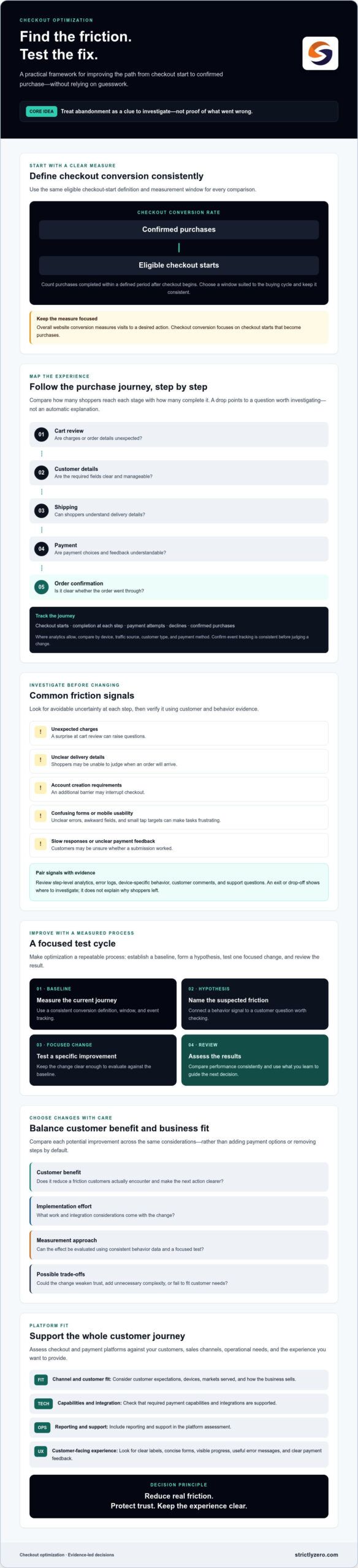
Before changing checkout, define what success means. Calculate checkout conversion as confirmed purchases divided by eligible checkout starts, using the same measurement window for every comparison. For example, count purchases completed within a defined period after checkout begins. Choose that period based on your buying cycle and keep it consistent, so results are comparable.
Checkout conversion rate measures how often eligible checkout starts become purchases; overall website conversion rate measures how often website visits lead to a desired action. The distinction matters: a sitewide rate can’t show whether shoppers struggle with delivery details, payment, or another checkout step. Treat abandonment as a signal to investigate, not proof that checkout alone caused the lost sale. A shopper may change their mind, compare options, or return later.
Map the full journey, from cart review through customer details, shipping, payment, and order confirmation. Compare the number of shoppers who reach each step with the number who complete it. A drop between steps points to a question worth investigating, not an automatic explanation. That’s the practical starting point for conversion rate optimization: use evidence to identify where a desired action becomes harder, then test a focused change.
Which checkout problems make customers hesitate or leave?
Look for avoidable uncertainty at each step. Unexpected charges can surprise shoppers at cart review; unclear delivery details can make it difficult to judge when an order will arrive. Requiring account creation may add a barrier, while confusing form errors can leave customers unsure what to fix. On mobile, small tap targets or awkward fields can make routine tasks frustrating. Slow responses and unclear payment feedback can also leave shoppers unsure whether a submission worked.
Separate evidence from assumptions. Review customer comments and support questions alongside step-level analytics, error logs, and device-specific behavior. A high exit rate on a payment step suggests where to investigate, but it doesn’t explain why customers left. Check what they saw and experienced before deciding what to change.
Which checkout metrics reveal where friction occurs?
Track checkout starts, completion at each step, payment attempts, declines, and confirmed purchases. Where your analytics allow, segment results by device, traffic source, customer type, and payment method. For example, compare mobile and desktop completion at the same checkout step to see whether a problem appears concentrated in one experience. Confirm that tracking records events consistently before using the results to judge a change.
For broader context on payment experiences across sales channels, read the ecommerce payment processing guide. A clear view of the journey helps you focus on the friction customers encounter, rather than making changes based on guesswork.
How Checkout Design and Payment Choices Shape the Buying Experience
Checkout is a sequence, not a single button. A customer reviews the order, enters the information needed to complete it, chooses a payment method, submits payment details, waits for authorization, and looks for confirmation that the order went through. Each transition should make the next action clear. If the customer isn’t sure what information is needed, whether payment is processing, or whether the order is confirmed, uncertainty can interrupt a purchase.
Payment friction is any avoidable obstacle between a customer’s intent to pay and a successfully completed payment. Clear labels, concise forms, visible progress, and useful error messages help customers understand what to do and what has happened. For example, an error should identify the field that needs attention and explain how to correct it, rather than leaving the customer to guess.
Payment choice also needs to fit the whole experience. Consider what customers expect, which devices they use, the markets you serve, and how your business sells. A method that suits an online purchase may not fit an in-person or mobile interaction. If you operate across channels, consistent payment operations can help create a more coherent journey. As you assess options, check that the payment capabilities and integrations you need are supported. For merchants comparing channels, explore unified payment processing as one possible approach.
How can checkout forms be simpler without losing necessary information?
Ask only for details needed to complete, fulfill, and support the transaction. Use familiar labels and input formats that match the information requested, then explain errors beside the relevant field. Evaluate guest checkout and account creation against customer needs and measured performance, rather than assuming one approach works for every audience. If an account is useful, make its purpose clear and avoid making it an unexplained hurdle.
How should businesses present payment methods and payment costs?
Show available payment methods clearly and explain any extra steps before customers commit. Make the total charge, including applicable fees, understandable before payment submission. If considering surcharging or dual pricing, verify the requirements that apply to your business and present the terms in plain language. Check whether customers understand the displayed price and payment choices; visibility alone doesn’t guarantee clarity.
These details matter because optimizing checkout for higher conversions means improving the full path to confirmation, not simply shortening a form. Review the experience on the devices customers use, and make sure the interface communicates what happens after each action. Clear expectations help customers proceed with confidence while giving your business a practical basis for evaluating checkout changes.
Compare Checkout Improvements by Impact, Effort, and Customer Fit
Not every checkout improvement addresses the same problem. Front-end changes alter what customers see and do, while payment-processing capabilities and channel infrastructure affect how a transaction is handled behind the scenes. Before investing, match the proposed change to an observed obstacle and decide how you’ll measure whether it helped.
| Option | Customer benefit | Effort | How to measure | Potential trade-off |
|---|---|---|---|---|
| Usability changes, such as clearer totals or improved mobile fields | Makes steps easier to understand and complete | Often limited to checkout design and testing | Compare step completion, errors, and confirmed purchases | A visual change may not address a payment or processing issue |
| Additional payment options | Can meet a demonstrated preference or transaction need | Depends on availability, configuration, and checkout integration | Review method selection, attempts, declines, and purchases | More choices can add complexity if customers don’t need them |
| Payment integrations | Can connect checkout to required business workflows | Varies with existing systems and implementation needs | Monitor successful handoffs, errors, and completion | Compatibility and maintenance require evaluation |
| Operational or channel capabilities | May support a more consistent experience across online, in-person, and mobile transactions | May involve broader process and platform changes | Compare outcomes by channel and transaction context | Changes can affect more than the website checkout |
For help evaluating processor considerations, see the credit card processing services guide. Verify integration details and supported capabilities with providers before planning implementation.
When should a business prioritize checkout design over adding payment methods?
Use funnel data, session recordings, and support contacts to identify the clearest obstacle. If customers encounter unclear totals, broken fields, or a difficult mobile form, address those issues before adding more options. Consider a new payment method when customer research or transaction data points to an unmet need, and define in advance how you’ll assess its impact.
How do payment capabilities differ across business needs?
Online checkout supports customer-led purchases; payment links can help with remote or direct payment requests, while a virtual terminal supports transactions entered by a business operator. Recurring billing may suit repeat charges. An API-first integration can be worth assessing for custom workflows, but confirm technical fit and implementation requirements. If customers move between online, in-person, and mobile interactions, a unified platform may support more consistent payment operations.
Optimizing checkout for higher conversions means prioritizing the change that fits both customer behavior and business needs, not simply choosing the option with the broadest feature list.
How to Optimize Checkout: A Measurable Step-by-Step Plan
Make checkout changes like experiments, not guesses. This workflow connects a specific customer obstacle to a measurable outcome while helping you watch for unintended effects.
- Establish a baseline. Record checkout starts, step completions, payment attempts, declines, and confirmed purchases. Include refunds, support contacts, and customer complaints as guardrail measures. Keep the measurement window and event definitions consistent.
- Locate friction. Use funnel data, customer feedback, and relevant session recordings to identify where shoppers encounter difficulty. Check whether the issue appears across the whole audience or is concentrated by device, traffic source, customer type, or payment method.
- Prioritize the issue. Rank candidate changes by observed customer impact, how much checkout volume they affect, implementation effort, and risk. A frequently reported broken field may deserve attention before a speculative feature addition.
- Test a focused change. Where feasible, change one clearly defined element at a time. Document the hypothesis, such as: “If we clarify this delivery label, more customers will complete this step.” Choose a comparison method suited to your traffic and implementation.
- Review the results. Compare the primary outcome with the guardrails, then document what changed and what didn’t. Don’t treat a small or inconsistent movement as definitive proof. Decide whether to adopt, revise, or retest the change.
Set the test duration and decision criteria before launch. Consider how much traffic the checkout receives and whether seasonal demand, promotions, or channel mix could affect results. If those conditions shift during the test, note them before drawing conclusions. This discipline is central to optimizing checkout for higher conversions without mistaking coincidence for progress.
How should teams prioritize checkout experiments?
Start with issues supported by multiple signals, such as funnel drop-off alongside customer complaints. State the expected behavior and the measure that would indicate improvement before changing the checkout. Keep the test focused, and assess whether the outcome is consistent enough to support a decision. If evidence is inconclusive, gather more data or refine the hypothesis rather than claiming a win.
How can businesses keep checkout improvements trustworthy?
Tell customers what payment steps to expect, make applicable fees clear before submission, and communicate order status after payment. Review security and data-handling responsibilities with qualified internal or external experts before implementing changes. Once you’ve defined your requirements for channels, integration, and customer clarity, explore payment processing options that fit your evaluation criteria.
Choose a Checkout and Payment Platform That Supports the Whole Customer Journey
A payment platform should fit the way your customers buy and your team operates, not just the final checkout screen. Before comparing providers, document your current payment journey: where customers pay, which steps create friction, what systems must connect, and what information your team needs to track transactions. This gives you a practical basis for evaluating capabilities against real requirements.
Use this checklist to guide provider conversations:
- Channel fit: Confirm the platform supports the online, in-person, and mobile payment experiences your business needs.
- Integration: List the systems and workflows it must connect with, then verify integration options and implementation details directly with the provider.
- Reporting: Ask what transaction and checkout information is available, and whether it can help your team investigate payment attempts, failures, and completed purchases.
- Operational support: Ask how payment failures are handled, what customers are told, and how your team can troubleshoot operational issues.
- Customer-facing clarity: Review how payment methods, additional steps, applicable fees, and order status appear to customers.
Verify which payment methods and workflows are supported rather than assuming a feature is available. If you’re considering surcharging or dual pricing, check current applicable requirements and customer disclosure needs before implementation. Clear communication is essential to evaluating the experience responsibly.
What should merchants verify before choosing a checkout solution?
Map each requirement to a specific question for the provider. For example, identify what happens when a payment is declined, what customers see after an unsuccessful attempt, and what information your team can use to resolve a problem. Confirm the reporting and integration details you need, then assess the proposed flow from the customer’s perspective. A capabilities review is most useful when it responds to documented needs.
How can a unified payment platform fit checkout optimization goals?
Unified processing can support consistent payment operations when customers move between online, in-person, and mobile interactions. Strictly offers an API-first payment platform for these channels, with payment links, a virtual terminal, and recurring billing. Its surcharge and dual pricing programs also include a Smart Pricing Engine with state-by-state compliance automation and debit card detection. These capabilities may fit particular payment workflows, but they shouldn’t be treated as guaranteed conversion gains. Evaluate them against the friction you’ve identified and verify the implementation details that matter to your business.
To take the next step, document your requirements, map the current payment flow, and ask providers to review how their capabilities align with it. If Strictly fits your evaluation criteria, review Strictly payment processing and discuss your requirements. This keeps optimizing checkout for higher conversions grounded in customer needs, operational fit, and measurable goals.
Turn Checkout Insights Into Your Next Improvement
Better checkout performance starts with understanding where customers encounter friction, not guessing at a fix. Track the journey from checkout start to confirmed purchase, and use customer feedback and step-level data to find obstacles worth addressing.
Then prioritize changes by customer impact, effort, and risk. Test a focused improvement against a clear hypothesis, set your decision criteria in advance, and review completed purchases alongside declines, refunds, and customer concerns. This evidence-led approach makes optimizing checkout for higher conversions a process your team can learn from, not a one-time redesign.
Payment operations matter across the full customer journey, too. Strictly offers unified processing for online, in-person, and mobile transactions through an API-first platform that includes payment links, a virtual terminal, and recurring billing. Evaluate these capabilities against your documented workflows and integration needs rather than assuming a feature will improve conversions on its own.
Ready to discuss how your payment setup could fit your checkout and channel requirements? Discuss your checkout and payment needs with Strictly. Start with the friction you’ve identified, then take the next improvement one measurable step at a time.
Frequently Asked Questions
What is checkout optimization?
Checkout optimization is the process of improving the steps customers take to complete a purchase, from reviewing their order to receiving confirmation. It can include simplifying forms, clarifying delivery information, improving mobile usability, or reviewing payment options. The aim is to remove avoidable obstacles while preserving trust and necessary safeguards. Measure changes using a consistent checkout conversion definition, and investigate customer behavior rather than assuming a particular design change will work.
How can I improve checkout conversion without redesigning my website?
You can improve checkout without rebuilding your website by making focused changes to the existing flow. Clarify totals and delivery details, fix confusing field errors, remove unnecessary form requests, and check that buttons and fields work well on mobile devices. Use customer feedback and funnel data to select an issue, then test a specific change. Optimizing checkout for higher conversions works best as a measurable process, not a collection of untested tweaks.
Can offering more payment methods increase checkout conversions?
Offering another payment method may help if your customers want it and can use it in their buying context, but more options don’t guarantee more completed purchases. Review customer requests, payment attempts, declines, and completed orders to identify unmet needs. Also verify that each method is supported by your checkout and fits your operations. If the main obstacle is an unclear form or unexpected charge, adding payment choices may not solve it.
How do I measure checkout conversion rate?
Divide confirmed purchases by eligible checkout starts, then apply a measurement window that you define and use consistently. For example, track how many checkout starts result in confirmed orders within your chosen period. Also monitor step completions, payment attempts, and declines to understand where customers may encounter friction. Segment by device, traffic source, customer type, or payment method when your data allows, and account for changes in traffic or seasonality.
Should checkout require customers to create an account?
Not necessarily. Requiring an account can add a step for shoppers who simply want to complete a purchase, while some customers may value account features such as saved details or order history. Consider offering guest checkout and presenting account creation as an option when it suits the customer journey. Compare completion rates and customer feedback across the available paths, and make sure any account requirement has a clear purpose.
How can a business make checkout fees clearer to customers?
Show the full amount due before customers submit payment, with applicable fees identified in plain language rather than revealed at the last step. Make clear whether a displayed amount reflects a payment choice or another pricing arrangement, and check that the checkout communicates this consistently. For surcharge or dual pricing, verify current requirements that apply to your business and test whether customers understand the disclosure before implementing it.
Does a faster checkout always convert better?
No. A shorter or faster checkout can still confuse customers if it hides important details, provides unclear payment feedback, or omits information needed to complete the transaction. Focus on reducing unnecessary delay and uncertainty while keeping essential steps understandable. Measure completed purchases alongside declines, refunds, support contacts, and complaints. Test changes with defined criteria, since a faster flow is useful only if it also works reliably for customers and your business.