
What Is a Merchant Identification Number (MID)? A 2026 Guide
Published:

Could the number you need to resolve a payment issue be different from your tax ID, bank account number, or terminal code? If you’re asking what is a merchant identification number (MID), it identifies a merchant relationship within payment processing, not your business everywhere. A processor or acquiring institution uses it to associate payment activity with the merchant account or profile set up for your business.
Payment identifiers are easy to mix up, especially when a provider’s paperwork or portal doesn’t make the MID obvious. Some businesses have more than one, while others may not see or manage an individual MID directly. The details depend on how the provider organizes payment processing.
This guide explains what a MID identifies, how it differs from a terminal ID, tax ID, and merchant account number, and where to look for yours. You’ll also learn why a business might have multiple MIDs and what to ask a payment provider when setting up payment acceptance. That way, you can confirm you have the right identifier before you need it to resolve a processing question.
Key Takeaways
- When asking what is a merchant identification number (MID), focus on the merchant relationship it identifies within payment processing, not a universal business identity.
- A MID, merchant account, EIN, terminal ID, and bank account number serve different purposes. Knowing the distinction can help you provide the right identifier when resolving a payment question.
- Check your merchant agreement, onboarding records, statements, and provider portal to locate your MID. It may appear under a different label.
- Your business may have more than one MID. Confirm with your provider how accounts are organized across locations and sales channels.
- Before setting up payment acceptance, ask a provider how its account structure affects reporting and support.
Table of Contents
- What Is a Merchant Identification Number (MID), and What Does It Identify?
- How a MID Works Across Payment Channels and Merchant Accounts
- MID vs. Merchant Account, EIN, Terminal ID, and Bank Account
- Where to Find Your MID and Confirm You Have the Right One
- What Your MID Means When Choosing or Managing a Payment Processor
What Is a Merchant Identification Number (MID), and What Does It Identify?
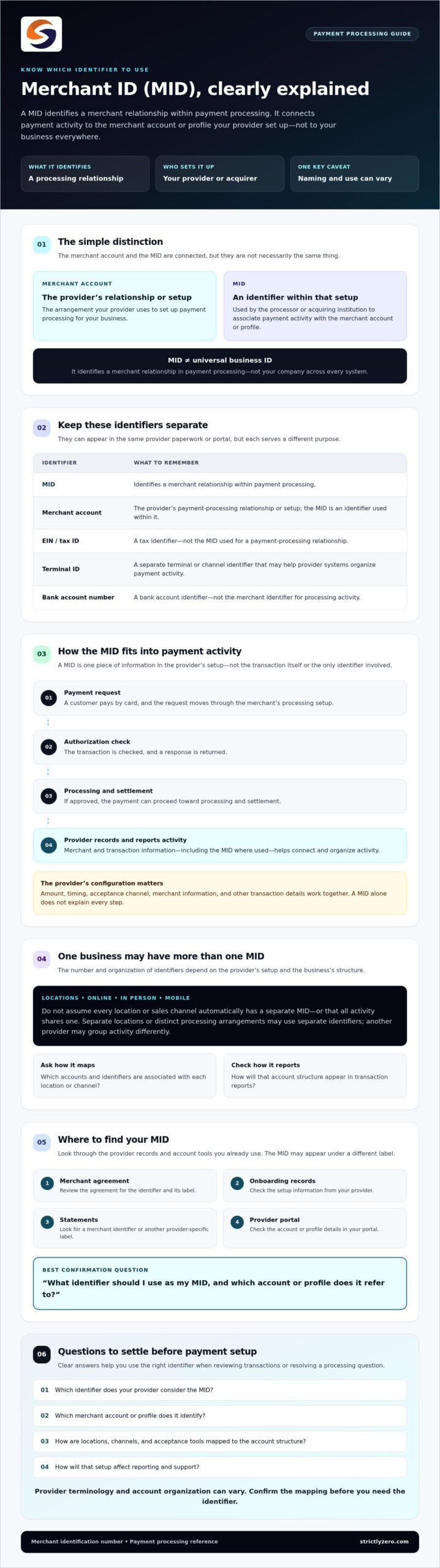
If you’re asking what is a merchant identification number (MID), think of it as an identifier within a merchant’s payment-processing relationship. A payment processor or acquiring institution uses it to associate payment activity with the merchant account or profile set up for the business. It isn’t a universal ID for your company, and its name, format, and role can vary by provider.
The MID is connected to a merchant account, but the two terms don’t necessarily mean the same thing. The account is the provider’s relationship or setup for processing payments, while the MID is an identifier used within that setup. Transaction details and terminal or channel identifiers may also help provider systems organize payment activity.
For a brief overview, watch this video:
How does a MID fit into a card payment?
Imagine a customer pays for a purchase by card. The payment request moves through the merchant’s processing setup for authorization. The transaction is checked, and a response is returned. If approved, it can proceed toward processing and settlement. Provider systems use merchant and transaction information to connect the activity with the appropriate account and organize it through the payment process.
The MID is one piece of that information, not the transaction itself or the only identifier involved. The provider’s setup determines how it uses the MID alongside other details to route or record activity. A MID alone doesn’t explain every step in a transaction, and different channels may not use identifiers in exactly the same way.
Who issues a merchant identification number?
A payment provider or acquiring institution typically establishes merchant identifiers when setting up payment acceptance. Card networks facilitate card-payment activity, but merchants shouldn’t assume that a network assigns or manages the MID shown in their provider account. You can record the identifier for reference, but the provider defines its terminology and how it’s used.
Ask your provider: “What identifier should I use as my MID, and which account or profile does it refer to?” That confirmation can prevent confusion when discussing transactions, reports, or account setup.
How a MID Works Across Payment Channels and Merchant Accounts
A MID is part of the provider’s merchant setup, not a complete record of every payment. A transaction also carries details such as its amount, timing, and acceptance channel. Provider systems use these details together to process and organize activity. For a broader overview of how merchant identifiers fit into payment acceptance, see What Is a Merchant ID.
This setup matters as a business adds locations or accepts payments online, in person, or by mobile. Don’t assume each channel or location automatically gets a separate MID, or that all of them share one. Ask your provider how accounts and identifiers map to your business structure and how that arrangement appears in transaction reports.
A typical setup and reporting flow:
- 1. Onboard: The provider establishes the merchant account or profile and explains its identifiers.
- 2. Configure: The provider maps relevant locations, channels, and acceptance tools to the account structure.
- 3. Accept payment: Transaction details move through the processing setup alongside merchant information.
- 4. Review activity: Reports group or display transactions according to the provider’s configuration.
Can one business have more than one MID?
It can, depending on the provider’s setup and the business’s structure. For example, separate locations or distinct processing arrangements may use separate merchant identifiers. Another provider may group activity differently. These are possibilities, not universal rules. Ask which accounts and identifiers are associated with each location and how to identify that mapping in reports.
Does a MID change between online and in-person payments?
Not necessarily. Channel arrangements vary by provider, so confirm whether online and in-person transactions share an account structure or use separate ones. A MID identifies a merchant relationship within that setup. It isn’t the same as the gateway, terminal, or software used to accept a payment. For more context on coordinating channels, read this omni-channel payment processing guide.
If you’re comparing providers, ask how locations and channels are mapped, whether reports can distinguish their activity, and who can explain the setup. Businesses exploring a unified approach to online, in-person, and mobile payments can also review Strictly’s payment processing platform.
MID vs. Merchant Account, EIN, Terminal ID, and Bank Account
These identifiers can appear in the same onboarding paperwork, but they aren’t interchangeable. If you’re still asking what is a merchant identification number (MID), compare its role with the other numbers and credentials used to set up and manage payment acceptance. Forbes’ overview of what a merchant ID is also explains that the term relates to payment processing, not a business’s tax or banking identity.
| Identifier | What it identifies or does | Who issues or establishes it | Where you may encounter it |
|---|---|---|---|
| MID | Identifies a merchant relationship or profile within provider systems. | Typically established by a payment provider or acquiring institution. | Merchant documents, provider portal, statements, or support correspondence. |
| Merchant account or profile | The account or processing arrangement associated with accepting payments. The MID may identify it within the provider’s systems. | Payment provider or acquiring institution. | Merchant agreement, onboarding materials, and account settings. |
| EIN or tax ID | An EIN identifies a business for federal tax purposes. It is not used as the payment-processing identifier. | The relevant tax authority. In the US, an EIN is issued by the IRS. | Tax records and provider application forms. |
| Terminal ID | May identify a particular terminal or acceptance point, depending on provider terminology. | Typically assigned within the provider’s or payment system’s setup. | Terminal settings, receipts, or transaction records. |
| Bank account number | Identifies a deposit account, not the merchant relationship used to process a payment. | The financial institution that holds the account. | Bank records and deposit or payout setup forms. |
| Gateway credentials | Allow a system or integration to connect to a payment gateway. They aren’t the MID itself. | The gateway provider. | Gateway dashboard or integration settings. |
Is a MID the same as an EIN or tax ID?
No. An EIN is a federal tax identifier, while a MID is used for payment-processing administration. A provider may request both during setup, but one cannot replace the other. Follow the exact field labels on each form. If a label or instruction is unclear, ask the provider before entering a number.
Is a MID the same as a merchant account or terminal ID?
No. A merchant account describes an account or processing arrangement. The MID is an identifier used within the provider’s systems. A terminal ID may point to a device or acceptance point, but its meaning can vary. Provider terminology and formats aren’t universal, so verify unfamiliar labels before sharing information or completing paperwork. For broader context, see this small-business credit card processing guide.
Where to Find Your MID and Confirm You Have the Right One
Your MID may not be labeled exactly that way, and providers don’t all display it in the same place. Start with documents and account areas issued by your payment provider. If you’re unsure, confirm the identifier directly. This can help you avoid confusing it with a tax ID, terminal code, or another account number.
What documents or account areas should you check?
Check these sources in order. Look for labels such as “merchant ID,” “MID,” “merchant number,” or another provider-specific term:
- Merchant agreement: Review the agreement or account details for identifiers tied to your processing setup.
- Onboarding records: Check emails and documents you received when payment acceptance was established.
- Provider statements: Look for a merchant or account identifier. Its label and placement may vary.
- Authenticated account portal: Sign in through your provider’s official website and check business profile, account, or payment settings.
Not seeing the MID doesn’t mean you’ve missed something. Providers may use different labels or make the identifier available through different channels. If documents show multiple numbers, don’t guess based on their length or where they appear on the page.
What should you ask payment-provider support?
Contact the provider using a verified support channel, such as contact details in your signed agreement or authenticated portal. Ask which number they mean by “MID,” whether it applies to the whole business or a specific location, and how your online, in-person, or mobile transactions map to the merchant setup.
If the provider identifies more than one number, ask what each one refers to and which to use for the task at hand. This is especially useful when a form or support request uses unfamiliar terminology. Asking “What is a merchant identification number (MID) in your system, and where can I confirm mine?” can prompt a provider-specific answer rather than a general definition.
Record the confirmed information in your internal payment records, noting which business or location it applies to. Store it securely, share identifiers only with trusted payment-provider contacts, and follow the provider’s security guidance. If your records don’t match the provider’s explanation, ask them to resolve the discrepancy before updating your files.
If you’re reviewing how payment acceptance works across channels, explore Strictly’s payment processing platform for online, in-person, and mobile transactions.
What Your MID Means When Choosing or Managing a Payment Processor
Knowing your MID can make account administration easier. It gives you a reference point when asking about a transaction, understanding how activity appears in reports, or helping a provider identify the merchant setup you’re discussing. But the MID alone won’t tell you whether a processor’s fees, services, or terms suit your business. Compare those separately, and use the MID to clarify how the account will be managed.
Before onboarding, ask the provider to explain how it organizes your account in plain language. This is especially useful if you have multiple locations or accept payments through different channels. For broader context on evaluating processing options, see this credit card processing services guide.
Which MID questions belong in a processor conversation?
Bring practical questions to the discussion. Ask the provider to explain any terms you don’t recognize before you complete onboarding:
- How will merchant accounts or profiles be structured for my business and its locations?
- Will online, in-person, and mobile transactions share an account setup, or be organized differently?
- Where will the relevant identifiers appear in statements, reports, or the account portal?
- How can support confirm which identifier applies to a particular account, location, or transaction?
- Which identifiers should my team use for account questions, and how should we distinguish them?
Clear answers help you understand how activity is organized and what information to have ready when asking for help. They also make it easier to maintain consistent internal records as your payment setup changes. If an answer is unclear, ask the provider to define the term and explain what it refers to in your account.
How can a merchant take the next step?
Start by locating the MID in provider-issued records or your account portal. Confirm with the provider what it applies to, then save that guidance securely for your team. Recheck the details if your locations or payment channels change. The MID is a useful account reference, not a substitute for reviewing the full processing arrangement.
As you assess a platform, list the payment methods and workflows your business needs, such as in-person, online, mobile, recurring, or virtual-terminal payments. Strictly provides payment processing for online, in-person, and mobile transactions, with virtual terminal and recurring billing capabilities. Explore Strictly’s payment processing platform to see whether its capabilities fit your payment needs.
Put Your MID Knowledge to Work
Now that you know what is a merchant identification number (MID), remember its key role: it identifies a merchant relationship within a payment provider’s setup. It isn’t the same as your EIN, bank account number, or terminal ID, and its format and use can vary by provider.
To avoid mix-ups, check your provider’s records, confirm which account or location the MID applies to, and keep the provider’s explanation securely with your payment records. If you’re choosing a processor, ask how its account structure handles your locations, sales channels, and reporting needs.
Strictly offers unified payment processing for online, in-person, and mobile transactions, alongside virtual terminal, payment links, and recurring billing capabilities. Explore Strictly’s payment processing platform to see whether it fits the way your business accepts payments. With the right questions and clear account records, you can manage payment processing with greater confidence.
Frequently Asked Questions
What is a merchant identification number (MID)?
A merchant identification number, or MID, is an identifier used within a payment provider’s systems to associate payment activity with a merchant account or profile. It isn’t a universal business ID. Providers may use different labels and account setups, so confirm what a particular MID refers to with the provider that issued or manages it, especially if your business has multiple locations or processing arrangements.
Is a MID the same as an EIN?
No. An EIN is a federal tax identifier for a business, while a MID is used within a payment-processing relationship. They serve different purposes and aren’t interchangeable. If a form requests one of these identifiers, follow its exact field label rather than substituting the other. If the instructions are unclear, ask the organization requesting the information which number belongs in that field.
Where can I find my merchant ID number?
Check your merchant agreement, onboarding documents, processor statements, and authenticated merchant account portal. Your provider may label it “MID,” “merchant ID,” “merchant number,” or use another term, and it may not appear in the same place across providers. If you can’t identify it, contact the provider using verified contact details and ask which identifier applies to your account or location.
Can a business have more than one MID?
Yes, a business may have multiple merchant identifiers, depending on its provider setup, business structure, locations, or processing arrangements. For example, a provider might organize separate locations or distinct processing setups under different identifiers, but this isn’t a universal rule. Ask your provider how each identifier maps to your accounts and locations, and how that setup affects reporting, account administration, and transaction questions.
Does each payment terminal have its own MID?
Not necessarily. A MID generally identifies a merchant relationship or profile in provider systems, while a terminal ID may identify a particular device or payment acceptance point. The way these identifiers are organized depends on the provider. Ask your processor how your terminals and locations map to your merchant account, and which identifier to reference for a specific transaction.
Is it safe to share a MID?
Treat a MID as business account information and share it only when there’s a clear reason, with a trusted payment-provider contact or authorized colleague. It isn’t the same as a password or card number, but providers may have specific instructions for handling account details. Use verified contact channels, check who is requesting the identifier, and follow your provider’s security guidance before sending it.
What should I do if I cannot find or recognize my MID?
Check provider-issued documents and your authenticated account portal, then contact the provider using verified contact details. Ask which number is the MID, whether it applies to your whole business or a specific location, and what unfamiliar labels mean. Don’t guess based on a number’s format or use an EIN, bank account number, or terminal ID in its place. Record the provider’s clarification securely.