
Merchant Account Requirements: A 2026 Guide to Getting Approved
Published:

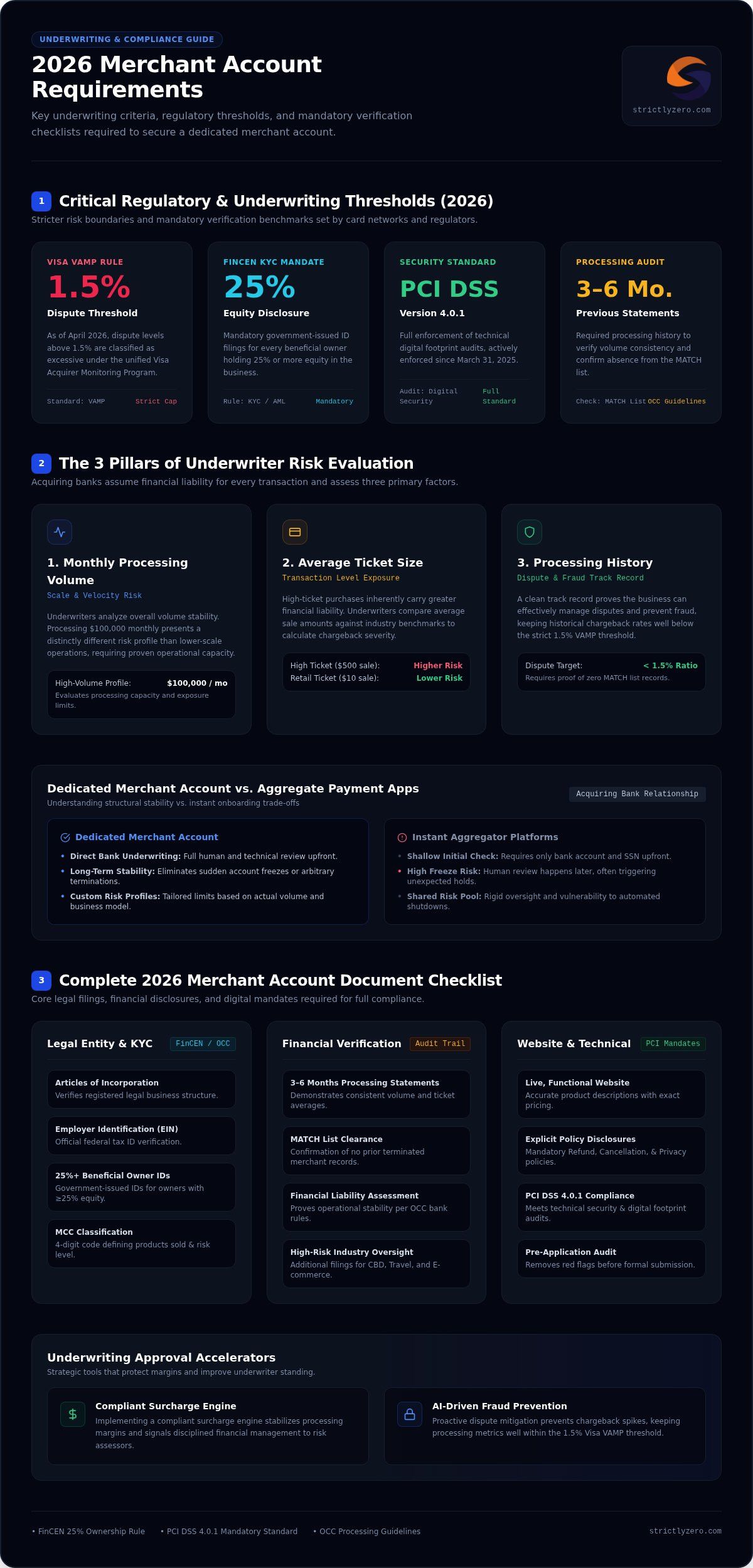
Did you know that as of April 2026, the threshold for “excessive” disputes dropped to just 1.5% under the unified Visa Acquirer Monitoring Program? This tighter standard means meeting merchant account requirements is no longer just about filling out forms; it’s about proving your business can stay within strict risk boundaries. It’s completely normal to feel overwhelmed by the time-consuming paperwork or the fear of a sudden application rejection based on hidden criteria.
You deserve a transparent path to approval that doesn’t leave you guessing about high-risk labels. This guide will help you master the specific underwriting criteria and document checklists needed to secure a dedicated merchant account for your business in 2026. We’ll walk through the essential 25% ownership disclosures required by FinCEN, the latest PCI DSS 4.0.1 security mandates, and how implementing a compliant surcharge engine can actually improve your standing with underwriters by protecting your margins. By the end of this article, you’ll have a clear roadmap to a fast, compliant approval process.
Key Takeaways
- Understand how processors evaluate financial liability and what you can do to position your business as a low-risk partner during the underwriting process.
- Identify the core 2026 merchant account requirements, including the specific legal filings and financial transparency documents needed to avoid application delays.
- Learn the “extra” requirements for high-risk industries like CBD, travel, and high-volume e-commerce to ensure you meet higher oversight standards.
- Discover how to conduct a pre-application audit of your financial statements and website compliance to eliminate common red flags before you apply.
- Explore how using AI-driven fraud prevention and compliant surcharge engines can stabilize your margins and make your business more attractive to underwriters.
Table of Contents
- Understanding Merchant Account Requirements and Underwriting
- The Essential Merchant Account Checklist for 2026
- How to Get a High-Risk Merchant Account
- 5 Steps to Prepare Your Business for Approval
- Why Strictly is the Best Choice for Merchant Approval
Understanding Merchant Account Requirements and Underwriting
Underwriting is the processor’s way of playing detective. They check whether your business is a safe bet or a potential financial liability. To master merchant account requirements, you have to look through the lens of risk assessment. Every time a customer pays with a card, the processor and their bank partner are essentially vouching for you. If your business fails or faces massive fraud, these institutions are the ones left holding the bill. This is why they demand specific documentation; it’s their only way to quantify the risk of doing business with you.
To better understand this concept, watch this helpful video:
In 2026, this process has become more data-centric. Regulatory shifts, specifically the full enforcement of PCI DSS 4.0.1, have moved the focus toward your technical security. Underwriters don’t just look at your bank balance; they audit your digital footprint. Your Merchant Category Code (MCC) also plays a massive role in this evaluation. This four-digit number tells the bank exactly what you sell. Some codes are automatically flagged as high-risk, which can trigger additional merchant account requirements regardless of your personal credit score.
The Role of the Acquiring Bank
A merchant account isn’t just a software connection; it’s a financial relationship with an acquiring bank. These institutions provide the capital and the network access to move money from your customer’s card to your business account. They evaluate your stability because they assume the risk for every transaction. Many “instant approval” platforms skip this deep dive initially. This often leads to sudden account freezes or terminations later when a human underwriter finally reviews the risk profile. A dedicated account might take longer to set up, but it offers far more stability for your long-term operations.
Risk Factors That Influence Approval
Underwriters focus on three main pillars: your volume, your ticket size, and your history. If you process $100,000 monthly with an average sale of $500, you’re viewed differently than a retail shop with $10 transactions. High-ticket items often carry higher chargeback risks. Your chargeback history is especially critical now that Visa’s VAMP program has lowered the excessive dispute threshold to 1.5%. A clean processing history proves you can manage customer disputes and fraud effectively. Using tools like AI-driven fraud prevention can actually make you a much more attractive candidate during this review process.
The Essential Merchant Account Checklist for 2026
Preparation is the only way to avoid the common pitfalls of the underwriting process. While aggregate payment apps might only ask for a bank account and an SSN, a dedicated account requires a comprehensive look at your business structure. Meeting modern merchant account requirements involves gathering a specific set of verified credentials that prove your business is legitimate and stable. You can’t just wing it. Underwriters look for consistency across your legal filings and your actual operations.
You’ll need your Articles of Incorporation and your Employer Identification Number (EIN) to verify the legal entity. Following federal KYC (Know Your Customer) rules, processors require government-issued IDs for every beneficial owner holding 25% or more equity. If you’ve processed cards before, provide 3 to 6 months of previous statements. Underwriters use these to check for volume consistency and to ensure you haven’t been placed on the MATCH list. This due diligence aligns with OCC merchant processing guidelines, which mandate that banks evaluate the operational risk of every merchant they board.
Digital and Website Requirements
Your website is often the first thing an underwriter audits. It must be a live, functional representation of what you sell. This means every product requires a clear description and exact pricing. You must also display explicit refund, cancellation, and privacy policies. These aren’t just suggestions; they’re mandatory for compliance. Since March 31, 2025, PCI DSS 4.0.1 standards also require specific scripts on your checkout page to prevent e-skimming. If your site looks unfinished or lacks contact information, your application will likely be rejected. Gathering the right merchant account requirements for your digital storefront is just as important as your financial paperwork.
Financial Stability Documents
Liquidity is a major factor in approval. Underwriters review your recent bank statements and tax returns to ensure you have enough cash flow to handle potential chargebacks. For standard accounts, a principal credit score of 580 to 600 is usually the baseline. If your business is new or operates in a volatile sector, be prepared for a rolling reserve. This typically involves the processor holding 5% to 10% of your gross daily sales for 90 to 180 days. Showing a strong balance sheet can sometimes help you negotiate these terms. If you want to simplify this process, choosing a partner that offers omni-channel payment processing can help consolidate your data and make your business more attractive to banks.
How to Get a High-Risk Merchant Account
Being labeled “high-risk” isn’t a permanent barrier to growth. It simply means the merchant account requirements involve a deeper level of scrutiny because your industry has a statistically higher chance of disputes or regulatory hurdles. Sectors like CBD, online gaming, travel, and high-volume e-commerce are standard examples. While standard low-risk businesses might breeze through with basic IDs, high-risk entities must prove they have the infrastructure to handle volatility. Transparency is your best asset here. If you try to mask your business model to get lower rates, you’ll eventually face an account freeze or a permanent spot on the MATCH list.
One strategic way to manage the higher costs associated with these accounts is through a surcharge and dual pricing engine. Since high-risk processing fees often range from 2.95% to 4.95% or more, passing these costs to the customer can protect your bottom line. Underwriters actually view this favorably. It shows that your business has a built-in mechanism to maintain consistent margins despite the higher cost of doing business in a sensitive vertical.
Preparing Your High-Risk Application
Success in high-risk underwriting starts with a robust business plan that explicitly addresses risk mitigation. You need to show that you aren’t just selling a product, but managing a secure environment. This includes providing proof of any specialized licenses or permits required for your industry. You should also highlight your use of AI-driven fraud prevention tools. Proving that you exceed basic PCI DSS compliance requirements by using automated detection mechanisms can significantly ease an underwriter’s concerns about potential fraud-related losses.
Managing High-Risk Expectations
You have to be realistic about the terms of a high-risk account. Expect higher processing rates and potentially longer settlement times, which the bank uses as a buffer against chargebacks. This is why a dedicated merchant account is far superior to a generic aggregator. Aggregators often provide instant access but have a low tolerance for the 1.5% dispute threshold set by the Visa Acquirer Monitoring Program. Strictly supports complex business models by providing a dedicated Merchant ID (MID) and tailored solutions that generic processors simply can’t offer. This stability is vital for industries where a single day of downtime can cost thousands in lost revenue.
5 Steps to Prepare Your Business for Approval
Getting your business ready for underwriting isn’t just about gathering papers. It’s about presenting a polished, low-risk image to the bank. Start by auditing your own records. If your bank statements show erratic swings or your website has broken links, an underwriter will likely move on to the next application. You’ve already learned about the basic merchant account requirements, but these five steps ensure you clear the bar on your first try.
- Conduct a pre-application audit: Review your financial statements for any red flags or unexplained losses.
- Optimize your website: Ensure your checkout flow is seamless and your compliance messaging is visible.
- Secure your KYC documents: Gather all identification and legal filings in a secure digital vault for quick access.
- Monitor your reputation: Address negative reviews and show that you actively manage customer satisfaction.
- Select a specialized partner: Choose a processor that understands the specific risks of your vertical.
Internal Audit and Credit Cleanup
Maintaining a personal credit score above 650 significantly accelerates the approval timeline for most standard merchant accounts. If you’ve faced a termination before, don’t hide it. Be ready to explain the steps you took to fix the underlying issue. Excessive chargebacks are often the result of poor customer service or fraud, so you should prove you’ve solved these problems by showing your new AI-driven fraud prevention protocols. Underwriters appreciate businesses that take proactive steps to meet merchant account requirements before the first human review occurs.
Choosing the Right Processing Model
You should also evaluate different cost-recovery models to see which fits your business best. For instance, zero fee credit card processing can be a massive profit-saver for businesses with tight margins. However, credit card processing for small business often works best when you have a dedicated account manager who understands 2026 surcharge compliance. Modern rules require your pricing engine to be state-compliant and transparent; it must detect a card’s origin and apply the correct fee in real-time. An API-first platform allows you to integrate these tools directly into your existing workflow without friction.
If you’re ready to secure a stable account and protect your margins, you can start your streamlined application with Strictly today.
Why Strictly is the Best Choice for Merchant Approval
Strictly simplifies the path to approval by acting as a bridge between your business and the complex world of acquiring banks. Meeting merchant account requirements often feels like a full-time job, but our streamlined onboarding process is designed to handle the heavy lifting. We focus on speed without sacrificing compliance, ensuring your application is audit-ready from the moment it hits an underwriter’s desk. By integrating AI-driven fraud prevention directly into our platform, we help you lower your risk profile automatically. This proactive approach doesn’t just protect your revenue; it signals to processors that your business is a stable, secure partner.
We don’t just cater to low-risk retail shops. Our team provides dedicated support for both standard and high-risk merchant categories, including those in complex sectors like CBD or high-volume e-commerce. Whether you’re using a virtual terminal for invoicing or a full omni-channel payment processing setup, we ensure your Merchant ID stays active and secure. We believe that every legitimate business deserves a stable processing relationship built on trust as a payment processor.
The Strictly Smart Pricing Advantage
Underwriters are naturally cautious about businesses with fluctuating profit margins. Our Smart Pricing Engine changes this dynamic by automating state-by-state surcharge compliance. When you use a surcharge or dual pricing model, you ensure that your processing costs are covered, creating the predictable margins that banks love to see. This technology handles the legal complexities of credit card fees in real-time, so you don’t have to worry about regional regulatory updates. Managing your entire operation through a single omni-channel platform also provides the unified data reporting that simplifies your annual PCI audits and ongoing merchant account requirements.
Ready to Start Processing?
Strictly removes the friction from merchant approval by providing the tools you need to succeed before you even process your first dollar. Beyond basic payment acceptance, our partner ecosystem offers tools like ClearSplit™ for automated partner compensation. This is a huge advantage for ISOs and developers who need a scalable, compliant infrastructure. We prioritize transparency, which is why we offer custom analysis to help you understand your specific risk factors and how to mitigate them.
If you’re tired of the confusion and rejection surrounding merchant approval, it’s time for a more intelligent approach. Contact our team today for a custom processing analysis and see how our platform can protect your margins while ensuring long-term account stability.
Secure Your Business Future with a Dedicated Account
Securing a dedicated Merchant ID in 2026 requires more than just a basic application. You’ve learned that meeting merchant account requirements involves proactive preparation, from auditing your digital storefront for PCI DSS 4.0.1 compliance to gathering verified KYC documents for all major owners. Whether you operate in a standard retail environment or a high-risk sector, transparency and risk mitigation remain your strongest assets during the underwriting process.
By leveraging tools like AI-Driven Fraud Prevention and a compliant Surcharge & Dual Pricing Engine, you don’t just protect your revenue; you prove to underwriters that your business is built for long-term stability. Omni-channel payment support ensures you’re ready for every customer, regardless of how they choose to pay. Don’t let the fear of rejection or complex paperwork hold your growth back.
Apply for your Strictly merchant account today and eliminate processing fees to start building a more resilient, profitable business. You have the roadmap; now it’s time to take the final step toward a stable processing future.
Frequently Asked Questions
What are the basic requirements to open a merchant account?
To open a merchant account, you must provide your EIN, Articles of Incorporation, and government-issued ID for any owner with 25% equity or more. For new business owners who have not yet incorporated, formation services like Form My Company can help establish the formal corporate entity and provide the required founding paperwork. Underwriters also require three to six months of business bank statements to verify cash flow. Your website must be live and include explicit refund policies and product descriptions. These merchant account requirements ensure your business is a legitimate legal entity capable of handling financial transactions.
Can I get a merchant account with bad credit in 2026?
You can still secure an account with a credit score below 580, but the terms will likely involve a rolling reserve or higher processing fees. Some specialized processors approve scores as low as 500 by requiring a personal guarantee or volume caps to mitigate risk. Demonstrating strong cash flow and low chargeback ratios can help offset a lower credit score during the underwriting process. It’s often better to apply with a partner who understands high-risk profiles.
How long does the merchant account approval process take?
Approval timelines typically range from 24 hours for standard retail businesses to two weeks for complex high-risk industries. If you have all your KYC documents and financial statements ready, the process moves much faster. Dedicated merchant accounts require human underwriting, which takes longer than aggregate platforms but provides more stability. Providing a complete application package on the first day is the best way to avoid back-and-forth delays with the bank.
What makes a business “high-risk” to a payment processor?
A business is considered high-risk if it operates in a vertical with high chargeback rates, such as CBD, gaming, or travel. Processors also look at your average ticket size and whether you sell products with long fulfillment cycles. If your industry is subject to heavy federal regulations or has a history of fraud, underwriters apply stricter merchant account requirements to protect the acquiring bank. High-volume e-commerce often falls into this category due to the nature of card-not-present transactions.
Do I need a business bank account for a merchant account?
What documents are needed for a high-risk merchant account application?
High-risk applications require your standard legal filings plus a detailed business plan that outlines your risk mitigation strategies. You must provide any specialized industry licenses, such as those required for nutraceuticals or gaming. Underwriters also expect six months of processing history to evaluate your chargeback-to-transaction ratio. Showing that you use AI-driven fraud prevention can significantly strengthen your case by proving you have the tools to stay below the 1.5% dispute threshold.
How does PCI compliance affect my merchant account requirements?
PCI compliance is a mandatory requirement for all businesses that accept credit cards, and version 4.0.1 is the current enforcement standard. You must complete an annual Self-Assessment Questionnaire (SAQ) and potentially undergo quarterly vulnerability scans depending on your transaction volume. For e-commerce, this includes implementing specific scripts to prevent browser-side e-skimming. Maintaining these security standards is essential to avoid monthly non-compliance fees and to ensure your account remains in good standing.
Are there setup fees for opening a merchant account with Strictly?
Strictly prioritizes transparency and provides a custom processing analysis for every applicant to determine the most cost-effective structure for your business. While the specific terms depend on your industry and volume, our surcharge and dual pricing engine is designed to eliminate your processing costs entirely. We don’t believe in hidden surprises, so any potential costs are discussed upfront during your initial consultation to ensure your account remains profitable.