
Cash Discount vs. Surcharging: Which Payment Model Fits Your Business?
Published:
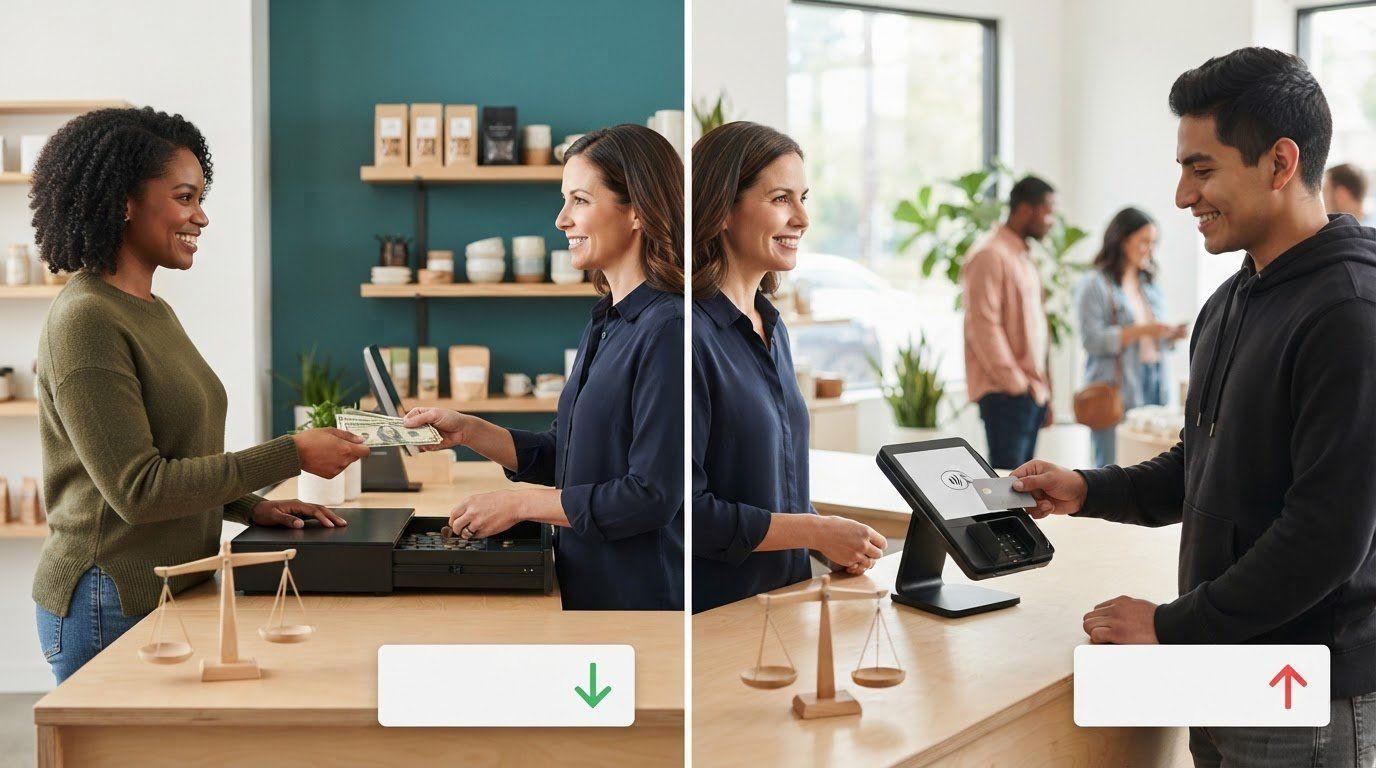
The better choice in cash discount vs surcharging may depend less on the fee itself than on the price customers see before they pay. A surcharge adds a charge to an eligible card transaction, while a cash discount reduces the stated price for customers paying with cash. That difference shapes the checkout experience, even when a business is trying to address the same payment costs.
It’s reasonable to worry that customers may bristle at an unexpected charge, and the terminology can make these models easy to mix up. The right fit depends on your pricing approach, accepted payment types, and whether your team can explain and apply the model consistently. This guide compares the customer experience and operational implications of each option, then outlines what to verify before making a choice. You’ll also learn why state rules, card-network requirements, and clear disclosures matter, and how an integrated payment workflow can support a program across sales channels.
Key Takeaways
- Compare cash discount vs surcharging by looking at the price customers see, which payment method changes it, and how clearly checkout explains the difference.
- Assess customer expectations, transaction mix, sales channels, and staff workflow instead of assuming one model is always better.
- Before implementation, verify current state requirements and card-network rules with qualified, up-to-date sources, then check that your disclosures and checkout process align.
- Plan the steps for pricing setup, customer communication, payment handling, and ongoing review so the model works consistently across transactions.
- Evaluate payment platforms for channel coverage, pricing configuration, reporting, support, and integrations. Remember that software doesn’t replace your compliance responsibilities.
Table of Contents
- Cash Discount vs. Surcharging: What Changes at Checkout?
- How Cash Discounts and Surcharges Affect Prices, Payments, and Customers
- Cash Discount vs. Surcharging: A Practical Decision Framework
- How to Check Compliance and Prepare Your Checkout
- Choosing a Payment Platform for Your Pricing Model
Cash Discount vs. Surcharging: What Changes at Checkout?
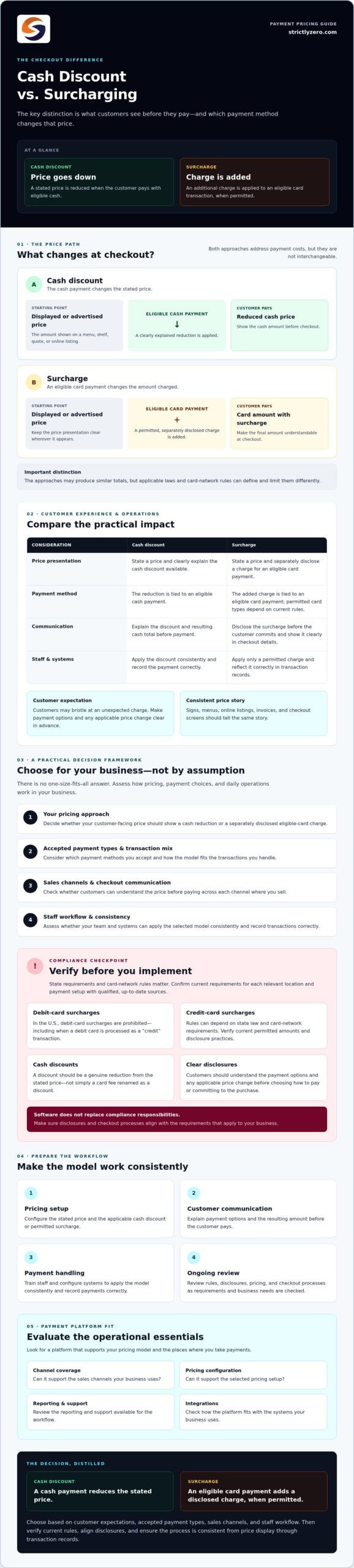
The key difference in cash discount vs surcharging is which price the customer sees first and what changes at payment. With a cash discount, the business states a price and reduces it for a customer paying with cash. With a surcharge, an additional charge is added to an eligible card transaction. These approaches may produce similar totals, but they aren’t interchangeable: applicable laws and card-network rules can define and limit them differently.
Think of the displayed or advertised price as the amount shown on a menu, shelf, quote, or online listing. A cash price is the amount due after an eligible cash discount is applied. A card transaction is the amount charged when the customer pays by card, which may include a surcharge if permitted. The payment surcharge overview provides additional context on the term and how it differs from a cash discount.
For an overview of how merchants distinguish these models, watch this video:
What is a cash discount?
A cash discount lowers the stated price when a customer chooses cash. For example, a business could display its regular price and clearly show the reduced cash amount before checkout. Customers should understand what they’ll pay before choosing how to pay, rather than discovering the discount or revised total only at the register.
A discount should be a genuine reduction from the stated price, not simply a card fee renamed as a discount. Requirements may affect how a program is presented and structured, so verify the rules for your business before describing or implementing it.
What is surcharging?
A surcharge is an added charge associated with an eligible card payment. In the U.S., debit-card surcharges are prohibited, including when a debit card is processed as a “credit” transaction. Credit-card surcharge rules can also depend on state law and card-network requirements, so confirm current rules for each relevant location and payment setup.
Customers should learn about a surcharge before committing to the purchase. Make payment options and any applicable charge clear in advance, then ensure the final amount is understandable at checkout and accurately reflected in the transaction details. Verify current disclosure practices and permitted amounts.
How Cash Discounts and Surcharges Affect Prices, Payments, and Customers
The choice affects more than what appears on a receipt. It shapes how prices are presented, what customers need to understand before paying, and how your team handles transactions across channels. In the cash discount vs surcharging comparison, consider the customer-facing price separately from the behind-the-scenes payment setup.
| Consideration | Cash discount | Surcharge |
|---|---|---|
| Price presentation | A stated price with a clearly explained cash discount available. | A stated price with a separately disclosed charge for an eligible card payment. |
| Payment method | The discount is tied to an eligible cash payment. | The added charge is tied to an eligible card payment; permitted card types depend on current rules. |
| Checkout communication | Explain the discount and resulting cash total before payment. | Disclose the surcharge before the customer commits and show it clearly in checkout details. |
| Operations | Staff and systems need to apply the discount consistently and record the payment correctly. | Systems need to apply the permitted charge correctly and reflect it in transaction records. |
How the customer sees the price
A cash discount presents a price and shows a reduction for cash, while a surcharge adds a disclosed charge to an eligible card payment. Signs, menus, online listings, invoices, and checkout screens should tell the same story. If a customer sees one amount while browsing and a different total at payment, they may wonder what changed. Review each place a price appears and make the payment options and final totals easy to understand.
Rules can vary by location and card network. Before configuring customer-facing language or checkout displays, consult current requirements, including Visa’s surcharging rules, and confirm what applies to your business.
How each model affects payment operations
Map the full workflow, not just the in-person checkout. A store may need to account for cash and card payments at a counter, while an ecommerce business must check how prices and disclosures appear online. Invoiced transactions and recurring billing raise their own questions: how will the amount appear before payment, and what will customers see on the invoice or future transaction records?
Review how your process handles refunds, receipts, invoices, and recurring transactions, then test customer communication across each channel. Don’t assume customers will respond in a particular way. Monitor questions and transaction patterns, and compare processing statements with your payment mix before estimating any financial effect. Businesses managing multiple sales channels can also assess omni-channel payment processing as part of their workflow review.
Cash Discount vs. Surcharging: A Practical Decision Framework
There isn’t one right answer for every business. Compare how each model fits your customers’ payment habits, sales channels, and ability to explain the final price. Then check whether your payment systems and staff can apply it consistently. A model that looks straightforward on paper may be harder to communicate across a storefront, website, invoices, and recurring transactions.
| Model | Potential advantages | Trade-offs to assess |
|---|---|---|
| Cash discount | Can make the cash-payment option clear by showing a discount from a stated price. | Requires consistent price presentation, clear signage or online messaging, and staff who can explain the discount. |
| Surcharge | Can identify an added charge for an eligible card transaction before payment. | Requires careful disclosure, appropriate payment configuration, and ongoing review of applicable rules. |
When a cash-discount approach may fit
Consider this approach if your business can present a standard price and explain a genuine cash discount clearly at each point of sale. Review your transaction mix: if cash is a practical option for customers and staff can apply the discount reliably, the workflow may be manageable. Also weigh the work involved in updating signs, menus, online displays, and invoices, and training staff to describe the final price consistently.
When a surcharge approach may fit
A surcharge may be worth evaluating if you accept eligible card transactions and can clearly disclose the charge before customers pay. Check that each sales channel can present it consistently and that your payment setup applies it only where permitted. Rules differ, so review current federal, state, and card-network requirements using qualified sources. For additional context on credit card surcharges, consult the federal guidance, then verify what applies to your specific business.
Neither model automatically removes every payment-processing expense. Before projecting an effect, review your processing statements and transaction patterns, including payment types and channels. Consider customer expectations and whether staff can explain the price without creating confusion. If you test a model, monitor questions and transaction data, then adjust communication or workflows based on what you observe rather than assuming how customers will respond.
For businesses comparing platform capabilities, Strictly offers omni-channel payment processing and a surcharge and dual-pricing engine. Explore Strictly’s payment processing platform as one option, and confirm that any system you consider fits your channels and operating needs. Platform tools can support a chosen model, but they don’t replace your responsibility to verify and follow applicable requirements.
How to Check Compliance and Prepare Your Checkout
Before choosing between cash discount vs surcharging, confirm that the model works under the rules that apply to your business. Legal and card-network requirements vary, can change, and may depend on location, transaction, card type, and sales channel. Treat compliance as something to verify before launch and review over time, not a setting to assume is correct.
What to verify before choosing
Use qualified, current sources, such as relevant state guidance, card-network rules, and advice from your payment processor or legal counsel. A current state-by-state guide to credit card surcharge rules can help you identify questions to check, but confirm the details for your specific operations.
- 1. Map where and how you sell. List your business locations and the transaction types and channels you use, including in-person, ecommerce, invoiced, and recurring payments. Verify which requirements apply to each.
- 2. Confirm eligible payment types. Ask your processor how debit cards and other excluded payment types are identified and handled. Debit-card surcharges are prohibited in the U.S.; verify current requirements and ensure your setup doesn’t apply a surcharge to debit transactions.
- 3. Check notices and disclosures. Confirm whether notice, registration, signage, online display, or receipt requirements apply to your chosen model. Don’t assume the rules are identical across states, networks, or channels.
- 4. Keep a record of your review. Note the sources consulted, requirements confirmed, and configuration or communication decisions. Set a process for checking for rule changes.
How to prepare staff and checkout systems
Once you’ve verified the requirements, make the customer experience consistent. Align posted prices, menus, website listings, payment screens, invoices, and receipts. Give staff a simple, accurate explanation of the price and payment options so customers hear the same message across channels.
- 5. Test the complete transaction flow. Run representative transactions for the payment types and channels you support. Check what the customer sees before paying and what appears on the receipt or invoice.
- 6. Test refunds and exceptions. Confirm how returns, cancellations, and other adjustments are handled in your systems and explained to customers.
- 7. Assign ongoing ownership. Document who reviews rule changes and who updates notices, staff guidance, and system settings when needed.
Payment tools can help apply a pricing model across channels, but they don’t transfer your responsibility to verify and follow applicable requirements. To explore a platform with omni-channel payment processing and a surcharge and dual-pricing engine, review Strictly’s payment processing options.
Choosing a Payment Platform for Your Pricing Model
After comparing cash discount vs surcharging, assess whether a payment platform can support your chosen model across the ways customers pay. A useful evaluation goes beyond a pricing feature: consider channel coverage, configuration, reporting, integrations, and the practical help available when you review your setup. A platform can support your process, but it can’t replace your responsibility to verify current legal and card-network requirements.
Questions to ask a payment processor
Use your actual payment mix and workflows to guide the conversation. Ask how the proposed setup handles:
- Channels: Can the model be configured for the in-person, online, and mobile payments your business accepts? What changes, if any, are needed for invoices or recurring transactions?
- Payment types: How does the system identify debit cards and other payment types that may be excluded from a surcharge? What happens when a card type can’t be identified as expected?
- Customer communication: Where do disclosures appear, and how are prices, payment options, and charges shown at checkout and on receipts?
- Reporting: Can you review transactions by payment type and channel to check how the model is operating? Compare reports with processing statements and your own transaction records.
- Fit and terms: What integrations are required? Review setup needs, contract terms, and available support against your business’s actual requirements.
How Strictly may fit an omni-channel business
Strictly provides payment processing for online, in-person, and mobile acceptance, along with a Surcharge & Dual Pricing Engine. Its Smart Pricing Engine includes state-by-state compliance automation and debit-card detection. Evaluate these as platform capabilities against your specific channels and workflow, not as a guarantee that a program complies with every requirement. Confirm current features and applicable rules before implementation.
For broader context on the pricing approach, readers can also consult Strictly’s zero-fee processing guide. As you evaluate platforms, check that the terminology, configuration, customer disclosures, and reports support the model you intend to use. The right fit should make the workflow manageable while leaving compliance decisions and ongoing verification with your business.
Explore Strictly’s payment processing platform to assess whether its omni-channel capabilities and pricing tools align with your needs.
Make Your Next Pricing Decision With Confidence
The choice between cash discount vs surcharging comes down to more than how a payment amount changes. Consider the price customers see, the payment options they use, and whether your team can explain and manage the model consistently across every sales channel.
Before you decide, verify current requirements for your locations, payment types, and channels. Then review your transaction patterns and processing statements, test the checkout experience, and make sure disclosures, receipts, and staff procedures line up. A payment platform can support your workflow, but your business remains responsible for confirming and following applicable rules.
If you’re comparing platforms, Strictly provides omni-channel payment processing for online, in-person, and mobile payments. Its Smart Pricing Engine includes automated state-by-state compliance support and debit-card detection. Review how those capabilities fit your needs, and verify current functionality and requirements before implementation.
Explore Strictly’s payment processing platform to assess whether its payment channels and pricing tools fit your business’s needs.
Frequently Asked Questions
Is a cash discount the same as a surcharge?
No. A cash discount reduces a stated price for customers who pay with cash, while a surcharge adds a charge to an eligible card transaction. The distinction depends on how the price is presented and the transaction is structured, not just the label on a receipt. Because legal and card-network requirements may define permitted practices, verify current rules before designing the pricing display or checkout process.
Can a business offer a cash discount and charge a card surcharge?
Possibly, but don’t assume you can combine both approaches or apply them to the same sale. The pricing structure must clearly distinguish a genuine cash discount from an added card charge, and each part must meet applicable requirements. Review how prices appear before payment, which transaction types are affected, and what customers see on receipts. Confirm the proposed setup with your processor and qualified legal guidance before launch.
Are cash discounts and credit card surcharges legal in every state?
No. Cash discounts are generally permissible when structured and disclosed correctly, but requirements still need to be checked. Credit-card surcharges are expressly prohibited in Connecticut, Maine, Massachusetts, and Puerto Rico, and some other states restrict the amount. Rules can change and may also depend on card-network requirements, transaction type, and channel. Verify current state and network rules for every location where you do business.
Can a business surcharge debit card transactions?
No. U.S. merchants can’t surcharge debit-card transactions, even when a debit card is processed as a “credit” transaction. This makes reliable card-type identification an important part of a surcharge setup. Ask your payment processor how debit cards are detected and what happens if the payment type is unclear. Confirm the current requirements before configuring checkout, including for online and other card-not-present transactions.
Which is better for a small business: cash discount or surcharging?
Neither model is universally better. A cash discount may suit a business that can present a clear stated price and explain a cash-payment reduction consistently. A surcharge may be an option where eligible card payments are accepted and the business can meet applicable disclosure and operating requirements. Compare customer expectations, transaction mix, sales channels, staff workflow, and actual processing statements before deciding. Test communication and review results.
How should a business disclose a cash discount or surcharge to customers?
Explain the price and payment options before the customer commits to the purchase. For a cash discount, make the stated price and reduced cash amount understandable. For a surcharge, disclose the charge clearly in advance and show it accurately during checkout and on the receipt, as required by applicable rules. Keep signs, menus, websites, invoices, payment screens, and staff explanations consistent, and verify current disclosure requirements.
What should a merchant ask a payment processor before choosing a pricing model?
Ask how the system supports your chosen model across in-person, online, mobile, invoiced, and recurring transactions. Find out how it identifies debit cards, displays disclosures, configures pricing, and records charges on receipts and reports. Review refund workflows, integrations, support arrangements, and contract terms against your needs. Also ask what the platform does not handle: payment tools can support your process, but don’t replace your compliance checks.