
Dual Pricing for Ecommerce: 2026 $0 Processing Guide
Published:

What if you could erase credit card transaction costs entirely without triggering a sudden spike in cart abandonment? Implementing dual pricing for ecommerce isn’t as simple as posting two static numbers on a retail shelf; it demands dynamic checkout automation that protects your store from card brand fines while maintaining shopper trust.
You already know how aggressively card processing fees erode digital profit margins. At the same time, the dread of alienating buyers with surprise fees at checkout, paired with confusing state-level surcharge bans and strict federal debit rules, leaves many merchants feeling forced to absorb the hit.
You don’t have to sacrifice your bottom line just to keep customers happy. In this guide, you’ll discover how compliant dual pricing eliminates online processing fees while keeping your checkout transparent and frictionless. We’ll cover the latest network regulations, critical debit routing requirements, and how automated pricing engines integrate seamlessly with platforms like WooCommerce to unlock zero-cost processing.
Key Takeaways
- Understand how dual pricing for ecommerce functions dynamically in online checkouts rather than relying on static retail price tags.
- Master the legal differences between credit surcharges and dual pricing to keep your digital store aligned with state laws and card network rules.
- Discover why real-time BIN detection is mandatory to isolate debit cards and protect your store from costly compliance violations.
- Learn practical integration steps for platforms like WooCommerce to display transparent card versus non-card pricing without triggering cart abandonment.
- See how an automated pricing engine removes manual overhead, letting you protect thin margins while preserving customer checkout trust.
Table of Contents
- What Is Dual Pricing for Ecommerce and How Does It Work Online?
- Dual Pricing vs. Surcharging Online: Key Compliance and Legal Differences
- Essential Features to Look for in an Ecommerce Dual Pricing Solution
- How to Implement Dual Pricing on WooCommerce and Online Stores
- Selecting the Right Dual Pricing Solution: Why Strictly Leads the Industry
What Is Dual Pricing for Ecommerce and How Does It Work Online?
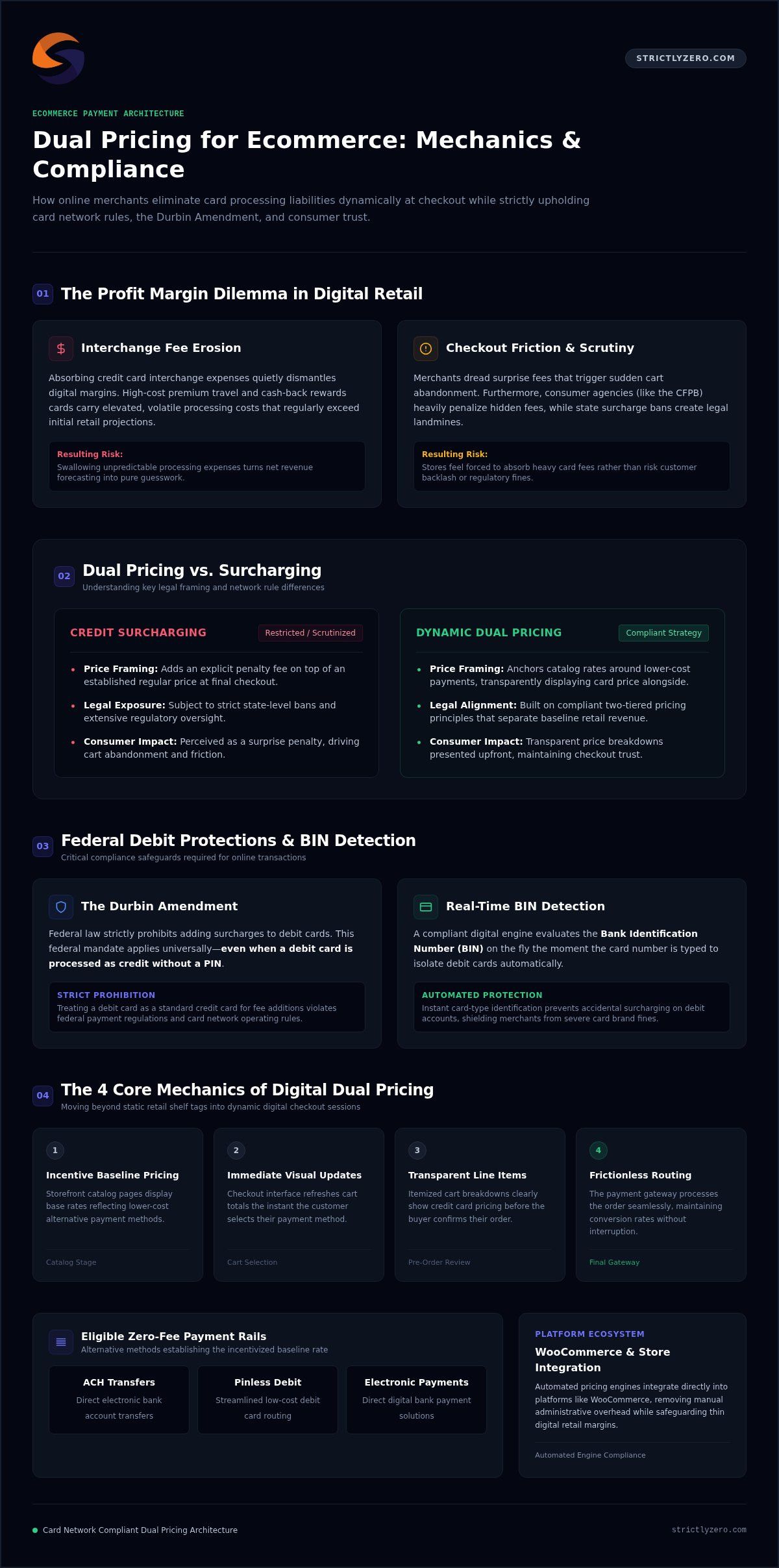
Brick-and-mortar stores often implement cash discounting by simply printing two prices on a physical shelf tag. On the web, the execution shifts radically. Rooted in traditional two-tiered pricing strategies, this model presents distinct prices for high-cost credit cards versus lower-cost alternative payment methods. Successfully implementing dual pricing for ecommerce requires dynamic checkout automation that recalculates shopping cart totals in real time based on the buyer’s selected payment type.
Eligible zero-fee alternatives often include ACH bank transfers, pinless debit, and electronic bank payments. Instead of absorbing interchange fees on every transaction, merchants set an incentivized baseline price while applying standard card rates to credit purchases. This structural shift shields profit margins by moving transaction processing expenses away from baseline retail earnings.
To better understand how price presentation shapes buyer perception, watch this helpful video:
The Core Mechanics of Digital Dual Pricing at Checkout
Unlike physical retail counters, online stores must automate price transparency across digital cart sessions. Compliant digital checkouts rely on four connected steps:
- Incentive baseline pricing: Storefront catalog pages display base rates reflecting lower-cost payment methods.
- Immediate visual updates: The checkout interface automatically refreshes total amounts the instant a user selects their preferred payment method.
- Transparent line items: Detailed cart breakdowns present credit card pricing before the customer confirms their final order.
- Frictionless gateway routing: The payment processing gateway handles the transaction smoothly, maintaining high conversion rates without checkout interruptions.
Why Online Merchants Are Moving Away From Absorbing Interchange
Card network interchange rates quietly erode thin margins in digital retail. Premium travel and cash-back rewards cards carry elevated processing costs that routinely exceed merchant financial projections. When businesses swallow these unpredictable expenses on every cart, estimating net revenue becomes guesswork. Adopting dual pricing for ecommerce protects vital margins, creates reliable cash flow, and eliminates volatile card processing liabilities across digital storefronts.
Dual Pricing vs. Surcharging Online: Key Compliance and Legal Differences
Many merchants treat dual pricing and surcharging as interchangeable phrases, but card brands and regulators view them through distinct legal lenses. Surcharging adds an explicit fee onto an existing regular price when a shopper inputs a credit card. In contrast, dual pricing frames the baseline catalog price around cash or alternative payment methods, displaying the card price alongside it. This subtle framing creates massive differences in technical implementation and legal liability for digital carts.
Consumer watchdogs scrutinize checkout fees closely. As agencies like the CFPB target hidden checkout friction, such as excessive credit card late fees in the consumer banking sector, online storefronts face equal pressure to keep payment adjustments transparent. Choosing a purpose-built Surcharge & Dual Pricing Engine keeps your store strictly compliant while giving shoppers total transparency.
Card Network Rules: Visa, Mastercard, and Debit Exclusions
Card brands strictly enforce their operating rules across the web. The most critical federal mandate involves debit transactions:
- Federal debit protections: The Durbin Amendment makes it illegal to add surcharges to debit cards, even when run as credit without a PIN.
- Automated BIN identification: Compliant gateways evaluate the Bank Identification Number (BIN) on the fly, immediately suppressing fee adjustments the moment a debit number enters the payment field.
- Cap restrictions: Visa and Mastercard cap surcharges at either 3% or the merchant’s actual cost of acceptance, whichever is lower.
State Regulatory Landscapes Governing Digital Pricing Disclosures
Operating a nationwide storefront means selling across patchwork state legislation. Credit card surcharges remain explicitly prohibited or heavily restricted in states like Connecticut, Maine, Massachusetts, and California. Dual pricing models, by presenting clear dual-rate disclosures upfront, remain legally recognized across all fifty states because they function as cash discounts rather than post-cart penalties.
Staying compliant requires dynamic storefront technology. An automated pricing engine reads customer geolocation and payment choices in real time, itemizing discounts clearly on cart summaries. Adopting compliant dual pricing for ecommerce protects your digital brand from regulatory violations, card brand fines, and unnecessary checkout disputes.
Essential Features to Look for in an Ecommerce Dual Pricing Solution
Selecting the right software for your store goes far beyond simple checkout math. A truly compliant setup must combine robust cart logic, dynamic card detection, and deep platform integration. Without these elements in place, digital stores risk technical errors, high bounce rates, and regulatory fines. If you want to understand how modern gateways handle multi-channel transactions end-to-end, explore our ecommerce payment processing guide before overhauling your store layout.
Your choice directly impacts both store conversion and network compliance. Here are three core capabilities your software needs to support effective dual pricing for ecommerce.
Automated BIN Detection and Dynamic Card Routing
Card routing cannot rely on customer honesty or manual selection. When a shopper enters their card details, the payment script must instantly read the first six to eight digits. This sequence, known as the Bank Identification Number (BIN), identifies the exact card type and issuing institution.
- Instant card validation: The software validates whether the card is credit, debit, or prepaid during active typing.
- Automatic fee suppression: Debit cards are immediately routed without added fees, keeping your store fully aligned with federal requirements.
- Network rule adherence: Built-in rules prevent human error and keep card adjustments well within brand boundaries.
Transparent Checkout UX That Protects Conversion Rates
Shoppers abandon carts when unexpected fees appear right before final payment. A well-designed checkout interface makes the pricing switch clear, simple, and intuitive. It dynamically displays the discounted total when shoppers choose zero-fee alternatives like ACH or debit, turning the price difference into an earned reward. Customizable text fields ensure the messaging aligns with your storefront styling and tone, avoiding harsh warning banners that create checkout hesitation.
Omni-Channel Integration and Reporting Dashboards
Digital retail rarely operates in a silo. Managing orders requires consistent pricing logic across online checkouts, mobile payments, and back-office virtual terminals. Robust dual pricing for ecommerce tools must synchronize with evolving state laws on credit card surcharges, updating rules in the background as legal requirements shift.
On the back end, your platform should provide transparent reporting dashboards. Clean ledger entries separate baseline merchandise revenue, sales tax, and payment card adjustments. This itemization makes daily reconciliation painless, saving your accounting team hours of manual spreadsheet audits each month.
How to Implement Dual Pricing on WooCommerce and Online Stores
Shifting from traditional processing to dynamic pricing requires careful technical execution. Because you aren’t simply slapping two price stickers on a shelf, your online checkout must adjust figures dynamically based on customer payment inputs. Successful deployment follows five sequential phases:
- Audit your product catalog to establish baseline non-credit incentive pricing.
- Select an omni-channel gateway equipped with dynamic pricing logic.
- Install the gateway extension or plugin into your ecommerce platform.
- Configure BIN inspection rules and set transparent checkout messaging.
- Run comprehensive sandbox tests across diverse card tiers before activating live transactions.
Configuring Product Catalog Pricing and Cart Display Rules
First, decide whether your storefront displays the cash-discounted price or the regular credit price by default. Most digital brands set the base catalog price to reflect non-credit transactions, then show the adjusted card total clearly at checkout. Ensure promotional discount coupons calculate strictly against baseline merchandise values rather than total cart amounts. Similarly, your cart logic must calculate sales tax and shipping expenses uniformly across both payment tiers without skewing order margins.
Connecting Payment Gateways to WooCommerce Without Checkout Friction
Connecting your software engine to WooCommerce starts with generating secure API keys within your processor portal. Once pasted into your WooCommerce payment settings, enable tokenized processing so returning shoppers can store card profiles securely without exposing sensitive cardholder data. For an exhaustive walkthrough on configuring these back-end mechanisms, read our complete guide to zero fee credit card processing. If you want a ready-to-deploy setup that handles these technical configurations straight out of the box, integrate Strictly’s pricing engine today.
Testing and Validating Compliance Before Launch
Never take an altered checkout live without thorough staging validation. Test every major card type in your sandbox environment to confirm compliance rules fire correctly:
- Run consumer credit cards from Visa, Mastercard, and American Express to check that card adjustments apply accurately.
- Process several debit cards to ensure automated BIN routing suppresses added fees instantly.
- Inspect digital invoices and automated confirmation emails to verify that itemized line items reflect exact payment methods and disclosures.
Completing these end-to-end checks ensures your rollout of dual pricing for ecommerce preserves your margins while keeping your checkout experience completely frictionless for customers.
Selecting the Right Dual Pricing Solution: Why Strictly Leads the Industry
Many legacy merchant providers try to force retail countertop equipment into digital environments, leaving online store owners stuck with broken plugins and compliance headaches. Modern online businesses require purpose-built software architectures. Strictly delivers a turnkey Surcharge & Dual Pricing Engine engineered specifically for web checkouts, helping digital sellers eliminate transaction overhead while honoring consumer trust.
Operating through a native omni-channel payment processing foundation, the platform connects your online storefront, virtual terminal, and mobile transactions under one roof. Processing expenses don’t have to chip away at your profitability. By returning transaction costs directly back to your baseline margin, your business secures predictable, healthy cash flow month after month.
Strictly’s Smart Pricing Engine and Automated Rule Management
Card network regulations and state consumer statutes shift constantly. Keeping up with these changes manually is nearly impossible for growing businesses. Strictly’s proprietary Smart Pricing Engine manages these shifting requirements through automated back-end logic:
- Algorithmic state compliance: The platform reads customer delivery addresses and payment types instantly, applying proper regional rules without merchant oversight.
- Flawless debit suppression: Proprietary BIN detection identifies debit cards the moment digits are typed, suppressing fees and defending you from card network penalties.
- Automated fee calculations: Every line item stays within card brand cost-of-acceptance caps automatically.
Payment organizations looking to deploy this robust technology for their portfolios can explore our comprehensive payment processing platform for ISOs overview.
Unlocking True Zero-Fee Processing Across Every Sales Channel
True financial efficiency extends across your entire sales operations. Rather than managing separate systems for online carts, phone billing, and recurring memberships, you gain a unified commerce solution. You can assess how this model compares across providers in our best credit card processing for small business breakdown.
Customers appreciate clarity and choice at checkout. When online buyers see transparent pricing, checkout confidence stays high and cart abandonment remains low. Ready to eliminate processing overhead and secure your digital revenue? Take complete control of your business margins with Strictly’s Dual Pricing Solutions to experience true zero-cost dual pricing for ecommerce.
Protect Your Store Margins and Reclaim Your Revenue
Absorbing high interchange costs is no longer the mandatory cost of running a digital storefront. Transitioning to dynamic checkout pricing gives you the power to defend your bottom line while offering shoppers total clarity. With automated BIN detection isolating debit transactions and real-time calculations matching complex state statutes, your online store stays protected against card brand penalties.
Adopting compliant dual pricing for ecommerce creates a transparent shopping environment where customers feel informed rather than penalized. When pricing adjustments appear accurately on every cart line item, trust remains intact and conversions hold steady. You don’t have to navigate these technical card rules or build complex custom scripts on your own.
Strictly delivers complete omni-channel payment processing, uniting your web cart, mobile payments, and virtual terminal billing under a single roof. Our proprietary Smart Pricing Engine handles real-time debit detection and state-level compliance automatically, so you can focus on scaling your business with predictable cash flow. Ready to stop losing profits to card processing overhead? Eliminate your online processing fees with Strictly today and transform your store’s long-term profitability.
Frequently Asked Questions
Is dual pricing for ecommerce legal in all 50 states?
Yes, dual pricing is legal across all 50 U.S. states. Regulators treat dual pricing as an upfront cash discount rather than an added surcharge fee. Because the baseline cash or non-card price is clearly published alongside the credit rate, it avoids the statutory bans that restrict traditional credit surcharging in states like Connecticut, Maine, Massachusetts, and California. Total transparency keeps the practice universally compliant nationwide.
How does dynamic dual pricing work on WooCommerce checkouts?
Dynamic dual pricing integrates with WooCommerce through a dedicated payment gateway plugin. As shoppers browse, product pages display baseline cash pricing. Once a buyer reaches the checkout screen, the gateway monitors the selected payment method. If the shopper enters a credit card, the cart script calculates and displays the adjusted card total instantly before the final order submission, keeping the checkout smooth and clear.
Can online merchants apply dual pricing to debit card transactions?
No, merchants cannot apply credit price increases to debit cards under federal law. The Durbin Amendment strictly prohibits surcharging on debit card transactions, regardless of whether the buyer enters a PIN or runs it as a signature transaction. When deploying dual pricing for ecommerce, your checkout system must automatically classify debit cards as eligible for the base discount, charging the non-credit price every time.
Will implementing dual pricing increase cart abandonment rates for online stores?
Not when it’s implemented transparently. Cart abandonment usually spikes when buyers encounter unexpected, hidden fees on the final confirmation screen. Dual pricing frames the price gap as an incentive for using lower-cost payment alternatives like ACH or debit. By communicating pricing structures clearly throughout the shopping flow, merchants protect their margins without hurting checkout conversions or creating consumer friction.
What is the difference between online dual pricing and credit card surcharging?
The fundamental difference lies in legal framing and visual disclosure. Surcharging adds an extra fee on top of an established regular price at the final payment step, which triggers state-level bans and card network caps. Dual pricing displays two separate prices upfront, offering an explicit discount for non-credit purchases. This structure bypasses surcharge prohibitions because merchants never assess a separate penalty fee.
How does payment gateway software detect debit cards versus credit cards?
Modern gateway software utilizes automated Bank Identification Number (BIN) lookups. When a shopper inputs the first six to eight digits of their card, the script instantly references an extensive global banking registry. This lookup determines the exact card type, issuing bank, and funding source before the customer clicks submit, ensuring debit cards bypass credit card price adjustments automatically.
Do merchants need to notify Visa and Mastercard before implementing dual pricing?
No, merchants do not need to register with card brands for true dual pricing programs. Visa and Mastercard require advance written notifications when merchants plan to surcharge credit transactions. Because compliant dual pricing for ecommerce functions as a cash discount model offering distinct pricing tiers rather than a punitive add-on fee, store owners avoid formal card network registration and 30-day waiting periods.