
Top Alternatives to Flat-Rate Processing for Growing Businesses in 2026
Published:

The predictable pricing structure that helped launch your business is quietly eating into your bottom line as you scale. While a flat fee keeps initial bookkeeping straightforward, blended rates charge you a steep premium on every sale, regardless of whether a customer uses a high-rewards credit card or a low-cost debit card. If rising transaction volume is shrinking your margins, exploring cost-effective alternatives to flat-rate processing is the fastest way to reclaim your hard-earned revenue.
You probably chose flat-rate billing for its convenience, but watching fees compound on high-ticket sales shouldn’t be the cost of doing business. This guide helps you discover the best alternatives to flat-rate processing, compare transparent fee models, and identify the right payment strategy for your margins. We’ll break down the practical differences between interchange-plus, subscription billing, and compliant dual pricing engines so you can pick a payment model that scales smoothly through 2026.
Key Takeaways
- Learn why bundled processing fees gradually eat into operating margins as your monthly card transaction volume expands.
- Compare transparent alternatives to flat-rate processing, including interchange-plus, subscription membership models, and zero-fee programs.
- Discover how automated dual pricing and compliant surcharging pass transaction costs directly to credit card users while safeguarding debit card sales.
- Calculate your business’s true effective processing rate to pinpoint exactly how much you can save across ecommerce, mobile, and virtual terminal channels.
Table of Contents
- Why Growing Businesses Outgrow Flat-Rate Payment Processing
- The Top Traditional Alternatives to Flat-Rate Models Compared
- Zero-Fee Merchant Solutions: Surcharging and Dual Pricing
- How to Evaluate and Select the Best Pricing Model for Your Business
- Upgrading from Flat-Rate Processing with Strictly
Why Growing Businesses Outgrow Flat-Rate Payment Processing
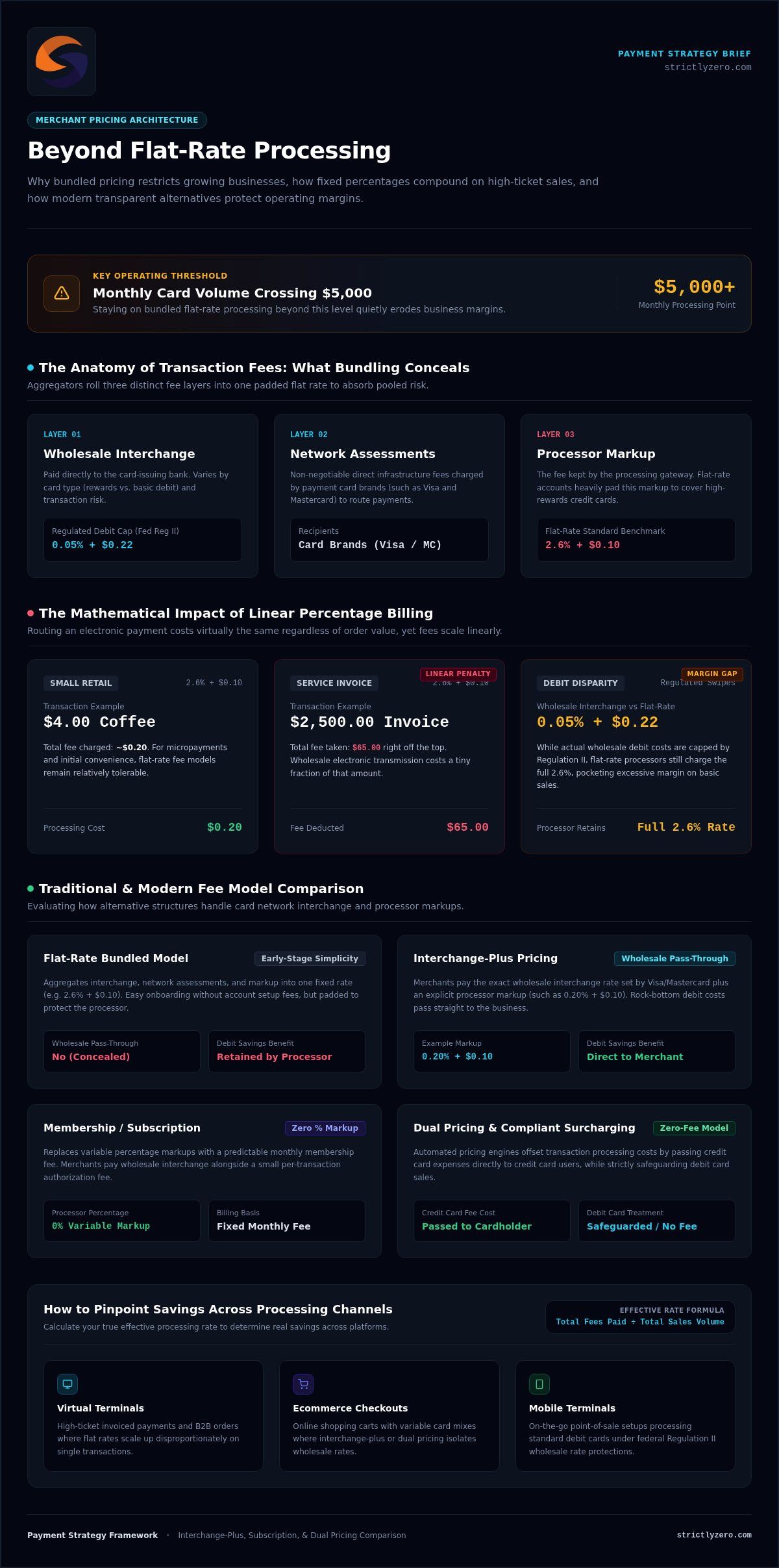
Flat-rate payment processing bundles every transaction cost into a single fixed percentage paired with a small authorization fee, such as 2.6% plus $0.10. On paper, this model offers unmatched simplicity. In reality, it masks the underlying costs set by card networks and merchant banks. As your monthly volume grows, the gap between what you pay and what the processor actually pays widens, quietly shaving thousands off your operating margins.
To see how this pricing structure holds up against more transparent alternatives, watch this breakdown of flat-rate versus cost-plus models:
For operations crossing $5,000 in monthly processing, staying on a bundled setup is rarely efficient. Exploring modern credit card processing for small business strategies reveals viable alternatives to flat-rate processing that align fees directly with your sales patterns.
The Convenience Trap of One-Size-Fits-All Pricing
Early-stage businesses love flat-rate accounts because onboarding takes minutes without account setup fees. Aggregators lump together three distinct fee layers: wholesale interchange rates paid to card issuers, network assessment fees paid to Visa or Mastercard, and the processor markup. Because the processor absorbs the liability and risk across a massive pool of small merchants, they set a padded rate high enough to cover premium credit cards. Once your business establishes consistent sales, paying that padded rate on every swipe becomes an expensive operational bottleneck.
The Mathematical Impact on Higher Average Order Values
Fixed percentages heavily penalize businesses with large ticket sizes. The underlying cost to route an electronic payment remains roughly identical whether an invoice totals $5 or $5,000, yet your flat-rate fee scales up linearly.
- Low-ticket sales: On a $4 coffee, a 2.6% plus $0.10 fee totals about $0.20, which is relatively fair for processing convenience.
- High-ticket invoices: On a $2,500 professional service invoice, that same 2.6% takes $65 right off the top, even though wholesale card handling cost only a fraction of that amount.
- Debit card disparity: Regulated debit cards carry wholesale interchange costs around 0.05% plus $0.22, but a flat-rate processor still pockets their full 2.6%, pocketing an oversized margin on your most basic sales.
Instead of watching your margins evaporate on high-value checkouts, forward-thinking operators use compliant mechanisms like a payment surcharge or dual pricing engines to offset network processing costs entirely. For companies with rising volume, shifting to viable alternatives to flat-rate processing stops the unnecessary subsidization of card aggregator profits.
The Top Traditional Alternatives to Flat-Rate Models Compared
Many merchants assume switching processors means simply trading one bundled rate for another. In practice, the primary alternatives to flat-rate processing split into three distinct structures: interchange-plus, subscription membership, and legacy tiered plans. Each handles network fees differently, directly altering how much cash stays in your business bank account at month’s end.
Interchange-Plus Pricing: Total Wholesale Transparency
Interchange-plus operates on a pass-through model. You pay the exact wholesale fee charged by card brands like Visa and Mastercard, plus an explicit, fixed processor markup (such as 0.20% + $0.10). Because wholesale costs shift based on card type, low-cost cards yield instant savings for you rather than padding a third-party aggregator’s margin. This structure is heavily shaped by federal Regulation II interchange fee standards, which cap swipe costs on regulated debit cards at just 0.05% + $0.22. On an interchange-plus plan, that rock-bottom debit expense passes straight to your bottom line instead of being marked up to flat-rate retail levels.
Membership and Subscription Processing Models
Subscription processing replaces variable percentage markups with a predictable monthly membership fee. Under this model, you pay direct wholesale interchange costs alongside a tiny per-transaction authorization fee (often just a few pennies), but zero percentage markup to the processor.
- Predictable platform dues: You pay a set monthly fee regardless of whether your revenue doubles or triples.
- High-volume efficiency: For businesses running tens of thousands in card payments every month, paying fixed cents per transaction easily beats losing 2.5% or more across gross receipts.
- Billing audits: Watch for ancillary fees on monthly statements, including PCI maintenance, gateway charges, or batch closure costs that some subscription vendors append.
The Perils of Legacy Tiered Pricing Schedules
Tiered pricing organizes transactions into subjective categories: qualified, mid-qualified, and non-qualified. Processors quote an attractive qualified rate, but routinely route premium rewards, corporate, and card-not-present payments into non-qualified tiers carrying steep markups. Because the vendor controls classification rules, these plans lack verifiable transparency.
If you want to move beyond opaque bills and fixed aggregator cuts, comparing modern alternatives to flat-rate processing helps identify an account structure tailored directly to your sales volume, ticket size, and operational setup.
Zero-Fee Merchant Solutions: Surcharging and Dual Pricing
Most comparisons frame interchange-plus as the sole alternative to bundled pricing. Yet, for businesses seeking complete margin protection, zero-fee payment structures offer a distinct path. Rather than hunting for minimal processor markups, models like compliant credit card surcharges and dual pricing offset payment acceptance expenses entirely by transferring processing costs directly to the cardholder at checkout.
Adopting modern zero fee credit card processing enables businesses to protect net revenue without absorbing 2.5% to 3.5% fee hits on every transaction.
Surcharging vs. Dual Pricing: Understanding the Mechanics
While often used interchangeably, these two zero-fee strategies function differently at the point of sale:
- Credit card surcharging: Adds a visible, line-item fee to the final bill when a patron opts to pay via credit card.
- Dual pricing: Displays two clear amounts simultaneously, an everyday card price and a discounted cash or debit price, giving buyers an immediate incentive to choose lower-cost tender.
In B2B commerce, virtual terminal environments, and service industries where electronic invoicing dominates, line-item surcharging integrates neatly into outgoing invoices. In high-traffic retail spaces, dual pricing creates immediate clarity at the register.
Navigating Surcharge Compliance and State Regulations
Running a compliant surcharge system requires strict adherence to card brand operating rules and state legislation. Under network guidelines from Visa and Mastercard, credit card surcharges cannot exceed 3% or the merchant’s actual cost of acceptance. Merchants must also deliver formal 30-day written notice to acquiring banks before launching.
Crucially, federal law under the Durbin Amendment strictly prohibits surcharging debit cards, even when run as credit without a PIN. In addition, several jurisdictions restrict or regulate credit card surcharges directly:
- Prohibited states: Surcharging is banned in Connecticut, Maine, Massachusetts, and Puerto Rico, alongside bans like California’s Senate Bill 478.
- Rate-capped states: Colorado caps surcharges at 2%, while Illinois enforces a 1% maximum.
- Cost-restricted states: New York, New Jersey, Nevada, and South Dakota limit fees strictly to actual acceptance costs.
Navigating these rules manually invites heavy network fines. A platform featuring an automated compliance engine is essential to detect debit cards instantly and enforce localized caps automatically.
Customer Experience and Communication Strategies
Clear transparency maintains consumer goodwill. Prominent signage at building entrances, checkout counters, and ecommerce carts prevents surprise friction. When customers understand that debit and cash payments remain surcharge-free, adoption shifts naturally toward lower-cost methods.
Evaluating these zero-fee setups alongside traditional pass-through accounts highlights the strongest best credit card processing for small business tactics, unlocking powerful alternatives to flat-rate processing that insulate your bottom line from ongoing fee increases.
How to Evaluate and Select the Best Pricing Model for Your Business
Leaving an aggregated processor requires a close look at your real payment data. Because no single pricing model fits every business model, transitioning to alternatives to flat-rate processing demands a clear evaluation of your monthly sales patterns, checkout environments, and operational tools.
Step 1: Calculate Your True Effective Processing Rate
Start by determining what you actually pay across all transactions. Pull your most recent monthly processing statement and apply this simple formula:
Effective Processing Rate = (Total Monthly Processing Fees / Total Monthly Sales Volume) x 100
If you processed $40,000 in volume and paid $1,280 in total card processing charges, your effective rate is 3.2%. While flat-rate marketing highlights a base rate like 2.6%, cross-border fees, keyed-in transactions, and fixed per-swipe cents push your true percentage higher. If your effective rate sits above 2.3% on standard retail volume, you have clear room to optimize.
Step 2: Map Payment Channels and Cardholder Behaviors
Look closely at how your customers pay. A retail store processing 60% debit cards will achieve massive immediate savings on an interchange-plus model, since wholesale debit fees cost a fraction of flat-rate cuts. Conversely, a B2B firm sending high-ticket invoices over email faces steep card-not-present rates and commercial card interchange markups.
For operations balancing online stores, payment links, and virtual terminals, unifying these touchpoints under an ecommerce payment processing strategy ensures you don’t pay separate aggregator markups across different channels.
Step 3: Review Processing Contract Terms and Equipment Policies
Before committing to any new processor, inspect their terms for operational traps:
- Month-to-month agreements: Avoid multi-year contracts with liquidated damages clauses that charge early termination penalties based on projected lost revenue.
- Hardware flexibility: Steer clear of non-cancelable equipment leases that cost thousands over their lifecycle. Verify that software supports open, non-proprietary card readers or cloud-based virtual terminals.
- Automated tooling: Ensure the platform supports virtual invoicing, recurring billing, and intelligent routing so your back office stays efficient.
Once you understand your effective rate and sales mix, you can easily evaluate which alternatives to flat-rate processing maximize your cash flow. If you are ready to stop losing margins to flat fees, schedule an account review with Strictly to discover your ideal payment structure.
Upgrading from Flat-Rate Processing with Strictly
Transitioning away from one-size-fits-all aggregators doesn’t mean taking on technical complexity. Strictly delivers an all-in-one omni-channel payment processing platform engineered specifically for growing merchants ready to eliminate wasted overhead. Built around trust, security, and transparent pricing architectures, Strictly gives businesses practical alternatives to flat-rate processing that protect profit margins as revenue accelerates.
Eliminate Merchant Fees with Smart Surcharging
Running a compliant zero-fee program requires reliable technology. Strictly’s Smart Pricing Engine removes the regulatory burden by automating state-by-state compliance rules dynamically during checkout. If a transaction originates in a state with fee caps or bans, the platform adjusts automatically. Crucially, built-in automated debit card detection identifies debit cards instantly, preventing non-compliant surcharges from being applied to debit transactions. Instead of giving up thousands of dollars every month to processing cuts, you retain your full ticket value and reinvest that capital directly into inventory, marketing, and staff.
Omni-Channel Capabilities for Modern Operations
Modern businesses rarely operate through a single checkout window. Strictly supports your entire workflow through versatile omni-channel payment processing:
- Virtual terminal and invoicing: Generate branded payment links, set up scheduled recurring billing, and process remote phone orders without standalone hardware dependencies.
- Ecommerce integrations: Connect secure, hosted checkout fields straight into digital storefronts using flexible, developer-friendly APIs.
- AI-driven fraud prevention: Guard every transaction across web, mobile, and back-office channels with machine-learning fraud monitoring that flags high-risk transactions before chargebacks occur.
- Centralized reporting: Track batch settlements, refunds, and multi-channel sales within a single unified merchant dashboard.
A Smooth Migration Away from Aggregator Lock-In
Migrating to an independent merchant account provides dedicated stability, insulated settlement schedules, and clear wholesale visibility. You no longer need to worry about arbitrary account freezes or blanket aggregator rate hikes. You can establish transparent billing, equip your team with robust invoicing tools, and preserve your hard-earned revenue. If you want proven alternatives to flat-rate processing that grow alongside your sales, take control of your margins by partnering with Strictly today.
Reclaim Your Processing Margins and Scale With Confidence
Flat-rate payment structures offer early simplicity, but expanding businesses quickly outgrow fixed percentage deductions. When high-ticket invoices and low-cost debit transactions carry the same inflated rates, your profits quietly leak away. Exploring transparent alternatives to flat-rate processing is the most reliable way to protect your cash flow as transaction volume accelerates across your sales channels.
Modern zero-fee pricing gives you the power to eliminate card acceptance expenses without operational friction. Strictly makes this transition seamless. Built as an omni-channel platform supporting virtual terminals, hosted web checkouts, and mobile payments, Strictly pairs automated debit card detection with an intelligent Smart Pricing Engine that handles state-by-state surcharge compliance dynamically. You don’t have to let bundled processing costs dictate your company’s growth. Take charge of your payment strategy and switch to Strictly to eliminate processing fees today.
Frequently Asked Questions
What is the primary difference between flat-rate processing and interchange-plus?
The primary difference is how card brand costs and processor margins are billed. Flat-rate pricing charges one fixed percentage on every sale, concealing true wholesale interchange fees. Interchange-plus separates network wholesale costs from an explicit processor markup, passing debit and basic card savings directly to you. As one of the most reliable alternatives to flat-rate processing, interchange-plus delivers clear line-item transparency that lowers your overall costs.
At what monthly sales volume should a business switch away from flat-rate processing?
Most businesses should consider switching when their card volume crosses $5,000 per month. At this threshold, the fixed percentage markups charged by aggregators begin to exceed the modest monthly platform dues or account fees of direct merchant accounts. Evaluating alternatives to flat-rate processing at this stage helps you stop overpaying on debit cards and higher average order values as your transaction volume continues to scale.
Is zero-fee credit card processing legal in all US states?
Credit card surcharging is legal in most states, but specific regional restrictions apply. As of 2026, surcharges are prohibited in Connecticut, Maine, Massachusetts, California, and Puerto Rico, while Colorado and Illinois enforce strict percentage caps. Dual pricing and cash discount programs remain legal across all 50 states when properly disclosed, providing a dependable zero-fee alternative everywhere without running into state-level surcharge bans.
Can my business legally apply a surcharge to customer debit card transactions?
No, applying a surcharge to debit card transactions is strictly illegal under federal law. The Durbin Amendment and card network regulations prohibit surcharges on all debit and prepaid cards, even if the cardholder chooses to process the payment as credit without a PIN. Modern payment systems must include automated debit card detection to instantly bypass surcharges and maintain full compliance with card brand rules.
How does a merchant calculate their true effective credit card processing rate?
You calculate your effective rate by dividing your total monthly processing fees by your gross monthly transaction volume, then multiplying by 100. For instance, if you paid $1,050 in fees on $35,000 in gross sales, your effective processing rate is exactly 3.0%. This figure includes all percentage cuts, batch fees, and monthly statement fees, revealing the actual percentage leaving your revenue every month.
What is the difference between credit card surcharging and cash discounting?
Surcharging adds an extra percentage fee to the advertised price when a customer pays by credit card. Cash discounting presents the regular shelf price as the card price and offers an instant discount at checkout for patrons paying with cash or debit. While surcharging faces specific state regulations and network caps, dual pricing and cash discounts display two distinct prices upfront, making them universally permissible.
Will switching from flat-rate processing to a surcharge program alienate my customers?
Customer pushback is rare when zero-fee programs are implemented with clear communication and transparency. In B2B invoices and high-ticket service sectors, surcharges are standard practice. In retail environments, dual pricing allows shoppers to pay with fee-free cash or debit cards without friction. Presenting lower-cost payment options clearly keeps checkout smooth while immediately recovering 2% to 3% of your gross sales margins.