
The Total Cost of Payment Processing: A 2026 Guide to TCO
Published:

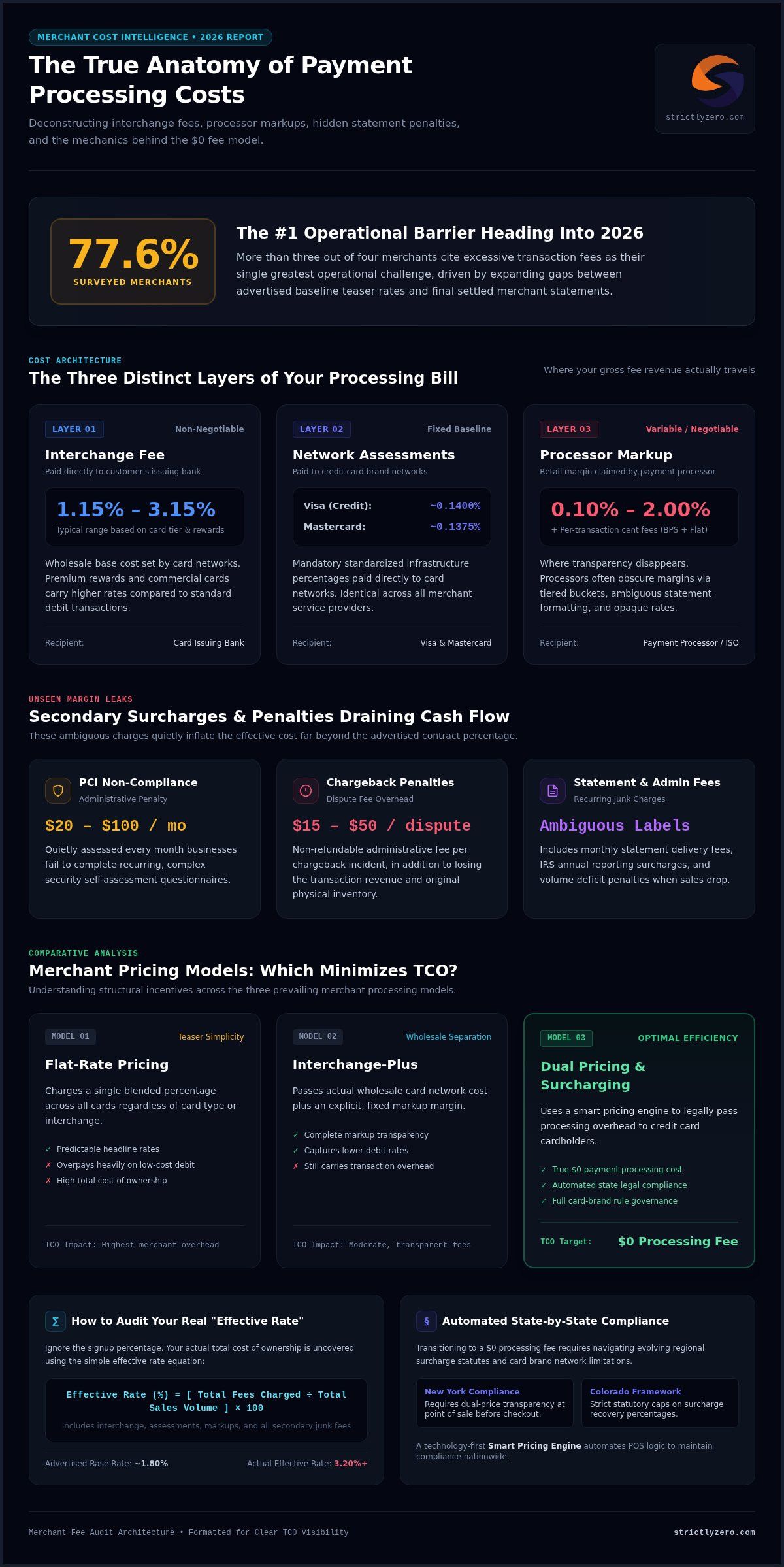
Did you know that 77.6% of merchants cited high transaction fees as their biggest business challenge heading into 2026? It’s frustrating to watch your hard-earned revenue vanish into a black hole of statement fees and PCI non-compliance charges. You likely feel that the “flat rate” you were promised was a bait-and-switch, especially when your actual total cost of payment processing ends up being much higher than the headline number. You aren’t imagining things; the gap between base rates and your final bill is wider than ever.
We understand that unpredictable monthly costs make it nearly impossible to forecast your ROI. This guide changes that by pulling back the curtain on the hidden markups and junk fees that plague modern merchant statements. We’ll provide a clear framework to calculate your real expenses and show you how a technology-first approach to surcharging can legally reduce your processing costs to zero. From the latest Visa and Mastercard interchange updates to state-specific compliance rules in places like New York and Colorado, you’ll gain the transparency you need to take back control of your bottom line.
Key Takeaways
- Understand the three distinct layers of your bill-interchange, assessments, and markups-to accurately calculate the total cost of payment processing for your business.
- Identify and eliminate “junk fees” like statement charges and PCI non-compliance penalties that often hide in plain sight on your monthly merchant statements.
- Compare flat-rate and interchange-plus models to determine which pricing structure offers the best balance of simplicity and transparency as your volume grows.
- Learn how a smart pricing engine can automate state-by-state compliance and help you transition to a $0 processing fee model through dual pricing.
- Master a step-by-step audit framework to uncover hidden expenses and project your potential annual savings using modern cost-recovery strategies.
Table of Contents
- The Anatomy of Payment Processing Costs: Beyond the Rate
- Hidden Costs That Inflate Your Monthly Merchant Statement
- Comparing Pricing Models: Which Minimizes TCO?
- The Zero-Fee Revolution: How Surcharging Redefines TCO
- Calculating Your Savings and Implementing the Solution
The Anatomy of Payment Processing Costs: Beyond the Rate
Understanding your merchant statement shouldn’t require a degree in forensic accounting. Most business owners look at their teaser rate and assume that’s the end of the story. However, the true total cost of payment processing includes far more than just the percentage you agreed to during signup. It encompasses direct transaction fees, indirect administrative labor, and the opportunity costs associated with payment friction or fraud. If you only focus on the base percentage, you’re missing the hidden leaks in your revenue.
To better understand this concept, watch this helpful video:
The journey toward a $0 processing model starts with breaking down the traditional three-tier cost structure. While many processors try to simplify their pricing into a single flat fee, your actual expenses are built from three distinct layers: interchange, assessments, and the processor’s markup. By identifying each component, you can see exactly where your money is going and which costs are actually within your power to change.
Direct Transaction Fees: The Non-Negotiables
These costs are the bedrock of the industry. An Interchange fee is the wholesale cost of credit card processing set by the card networks. This fee is paid to the bank that issued the customer’s card, and it isn’t negotiable. It changes based on the type of card used, such as a premium rewards card versus a standard debit card. Interchange fees typically range from 1.15% to 3.15% as of 2026, depending on the risk and rewards associated with the card.
Along with interchange, you’ll see assessment fees. These are small, mandatory percentages paid directly to networks like Visa or Mastercard to maintain their global infrastructure. In 2026, Visa charges approximately 0.14% for credit transactions, while Mastercard sits around 0.1375%. Because these rates are fixed by the networks, every processor pays the same baseline wholesale price.
Processor Markups: Where Transparency Disappears
This is where the math often gets murky. The processor markup is the retail portion of your bill, representing the profit the processor makes on top of the wholesale costs. This is typically expressed in basis points (BPS), where one basis point equals 0.01%, alongside a per-transaction cent fee. This markup can range from 0.10% to 2.00% depending on your industry and volume.
Processors often hide their true margins by using complex statement layouts or tiered models that bucket transactions into arbitrary categories. If you don’t know your effective rate, which is your total fees divided by your total sales volume, you can’t accurately measure the total cost of payment processing for your business. The final evolution of this journey is moving toward a Zero Fee model. By using a Smart Pricing Engine to facilitate compliant surcharging, you can shift these markup costs away from your margins entirely, effectively reducing your processing overhead to zero.
Hidden Costs That Inflate Your Monthly Merchant Statement
Teaser rates on your merchant agreement are rarely what you actually pay. While banks accumulate billions in interchange revenues each year, traditional processors tack on an array of secondary fees that quietly inflate your total cost of payment processing. These “junk fees” often sneak onto statements under ambiguous labels like administrative fees, IRS reporting charges, or minimum processing penalties if your monthly volume dips below a predefined threshold.
Security compliance is another common area for hidden markups. Many business owners find themselves paying $20 to $100 per month in PCI non-compliance penalties simply because they haven’t completed a confusing self-assessment questionnaire. Beyond these administrative leaks, chargeback management acts as a direct drain on your cash flow. When a customer disputes a transaction, you don’t just lose the sale; you lose the physical inventory, pay a non-refundable penalty fee of $15 to $50, and watch your processing history take a dangerous hit.
You also need to account for the digital pipes carrying your transaction data. Gateway fees and virtual terminal access charges are frequently billed separately from actual transaction percentages, adding fixed monthly overhead regardless of whether you swipe ten cards or ten thousand.
Operational and Integration Expenses
Software development isn’t free. Building and maintaining custom payment integrations requires substantial developer hours to ensure security patches and API updates don’t break your checkout flow. When your physical storefront, mobile app, and website operate on separate systems, you get stuck with siloed data. This separation forces your accounting team to waste hours manually reconciling mismatched reports every week. To eliminate this operational drag, reading an Ecommerce Payment Processing Guide can help you design a unified, efficient architecture across all sales channels.
Risk and Security Overhead
Defending your business from fraud introduces its own set of financial burdens. Relying on manual reviews costs valuable staff time, while basic fraud filters often block legitimate customers by mistake. Some industry studies suggest that every $1 lost to fraud actually costs a merchant $3.75 in total recovery expenses when accounting for shipping, labor, and chargeback penalties. Customer churn caused by payment failures also damages your margins. Utilizing advanced retention tools like ChurnIQ™ provides the intelligence needed to prevent involuntary churn and protect your recurring revenue. If you want to stop guessing what your merchant provider is charging you, consider partnering with an omni-channel platform like Strictly to bring total transparency back to your billing.
Comparing Pricing Models: Which Minimizes TCO?
Choosing a pricing model is the most consequential decision you’ll make regarding your total cost of payment processing. While many providers lead with the promise of simplicity, that convenience often comes with a steep price tag that scales as your business grows. You shouldn’t have to choose between understanding your bill and keeping your profit margins intact. The right model doesn’t just show you the costs; it provides a pathway to eliminate them.
Tiered pricing is perhaps the most common trap for unwary merchants. This model buckets transactions into “Qualified,” “Mid-Qualified,” and “Non-Qualified” tiers. Because the processor controls the definitions for these buckets, they can shift your transactions into higher-cost tiers without notice. This lack of transparency makes it impossible to predict your monthly expenses, leaving you with a total cost of payment processing that fluctuates wildly based on the types of cards your customers prefer to use.
The Transparency Trap of Flat-Rate Pricing
Flat-rate models are popular because they’re easy to explain. You pay one fixed percentage regardless of the card brand or type. However, this is effectively a “simplicity tax.” Since the wholesale cost for a standard debit card is significantly lower than a premium rewards credit card, the processor pockets the massive difference on every debit swipe. This is precisely why large enterprises avoid flat-rate models; they know that paying a premium for “simplicity” drains thousands from the bottom line. When searching for the Best Credit Card Processing for Small Business, it’s vital to look past the headline rate and analyze the underlying cost of your specific transaction mix.
Interchange Plus vs. Surcharging
Interchange Plus is widely considered the gold standard for transparency. It passes the wholesale cost directly to you with a clear, fixed markup. This model makes it easy to see how to calculate processing fees by separating the non-negotiable bank rates from the processor’s profit. While this transparency is a huge step up from tiered pricing, it still leaves the merchant responsible for the entire bill. You see the cost, but you’re still the one paying it.
Zero-fee surcharging is the final evolution of this journey. Instead of just documenting your expenses, a technology-driven surcharge engine uses automated logic to identify credit cards and apply a compliant fee to the transaction. This shifts the cost of credit acceptance to the consumer while keeping debit transactions at their low wholesale rates. By using a Zero Fee Merchant Guide to implement these strategies, you can maintain state-by-state compliance and finally drive your processing overhead toward zero.
The Zero-Fee Revolution: How Surcharging Redefines TCO
For decades, merchants accepted high transaction fees as an unavoidable tax on growth. The zero-fee revolution upends this assumption by shifting the focus from simply managing expenses to eliminating them through technology. By leveraging a Smart Pricing Engine, businesses can now differentiate between debit and credit cards in real-time. This distinction is vital because, while credit cards can be surcharged to offset costs, surcharging debit cards remains prohibited nationwide under the Durbin Amendment. An automated engine ensures that your customers are charged fairly based on their chosen payment method without requiring manual intervention from your staff.
Dual pricing offers a transparent alternative by presenting a “Cash Price” and a “Card Price” side-by-side. This model empowers customers with a clear choice rather than a surprise fee at the end of a transaction. When implemented with full transparency, the psychological impact on customers is minimal; most appreciate the honesty and the option to save money by using lower-cost payment methods. This approach fundamentally changes your total cost of payment processing by moving the burden of credit card rewards programs from your margins to the consumers who benefit from them.
Automated Compliance and State Laws
The regulatory landscape in 2026 requires precision. As of early this year, credit card surcharges remain prohibited in Connecticut, Massachusetts, and Maine. Other states have implemented strict caps; for example, Colorado limits surcharges to 2%, while New York and New Jersey require that fees do not exceed the merchant’s actual cost of acceptance. Furthermore, card networks like Visa and Mastercard have set a hard ceiling of 3% on all surcharges.
Attempting to manage these variations manually is a massive legal risk. An automated platform handles the state-by-state logic and ensures that digital and physical signage meets all disclosure requirements. Using a professional Credit Card Processing Service that specializes in automated compliance is the only way to scale a zero-fee program across state lines without falling into regulatory traps.
ROI of a Zero-Fee Program
The financial impact of removing processing fees is immediate and substantial. Most merchants see a net profit margin increase of 2.5% to 4% after transitioning to a surcharge or dual pricing model. For a business doing $1 million in annual sales, this equates to an extra $25,000 to $40,000 in liquidity every year. These savings can be strategically re-invested into marketing, AI-driven fraud prevention, or expanding your omni-channel reach. By driving your total cost of payment processing toward zero, you transform a legacy expense into a powerful competitive advantage. Start your transition to zero fees today to reclaim your hard-earned revenue.
Calculating Your Savings and Implementing the Solution
Calculating your actual total cost of payment processing is the first step toward financial recovery. You can’t fix what you haven’t measured. By looking at a single month’s statement, you can uncover exactly how much margin you’re losing to inefficiencies. Transitioning to a zero-fee model shouldn’t be a leap of faith; it should be a calculated move based on your unique transaction data. Once you see the numbers, the decision to modernize your overhead becomes a simple matter of math.
Auditing Your Current Statement
To find your effective rate, divide your total monthly fees by your total sales volume. For instance, if you paid $2,500 in fees on $100,000 in sales, your effective rate is 2.5%. This number is the only true benchmark for comparison. While the average effective swipe fee across Visa and Mastercard in 2025 was 2.36%, your specific rate might be higher due to your industry or card mix. Look closely at the “miscellaneous” section of your bill. You’ll likely find recurring charges for statement delivery or IRS reporting that serve no purpose other than padding the processor’s profit. Identifying these leaks prepares your data for a side-by-side comparison with a zero-fee model.
Implementation and Next Steps
Modern migration doesn’t require shutting down your business. An API-first, omni-channel platform allows you to integrate new virtual terminals and invoicing tools alongside your existing storefront operations. This architecture ensures zero downtime while you switch to a more transparent system. Training your staff is equally important. When employees understand how to explain dual pricing, they can confidently tell customers that the “cash price” is a discount for avoiding credit card overhead. This clarity builds trust and reduces friction at the point of sale.
Selecting the right partner is about more than just software. You need a trust-first processor that offers a comprehensive suite of tools to protect your bottom line. Use this final checklist when evaluating your options:
- Automated Compliance: Does the system handle state-by-state logic for 2026 regulations automatically?
- AI-Driven Fraud Prevention: Can the platform lower your recovery costs by stopping fraudulent transactions before they happen?
- Retention Intelligence: Does it include tools like ChurnIQ™ to prevent involuntary churn?
- Unified Reporting: Can you view all omni-channel data in a single dashboard?
By following this roadmap, you’ll move from being a passive payer of fees to an active manager of your revenue. The total cost of payment processing doesn’t have to be a permanent drain on your resources. Estimate your savings with Strictly’s Zero-Fee Program and see how much you could reclaim by the end of the year.
Future-Proof Your Bottom Line in 2026
Stop letting junk fees and complex pricing models erode your hard-earned margins. As we’ve explored, the true path to profitability involves moving past teaser rates and identifying the hidden leaks in your merchant statements. By understanding your effective rate and choosing a model that prioritizes transparency, you can finally stop the unpredictable revenue drain that plagues so many small businesses.
Reducing your total cost of payment processing to zero is no longer a theoretical goal; it’s a strategic reality powered by modern technology. With a Smart Pricing Engine that manages 2026 state compliance and ChurnIQ™ providing retention intelligence, you can protect your recurring income while eliminating transaction overhead. Our omni-channel API ensures that this transition happens instantly across all your sales platforms without disrupting your daily operations.
You’ve put in the work to build a successful brand. It’s time to keep the revenue you’ve earned and re-invest those savings into your next stage of growth. Eliminate your processing fees today with Strictly’s Zero-Fee Program. Taking control of your financial future starts with a single audit, and we’re here to help you every step of the way.
Frequently Asked Questions
What is the average total cost of credit card processing for a small business?
The average total cost for U.S. merchants in 2026 typically ranges between 1.5% and 3.5% of each transaction. This figure includes the base interchange rate, network assessments, and the processor’s markup. When you add per-transaction fees of $0.10 to $0.30, the average effective rate for credit cards sits at approximately 2.24%. Understanding these averages helps you identify if your current provider is overcharging you through excessive markups.
Is surcharging legal in all 50 states in 2026?
No, surcharging is not legal in every state. As of 2026, credit card surcharges are prohibited in Connecticut, Massachusetts, and Maine. Other states permit them but with strict limitations; Colorado has a 2% cap, while New York and New Jersey limit the fee to your actual cost of acceptance. Using an automated Smart Pricing Engine is the safest way to ensure your business stays compliant with these evolving state-by-state regulations.
What is the difference between a surcharge and a convenience fee?
A surcharge is a fee added to a transaction specifically for the use of a credit card to cover the merchant’s cost of acceptance. Conversely, a convenience fee is charged for the privilege of using a non-standard payment channel, such as paying a utility bill online when the office usually accepts checks. Surcharges are capped at 3% by card networks and are strictly prohibited on debit card transactions nationwide.
How do hidden fees like PCI compliance impact my total cost of ownership?
Hidden charges like PCI non-compliance fees significantly inflate the total cost of payment processing without adding any operational value. These fees can cost your business $20 to $100 every month simply because you haven’t completed a complex annual questionnaire. By partnering with a processor that prioritizes transparency and automated security, you can eliminate these junk fees and ensure your total cost of ownership remains as low as possible.
Can I use a surcharge program for both online and in-person payments?
Yes, you can implement these programs across all sales channels. An omni-channel platform allows you to apply consistent pricing logic to your virtual terminal, e-commerce checkout, and in-person transactions. This unified approach ensures that your Smart Pricing Engine detects debit cards and premium credit cards correctly every time. It provides a seamless experience for your customers while protecting your margins across every physical and digital touchpoint in your business.
Will passing processing fees to my customers cause them to shop elsewhere?
Most businesses find that transparency preserves customer loyalty. When you explain that a credit card surcharge covers the high cost of rewards programs, customers generally understand the trade-off. Transitioning to a dual pricing model is often the most effective strategy, as it frames the lower price as a cash discount. This gives shoppers a clear choice to save money, which helps maintain high retention rates while you offset your processing overhead.
What are the most common ‘junk fees’ found on merchant statements?
The most frequent junk fees include statement fees, IRS reporting fees, and minimum processing penalties. You should also watch for high PCI non-compliance charges and monthly gateway access fees that aren’t bundled into your base rate. These costs are often used by traditional processors to hide their true profit margins. Auditing your statement to identify these line items is the first step toward reducing your total cost of payment processing.
How does dual pricing differ from credit card surcharging?
Surcharging adds a fee on top of the listed price for credit card transactions, while dual pricing presents two distinct prices to the customer from the start. Dual pricing is generally considered more customer-friendly and is legal in all 50 states because it functions as a cash discount. Surcharging is more regulated and requires specific signage and network notifications, making it essential to use a compliant engine to manage the process.