
Is It Bad for Business to Add a Credit Card Fee? Pros, Risks, and Alternatives
Published:

What if adding a credit card fee protects your margins but makes customers think twice before buying? If you’re asking, “is it bad for business to add a credit card fee,” the answer depends on more than processing costs. How you present the fee, what customers expect, and the rules that apply to your business can all affect the outcome.
It’s understandable to look for ways to manage payment expenses, especially when margins are tight. But a surcharge isn’t an automatic win or a guaranteed customer-relations mistake. It may help offset costs, while also adding friction at checkout or affecting trust. The right choice depends on your business, how customers pay, and how they respond to the total price.
This article explains how to weigh potential effects on sales, customer experience, and margins; compare surcharging with alternatives such as dual pricing; and identify what to verify before changing your pricing. Requirements can vary by location and payment type. Payment technology may support implementation, but it doesn’t replace checking the rules that apply to your business.
Key Takeaways
- Whether is it bad for business to add a credit card fee depends on how cost recovery balances with customer experience and implementation.
- Assess more than processing costs. Checkout visibility, customer expectations, and the work involved in managing the change can also affect the outcome.
- Compare a surcharge, higher listed prices, and absorbing costs against your margins and the experience you want to offer.
- Before changing your pricing, verify current requirements for your location, card networks, and payment types with qualified sources.
- Explore surcharge or dual-pricing tools only after considering your margin pressure, sales channels, and verified requirements. Payment technology can support implementation, but it doesn’t replace your checks.
Table of Contents
- Is it bad for business to add a credit card fee? The honest answer
- How a credit card fee can affect customers, sales, and margins
- Credit card fee, higher prices, or absorbing costs: compare the options
- How to assess and introduce a credit card fee responsibly
- A surcharge program may fit, but choose based on your business
Is it bad for business to add a credit card fee? The honest answer
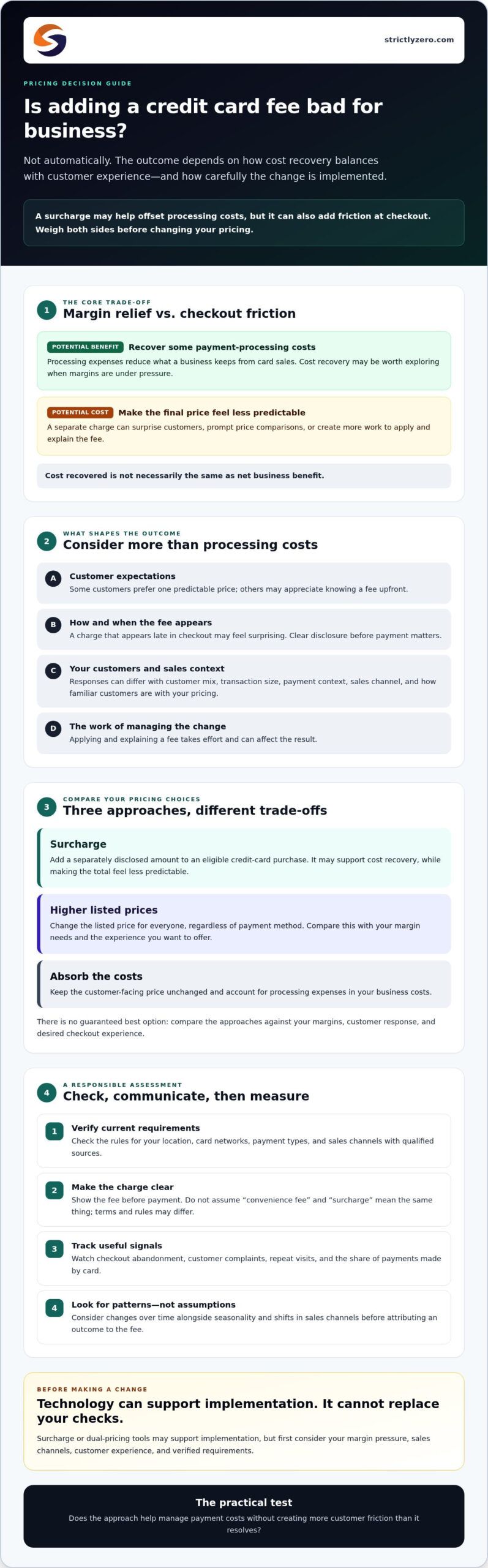
Not automatically. A credit card fee may help recover some payment-processing costs, but its effect depends on customer response and whether the program is implemented correctly. If you’re asking, “is it bad for business to add a credit card fee,” weigh potential margin relief against the friction customers may feel when they see an added charge at checkout.
A credit card surcharge is an additional amount applied to an eligible credit card purchase and shown separately from the base price. That differs from a general price increase, which changes the listed price for everyone, regardless of payment method. A payment surcharge can support cost recovery, but it may also make the total feel less predictable to customers.
For a quick overview of the issue, watch this report:
A surcharge can offset some processing costs, but it can also add friction at checkout. Its business impact depends on both the customer experience and the details of the program. The result may differ by business type, customer mix, transaction size, and payment context. Customers may notice a fee differently on a low-value purchase than on a larger transaction, but their reactions aren’t guaranteed either way.
What does adding a credit card fee mean for a customer?
The customer sees a separate charge added to the amount due, so clear disclosure before payment matters. Don’t assume a “convenience fee” is interchangeable with a surcharge. The terms can refer to different practices, and rules may depend on the payment channel and location. Debit-card transactions may also be treated differently from credit cards. Verify current requirements for your state, card networks, and payment types before making a change.
Why do businesses consider charging a card fee?
Processing expenses reduce the amount a business keeps from each card sale. For a lower-margin business, those costs can put pressure on profitability, making cost recovery worth exploring. Still, a surcharge doesn’t guarantee net savings. Customer response, the business’s payment mix, and the work involved in applying and explaining the fee can all affect the outcome.
Some customers may appreciate knowing the fee upfront; others may prefer a single, predictable price. Consider what customers expect in your setting, then assess whether a separately disclosed fee supports your goals without creating more checkout friction than it resolves.
How a credit card fee can affect customers, sales, and margins
Recovering a payment cost is only one part of the calculation. A surcharge may offset some processing expenses, but the overall result also depends on customer response, how clearly the fee is presented, and the time required to administer the change. The amount recovered isn’t necessarily the same as the net business benefit.
The same fee may help one business protect its margins and hurt another by adding friction where customers expect a simple, all-in price. A business with repeat customers who understand its pricing may get a different response from one where shoppers compare prices before buying. Neither outcome is guaranteed, so measure customer impact rather than assuming it.
Could a credit card fee drive customers away?
It could. A fee that appears late in checkout may surprise customers or prompt them to compare the final price with another seller’s. That risk may be more noticeable when customers are price-sensitive, expect one upfront price, or have an ongoing relationship with the business. Clear communication can reduce confusion, but it can’t ensure every customer will accept the added charge.
Before and after a change, track useful signals such as checkout abandonment, customer complaints, repeat visits, and the share of payments made by card. Look for patterns over time, and consider other factors, such as seasonality or shifts in sales channels, before attributing a change to the fee.
How you present the total matters. The FTC guidance on fee disclosure explains how mandatory fees should be represented in upfront pricing. Review the guidance alongside the rules that apply to your payment method and location. Make sure staff can explain the charge consistently, too. Straightforward answers can help keep a pricing change from becoming a confusing checkout interaction.
When might the fee support business margins?
A fee may support margins when it helps recover eligible processing expenses without creating greater costs through lost sales, extra administration, or changes in customer behavior. Review your processing statements alongside transaction values and gross margins. A percentage that looks small can affect low-margin sales differently from higher-margin ones, and the impact may vary across payment channels.
Include the less visible work in your assessment: updating checkout information, answering questions, and monitoring whether customers change how they pay. If the fee creates confusion or shifts payment behavior, the amount recovered may not translate into a meaningful net benefit.
For businesses comparing implementation approaches, Strictly offers omnichannel payment processing and surcharge and dual-pricing programs. Exploring surcharge and dual-pricing tools may help clarify what implementation support is available. Confirm that any approach fits your business, and verify applicable requirements independently.
Credit card fee, higher prices, or absorbing costs: compare the options
If you’re deciding whether is it bad for business to add a credit card fee, compare it with changing your prices or keeping processing expenses in your budget. Each approach affects customers and margins differently. Dual pricing is another distinct option: customers see different prices based on payment method, such as a displayed non-cash price and a discount for cash. Its rules and setup requirements still need to be checked for your location and payment types.
| Approach | Customer visibility | Potential margin effect | Operational work and verification |
|---|---|---|---|
| Credit card surcharge | A separate fee is added to eligible credit card transactions. | May recover some processing costs, but doesn’t guarantee net savings. | Requires clear communication and checks of current state, card-network, and payment-type requirements. |
| Adjust listed prices | Customers see a higher price regardless of payment method. | May help cover expenses across sales, but changes the price for all customers. | Requires price updates across relevant channels and consideration of competitive positioning. |
| Absorb processing costs | No separate payment fee appears at checkout. | Processing expenses remain with the business and affect its margins. | Usually avoids fee-specific disclosures, but still requires routine cost and margin review. |
When might a surcharge be worth evaluating?
Consider evaluating a surcharge if processing expenses materially affect your margins and customers can see the relevant pricing before they decide to pay. Start by reviewing customer expectations, competitors’ pricing, your sales channels, and transaction patterns. Then verify applicable state and card-network requirements, including how different payment types must be handled. Make those checks a prerequisite, not a last-minute task. A platform may support implementation, but it doesn’t replace your own verification.
When could higher prices or absorbing costs be a better fit?
All-in pricing may suit businesses where a predictable total is central to the customer experience. Raising listed prices spreads the change across customers and payment methods, while absorbing costs preserves current prices but leaves those expenses with the business. Consider whether you want a price change to affect every customer or only particular transactions. The zero-fee credit card processing guide offers another perspective to consider as you compare approaches.
There’s no universal winner. Match the approach to your margin pressure, customer expectations, and ability to manage the operational details. Then monitor the results and reassess if the trade-off isn’t working.
How to assess and introduce a credit card fee responsibly
A careful rollout starts with evidence, not a checkout setting. If you’re weighing whether a fee makes sense, use this process to understand its likely financial effect, check what applies to your business, and prepare customers and staff for the change.
- 1. Calculate your costs. Review processing statements and estimate expenses across transaction sizes, payment types, and sales channels. Separate credit card costs from debit and other payment costs so your analysis reflects what you may actually be able to recover.
- 2. Compare your options. Assess a surcharge alongside adjusted listed prices and absorbing processing costs. Consider each option’s effect on margins, customer experience, and the work needed to maintain it.
- 3. Verify the requirements. Confirm current state requirements, card-network rules, notice obligations, and how debit-card transactions must be treated. Requirements can vary, so check with qualified sources and your payment processor. Don’t assume a rate that works in one place is permitted for your business.
- 4. Prepare your disclosures and setup. Check how the fee will appear before payment, on receipts, and in staff explanations. Review each customer-facing touchpoint, including in-person, online, and mobile checkout. Make sure the processor’s setup, displayed information, and staff procedures are consistent.
- 5. Monitor and reassess. Record a baseline before launch, then compare results after the change. Set a review date and be ready to adjust or reverse the approach if the evidence shows the trade-off isn’t working.
What should a business verify before adding a fee?
Check the rules that apply to your location and payment types, including debit-card treatment and any required notices. Then walk through a sample transaction in each channel. Confirm the checkout display, the amount charged, and how the fee appears on the receipt. Ask your processor how its setup handles these requirements, but don’t treat a platform feature as a substitute for your own verification. Credit card surcharge rules by state can help identify issues to investigate; confirm current requirements with qualified sources.
How can you monitor the impact after launch?
Capture transaction volume, average order value, complaints, and payment mix before making a change. Afterward, review those measures across online, in-person, and mobile sales, and compare customer segments where useful. A single complaint or a short-term dip doesn’t prove the fee caused a problem. Look for patterns and account for other changes in the business.
If you’re evaluating payment tools for a potential rollout, explore Strictly’s surcharge and dual-pricing options. Its Smart Pricing Engine supports state-by-state rules and debit-card detection, but you’ll still need to verify that the setup fits your business and applicable requirements.
A surcharge program may fit, but choose based on your business
Whether a surcharge is worth exploring depends on more than processing costs. Consider how strongly those costs affect your margins, what customers expect at checkout, where you accept payments, and whether you’ve verified the requirements that apply to your business. The answer to “is it bad for business to add a credit card fee” depends on your operating context, not a rule that fits every merchant.
Strictly offers surcharge and dual-pricing programs for businesses to investigate. Its Smart Pricing Engine supports state-by-state surcharge rules and debit-card detection, while its omnichannel payment processing supports online, in-person, and mobile transactions. These capabilities may support implementation, but they don’t guarantee compliance or determine whether a fee is right for your customers. You remain responsible for confirming fit and applicable requirements.
What to ask a payment provider before choosing a program
Bring your actual payment channels and planned approach into the conversation. Ask specific questions about how the program works, what it supports, and what responsibilities remain with your business. For example:
- How does the program detect debit cards and support relevant state-specific rules?
- Which online, in-person, and mobile payment workflows can it support?
- How are checkout disclosures and receipt details handled, and what must your team configure or communicate?
- What reporting is available, and which ongoing compliance checks remain your responsibility?
Request clear answers you can compare with your own requirements. A provider’s tools can assist with implementation, but they aren’t a substitute for checking current rules with qualified sources.
When should you keep evaluating alternatives?
If your customers strongly value one clear, all-in price, a separate fee may not suit their expectations. Compare it with adjusting listed prices or absorbing processing costs using your own transaction and margin data. Consider how each approach affects different payment methods and sales channels, then revisit the decision if customer feedback or performance measures suggest a poor fit.
Before discussing a program with a provider, write down your priorities: the costs you’re trying to address, the channels you use, the customer experience you want, and the rules you need to verify. That preparation can help you assess whether a surcharge or dual-pricing approach fits, or whether another pricing option deserves a closer look.
To review Strictly’s payment processing options and discuss your business’s needs, explore payment processing with Strictly.
Choose a payment approach with confidence
So, is it bad for business to add a credit card fee? Not necessarily. A surcharge may help address processing expenses, but its real impact depends on your margins, customer expectations, payment channels, and how clearly the fee is handled. Compare it with adjusting listed prices or absorbing the costs, then measure what happens rather than assuming the outcome.
Before making a change, verify current requirements for your location, card networks, and payment types. Clear disclosures and a consistent checkout experience can help customers understand what they’ll pay, while regular reviews can show whether the approach still makes sense for your business.
Strictly offers omnichannel payment processing for online, in-person, and mobile transactions, along with surcharge and dual-pricing programs that include debit-card detection. These tools may support implementation, but you’ll still need to confirm that a program fits your needs and applicable requirements.
Ready to explore your options? Explore payment processing options with Strictly and take the next step toward a payment approach that works for your business.
Frequently Asked Questions
Is it legal for a business to charge a credit card fee?
Sometimes, but permission depends on the business’s location, the card network’s rules, and how the fee is applied and disclosed. As of October 2026, Connecticut, Massachusetts, Maine, and Puerto Rico are identified as places where surcharging is prohibited, while other locations may have specific limits. Network rules also restrict the amount. Verify current requirements with qualified sources and your payment processor before introducing a fee.
Can a business charge a fee for debit card payments?
Generally, no. Surcharges on debit and prepaid cards are prohibited nationwide, even if a debit card is processed using the credit option. A payment method’s appearance at checkout doesn’t necessarily reveal how it’s classified for fee rules. Confirm how your processor identifies debit transactions and check current requirements before applying any surcharge. Don’t assume a program intended for credit cards can be applied to debit purchases.
Do customers avoid businesses that add a credit card fee?
Some customers may reconsider a purchase if a fee feels unexpected or makes the total less competitive, while others may accept it when it’s clearly explained. Responses vary by customer, purchase, and business relationship, so there’s no reliable universal answer. If you introduce a fee, monitor complaints, repeat visits, payment mix, and checkout abandonment. Compare results with a baseline rather than relying on a few customer comments.
Will adding a credit card fee hurt sales?
It might, but the effect depends on the fee’s visibility, customer expectations, and the alternatives available. The question “is it bad for business to add a credit card fee” is best answered with your own sales and customer data, not an assumption. Record transaction volume and average order value before a change, then review them across sales channels afterward. Consider other business changes before linking a sales shift to the fee.
What is the difference between a surcharge and a convenience fee?
A surcharge is generally an additional charge applied to eligible credit card transactions. A convenience fee is associated with using a nonstandard payment channel, such as paying a bill online instead of by mail. They aren’t interchangeable labels, and the permitted use of either can depend on the transaction, location, and applicable rules. Before choosing a fee type, confirm the definitions and requirements with your processor and qualified sources.
How should a business disclose a credit card fee?
Make the fee and its effect on the total clear before the customer pays, and check the specific disclosure rules that apply to your business and payment channel. Card-network requirements may include advance notice and clear signage or receipt details. Review each checkout journey, whether online, in person, or mobile, and train staff to explain the charge consistently. Confirm current notice and disclosure obligations with your processor and qualified sources.
Is it better to add a fee or raise prices?
Neither approach is best for every business. A surcharge makes the extra charge visible on eligible transactions, while raising listed prices changes the price across customers and payment methods. Absorbing processing costs keeps checkout simpler but leaves those expenses with the business. Compare the options using your margins, transaction patterns, customer expectations, and applicable requirements. Then monitor the results to see which trade-off works for your business.
Can a small business pass credit card processing fees to customers?
A small business may be able to pass some eligible credit card processing costs to customers through a surcharge, but only if the approach complies with applicable laws and card-network rules. Requirements may limit the amount or require advance notice and clear disclosures. Debit and prepaid card transactions are treated differently from credit cards. Confirm current requirements for your location, processor, and payment types before changing how you price transactions.