
Credit Card Surcharge Rules in 2026: A Merchant Compliance Guide
Published:

A surcharge can comply with one set of rules and still fail another. The credit card surcharge rules 2026 require merchants to consider state law, card-network requirements, and transaction details, not just whether surcharging is allowed where they operate. Debit and prepaid cards can’t be surcharged, and permitted rates may be limited by both network caps and actual processing costs.
It’s understandable to worry about ineligible transactions, notice requirements, and whether fees appear consistently at a register, online, or through another payment channel. A surcharge program is an ongoing transaction workflow, not a one-time legal check. A missing disclosure or an inconsistent checkout can cause problems even when the surcharge amount seems correct.
This guide explains how state restrictions, network rules, advance notifications, checkout disclosures, and receipts fit together. Use the practical checklist to plan a rollout and review differences across locations and payment channels. You’ll also see where tools such as a surcharge engine can support consistent processes, including debit-card detection, while keeping documented merchant review in the workflow.
Key Takeaways
- Apply the credit card surcharge rules 2026 as a combined set of legal, card-network, and processor requirements, rather than relying on a single rules check.
- Classify each jurisdiction’s rules as allowed, restricted, or prohibited, and recheck them when laws or network requirements change.
- Build a rollout checklist that covers eligible transactions, customer disclosures, testing, staff training, and records.
- Keep surcharge information consistent across in-person checkout, online payments, invoices, and receipts.
- Automation can help manage changing rules and detect debit cards, but it should support a documented compliance process, not replace merchant review.
Table of Contents
- Credit Card Surcharge Rules in 2026: Which Requirements Apply?
- Card-Network Surcharge Rules: Caps, Notice, and Debit Cards
- Are Credit Card Surcharges Legal in Every State in 2026?
- How to Set Up a Compliant Credit Card Surcharge
- Keep 2026 Surcharge Compliance Consistent Across Every Channel
Credit Card Surcharge Rules in 2026: Which Requirements Apply?
A credit card surcharge is an added amount charged when a customer pays by credit card, typically to help offset the cost of accepting that payment. Its purpose alone doesn’t determine whether it’s permitted or how it must be handled. The credit card surcharge rules 2026 can involve applicable state law, card-network requirements, and the procedures your processor uses to put those requirements into practice.
For a neutral introduction to the concept, see Surcharge (payment systems). For a jurisdiction-specific overview, consult the 2026 state-by-state surcharge guide alongside the other rules that apply to your transactions.
Here’s a short video that illustrates how surcharges and convenience fees can affect the customer experience:
What counts as a credit card surcharge?
A surcharge is tied to a customer choosing to pay by credit card. A cash discount works in the other direction: the customer pays a lower price when using cash. Dual pricing presents different prices for different payment methods before the customer chooses how to pay. The details of the setup and how it is presented matter. Calling a fee a “convenience fee” or describing a price reduction as a “discount” doesn’t, by itself, determine how the arrangement is treated under law or network rules. Don’t assume that a setup used elsewhere will fit your business.
Which rule layers should merchants check?
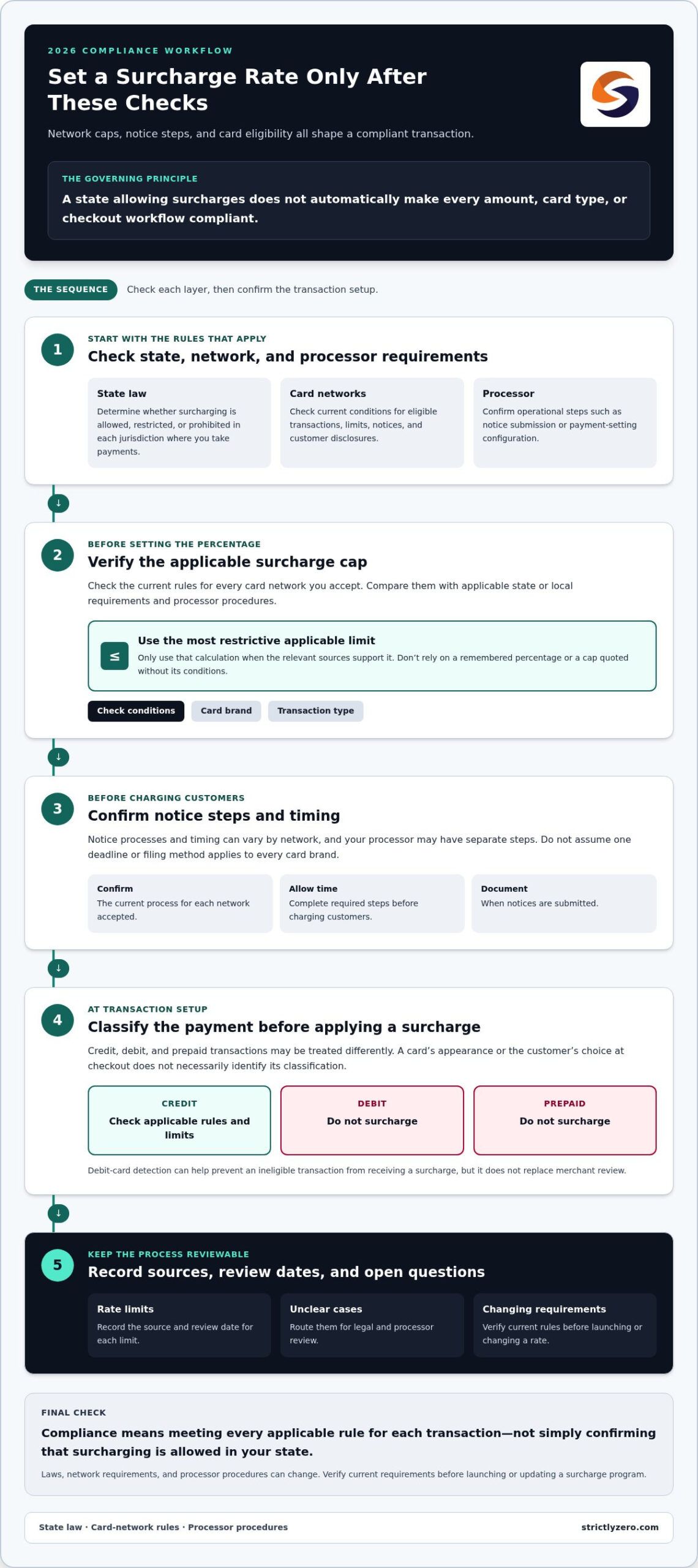
Check each layer separately, then confirm that your process meets all applicable requirements:
- State law: Determine whether surcharging is allowed, restricted, or prohibited in every jurisdiction where you take payments. Rules can differ and change, so use the state guide for location-specific detail.
- Card-network requirements: Networks set their own conditions for surcharges, which may apply even where state law permits them. Check current rules for eligible transactions, limits, notices, and customer disclosures.
- Processor procedures: Your processor may require operational steps, such as submitting notice or configuring payment settings. These procedures don’t replace legal or network obligations, but they can affect implementation.
Surcharge compliance means meeting every applicable rule for each transaction, not simply confirming that surcharging is allowed in your state. This section is general information, not legal advice. Laws, network requirements, and processor procedures can change, so verify current requirements before launching or updating a program.
Card-Network Surcharge Rules: Caps, Notice, and Debit Cards
State law is only one part of a surcharge decision. Card networks set separate conditions for merchants that accept their cards, and processor procedures can add steps for configuring or notifying the payment system. A state may permit surcharging, but that doesn’t automatically mean every surcharge amount, card type, or checkout workflow meets network requirements. For jurisdictional context, the National Conference of State Legislatures summarizes state laws on credit card surcharges.
How should merchants verify surcharge caps?
Don’t rely on a remembered percentage or a cap quoted without its conditions. Before setting a rate, check the current rules for each card network you accept. Then compare them with applicable state or local requirements and your processor’s procedures. More than one rule may limit the permitted amount, so use the most restrictive applicable limit only when the relevant sources support that calculation.
Record the source and review date for each limit. Check for differences by card brand or transaction type, and route unclear cases for legal and processor review. Verify the credit card surcharge rules 2026 against current requirements before launching a program or changing its rate.
What about notice requirements?
Notice processes and timing can vary by network, and there may be separate steps involving your processor. Don’t assume that one deadline or filing method applies to every card brand. Confirm the current process for each network you accept, document when notices are submitted, and allow time to complete required steps before charging customers.
Can a surcharge apply to debit or prepaid cards?
Credit, debit, and prepaid transactions may be treated differently under applicable laws and network rules. A card’s appearance or the customer’s choice at checkout doesn’t necessarily tell you how to classify it. Include debit and prepaid eligibility in your review, and verify how the rules apply to each payment type before configuring a surcharge.
One surcharge setting may not fit every card type, because eligibility and limits can depend on the transaction’s classification and the rules that apply. Debit-card detection can help prevent an ineligible transaction from receiving a surcharge, but it’s an operational control, not a replacement for merchant review. Strictly’s Smart Pricing Engine combines debit-card detection with state-by-state compliance automation to support a documented workflow. Learn about surcharge and dual-pricing tools as part of a broader compliance process.
Are Credit Card Surcharges Legal in Every State in 2026?
No single yes-or-no answer covers every merchant. Whether a surcharge is permitted depends on the laws that apply where you operate or sell, the transaction involved, and applicable card-network requirements. The state-by-state surcharge rules reference can help identify jurisdictions that need closer review. Treat it as a starting point and verify current requirements before acting.
A practical first step is to sort each jurisdiction into one of three categories:
- Allowed: Surcharging may be permitted, subject to applicable laws, network rules, and disclosure requirements.
- Restricted: Surcharging may be possible only under specific limits or conditions, such as rules about the amount, transaction, or customer disclosure.
- Prohibited: A surcharge may not be allowed for the transactions or circumstances covered by the relevant restriction.
Use these categories to organize your review, not as a substitute for checking the rules themselves. A merchant selling online across state lines may need to assess more than its storefront location. The relevant jurisdictions and transaction details matter.
What should merchants verify for their state?
Review current statutes, regulations, and authoritative state guidance for every place where your business operates or takes sales. Look for requirements about signage, checkout disclosures, receipts, eligible transaction types, and other conditions. Record the source, review date, jurisdiction, and conclusions used to configure your payment workflow. This gives your team a clear baseline to revisit when rules change.
What if state rules and network rules differ?
Network permission alone doesn’t establish that a surcharge is legal under state law. Don’t treat a more permissive rule as overriding a stricter applicable restriction. Merchants need to satisfy all requirements that apply to the transaction, including state law and the relevant network’s rules. If the requirements seem inconsistent, or an unusual transaction doesn’t fit the usual guidance, pause that surcharge decision and seek qualified legal guidance.
Use the credit card surcharge rules 2026 as a prompt to verify, not as a permanent answer. Assign responsibility for reviewing each jurisdiction, save the supporting sources, and revisit your assessment when laws, network requirements, or your sales footprint changes. A payment platform with state-by-state compliance automation can support consistent settings, but it doesn’t replace source review or merchant responsibility.
How to Set Up a Compliant Credit Card Surcharge
A reliable rollout connects each compliance decision to the customer’s payment experience. Before launch, document the rules you’ve reviewed, configure which transactions qualify, and test every checkout path where a surcharge might appear. Use this sequence as a working checklist, then revisit it when laws, network requirements, or your payment workflow changes.
- 1. Verify the rules. Review applicable state requirements, card-network rules, and processor procedures for each place you sell and each transaction type you accept.
- 2. Configure eligibility. Set which transactions may receive a surcharge and exclude card types or other transactions that aren’t eligible under the rules you’ve verified.
- 3. Disclose the fee. Show the applicable surcharge before the customer completes payment, using the wording and placement required for that channel.
- 4. Test the workflow. Check the displayed amount and final transaction across the in-person, ecommerce, mobile, payment-link, and invoice experiences you use.
- 5. Train your team. Give staff a consistent, factual explanation of the fee and a process for escalating questions they can’t answer.
- 6. Document and review. Save dated rule sources, notices, settings, test results, and updates so the program can be checked and maintained.
Before launch, verify the applicable rules, eligible card types, surcharge calculation, customer disclosures, checkout behavior, receipt details, staff guidance, and supporting records. Exact disclosure language and placement depend on current requirements, so don’t treat one sign or checkout template as suitable everywhere.
What disclosures should customers see?
Customers should be able to understand the applicable surcharge before they commit to payment. Check how the fee appears on in-store signage and at checkout, as well as in online and mobile payment flows, payment links, and invoices. Confirm required wording, placement, and receipt details against current state and network rules. Keep the message consistent across channels, adapting its format to each customer journey.
How should teams test and document the setup?
Run test transactions for eligible credit cards, debit and prepaid cards, and any excluded cases. Confirm the surcharge calculation, what the customer sees, how refunds are handled, and what appears on receipts. Train employees to describe the fee without promising that a particular setup is legally compliant. Keep dated copies of policies, notices, configuration records, training materials, and test results.
Manual checks can work, but they may be harder to keep aligned across locations and payment channels. Strictly’s Smart Pricing Engine supports state-by-state compliance automation and debit-card detection as part of a documented merchant review process. See how surcharge and dual-pricing tools can support a consistent rollout.
Keep 2026 Surcharge Compliance Consistent Across Every Channel
A compliant setup can drift out of alignment as laws, card-network requirements, processor procedures, or payment workflows change. Treat review as an ongoing control, not a one-time launch task. The credit card surcharge rules 2026 offer a starting point, but your records and settings need to reflect current requirements for every jurisdiction and channel where you accept payments.
What should a recurring compliance review include?
Assign an owner to review the program when a relevant rule or processor procedure changes, and schedule periodic checks as well. A useful review should cover:
- Whether the jurisdictions where you operate or sell have changed, and what current rules apply there.
- Updates to card-network requirements, transaction eligibility, surcharge settings, and customer disclosures.
- Complaints, refunds, and transaction records that may reveal confusing notices, incorrect fees, or inconsistent handling.
Keep a dated record of each review, including the sources checked, decisions made, and any configuration or disclosure changes. This makes it easier to see what changed and why, rather than relying on memory or an undated checklist.
Where can payment automation help?
Manual controls can work, but keeping settings, signs, and checkout flows synchronized across locations and channels takes careful coordination. Automated state-rule handling and debit-card detection can support consistent configuration and help reduce the risk of applying the wrong setting to a transaction. Automation still depends on accurate inputs and current review; it doesn’t transfer compliance responsibility away from the merchant.
Strictly’s Smart Pricing Engine is designed to automate state-by-state compliance and detect debit cards. Strictly’s omnichannel payment processing supports online, in-person, and mobile transactions, helping merchants manage payment workflows across customer touchpoints. For a broader overview, read the credit card processing services guide, and see the zero-fee credit card processing guide for additional payment-model context.
Make your next step a channel-by-channel review: map where customers pay, compare those workflows with your documented rules, and identify settings or disclosures that need attention. An omnichannel payment workflow can support a more consistent surcharge program.
Build a Surcharge Program You Can Keep Current
The credit card surcharge rules 2026 call for more than a quick check of state law. A sound program accounts for applicable laws, network requirements, transaction eligibility, and clear disclosures across every payment channel. Keep dated records of your decisions, test the customer experience, and review your setup as rules or workflows change.
Consistent processes are easier to maintain when payment settings work across online, in-person, and mobile transactions. Strictly’s Smart Pricing Engine supports state-by-state compliance automation and debit-card detection, helping merchants manage key controls while keeping legal review and merchant oversight in the process.
Explore Strictly’s payment processing and surcharge capabilities to see how an omnichannel workflow can support a consistent surcharge program. With clear controls and regular review, you can move forward with greater confidence.
Frequently Asked Questions
Are credit card surcharges legal in all states in 2026?
No. Whether you can surcharge depends on the laws and rules that apply to your business and transactions. State and local requirements can differ or change, and card-network rules and processor procedures also matter. Before launching, review current authoritative sources for every jurisdiction where you accept payments. The credit card surcharge rules 2026 state reference can help you identify where to look, but it isn’t a substitute for checking the rules themselves.
What is the maximum credit card surcharge allowed in 2026?
There isn’t one universal maximum that merchants can safely apply. The permitted amount may depend on current card-network rules, applicable state law, and the merchant’s processing cost. Check both the cap and how it must be calculated for your situation. Avoid relying on a familiar percentage without verifying its conditions, and keep a dated record of the sources and decisions used to set your surcharge.
Can a business surcharge debit card transactions?
Generally, merchants must not apply a credit-card surcharge to debit or prepaid transactions. Federal requirements and card-network rules treat these payment types differently from credit cards. Configure your payment workflow to identify eligible transactions, and test debit and prepaid scenarios before launch. If a transaction’s classification is unclear, don’t apply the fee broadly. Pause and obtain qualified guidance before deciding how to handle it.
Do merchants have to notify Visa or Mastercard before surcharging?
Notification steps and timing depend on current card-network requirements and your processor’s procedures. Don’t rely on an old checklist or assume one submission covers every card brand. Review current official network guidance, identify any required notice and deadline, and document what you submit and when. Complete applicable steps before activating the surcharge, and repeat the review if network or processor procedures change.
What disclosures are required for a credit card surcharge?
Customers generally need clear notice of an applicable surcharge before they pay. Required wording, placement, signage, and receipt details can vary based on jurisdiction and network rules. Review each payment experience separately, including in-person, online, mobile, and invoice payments. Then test the customer journey to confirm the fee is visible before payment is completed and transaction records reflect the required information.
Can a business add a surcharge to online transactions?
Possibly, but online surcharging still requires review of applicable laws, network rules, and processor procedures. Consider which jurisdictions and transaction details affect the sale, then disclose the surcharge clearly before the customer completes payment. Test the checkout notice, displayed amount, final total, and receipt on the devices and payment flows you support. An in-store sign or configuration doesn’t automatically make an ecommerce checkout compliant.
What happens if a merchant breaks surcharge rules?
Consequences depend on the applicable requirements and circumstances; no single outcome is automatic. A violation could lead to customer disputes, card-network action, regulatory scrutiny, or other consequences. Reduce risk by reviewing rules before launch, keeping dated compliance records, training staff, and correcting problems promptly. If you receive a specific complaint or enforcement notice, preserve the relevant records and seek qualified legal advice about how to respond.
How often should a merchant review surcharge compliance?
Review your program when relevant laws, network requirements, processor procedures, or payment channels change, and schedule periodic checks to catch issues between updates. Revisit transaction eligibility, disclosures, customer complaints, refunds, and payment records. Assign an owner and save the date, sources checked, findings, and changes made. Automation, including tools that support state-by-state settings and debit-card detection, can help maintain consistency but doesn’t replace merchant oversight.