
Automated Residual Reporting for ISOs: Scaling Your Payments Business in 2026
Published:

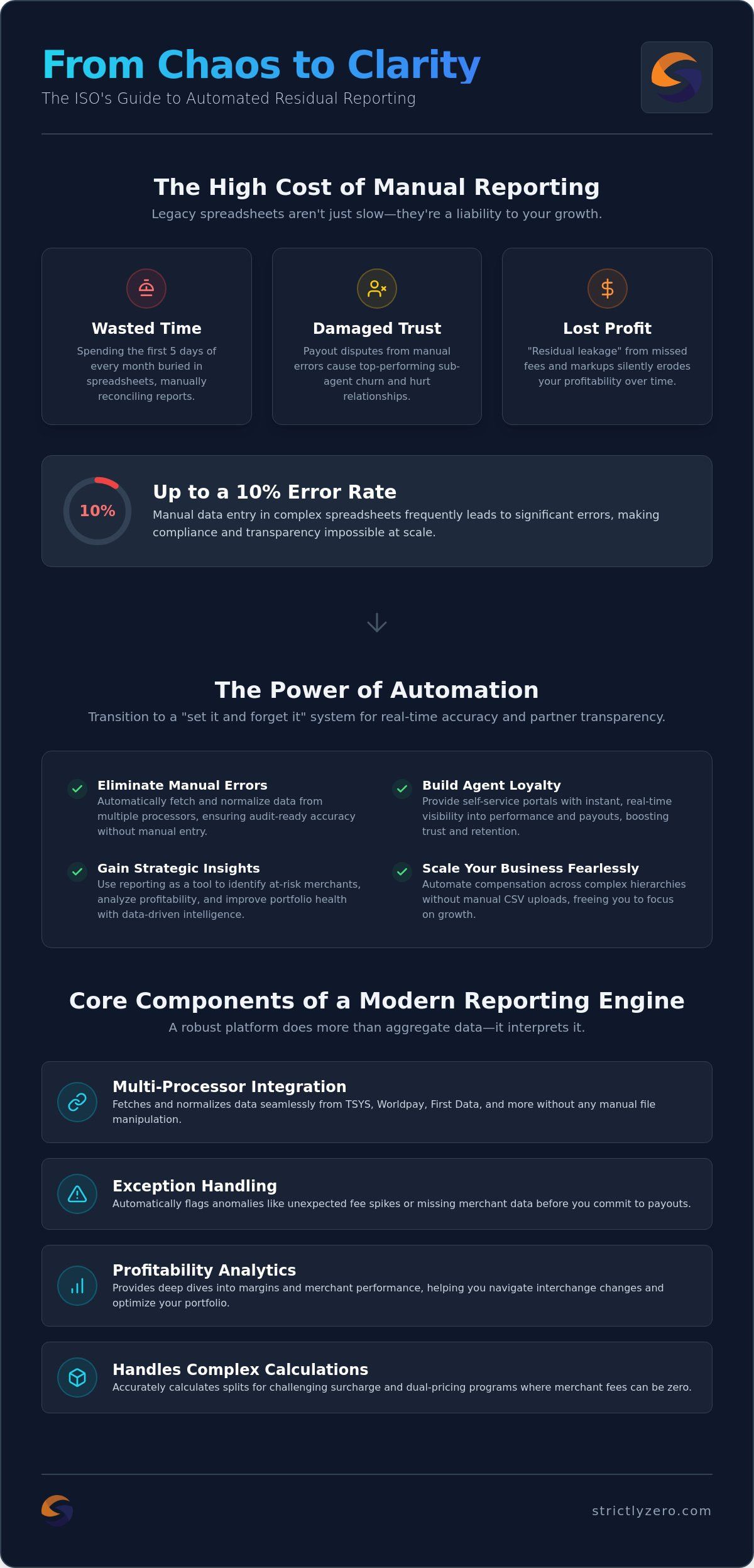
If you’re still spending the first five days of every month buried in complex Excel spreadsheets, you aren’t just losing time. You’re likely losing the trust of your top-performing agents. Manual data entry errors often lead to payout disputes that damage professional relationships and cause sub-agent churn. In a year where the ISO 20022 deadline is mandating stricter data standards and interchange rates are becoming increasingly granular, relying on a manual process is a recipe for stagnation. Implementing automated residual reporting for ISOs is no longer a luxury. It’s the fundamental infrastructure you need to scale your payments business in 2026.
We understand that reconciling processor reports across different surcharge and dual-pricing models feels like a never-ending battle. It’s frustrating to lack clear visibility into your portfolio health or merchant churn until it’s too late to react. This article will teach you how to transition to a “set it and forget it” residual system that offers real-time transparency for your partners. You’ll learn how to automate complex calculations, reduce support tickets, and finally get a clear view of your profitability so you can focus on growth instead of data entry.
Key Takeaways
- Eliminate manual errors by moving away from legacy spreadsheets and adopting a system that automatically fetches and normalizes data from multiple processors.
- See how automated residual reporting for ISOs builds agent loyalty through self-service portals that provide instant visibility into their performance and payouts.
- Learn to navigate the specific calculation challenges of surcharge and dual-pricing programs to ensure accurate splits even when merchant fees are zero.
- Use your residual reporting as a strategic tool to identify at-risk merchants and improve portfolio retention through data-driven insights.
- Scale your business by integrating partner management tools that automate compensation across complex hierarchies without the need for manual CSV uploads.
Table of Contents
- What is Automated Residual Reporting for ISOs?
- Key Features Every Automated Residual System Needs
- Solving the Complexity of Surcharge and Dual Pricing Residuals
- Strategic Growth: Linking Residuals to Retention Intelligence
- Scaling with Strictly’s ClearSplit™ Infrastructure
What is Automated Residual Reporting for ISOs?
Automated residual reporting for ISOs is a software-driven process that fetches, normalizes, and calculates merchant processing commissions without the need for manual intervention. It acts as the critical bridge between the raw, often messy data provided by a payment processor and the final, actionable compensation statements for your agents. By pulling data directly through APIs or secure file transfers, these systems eliminate the human error inherent in legacy workflows.
We’ve officially moved past the “spreadsheet era.” For decades, ISOs managed their books using complex Excel macros, but manual data entry frequently leads to error rates as high as 10%. In a high-volume payment processing environment, maintaining compliance and transparency is impossible if your data is prone to typos or formula breaks. Implementing automated residual reporting for ISOs ensures that your reporting remains audit-ready and accurate, regardless of how many thousands of transactions pass through your portfolio.
To better understand why this transition is so important for your business, watch this helpful video:
The Shift from Manual to Automated Systems
Manual reconciliation often becomes a crippling bottleneck once an ISO grows beyond its first 50 merchants. When you’re small, you can catch errors by hand, but scaling requires a different approach. Without automation, you face the constant risk of “residual leakage,” where specific fees or markups are missed during the calculation process. This isn’t just about losing a few dollars; it’s about the cumulative loss of profit over months of miscalculated reports. Transitioning to automated residual reporting for ISOs provides a single source of truth for owners, allowing you to identify exactly which merchants are profitable and which are costing you money.
Core Components of a Modern Reporting Engine
Key Features Every Automated Residual System Needs
Not all reporting tools are built the same. To scale effectively, you need a system that does more than just aggregate data; it needs to interpret it. A robust platform for automated residual reporting for ISOs should eliminate manual CSV uploads entirely. Instead, it should pull data directly from back-end processors, ensuring your numbers are fresh and accurate every morning. Successfully implementing automated residual reporting for ISOs allows you to stay ahead of interchange changes and regulatory updates without increasing your administrative headcount.
- Multi-Processor Integration: Fetches data seamlessly from various backends without the need for manual file manipulation.
- Exception Handling: Automatically flags anomalies, such as unexpected fee spikes or missing merchant data, before you commit to payouts.
- Profitability Analytics: Provides deep dives into margins, which is vital as the Visa/Mastercard settlement reduces average interchange rates by 0.10% for five years starting in 2025.
- Automated ACH Payouts: Streamlines the final step of the process, ensuring agents are paid on time while adhering to 2026 Nacha fraud detection rules.
The Importance of Multi-Processor Agility
Every backend provider has a unique way of presenting data. One might list a fee as an “Auth Fee” while another calls it a “Transaction Surcharge.” Without an agile system, you’re stuck doing “apples to apples” comparisons by hand. Automation normalizes these structures, reducing the technical debt of maintaining custom API connections. This agility helps you manage the 0.14% Visa credit assessment fee and the 0.1375% Mastercard fee without getting bogged down in the math. ISOs using Partner Management Tools can bypass these technical hurdles and focus on portfolio growth instead of data entry.
Transparency Through Agent Dashboards
Nothing kills agent morale faster than a vague commission statement. Modern systems provide self-service dashboards where agents can track their own performance in real-time. This visibility drastically reduces “where is my money” support tickets and builds long-term loyalty. When agents see itemized splits and manage their own sub-portfolios, they feel like partners rather than just contractors. This level of transparency is essential for maintaining a healthy sales force. It also ensures compliance with the November 2026 ISO 20022 deadline, which mandates structured address formats for all payment data. By providing clear, compliant reporting, you position your ISO as a professional, forward-thinking leader in the space.
Solving the Complexity of Surcharge and Dual Pricing Residuals
Surcharge and dual pricing programs have revolutionized the industry, but they’ve also made residual math significantly more difficult. In a standard model, you simply subtract interchange from the merchant’s markup. In a surcharge environment, the cardholder covers the processing cost. This means your “net revenue” is the spread between the surcharge collected and the wholesale processing costs. Managing these inverted splits is where most legacy systems fail; it makes automated residual reporting for ISOs a necessity rather than an upgrade. Without a specialized Surcharge & Dual Pricing Engine, your team is left to manually reconcile thousands of micro-transactions to find the true margin.
Beyond just calculating payouts, your reporting system should act as a business intelligence tool. By analyzing your data, you can identify whether surcharge or dual pricing models are driving higher margins for your specific merchant mix. For instance, you might find that certain high-ticket industries respond better to dual pricing, which often leads to lower churn. Tracking these trends through automated residual reporting for ISOs allows you to guide your sales team toward the most profitable and sustainable pricing strategies. It’s about knowing which pricing models are actually growing your bottom line.
Automating the $0 Processing Fee Model
When a merchant utilizes zero fee credit card processing, their monthly statement might show a zero balance, but the ISO still needs to calculate agent splits from the collected surcharge revenue. Automation ensures agents see exactly how these splits work. It provides clarity on the profitability of each merchant, helping sales teams understand that a “zero fee” account can often be more lucrative than a traditional one. A modern system tracks the impact of these programs on merchant retention and volume, ensuring you aren’t sacrificing long-term portfolio health for short-term gains.
Compliance Reporting for Surcharges
State-by-state regulations remain a moving target in 2026. Some jurisdictions cap surcharge percentages or require specific receipt disclosures. A modern reporting engine should flag transactions that don’t align with these rules. This proactive approach reduces the risk of expensive clawbacks or regulatory fines from the card networks. By maintaining a clean audit trail for every surcharge split, you protect your portfolio’s long-term value and maintain trust with your merchants. This level of oversight is impossible to achieve with spreadsheets, especially as you scale into new geographic markets with varying legal requirements.
Strategic Growth: Linking Residuals to Retention Intelligence
Most ISO owners view their monthly reports as a rearview mirror. They look at what happened last month to see how much they owe their agents. However, treat automated residual reporting for ISOs as a dashboard for the road ahead. If you only look at residuals to calculate payouts, you’re missing the early warning signs of merchant attrition. A 2% dip in volume might look like a seasonal fluctuation on a spreadsheet, but when cross-referenced with historical data, it often signals that a merchant is testing a competitor. Using tools like ChurnIQ™ allows you to identify these at-risk accounts before the cancellation notice arrives on your desk.
By linking your financial reporting to retention intelligence, you transform your back office into a proactive sales support center. When your system flags a declining residual trend, it gives your agents a reason to pick up the phone and save the account. This proactive approach is essential in 2026, where card networks are introducing more detailed transaction categories that can confuse merchants and lead to dissatisfaction. Empowering your team with real-time data ensures they can explain these changes and reinforce the value of your partnership. It’s about shifting the conversation from cost to value before a competitor does.
Predictive Analytics in Residual Reporting
Modern reporting engines use predictive analytics to spot “red flag” volume drops across your entire portfolio. Instead of waiting for the end of the month, the system can trigger automated alerts the moment a key merchant’s processing activity deviates from their norm. This allows agents to intervene immediately. These systems also help you forecast future growth by analyzing historical trends, making it easier to plan for seasonal shifts or upcoming interchange updates. If you want to protect your margins, you need to partner with a processor that prioritizes these advanced management tools.
Maximizing Lifetime Value (LTV)
Retention is only half the battle; the other half is knowing where to focus your acquisition efforts. High-performance reporting shows you which industry verticals provide the most consistent residuals and the lowest churn rates. By integrating this data with your CRM, you get a holistic view of your portfolio’s health. You might discover that while retail merchants have high volume, your B2B accounts offer better long-term stability by utilizing Level 2 and Level 3 data to qualify for lower rates. This insight allows you to steer your sales force toward high-margin, stable categories that maximize the lifetime value of every contract signed. Using automated residual reporting for ISOs to guide your strategy ensures you aren’t just growing fast, but growing smart.
Scaling with Strictly’s ClearSplit™ Infrastructure
Scaling a payments business in 2026 requires more than just a large sales team; it requires an infrastructure that can handle the weight of your success. ClearSplit™ is designed to be that foundation. By providing automated residual reporting for ISOs, it removes the friction that usually slows down growth. When you reduce administrative overhead by 90%, you free up your leadership team to focus on high-level strategy instead of chasing down missing pennies in a CSV file. This efficiency is vital as you navigate the 2026 ACH rule changes, which mandate enhanced fraud detection and standardized entry descriptions for payroll and purchase transactions.
The real value of ClearSplit™ lies in the trust it builds between you and your partners. In an industry where agent churn is often driven by payout disputes, providing a transparent, real-time view of earnings is your greatest retention tool. By integrating automated residuals with a unified payment processing platform for ISOs, you aren’t just buying software; you’re investing in a professional reputation. You become the tech-forward leader that top agents want to work for, especially as the November 2026 ISO 20022 deadline makes legacy, unstructured reporting formats obsolete.
The ClearSplit™ Advantage
Complex partner hierarchies often involve multiple sub-agents, managers, and referral partners. ClearSplit™ handles these multi-layered calculations automatically, ensuring that every split is accurate down to the cent. Because it integrates directly with Strictly’s omni-channel gateway, the data is always fresh. This creates a seamless lifecycle from the moment a new agent is onboarded to the moment their first residual hits their account. You don’t have to worry about manual errors in surcharge splits or dual-pricing markups; the system manages the math so you can manage the relationship.
Next Steps: Moving to an Automated Future
Transitioning your existing portfolio into an automated system doesn’t have to be a multi-month project. Start by migrating your most complex agent groups first to see the immediate time savings. Once your data is normalized within the automated residual reporting for ISOs workflow, focus on training your agents to use the transparency tools. Showing them how to track their own performance through their portal reduces support volume and empowers them to manage their sub-portfolios more effectively. If you’re ready to leave the spreadsheet era behind and build a more resilient business, schedule a demo of Strictly’s partner platform today and see how we can help you scale with confidence.
Future-Proof Your ISO with Intelligent Automation
The payments industry is evolving too fast for legacy spreadsheets to keep up. Scaling your business in 2026 requires a shift from reactive math to proactive portfolio management. By implementing automated residual reporting for ISOs, you eliminate the risk of manual errors and residual leakage while building a foundation of trust with your sales force. You aren’t just saving time; you’re gaining the visibility needed to identify churn before it happens and manage complex surcharge splits with total accuracy.
Strictly provides the tools you need to stay ahead of regulatory changes and card network updates. With ClearSplit™ automated compensation and the ChurnIQ™ retention intelligence system, you can focus on high-level growth instead of monthly administrative headaches. Our state-by-state surcharge compliance engine ensures your revenue remains protected and audit-ready. Don’t let manual processes hold your portfolio back from its full potential.
Partner with Strictly: Scale Your Payments Business with Automated Residuals
The transition to automation is the single most important step you can take to secure your ISO’s future. We’re here to help you build a smarter, more transparent payments business that agents are proud to represent. Your path to a more efficient and profitable portfolio starts today.
Frequently Asked Questions
How long does it take to implement automated residual reporting?
Most ISOs can complete the transition to an automated system within two to four weeks. The exact timeline depends on the number of processor integrations required and the complexity of your current agent hierarchies. Platforms that offer direct API connections usually speed up the process by eliminating the need for custom data mapping and manual file testing.
Can I use automated reporting with multiple different payment processors?
Yes, modern systems are designed to normalize data from various back-end providers into a single, unified view. You can aggregate reports from TSYS, Worldpay, and First Data without manually merging spreadsheets. This capability is the core benefit of automated residual reporting for ISOs, as it allows for “apples to apples” comparisons across your entire portfolio.
Is automated residual reporting secure for sensitive financial data?
Security is a fundamental component of these platforms, which typically utilize bank-level encryption and adhere to SOC 2 compliance standards. These systems protect sensitive merchant information and financial records during both transmission and storage. Multi-factor authentication and granular access controls ensure that only authorized personnel can view specific payout data or agent details.
How does automation handle residual clawbacks from merchants?
Automation manages clawbacks by identifying negative residuals from processor reports and automatically applying them to the correct agent’s balance. If a merchant cancels or a transaction is reversed, the system calculates the impact across the entire hierarchy. This ensures your payouts remain accurate and prevents the administrative headache of manually chasing down overpayments from previous months.
What is the cost of residual management software for a small ISO?
Pricing for these tools usually scales based on your merchant count or the total processing volume of your portfolio. While costs vary between providers, many offer entry-level tiers specifically for smaller ISOs looking to professionalize their operations. You should check with specific vendors for a quote that aligns with your current scale and growth projections for 2026.
Does automated reporting help with agent recruitment and retention?
Providing professional dashboards is one of the most effective ways to attract and keep high-performing agents. Top-tier sales professionals prefer automated residual reporting for ISOs because it offers real-time transparency and eliminates the “trust gap” often caused by vague commission statements. Accurate, on-time payouts significantly reduce the friction that typically leads to agent churn.
How does automated reporting handle surcharge-based pricing models?
Specialized reporting engines calculate the margin between the surcharge collected from the cardholder and the wholesale cost of the transaction. The software automatically applies your specific split logic even when the merchant pays zero in fees. This ensures that agents are paid correctly on complex dual-pricing accounts without the need for manual calculations or error-prone spreadsheet work.
Can I automate ACH payouts directly from the reporting dashboard?
Many modern platforms integrate directly with banking networks to allow for one-click ACH transfers. Once you review and approve the monthly residual totals, the system can trigger payments to your entire agent network simultaneously. This feature helps you stay compliant with the 2026 Nacha fraud detection rules while drastically reducing the time spent on manual data entry at your bank.