
Best 2026 Online Credit Card Platforms: Merchant Guide
Published:

What if the “cost of doing business” didn’t actually have to include those mounting transaction fees? Most merchants accept that losing 3% or more of every sale is just part of the game, but by 2026, that’s no longer the case. Finding the best platforms for accepting credit cards online 2026 means looking beyond basic processing to find systems that actually protect your margins. You’ve likely felt the sting of high fees eating into your profits while struggling to keep up with complex PCI DSS requirements and fragmented sales data across different channels.
It’s frustrating to watch your hard earned revenue disappear into a black hole of processing costs. This guide will show you how to choose a platform that offers more than just a checkout button. We’ll explore how the latest AI driven fraud prevention and omni-channel tools can streamline your operations. You’ll discover the top payment solutions for 2026 and learn how to use smart pricing engines to eliminate processing fees entirely, ensuring your business stays profitable and compliant in an evolving market.
Key Takeaways
- Learn why traditional fee structures are outdated and how protecting profit margins has become the top priority for modern merchants.
- Identify the essential omni-channel features and security protocols that define the best platforms for accepting credit cards online 2026.
- Understand how compliant surcharge and dual pricing models allow you to pass on processing costs to reach $0 in transaction fees.
- Compare industry giants against high-margin alternatives to find a unified system that manages web, mobile, and virtual terminal sales.
- Discover how automated state-by-state compliance tools and API-first architecture help your business scale without manual regulatory tracking.
Table of Contents
- The 2026 Payment Landscape: Why Margin Protection is the New Priority
- Essential Features for Online Credit Card Acceptance in 2026
- Comparing the Top 5 Platforms for Online Credit Card Processing
- The Zero-Fee Revolution: How Surcharging Redefines 'Best' in 2026
- Scaling with Strictly: The Future-Proof Platform for Modern Merchants
The 2026 Payment Landscape: Why Margin Protection is the New Priority
E-commerce looks different than it did just a few years ago. High transaction fees that once felt like a minor inconvenience have become a massive drain on business health. Standard 2.9% rates are no longer sustainable when margins are already squeezed by inflation. A modern payment service provider must do more than just move money; it must actively protect your bottom line. Merchants have realized that losing a slice of every sale to processing costs is a barrier to true growth.
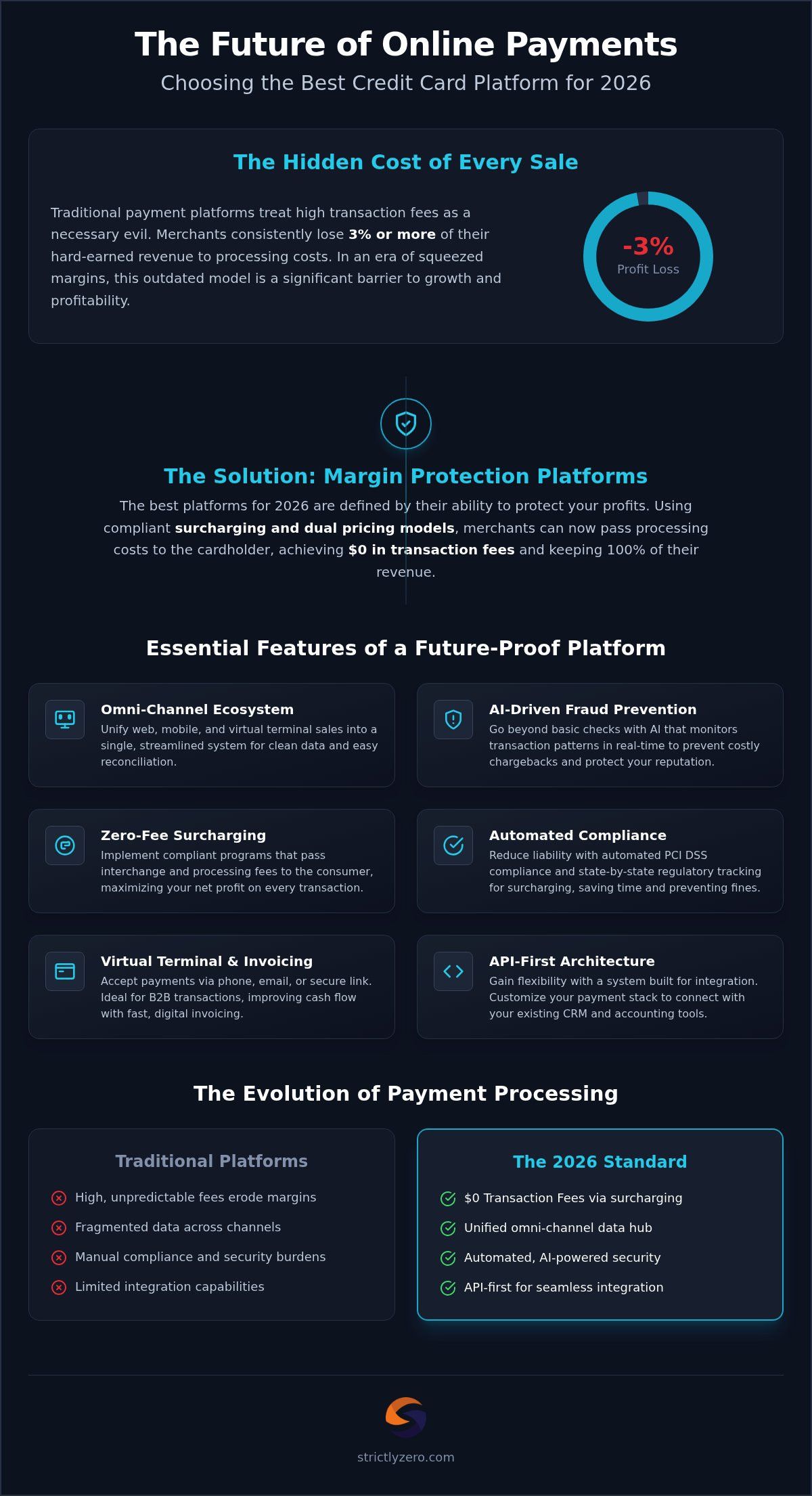
What defines the best platforms for accepting credit cards online 2026? It isn’t just about the fastest setup or the slickest user interface. The “best” platform is now defined by its ability to offer margin protection through compliant surcharging and dual pricing. Merchants are shifting away from simple gateways toward comprehensive omni-channel ecosystems that unify web, mobile, and virtual terminal data. This shift ensures that every dollar earned is a dollar kept, rather than a dollar taxed by outdated fee structures.
The True Cost of Online Credit Card Processing
Every transaction carries three main costs: interchange fees paid to the bank, assessment fees for the card network, and the processor’s markup. Flat-rate pricing models often hide the fact that the processor is taking a significant cut on every swipe. This lack of transparency makes it hard to scale. As your volume grows, those small percentages turn into thousands of dollars in lost profit. Transitioning to a zero-fee model by passing these costs to the cardholder is becoming the standard for businesses that want to stay competitive and maximize their net profit.
Emerging Trends in 2026 Payment Tech
Technology has caught up to the needs of the merchant. AI-driven fraud prevention is no longer a luxury; it’s a baseline requirement to prevent costly chargebacks and protect business reputation. We’re also seeing a massive move toward API-first platforms. Developers and business owners want systems they can customize and integrate without fighting outdated code. The goal for the best platforms for accepting credit cards online 2026 is a single, unified view of all sales channels. This ensures that whether a customer pays via an online invoice or a mobile link, your data remains clean and your compliance is automated.
Essential Features for Online Credit Card Acceptance in 2026
The best platforms for accepting credit cards online 2026 have moved beyond basic payment processing. They now act as central hubs for business operations. To stay competitive, you need a system that handles omni-channel sales effortlessly. This means your web store, mobile app, and back-office virtual terminal all share the same data and security protocols. When your systems talk to each other, you spend less time on manual reconciliation and more time growing your brand.
Flexibility is a core requirement for any modern merchant. Your platform should integrate with your current tech stack, from CRM software to accounting tools. It should also support modern business models through robust recurring billing and subscription management. If your processor doesn’t offer these automated features, you’re likely working harder than you need to. Modern systems simplify the complex so you can focus on the customer experience, and you can explore Monthly Recurring Subscription Fees for Hosting Infrastructure to ensure your back-end costs remain just as streamlined.
The Virtual Terminal Advantage
Not every sale happens on a traditional checkout page. A virtual terminal gives you the power to accept credit card payments in-store and online using nothing more than a web browser. You can send secure payment links to clients or process phone orders in seconds. This is especially useful for B2B transactions where digital invoicing speeds up the payment cycle and improves cash flow. It’s about meeting your customers where they are, whether that’s in their inbox or on their mobile device.
Compliance and Security Automation
Security is a baseline, not a feature. The best platforms for accepting credit cards online 2026 automate PCI DSS compliance to significantly reduce your liability. They use tokenization to ensure sensitive data never touches your servers. Beyond basic theft, you need protection from sophisticated fraud. AI-driven fraud prevention monitors patterns in real-time, catching suspicious activity that simple CVV checks miss. This proactive approach saves you from the headache of chargebacks and lost inventory.
Legal compliance is just as critical, particularly if you choose to pass on processing fees. Because laws vary by region, a built-in state-by-state compliance engine is vital. You can consult the Credit or Debit Card Surcharges Statutes to see how complex these regulations can be. Automating this process ensures you stay within the law while protecting your margins. If you’re ready to modernize your workflow, you can explore omni-channel solutions that prioritize your profit and security.
Comparing the Top 5 Platforms for Online Credit Card Processing
Choosing between the big names and emerging leaders requires a clear understanding of your long term goals. While many merchants default to household names, the best platforms for accepting credit cards online 2026 are those that offer transparency and margin control. You have to weigh the convenience of a quick setup against the cumulative cost of transaction fees that eat your profits over time. Reliability is key, which is why “Trust as a Payment Processor” has become a non-negotiable standard for businesses that can’t afford downtime or surprise account freezes.
The best platforms for accepting credit cards online 2026 must offer more than just a gateway; they must offer a path to zero processing costs. When comparing options, look at how each handles various fee structures. Flat rate pricing is simple but often the most expensive for high volume sellers. Interchange plus is more transparent but fluctuates. The emerging gold standard is the zero fee model, which uses smart engines to offset costs entirely.
The Legacy Giants: Square and PayPal
Incumbent processors are often praised for their brand recognition and simple interfaces. However, their flat rate fee structures can become a significant burden as your sales volume increases. Square offers a powerful ecosystem for those who need hardware, but many wonder if it truly provides the best credit card processing for small business online when profit margins are tight. PayPal remains a popular choice for customer trust, yet their higher rates and complex dispute processes often frustrate sellers who want more control over their revenue. These legacy processors prioritize their own ease of use over your bottom line.
Modern Alternatives: The Zero-Fee Contenders
A new wave of platforms is redefining what merchants should expect from a processor. Instead of accepting a standard loss on every swipe, businesses are turning to zero fee credit card processing models. Strictly stands out as a high margin alternative by offering a Smart Pricing Engine that handles dual pricing and surcharging automatically. This ensures you stay compliant with federal regulations on credit card fees without having to track state by state changes yourself.
These modern platforms provide several advantages over big tech giants:
- Automated Compliance: Systems that adjust to local laws in real time.
- Margin Protection: The ability to pass on processing costs to reach $0 in fees.
- API-First Logic: Building custom payment experiences with the same ease as legacy tools but with better financial outcomes.
- Omni-Channel Support: Unified data across web, mobile, and virtual terminals.
By moving away from processors that treat your revenue as their profit source, you can reinvest those saved fees back into your business growth. The shift toward these margin focused platforms represents the most significant change in the 2026 payment landscape.
The Zero-Fee Revolution: How Surcharging Redefines ‘Best’ in 2026
Surcharging has moved from a niche practice to a mainstream business strategy. In 2026, the best platforms for accepting credit cards online 2026 don’t just facilitate transactions; they eliminate the overhead associated with them. By implementing a surcharge or dual pricing model, you can pass the cost of processing directly to the cardholder. This isn’t about cutting corners. It’s about maintaining a sustainable business model in an era where card networks continue to raise their interchange rates. When you stop paying for your customers’ rewards points, your profit margins finally have room to breathe.
Consumer behavior has shifted alongside these technological changes. Shoppers are now accustomed to small convenience fees in various industries, from travel to food delivery. Most customers are willing to pay a small percentage to use their preferred credit card, especially when they understand it helps keep the base prices of your products or services lower. The financial impact of moving to a $0 processing fee model is immediate. For many merchants, this shift represents a 3% to 4% increase in net profit, which can be the difference between stagnating and scaling your operations.
Smart Pricing Engines and Debit Detection
The biggest challenge with surcharging is staying within the law. Federal regulations are clear: you cannot surcharge debit cards, even when they’re processed as credit. Attempting to do this manually is a recipe for legal trouble. Modern platforms solve this with a smart pricing engine that identifies the card type in real-time during the checkout process. If a customer enters a debit card number, the system automatically suppresses the surcharge. This ensures you remain compliant without having to train your staff or monitor every transaction yourself.
Transitioning to a Zero-Fee Model
Switching to a zero-fee model doesn’t have to alienate your loyal customer base. The key is clear communication and transparency. Most businesses find success by framing the change as a way to avoid raising prices across the board. You can use a zero fee merchant services approach to offer dual pricing. This presents the customer with two clear options: a lower price for cash or debit and a slightly higher price for credit. This gives the power of choice back to the consumer while protecting your bottom line.
If you’re ready to stop losing money on every swipe, you can start using a compliant surcharge engine today to reclaim your revenue and simplify your operations.
Scaling with Strictly: The Future-Proof Platform for Modern Merchants
Strictly isn’t just another name in a crowded market; it’s the partner merchants need to scale without friction. In the search for the best platforms for accepting credit cards online 2026, Strictly stands out by prioritizing the merchant’s net profit over transaction volume. It’s built on an API-first architecture. This allows businesses to create custom, seamless checkout experiences without the heavy lifting often required by legacy code. By choosing a platform that values transparency and margin protection, you position your business to thrive even as card network costs rise.
Beyond simple payment processing, Strictly provides deep business intelligence tools that legacy giants often overlook. Tools like ChurnIQ™ provide real-time insights into merchant retention, helping you understand customer loyalty patterns before they impact your bottom line. Meanwhile, ClearSplit™ automates the complex task of partner compensation. These features aren’t just add-ons. They are essential components for any business looking to optimize operations and keep more of its hard earned revenue in 2026.
Unified Omni-Channel Control
Managing multiple sales streams shouldn’t be a fragmented nightmare. Strictly provides a single, intuitive dashboard to oversee web, mobile, and virtual terminal sales. This unified approach is a critical component of modern credit card processing services. You get AI-driven data that helps you understand customer behavior across all channels simultaneously. This visibility allows you to make informed decisions about inventory, marketing, and expansion without digging through multiple disconnected systems. It’s about having total control over your financial data in one place.
Partnering for Success: ISOs and Developers
For those building the financial infrastructure of the future, Strictly is the ultimate payment processing platform for ISOs. Independent Sales Organizations can finally offer their merchants a zero-fee model that actually works, backed by a state-by-state automated compliance engine. ClearSplit™ handles the complex math of revenue sharing automatically, ensuring partners are paid accurately and on time. Developers also gain a significant edge. Using Strictly’s robust API for enterprise integrations means you can build faster and more reliably. It’s a system designed for growth, built on a foundation of trust and technological superiority. As you evaluate the best platforms for accepting credit cards online 2026, look for the one that empowers your partners as much as your customers.
Take Control of Your Business Margins in 2026
The payment landscape has shifted toward radical transparency and margin protection. By now, it’s clear that the best platforms for accepting credit cards online 2026 are those that empower you to keep more of your revenue. You’ve seen how legacy processors often prioritize their own transaction volume over your bottom line. Transitioning to a model that utilizes automated surcharging and omni-channel integration isn’t just a technical upgrade; it’s a strategic move to protect your business from rising costs.
Success in 2026 requires a system that handles state-by-state compliance and fraud prevention without manual effort. You can finally stop viewing processing fees as an unavoidable expense. With a Smart Pricing Engine and an API-first infrastructure, you can unify your sales channels while reaching $0 in processing costs.
Ready to transform your financial outlook? Eliminate your processing fees today with Strictly’s Zero-Fee Platform. Our infrastructure is trusted by ISOs and high-volume merchants to provide 100% compliant, omni-channel solutions. It’s time to stop paying for your customers’ rewards and start reinvesting in your own growth. Your more profitable future is just one integration away.
Frequently Asked Questions
What is the best platform for accepting credit cards online in 2026?
The ideal platform depends on your specific business goals, but Strictly is the top choice for merchants prioritizing margin protection. Unlike legacy processors that charge high flat rates, Strictly offers a Smart Pricing Engine that allows you to reach $0 in processing costs. When evaluating the best platforms for accepting credit cards online 2026, you should look for omni-channel support, API-first architecture, and automated compliance tools that protect your profit.
Can I really eliminate credit card processing fees entirely?
Yes, you can eliminate fees by utilizing a compliant surcharge or dual pricing model. These programs pass the transaction cost directly to the cardholder, meaning you receive the full purchase price of your goods or services. Modern platforms automate this entire process, ensuring that your business no longer has to absorb the 3% or 4% hit on every credit sale. This shift allows you to reinvest those savings back into your business growth.
Is it legal to pass credit card fees to the customer in every state?
Surcharging is legal in the vast majority of states, though specific regulations vary by jurisdiction. Some states have historically restricted these practices, so it’s vital to use a platform with a built-in compliance engine. These systems track state-by-state statutes in real-time, automatically adjusting your checkout process to ensure you stay within legal boundaries while protecting your profits. Always check local regulations to ensure your specific business model remains compliant.
What is the difference between surcharging and dual pricing?
Surcharging adds a specific percentage fee to credit card transactions at the point of sale. Dual pricing displays two different prices for every item: a lower price for cash or debit and a slightly higher price for credit. While both help you reach $0 in fees, dual pricing is often preferred in certain regions because it provides clear transparency and choice to the consumer. Both models are supported by modern smart pricing engines.
Do I need a separate merchant account for my online store?
You don’t necessarily need a separate account if you use an omni-channel platform that unifies all sales data. Modern systems allow you to manage online, mobile, and virtual terminal sales through a single dashboard. This streamlined approach simplifies your accounting and gives you a holistic view of your business performance without the headache of managing multiple processor relationships or fragmented reporting. It’s a more efficient way to handle diversified sales.
How long does it take to set up a zero-fee payment platform?
Most modern platforms offer quick integration, often taking only a few business days to fully activate. Because these systems are API-first, they can be integrated into your existing tech stack without a massive technical overhaul. Once your account is approved, the automated surcharge engine and AI-driven fraud prevention tools begin working immediately. This allows you to start saving on fees with your very next transaction without long delays.
What happens if a customer pays with a debit card on a surcharge platform?
Federal law prohibits surcharging on debit cards, regardless of whether they are processed as “credit” transactions. A smart pricing engine will detect the card type the moment the customer enters their number during checkout. If it’s a debit card, the surcharge is automatically suppressed. This ensures you maintain 100% compliance with card network rules and federal regulations without needing to manually inspect every card or train your staff on complex rules.
Are online credit card processing platforms secure enough for 2026 fraud trends?
Leading platforms now use AI-driven fraud prevention to stay ahead of increasingly sophisticated threats. When searching for the best platforms for accepting credit cards online 2026, ensure they offer tokenization and automated PCI compliance. These features ensure that sensitive data never touches your servers, significantly reducing your liability. Proactive monitoring catches suspicious patterns in real-time, protecting your business from the financial and reputational damage caused by data breaches and chargebacks.