
Best POS Lending Providers in 2026: A Merchant’s Guide to Boosting Sales
Published:
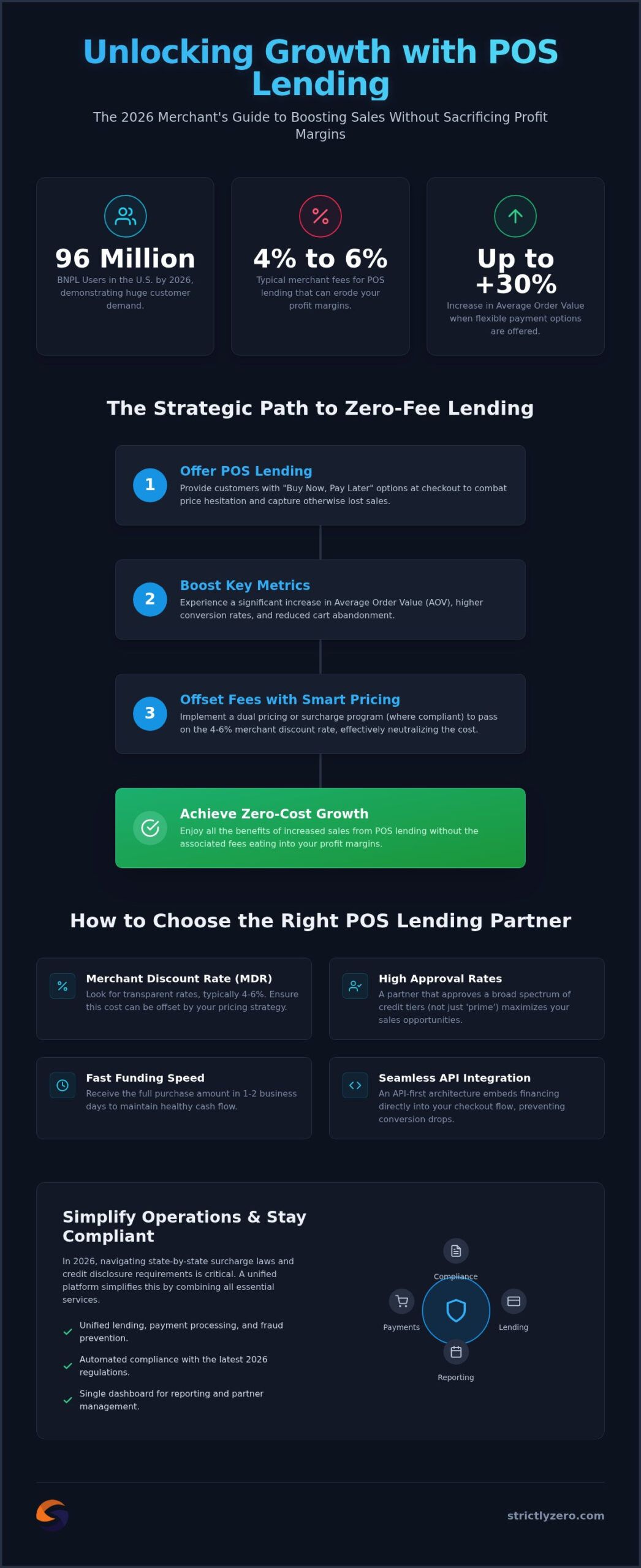
What if the very tool you’re using to boost sales is actually quietly eroding your profit margins? Most merchants realize that offering flexible payment options is no longer optional. With approximately 96 million BNPL users in the U.S. as of 2026, your customers expect the ability to pay over time. However, it’s incredibly frustrating when the 4% to 6% merchant fees charged by many pos lending providers end up eating the gains you made from a higher average order value. Managing fragmented systems where lending and payment processing live in different silos only adds to the operational complexity.
You deserve a strategy that scales your business without sacrificing your bottom line. You will learn how to choose the right lending partner to increase your average order value while using integrated payment strategies to eliminate transaction fees. This guide explores the top providers for 2026 and looks at how modern omni-channel platforms are now pairing lending with smart pricing engines to remove processing overhead for good. By the end of this article, you’ll know exactly how to create a seamless, cost-effective checkout experience that keeps both your customers and your accountants happy.
Key Takeaways
- Learn how POS lending acts as a critical tool to combat consumer hesitation and boost average order value in a competitive market.
- Identify the top pos lending providers by evaluating their merchant discount rates and their ability to integrate with your current virtual terminal.
- Discover how pairing financing options with a dual pricing strategy can help you offset the high merchant fees typically associated with credit sales.
- Stay compliant with 2026 regulations by understanding the latest state-by-state surcharge laws and updated credit disclosure requirements.
- Simplify your business operations by unifying lending, fraud prevention, and partner management within a single omni-channel platform.
Table of Contents
- What is POS Lending and Why Does Your Business Need It?
- Key Criteria for Evaluating POS Lending Providers
- The Strategic Advantage: Combining Lending with Zero-Fee Processing
- Compliance and Security Standards for 2026
- Why Strictly is the Preferred Partner for POS Lending
What is POS Lending and Why Does Your Business Need It?
At its core, What is POS Lending involves offering customers the ability to finance a purchase at the exact moment they’re ready to buy. Instead of requiring a shopper to have the full amount upfront, your business provides a way to split that cost into manageable installments. This setup is particularly effective for high-ticket industries like home improvement or luxury retail, where a large total price tag might otherwise cause hesitation. By the time we reached 2026, the market shifted significantly away from traditional, high-interest credit cards toward transparent installment plans. Leading pos lending providers have made this transition seamless by removing the friction typically found in old-school loan applications.
When you offer financing at the point of sale, you aren’t just giving a loan. You’re providing a psychological “yes” to a customer who might have walked away. In a climate where economic shifts influence spending habits, providing a path to ownership through pos lending providers acts as a safety net for your revenue. It allows your business to capture sales that would have otherwise been lost to budget constraints or deferred indefinitely.
The Impact on Sales and Conversion
The most immediate benefit of point-of-sale financing is the dramatic increase in your bottom line. Industry data shows that merchants offering these options can see their Average Order Value (AOV) jump by up to 30%. When shoppers know they can pay $100 a month instead of $1,200 upfront, they’re far more likely to opt for premium upgrades or additional accessories. This flexibility directly reduces cart abandonment because it solves the price objection before the customer even reaches the final checkout screen. Instant Credit is defined as a real-time financing approval that happens in seconds, serving as a primary driver for impulse purchases and high-value conversions.
POS Lending vs. Traditional Merchant Credit
Unlike the store credit cards of the past, modern POS lending relies on speed and sophisticated risk management. Today’s providers use AI-driven engines to perform real-time credit checks that don’t always require a hard pull on a consumer’s credit report. This speed is essential for maintaining momentum in the customer journey. Additionally, the risk profile is much safer for you as a business owner. The lender, not the merchant, carries the default risk; you get paid the full amount shortly after the transaction is finalized. Integrating this with reliable credit card processing for small business ensures that your lending workflows and daily sales reports remain unified, preventing the administrative nightmare of managing separate, fragmented systems.
Key Criteria for Evaluating POS Lending Providers
Selecting the right partner from the sea of pos lending providers requires a deep dive into how their service impacts your daily operations. While many comparisons focus solely on the consumer’s APR, the merchant’s experience is defined by the Merchant Discount Rate (MDR) and the speed of capital. In 2026, standard MDRs for major players often hover between 4% and 6% per transaction. If your margins are thin, these costs can be prohibitive unless you have a strategy to offset them. Beyond the price tag, you must evaluate the provider’s approval rates across diverse credit tiers. A lender that only approves “prime” borrowers leaves too much money on the table. You need a partner that can safely approve a broader spectrum of your customer base without increasing your risk.
Funding speed is another critical factor. The best providers ensure you receive the full purchase amount within one to two business days, regardless of the customer’s payment schedule. If a provider’s settlement window is longer, it could create a cash flow bottleneck, especially for businesses with high inventory turnover. Reliability matters here. You’re entrusting this partner with your customer’s checkout experience, so their uptime and support must be impeccable.
Technical Integration and API Support
A seamless checkout is non-negotiable. If the financing application feels like a separate, clunky website, your conversion rate will plummet. Modern pos lending providers should offer an API-first architecture. This allows you to embed the financing application directly into your custom e-commerce checkout or mobile app. For businesses operating in the field or over the phone, look for providers that integrate with a virtual terminal. This ensures your sales team can offer payment plans during a live conversation, closing the deal before the lead goes cold. Mobile optimization is equally vital, as more consumers in 2026 complete high-ticket purchases on their smartphones while on the move.
Transparency and Fee Structures
Contracts often hide costs that aren’t immediately apparent in the headline MDR. You might encounter chargeback fees, monthly subscription costs, or technical maintenance fees. It’s also important to monitor Compliance and Security Standards for 2026 to ensure your provider adheres to evolving federal guidelines regarding consumer data and disclosures. Some lenders might try to lock you into long-term technical contracts that make it difficult to switch if their service quality drops. Comparing flat-fee models against percentage-based costs is essential for high-volume merchants. If you want to maximize your profit, consider using an omni-channel payment platform that pairs lending with zero-fee processing strategies to neutralize these overhead costs.
The Strategic Advantage: Combining Lending with Zero-Fee Processing
Many merchants view financing as a necessary evil that inevitably cuts into their profit margins. If you’re paying a 5% merchant discount rate to your financing partner on top of standard processing fees, your profit on that sale shrinks fast. However, the most successful businesses in 2026 don’t treat these as separate costs. They use a zero fee credit card processing model to reclaim the 2% to 3% they usually lose on standard card swipes. By eliminating those traditional processing overheads, you effectively create a subsidy fund that covers the cost of offering lending. This integrated approach transforms your payment stack from a cost center into a growth engine.
A Smart Pricing Engine makes this possible by automatically calculating the correct price based on the payment method. You can offer a “Cash” price for debit and cash, a “Card” price that includes a compliant surcharge, and a “Financed” price. This transparency is vital for consumer trust. Recent research shows that users often carry multiple loans simultaneously, so providing clear, upfront costs is essential. Understanding these consumer habits is among the Key Criteria for Evaluating POS Lending Providers for any merchant looking to maintain long-term customer loyalty while protecting their bottom line.
Consider the example of a luxury HVAC installer. By switching to a zero-fee processing model, they saved $4,000 a month in standard credit card fees. They redirected those savings to pay for the merchant fees of their preferred pos lending providers. The result was significant. They offered “0% interest” financing to customers without losing a penny of their original profit margin. This strategy allows you to compete with larger retailers who have deeper pockets for financing subsidies.
Lending and Surcharging Synergy
The math is simple but powerful. A standalone lending cost of 4% to 6% can be painful, but when integrated into a zero-fee model, the net cost to the merchant drops toward zero. Strictly’s surcharge engine protects margins on financed sales by ensuring the merchant doesn’t pay for the underlying credit card interchange fee on top of the lending MDR. Dual pricing is the most consumer-friendly way to offer financing because it gives the shopper the power to choose the payment path that fits their budget without hiding the costs of the transaction.
Omni-Channel Consistency
Your customers expect the same flexibility whether they are shopping on their couch or in your showroom. Maintaining the same financing offers across online and in-person channels prevents confusion and builds brand authority. Utilizing ecommerce payment processing with built-in lending allows you to track every transaction through a single, unified dashboard. This centralized reporting makes it easy to see exactly how much your pos lending providers are contributing to your total volume without having to manually reconcile data from multiple, fragmented vendors.
Compliance and Security Standards for 2026
Security and regulatory adherence are no longer just back-office concerns. They are the pillars of consumer trust. When you partner with pos lending providers, you handle sensitive financial data that goes far beyond a simple credit card number. This includes full credit applications, Social Security numbers, and income verification. Protecting this information requires robust tokenization and strict PCI DSS compliance. Beyond data security, merchants must stay current with shifting federal laws. For instance, as of January 1, 2026, the Fair Credit Reporting Act (FCRA) file-disclosure fee cap increased to $16.00. Additionally, thresholds for Regulation Z and Regulation M have risen to $73,400. These specific figures impact how you disclose terms and manage consumer credit files.
Fraud prevention has also evolved significantly. Modern AI-driven systems now identify synthetic identities in real-time, preventing criminals from using fabricated credit profiles to secure financing at your store. This level of protection is vital for maintaining a healthy merchant account. Choosing from the top pos lending providers means finding a partner that stays current with localized laws, such as the 36% interest rate cap Oregon enacted in May 2026 for consumer finance loans of $50,000 or less. Ensuring your lending partner adheres to these specific caps is essential for avoiding legal pitfalls and protecting your brand’s reputation.
Automated Compliance Engines
Managing state-by-state surcharge legality manually is nearly impossible for omni-channel businesses. A Smart Pricing Engine solves this by automatically applying geography-based rules to every transaction. For example, while Visa maintains a 3% surcharge cap in 2026, individual state laws may impose stricter limits or specific disclosure requirements. Your system must generate the correct digital disclosures and signage at the point of sale to remain compliant. This automation also extends to managing chargeback disputes on financed transactions. By having a unified trail of lending and processing data, you can provide the necessary evidence to resolve disputes more effectively without manual searching.
Risk Intelligence and Retention
Stability is key to long-term growth. Tools like ChurnIQ™ allow you to monitor the health of your portfolio by analyzing merchant retention intelligence. This proactive monitoring helps identify potential risks before they lead to account closures or funding delays. For in-person financing, using EMV-certified hardware is non-negotiable. It provides the physical security layer needed to prevent card-present fraud during high-ticket sales. Meanwhile, risk-based monitoring for card-not-present (CNP) transactions ensures that your online lending remains secure against sophisticated digital threats. If you want to ensure your business stays ahead of these shifting regulations, partner with a payment processor that prioritizes compliance and security.
Why Strictly is the Preferred Partner for POS Lending
Choosing between various pos lending providers often feels like a trade-off between ease of use and the ability to scale. Many platforms operate as “black boxes,” offering little transparency for the partners and developers who actually build the merchant experience. Strictly changes this dynamic by offering a unified platform designed specifically for both direct merchants and ISO partners. By positioning itself around “Trust as a Payment Processor,” Strictly ensures that every transaction is backed by high-level security and AI-driven fraud prevention. This integrated approach means you don’t have to manage a separate vendor for every part of your payment stack.
The core of our platform is an API-first architecture. This design allows you to add lending to any existing business workflow without having to rebuild your entire checkout process. Whether you’re operating through a virtual terminal or a custom mobile app, the integration is fluid and reliable. For those who prioritize efficiency, ClearSplit™ provides automated residual management. This ensures that partners offering lending solutions are compensated accurately without the need for manual reconciliation or complex spreadsheets. It’s a system built for the realities of modern commerce, where speed and accuracy are non-negotiable.
Empowering ISOs and Developers
Scaling a payments business in 2026 requires more than just offering the lowest rate. It requires providing high-value tools that solve merchant pain points, like inflation-driven consumer hesitation. We offer white-label opportunities that allow partners to brand their own lending and payment portals. This builds your own brand equity while leveraging our robust infrastructure. Developers will find our comprehensive documentation for platform integrations and custom solutions easy to navigate. By offering these high-value lending add-ons, you can differentiate your services from generic processors and build a more loyal merchant base.
Merchant ROI and Next Steps
Liquidity is the lifeblood of your business. While your customers might take months or years to pay off their purchases, you shouldn’t have to wait to see that revenue. We provide next-day funding to ensure your cash flow remains steady even as you offer flexible payment terms. Our setup for surcharge and dual pricing programs is completely transparent, allowing you to see exactly how much you’re saving on every transaction. Getting started is simple. You can onboard your business in minutes and begin using a strategy that offsets the fees typically charged by other pos lending providers. It is time to stop viewing financing as a cost and start seeing it as a competitive advantage that protects your profit margins.
Future-Proof Your Payment Strategy
The landscape of point-of-sale financing has evolved into a strategic necessity for sustainable growth. You’ve seen how integrating financing with a zero-fee processing model can protect your margins from being eroded by high merchant discount rates. By choosing from the top pos lending providers that offer seamless technical integration and real-time AI fraud prevention, you don’t just increase your average order value; you build a more resilient business. Staying compliant with 2026 regulations while maintaining a unified omni-channel presence is no longer a complex hurdle when you have the right tools in place.
Strictly provides a unified omni-channel platform that offers compliant surcharge programs in all 50 states, ensuring you never have to worry about local regulatory shifts. For our partners, ClearSplit™ handles automated residuals so you can focus on scaling your portfolio instead of managing spreadsheets. It’s time to stop letting high transaction fees eat your profits on every financed sale. Boost your sales and eliminate fees with Strictly today and transform your checkout into a powerful engine for conversion. Your bottom line will thank you for making the switch to a smarter, more integrated payment stack.
Frequently Asked Questions
Is POS lending the same as Buy Now, Pay Later (BNPL)?
BNPL is actually a specific subset of the broader POS lending category. While POS lending is the umbrella term for any financing offered at the moment of purchase, BNPL usually refers to short-term installment plans like “pay-in-four” models. Traditional POS loans often handle much higher dollar amounts and longer repayment terms that can span several years, making them ideal for major purchases like home renovations.
How much do POS lending providers typically charge merchants?
Merchant discount rates for pos lending providers typically fall between 4% and 6% of the transaction total. For high-volume merchants with over $5 million in annual sales, some providers may offer negotiated rates as low as 3.29% plus a fixed fee. These costs are higher than standard processing because the lender assumes all risk for customer default, ensuring you get paid even if the buyer stops making payments.
Can I use POS lending for B2B transactions or only B2C?
You can use these financing tools for both B2B and B2C environments. While consumer retail made BNPL famous, B2B financing is a growing segment in 2026. Business-to-business lending allows your corporate clients to manage their capital more effectively while still purchasing the high-value equipment or professional services your company provides. This flexibility helps close larger contracts that might otherwise be delayed by budget cycles.
Are surcharge fees legal when combined with POS financing in 2026?
Surcharging is legal in 2026 across the majority of U.S. states when implemented with the right compliance tools. You must adhere to the 3% cap set by card networks like Visa and follow specific disclosure requirements at the point of sale. A compliant pricing engine automatically handles these rules so you can offset the cost of credit and lending without risking regulatory fines or legal complications.
How does POS lending affect my business’s credit score?
Offering these payment options has no direct impact on your business’s credit score. The lending agreement exists strictly between the customer and the third-party finance company. Because you aren’t the borrower and you receive the full purchase amount upfront from the lender, your company’s credit profile remains independent of your customers’ individual financing choices and repayment behaviors.
What is the best way to integrate financing into a virtual terminal?
An API-based integration is the most effective method for virtual terminals. This allows you to generate a unique financing link that you can send to a customer via email or SMS during a live sales call. It creates a seamless bridge between your invoicing system and the lender’s approval engine, allowing the customer to secure credit without needing to visit a separate website or fill out paper forms.
Do I need special hardware to offer POS lending in my store?
You don’t need any proprietary hardware to work with pos lending providers in 2026. Most modern solutions are software-based and run on standard tablets, computers, or existing EMV-certified terminals. Many merchants simply use a QR code at the counter. This allows the customer to apply privately on their own smartphone while they are still in your store, keeping the checkout line moving quickly.
How does Strictly’s ClearSplit™ help ISOs manage lending residuals?
ClearSplit™ removes the administrative burden of partner payments by automating residual distributions in real-time. Instead of waiting for monthly reports, ISOs can see their earnings immediately as transactions settle. The system handles the complex math of splitting processing fees and lending residuals. This ensures that every partner is paid accurately and on time without the need for manual calculations or monthly reconciliations.