
Best Practices for Implementing Dual Pricing: The 2026 Merchant Strategy
Published:

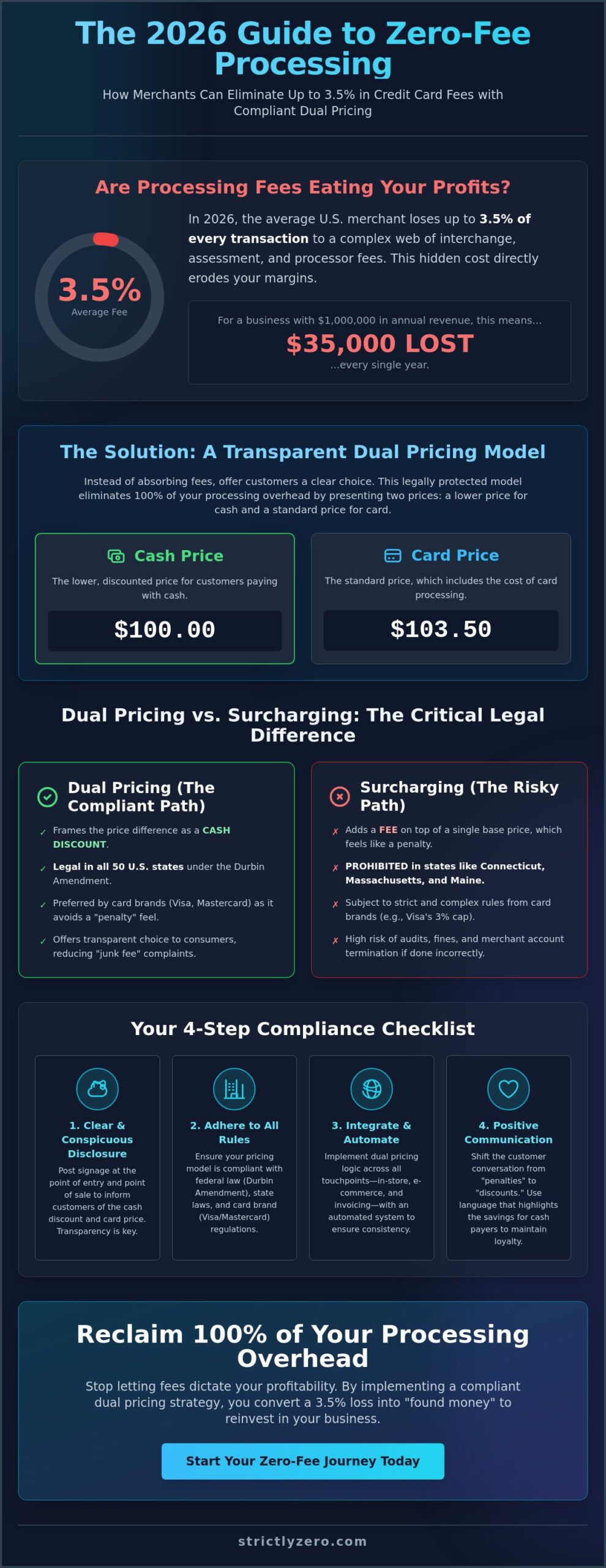
What if you could wipe out your credit card processing overhead entirely without losing a single customer to price frustration? In 2026, the average U.S. merchant loses up to 3.5% of every transaction to fees, making the best practices for implementing dual pricing more critical than ever. It’s a heavy burden that eats into margins and complicates growth. You’ve likely felt the sting of these rising costs and the confusion of trying to follow shifting state laws in places like Connecticut or Maine.
The good news is that you don’t have to choose between profitability and compliance. This guide will show you how to transition to a zero-fee model that customers actually appreciate. You’ll learn how to leverage a transparent cash-discount framework that stays on the right side of the Durbin Amendment while providing a frictionless checkout. We’ll walk through the essential steps for automating your pricing strategy, ensuring every transaction is legally sound and your bottom line stays protected.
Key Takeaways
- Navigate the 2026 legal landscape by understanding how to separate compliant dual pricing from restricted surcharging models across all 50 states.
- Master the best practices for implementing dual pricing through clear, conspicuous disclosures that protect your business from “junk fee” scrutiny.
- Shift the customer conversation from “penalties” to “discounts” using proven communication strategies that maintain loyalty during the transition.
- Learn to integrate dual pricing logic into every touchpoint, including e-commerce carts, virtual terminals, and digital invoicing systems.
- Scale your operations using automated engines that handle complex compliance and partner compensation without manual overhead.
Table of Contents
- Understanding Dual Pricing in the 2026 Payment Landscape
- Compliance Best Practices: Navigating Legal and Brand Rules
- Customer-First Communication: Preserving Loyalty and Transparency
- Implementing Dual Pricing Across Omni-Channel Touchpoints
- Scaling Your Strategy: The Strictly Advantage for Merchants and Partners
Understanding Dual Pricing in the 2026 Payment Landscape
Dual pricing is no longer a niche strategy for small shops; it’s a structural shift in how businesses handle the cost of commerce. At its core, dual pricing involves displaying two distinct prices for every item: a lower price for cash and a standard price for card users. This transparency is the foundation of Understanding Dual Pricing as a legitimate business strategy. By 2026, this has become the standard for merchants who refuse to let 3.5% of their revenue vanish into processing fees. It’s a “Zero Fee” revolution that prioritizes the merchant’s margin without hiding the costs from the consumer.
The urgency for this shift is driven by economic necessity. With average interchange fees sitting at 1.97% for Visa and 1.79% for Mastercard, plus various assessment fees and processor markups, the total cost of acceptance often hits 3.5%. Following the best practices for implementing dual pricing allows businesses to offset these costs entirely. Unlike older models that felt like hidden penalties, modern dual pricing gives customers a clear, honest choice at the point of sale. It effectively eliminates 100% of processing overhead by ensuring the cost of the transaction is covered by the payment method selected.
To see how these concepts look in a real-world setting, watch this detailed breakdown of the 2026 standards:
Dual Pricing vs. Surcharging: Why Intent Matters
The distinction between dual pricing and surcharging is vital for legal compliance. Surcharging is the act of adding a fee on top of a regular price, a practice currently prohibited in Connecticut, Massachusetts, and Maine. Dual pricing, however, is legal in all 50 states because it’s structured as a discount for cash. Federal protections under the Durbin Amendment safeguard this right. Card brands like Visa and Mastercard prefer this model because it avoids the “junk fee” stigma by showing the full price upfront. By following the best practices for implementing dual pricing, you stay compliant with state laws and card network rules, including the 3% cap on credit fees established by Visa.
The Economic Impact of Processing Fees on 2026 Margins
For a merchant doing $1M in annual revenue, processing fees can easily cost $35,000 or more. In an era where consumer spending is tightening, that’s capital that could be used for expansion or inventory. Eliminating that overhead is like getting an immediate 3.5% raise on your total revenue. Instead of padding the profits of banks and processors, you can reinvest that “found money” into your business growth. In 2026, where shoppers are more price-sensitive than ever, having the ability to offer a lower cash price provides a competitive edge that protects your bottom line while giving customers a way to save money.
Compliance Best Practices: Navigating Legal and Brand Rules
Compliance is the thin line between a successful zero-fee strategy and a regulatory nightmare. While the federal Durbin Amendment protects your right to offer cash discounts, state-level nuances create a complex patchwork of requirements. You need to stay updated on state-by-state surcharge laws to ensure your dual pricing model doesn’t accidentally cross into illegal territory. In states like Connecticut and Maine, surcharging is strictly prohibited, making a properly structured dual pricing model the only legal path to offsetting fees.
Card brands also have their own set of non-negotiable rules. Visa and Mastercard require merchants to provide at least 30 days’ notice before implementing any surcharge program. While dual pricing is technically different, following the best practices for implementing dual pricing often means adhering to the strictest standards to remain future-proof. For instance, Visa caps credit card surcharges at 3%, even if your actual cost of acceptance is higher. Trying to manage these caps and notifications manually is a high-risk strategy that often leads to costly audits or merchant account termination.
Essential Signage and Disclosure Requirements
The “Clear and Conspicuous” rule is your primary defense against consumer complaints. You must provide notice at the point of entry and again at the point of sale. This isn’t just for physical stores; digital environments must show both the card and cash price in the cart before the final checkout. Using standardized wording like “Standard Price” and “Cash Discount Price” helps avoid deceptive trade practice claims. If you want to ensure your disclosures meet every 2026 standard, you can explore compliant signage solutions that align with current brand rules.
Automating Compliance with a Smart Pricing Engine
The biggest risk in 2026 is the accidental surcharging of debit cards, which is prohibited nationwide by federal law. A manual system relies on staff to spot the difference between a credit and debit card, which is nearly impossible with modern card designs. An automated Surcharge & Dual Pricing Engine removes this human error by detecting the card type instantly at the terminal. These cloud-synced systems also update automatically when state laws change, such as Colorado’s 2% cap or California’s SB 478 “junk fee” requirements. This ensures your business stays PCI DSS compliant without requiring you to become a legal expert.
Customer-First Communication: Preserving Loyalty and Transparency
Success with dual pricing depends on more than just the right software; it requires a shift in how you talk to your customers. In 2026, consumer price sensitivity is at an all-time high. A survey found that while more Americans are shopping, their planned spending has plummeted by 70% compared to previous years. This means every dollar matters. One of the best practices for implementing dual pricing is framing the change as a way to protect your customers from broad price increases. By separating the cost of card acceptance, you’re giving them the power to choose how they save.
The psychology of the “Cash Discount” is far more effective than a “Credit Penalty.” Humans naturally resist losing something they already have, which is why a surcharge often triggers a negative emotional response. Dual pricing avoids this by presenting a standard price alongside a discounted cash price. This approach aligns with the “junk fee” conversation happening in 2026, where transparency is the gold standard. When shoppers see two clear options, they feel empowered rather than exploited. It turns a transaction into a choice, which preserves brand loyalty even as you eliminate your processing overhead.
Staff Training and Talking Points
Your front-line employees are the face of this transition. If they can’t explain why the prices differ, your customers will feel uneasy. Develop a consistent internal script that focuses on business sustainability. Instead of saying “we charge more for cards,” have them say, “We offer a discount for cash to help keep our base prices as low as possible.” Role-playing common objections is essential. Staff should be ready to explain that this model allows the business to avoid raising prices for everyone just to cover the high interchange fees associated with premium credit cards.
Marketing the Transition
Don’t let the first time a customer hears about your new pricing be at the checkout counter. Use your email newsletters and social media channels to announce the “Choice Pricing” model. You can adapt the strategies found in this guide on how to tell customers you are adding a surcharge fee to fit the dual pricing narrative. Emphasize that this change is about transparency and fairness. By explaining the “Zero Fee” model as a move toward long-term sustainability, you invite your customers to support your business’s growth while giving them a direct way to save on their own purchases.
Implementing Dual Pricing Across Omni-Channel Touchpoints
Many merchants think dual pricing is limited to a sticker on a cash register or a sign at the door. In 2026, that’s a dangerous assumption. Modern shoppers expect a unified experience whether they’re buying from a smartphone, a desktop, or over the phone. Implementing these strategies across digital channels is one of the most effective best practices for implementing dual pricing because it captures savings on high-ticket remote transactions. These “card-not-present” sales usually carry the highest processor markups, making fee elimination even more valuable for your bottom line.
E-commerce checkout logic must be dynamic to stay compliant and transparent. When a customer lands on your payment page, the system should present the standard price and the cash-discounted price side-by-side. As soon as the customer begins entering their card number, the gateway must perform a real-time BIN lookup. This ensures that debit cards, which are protected by federal law and capped at lower interchange rates, aren’t accidentally surcharged. This level of automation is what separates a professional operation from one that risks legal scrutiny or merchant account termination.
The Role of Payment Links and Invoicing
For service-based businesses, virtual terminals are the backbone of the “Zero Fee” model. Instead of sending a static PDF invoice that forces a single price, use dynamic payment links that allow the client to toggle between payment methods. The digital invoice should clearly display the “Card Price” and the “Cash/ACH Price.” By providing this choice digitally, you reduce friction and accelerate the settlement of funds. This is especially important as real-time payment systems like FedNow become the 2026 standard for immediate transaction settlement.
Developer Best Practices: API Integration
Custom enterprise stacks require an API-first approach to maintain consistency. Developers should fetch the “Smart Price” from the pricing engine before the transaction executes. This ensures the math is identical across every custom UI, from mobile apps to in-store kiosks. The API must handle the heavy lifting of state-specific fee caps, such as Nevada’s restriction to actual processing costs. Accurate reporting is also crucial; your backend needs to reflect the split-price logic so that accounting teams can reconcile the “Zero Fee” transactions without manual adjustments. Following these technical best practices for implementing dual pricing ensures your system remains scalable as your transaction volume grows.
If you’re ready to modernize your checkout across every sales channel, explore our Omni-Channel Payment Processing solutions today.
Scaling Your Strategy: The Strictly Advantage for Merchants and Partners
Scaling a business in 2026 requires more than just a good product; it demands a sophisticated financial infrastructure. As you move from understanding the basics to full execution, the technical burden of staying compliant can become overwhelming. Strictly’s Smart Pricing Engine is designed to solve this by automating the best practices for implementing dual pricing at the software level. It removes the need for manual calculations or constant monitoring of state law changes. This automation is the foundation of a successful zero fee credit card processing strategy, allowing you to focus on your customers while the system handles the complexity of 2026 payment standards.
The move to a zero-fee model is a long-term play for sustainability. By removing the 3.5% friction from every transaction, you’re effectively increasing your capital for inventory, marketing, and expansion. Strictly provides the data intelligence needed to track this growth in real time. You don’t have to guess if the strategy is working; the ROI is visible on every dashboard. This level of clarity is what separates modern merchants from those still stuck with legacy processors and hidden markups.
For Merchants: Total Fee Elimination
Transitioning to a new pricing model shouldn’t be a headache. Strictly’s omni-channel platform streamlines the process across your web store, virtual terminal, and mobile apps. You get access to real-time savings reports and ROI dashboards that show exactly how much you’re saving by eliminating processing overhead. Beyond just pricing, the platform integrates AI-driven fraud prevention to protect those higher margins. By combining dual pricing with real-time adaptive risk scoring, you aren’t just saving on fees; you’re also reducing the cost of chargebacks and fraudulent transactions. This holistic approach ensures that your move to zero fees doesn’t come at the expense of security or user experience.
For ISOs and Developers: Building a Payments Business
For those looking to grow their own payments business, the payment processing platform for ISOs provides the tools needed to scale in 2026. Managing partner compensation in a zero-fee environment can be tricky, but ClearSplit™ automates residuals with total transparency. It ensures that every partner in the ecosystem is compensated fairly without manual accounting. To keep your merchant base stable, ChurnIQ™ uses data intelligence to identify at-risk accounts before they leave. In 2026, dual pricing is the ultimate merchant retention tool because it provides immediate, tangible value that competitors using traditional fee models can’t match. By following the best practices for implementing dual pricing and leveraging these advanced tools, you can build a resilient, high-margin payments portfolio.
Take Control of Your Profit Margins Today
Reclaiming the 3.5% that usually disappears into processing fees is no longer a luxury; it’s a necessity for 2026 merchants. By mastering the best practices for implementing dual pricing, you’ve learned how to turn a mandatory expense into a sustainable growth engine. The shift toward a transparent, two-price model isn’t just about saving money. It’s about building a brand that respects customer choice while protecting its own bottom line across every sales channel.
Success requires the right technology to handle the heavy lifting of compliance and card detection. You don’t have to navigate these complex regulations alone or risk manual errors that could jeopardize your merchant account. With a system that’s compliant in all 50 states and features automated debit card detection, you can focus on scaling your business with total confidence. Tools like ClearSplit™ also ensure your partner management remains as transparent as your customer-facing pricing.
Ready to stop letting fees eat your margins? Eliminate your processing fees today with Strictly’s Smart Pricing Engine. Your path to a zero-fee future starts now, and we’re here to help you every step of the way.
Frequently Asked Questions
Is dual pricing legal in all 50 U.S. states in 2026?
Dual pricing is legal in all 50 U.S. states as of 2026. This practice is protected under the Durbin Amendment because it is structured as a discount for cash rather than a surcharge for card users. While states like Connecticut, Massachusetts, and Maine prohibit credit card surcharging, they allow dual pricing because customers are offered a clear choice to save money by paying with cash.
What is the main difference between dual pricing and a credit card surcharge?
The main difference is transparency and how the price is displayed to the customer. Dual pricing shows two distinct prices for every item, whereas a surcharge is a fee added at the end of a transaction. Surcharging is subject to a 3% cap by Visa and requires 30 days’ notice to card brands. Dual pricing avoids these specific surcharge restrictions by presenting a standard price and a discounted cash price.
How do I display dual pricing on my website or e-commerce store?
You must display both the “Card Price” and “Cash Price” clearly before the final checkout step. One of the best practices for implementing dual pricing in a digital environment is using a dynamic cart that updates based on the selected payment method. This ensures that your website meets the “clear and conspicuous” disclosure requirements mandated by card brand rules and New York’s specific pricing laws.
Can I use dual pricing if I accept debit cards?
You can use dual pricing alongside debit cards, but you must process debit transactions at the lower cash price. Federal law and card network rules prohibit surcharging debit and prepaid cards. A smart pricing engine will automatically detect the card type via the Bank Identification Number (BIN) to ensure you don’t accidentally charge the higher price for a debit transaction, keeping your business compliant.
Do I need special hardware to implement a dual pricing program?
You do not need to purchase new physical POS hardware to launch a dual pricing strategy. Most modern implementations rely on a software-based Surcharge & Dual Pricing Engine that integrates with your existing virtual terminal or e-commerce stack. The key is finding a processor that provides the logic to calculate and display these two prices accurately across all your physical and digital sales channels.
How do I explain dual pricing to a customer who is upset about the card price?
The best approach is to emphasize the savings opportunity for the customer. Explain that the “Standard Price” reflects the high costs of processing, but you offer a “Cash Discount” for those who choose to pay with cash or ACH. This keeps your base prices lower for everyone. It prevents you from having to raise prices across the board to cover the average 1.97% interchange fee for Visa.
What happens if I don’t follow the card brand rules for dual pricing?
Failing to follow card brand rules can lead to heavy fines, audits, or the loss of your merchant account. Visa and Mastercard require clear signage and specific notification before you begin any program that involves different pricing. Following the best practices for implementing dual pricing ensures you stay within the 3% cap and provide the necessary disclosures at both the point of entry and the point of sale.
Is dual pricing the same as a cash discount?
Yes, dual pricing is essentially a formalized and more transparent way of offering a cash discount. While a traditional cash discount might be a simple sign at the register, dual pricing is a robust system that labels both prices on every tag, receipt, and digital invoice. This level of detail is preferred by regulators in 2026 because it eliminates any confusion about exactly what the customer is paying.