
Beyond Negotiation: 5 Alternatives to Lowering Credit Card Processing Fees in 2026
Published:

What if you could stop fighting for 0.1% rate cuts and just eliminate your processing costs entirely? It’s a frustrating cycle that most business owners know all too well. You spend hours on the phone negotiating a slightly better markup, only to see “junk fees” and mysterious assessments creep back onto your statement six months later. If you’re tired of these temporary fixes, it’s time to look at structural alternatives to negotiating credit card processing fees that actually stick for the long term.
You deserve a transparent pricing model that doesn’t require constant monitoring or a degree in forensic accounting to understand. While the average processing fee for a small business in 2026 sits between 1.5% and 3.5%, you don’t have to be the one footing that bill. This guide explores how to reclaim your profit margins and improve your bottom line without raising your base product prices. We’ll show you how to leverage modern tools like dual pricing engines, virtual invoicing, and automated surcharging to transform your merchant overhead into a permanent, predictable solution for your business.
Key Takeaways
- Understand why standard negotiations only impact processor markups and how to target the larger, fixed costs of merchant accounts.
- Explore effective alternatives to negotiating credit card processing fees, including dual pricing models that offer transparency to your customers.
- Learn how to utilize ACH and real-time bank transfers to handle large invoices at a fraction of the cost of traditional credit cards.
- Identify the specific signage and staff training techniques required to implement fee changes while maintaining strong customer loyalty.
- See how an automated surcharge engine can handle the complexities of state regulations and card brand rules for you.
Table of Contents
- Why Negotiating Credit Card Processing Fees Often Yields Diminishing Returns
- The Zero-Fee Model: Surcharging and Dual Pricing as the Ultimate Alternative
- Exploring Non-Card Alternatives: ACH, Pay-by-Bank, and Wholesale Pricing
- How to Transition to a New Fee Structure Without Risking Customer Churn
- Leveraging Strictly’s Smart Pricing Engine to Eliminate Processing Costs
Why Negotiating Credit Card Processing Fees Often Yields Diminishing Returns
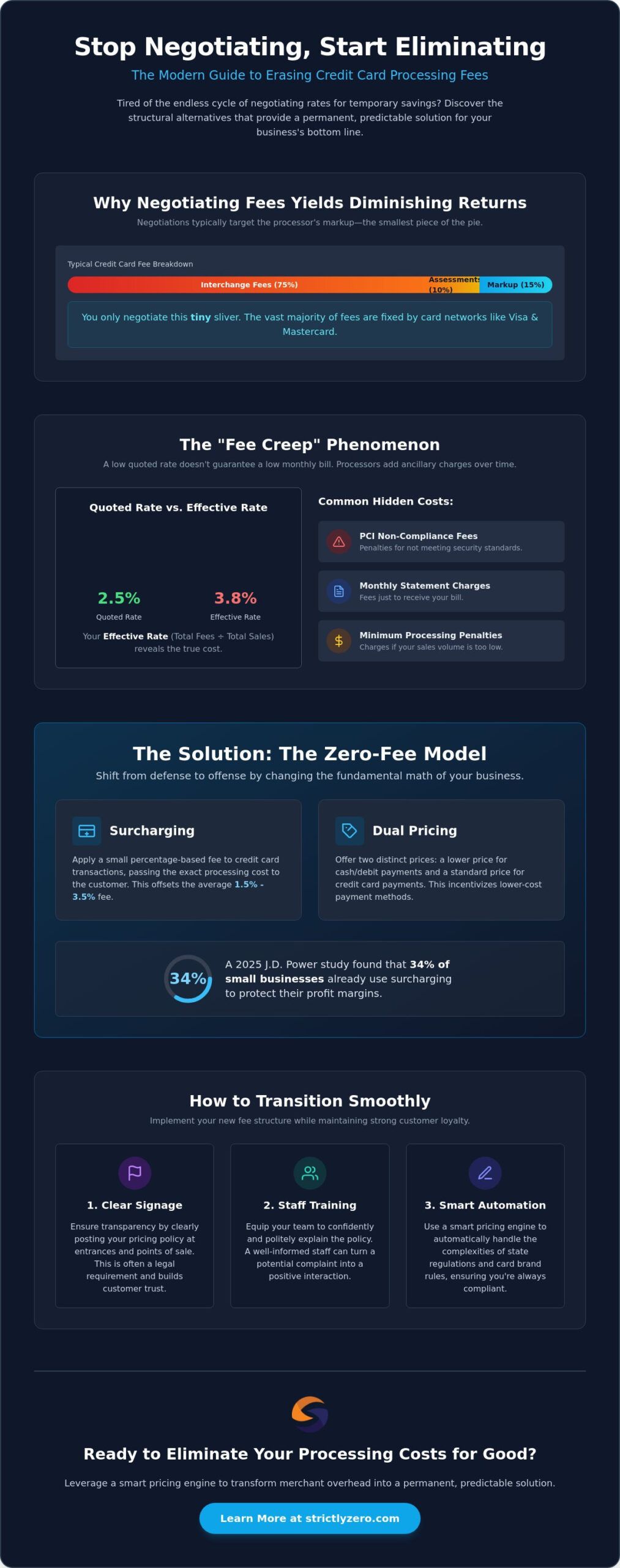
Many business owners treat merchant account statements like a cable bill. They call in once a year, threaten to leave, and walk away with a slightly lower markup. This strategy feels like a win, but it rarely moves the needle on your bottom line. Negotiation typically only targets the processor’s markup, which is the smallest portion of your total cost. The lion’s share of what you pay is dictated by the card networks, leaving you with diminishing returns for your effort. If you want a permanent fix, you need to look at structural alternatives to negotiating credit card processing fees.
To better understand how these costs are structured and why negotiation has its limits, watch this helpful video:
The real problem with traditional negotiation is the introductory rate trap. Processors often offer a teaser rate to win your business. Once the contract matures, they slowly raise rates or introduce new line items that offset any savings you fought for. These hidden costs often include:
- PCI non-compliance fees
- Monthly statement charges
- Minimum processing penalties
- Annual membership fees
Instead of growing your business, you’re stuck in a cycle of constant haggling just to maintain your current margins. Every hour spent on the phone with a sales rep is an hour you aren’t spending on core business growth.
The Myth of the “Wholesale Rate”
The term wholesale is often used by sales reps to make a deal sound exclusive. In reality, the Interchange fee is a fixed cost set by card networks like Visa and Mastercard. As of 2026, these rates typically range from 1.15% to 3.15% depending on the card type. No processor can lower these rates for you. They only control their own markup, which might be as low as 0.10%. While flat-rate providers offer simplicity, they often hide high costs for high-volume businesses. You aren’t getting a deal; you’re paying for a convenience that scales poorly.
The “Fee Creep” Phenomenon
A low rate on a proposal doesn’t always lead to a lower monthly statement. This is known as fee creep. Processors add ancillary charges over time to recover lost margins, hoping you won’t notice the extra charges. To see the truth, you must calculate your effective rate by dividing your total fees by your total sales volume. If your quoted rate is 2.5% but your effective rate is 3.8%, you aren’t actually saving money. This gap is exactly why exploring structural alternatives to negotiating credit card processing fees is more effective than just asking for a discount.
The Zero-Fee Model: Surcharging and Dual Pricing as the Ultimate Alternative
If negotiation is a defensive play, then adopting a zero-fee model is a strategic offensive. You’re no longer asking a processor for a slightly smaller bill. You’re changing the fundamental math of your business. By viewing credit card acceptance as a premium service rather than a mandatory tax, you can reclaim thousands in lost revenue every month. These structural shifts represent the most effective alternatives to negotiating credit card processing fees because they provide a permanent fix that isn’t subject to “fee creep” or expiring teaser rates.
This model moves the cost of convenience from the merchant to the cardholder. It’s a psychological shift that many businesses in 2026 are already making. A 2025 J.D. Power study found that 34% of small businesses were already adding credit card surcharges to protect their margins. When you stop absorbing the 2.35% average cost of a Visa or Mastercard transaction, that money stays in your bank account, allowing you to reinvest in your staff or your facility without raising your base prices.
How Surcharging Eliminates Processing Costs
Surcharging is a method to offset merchant service fees by applying a percentage-based fee to the customer at the point of sale. This model allows you to pass through the exact cost of the credit card transaction. However, compliance is essential to avoid heavy fines from card brands. As of 2026, Visa caps these fees at 3% while Mastercard allows up to 4%. It’s also vital to remember that surcharging debit cards is a violation of federal law. Because regulations vary by location, you should check the state-by-state statutes to ensure your program meets local requirements. For example, states like Connecticut and Massachusetts still prohibit surcharging entirely, making dual pricing the better path in those regions.
Dual Pricing: The Transparent Alternative
While surcharging adds a fee at the end of a transaction, dual pricing presents two distinct prices from the beginning: one for cash and one for card. This is often the preferred choice for retailers with high foot traffic because it offers total transparency. Customers don’t feel surprised by a fee at the end of the checkout process. Instead, they’re given a clear choice. This model is generally legal in all 50 states when structured correctly. The impact on your profit margins is immediate. By saving the 3% to 4% typically lost to processing, a business can see a significant boost to its bottom line without changing its product lineup.
Transitioning to these models doesn’t have to be a manual headache. You can implement a compliant surcharge and dual pricing engine that handles the complex math and card-brand rules for you, ensuring every transaction is processed legally and profitably.
Exploring Non-Card Alternatives: ACH, Pay-by-Bank, and Wholesale Pricing
While surcharging shifts costs to the cardholder, some businesses prefer to bypass the expensive card networks altogether. This is where non-card payment rails become essential. By leveraging direct bank transfers, you can avoid the percentage-based fees that eat into high-ticket sales. These methods are powerful alternatives to negotiating credit card processing fees because they use a completely different infrastructure with much lower overhead. Moving away from the “swipe” mindset allows you to keep more of your revenue without having to fight for a few basis points on a markup.
The payment landscape in 2026 is rapidly evolving toward these direct solutions. For businesses dealing with large invoices or recurring billing, the savings are too large to ignore. Instead of paying for the “convenience” of a credit card network, you’re utilizing the bank’s own secure rails. This shift doesn’t just lower costs; it often speeds up settlement times and reduces the risk of chargebacks that are common with credit card transactions.
The Rise of ACH and Real-Time Payments
ACH transfers are no longer the slow, clunky option they used to be. For professional services or high-ticket items, they’re the gold standard for cost-efficiency. In 2026, ACH fees are often a flat rate between $0.20 and $1.50 per transaction, or a small percentage capped at a low dollar amount. Compare that to a $1,000 credit card transaction. At an average 2.35% rate, you’d pay $23.50. With ACH, you might pay less than two dollars. Modern tools like a virtual terminal and invoicing platform make this transition seamless for your customers. Additionally, real-time payment (RTP) networks are expanding. By 2026, almost 80 countries have adopted RTP networks, and 58% of U.S. financial institutions now provide instant payment options like FedNow or RTP.
Understanding Interchange-Plus
If your business model doesn’t allow for surcharging or bank transfers for competitive reasons, you should at least demand the most transparent pricing model available: interchange-plus. This is often referred to as wholesale pricing. Instead of being lumped into “tiers” where you’re overcharged for rewards cards, you pay the exact cost set by the card networks plus a small, fixed markup. It’s the same model used by enterprise corporations. To ensure you’re getting the best deal, audit your statement for the effective rate. If your markup is consistently high, it’s a sign that your processor is padding their margins. Switching to a transparent, omni-channel payment processing partner ensures you get the benefits of these wholesale rates across all your sales channels without the hidden “junk fees” common in tiered plans.
How to Transition to a New Fee Structure Without Risking Customer Churn
Transitioning to a new fee structure is more about psychology than technology. While the mechanical part happens in the background, the human element determines if your new model succeeds or fails. If you’ve chosen one of the structural alternatives to negotiating credit card processing fees, you must be prepared to lead your customers through the change. Transparency is your greatest tool. When customers understand that processing fees are an external cost rather than a merchant markup, they’re far more likely to accept the change or switch to a lower-cost payment method like cash or ACH.
Signage is your first line of defense. It needs to be clear, visible, and placed exactly where customers make their buying decisions. In 2026, customers are increasingly familiar with these models, but surprise fees at the very end of a transaction still cause friction. By placing disclosures at the entrance and the point of sale, you eliminate the “gotcha” moment. Beyond the physical store, your digital presence must also reflect these changes. Clear communication on your website and invoices ensures that your omni-channel customers receive a consistent experience regardless of how they choose to pay.
Compliance and Legal Requirements in 2026
Navigating the legal landscape requires precision. While surcharging is widely permitted, specific states like Connecticut, Massachusetts, and Maine continue to ban the practice as of 2026. If you operate in these regions, a dual pricing model is your safest path forward because it is generally legal in all 50 states. You must also provide a 30-day notice to card brands before implementing a surcharge program. Automated compliance engines are essential here; they detect card types in real-time to ensure you never accidentally surcharge a debit card, which remains a federal violation. Maintaining PCI DSS compliance throughout this transition is vital to keep your transaction data secure. To simplify this process, many merchants are moving to a unified Surcharge & Dual Pricing Engine that handles these regional variations automatically.
Communication Strategies for Merchants
Staff training is the bridge between your new policy and customer acceptance. Your team shouldn’t apologize for the change; they should explain it as a way to keep base prices low and support the business. A simple script works best: “To keep our product prices as low as possible for everyone, we offer a discount for cash payments, while credit card transactions include a small processing fee.” This positions the change as a benefit to the shopper rather than a penalty. Monitor customer feedback closely during the first 90 days to identify any points of confusion. For a deeper dive into these conversations, read our guide on How to Tell Customers You’re Adding a Surcharge Fee.
Leveraging Strictly’s Smart Pricing Engine to Eliminate Processing Costs
When you look for alternatives to negotiating credit card processing fees, the most effective path is moving toward a platform that automates the entire savings process. Strictly provides a unified omni-channel payment processing platform that bridges the gap between online and in-person transactions. Instead of managing different systems with varying fee structures, you get a single source of truth for your revenue. This platform is designed for the 2026 financial ecosystem, where speed and transparency are the primary drivers of business success.
At the heart of this system is the Smart Pricing Engine. This technology solves the biggest headache of surcharging: compliance. The engine uses real-time detection to identify whether a customer is using a credit or debit card. Because surcharging debit cards is a violation of federal law, this instant detection ensures you stay within legal boundaries without having to train your staff to inspect every physical card. It’s a seamless way to protect your margins while offering your customers a modern checkout experience. Beyond just cutting fees, the platform integrates AI-driven fraud prevention and POS lending, giving you tools to grow your top-line revenue while protecting your bottom line.
Automated Compliance and Risk Management
The legal landscape for merchant fees is a moving target. Rules change at the state level, and card brands frequently update their own requirements. Strictly manages these complexities so you don’t have to. The Smart Pricing Engine receives real-time updates on state-by-state statutes, ensuring that a transaction in a restricted state is handled differently than one in a surcharge-friendly region. This API-first platform is built for security and scale. By automating compliance, you reduce the risk of fines and audits, allowing you to focus on your customers rather than your processor’s fine print.
Partnering for Growth
It’s not just individual merchants who benefit from these structural changes. ISOs and Managed Service Providers (MSPs) use Strictly to provide more value to their own merchant clients. By offering a zero-fee solution, partners can differentiate themselves in a crowded market and build long-term trust. This collaborative approach helps businesses of all sizes scale by removing the friction of high processing overhead. To learn more about how we support our partners, read about The Ultimate Payment Processing Platform for ISOs.
Stop settling for marginal gains and temporary discounts. It is time to implement a permanent, structural solution that eliminates the need for constant haggling. Ready to eliminate your processing fees? See how Strictly works.
Take Control of Your Profit Margins Today
You don’t have to be at the mercy of annual rate hikes or opaque fee structures any longer. By shifting to a zero-fee model or leveraging bank-to-bank transfers, you move beyond the limitations of traditional markups. These strategies provide the structural alternatives to negotiating credit card processing fees that your business needs to thrive in a competitive 2026 market. You can now offer customers total transparency through dual pricing while using automation to handle the complex legal requirements of different jurisdictions.
Strictly’s platform provides the AI-driven debit and credit detection you need to stay compliant in all applicable states. Whether you sell online or in person, our omni-channel support ensures your margins remain protected from the start. It’s time to stop haggling over pennies and start keeping your hard-earned revenue. Calculate your potential savings with Strictly’s Zero-Fee Model and see how much revenue you can reclaim starting today. Your bottom line is worth the switch.
Frequently Asked Questions
Is it legal to surcharge credit card fees in all 50 states?
No, surcharging is not legal everywhere. As of 2026, Connecticut, Massachusetts, and Maine continue to prohibit credit card surcharges. Other states like Colorado have specific caps, limiting the fee to 2%. If you operate in a restricted state, dual pricing is often the best of the alternatives to negotiating credit card processing fees because it remains legal across the entire country.
What is the difference between a surcharge and a cash discount?
A surcharge adds a fee onto your advertised price when a customer chooses to pay with a credit card. A cash discount works the opposite way by offering a lower price than the listed one for customers who pay with cash. Dual pricing is a modern hybrid that displays both the cash and card price transparently at the point of sale, which helps avoid customer confusion at checkout.
Will I lose customers if I stop paying for their credit card rewards?
Most merchants find that customer churn is minimal when the change is explained clearly. While a 2025 J.D. Power report found that some cardholders switch payment methods to avoid fees, many customers prefer that you keep your base product prices lower rather than raising prices for everyone to cover rewards. Clear signage and staff training are the most effective ways to maintain loyalty during the transition.
How do I know if my current processor is overcharging me?
You can identify overcharging by calculating your “effective rate,” which is your total monthly fees divided by your total sales volume. If your effective rate is significantly higher than the standard interchange rates of 1.15% to 3.15%, your processor is likely padding the bill with markups. High effective rates are a primary reason why merchants seek structural alternatives to negotiating credit card processing fees.
Can I surcharge on debit card transactions?
No, it’s a violation of federal law and card network rules to surcharge debit or prepaid cards. This rule applies even if the customer chooses “credit” at the terminal instead of entering a PIN. If you accidentally surcharge a debit card, you could face heavy fines and the loss of your merchant account, which is why automated detection technology is so important.
What is the Smart Pricing Engine and how does it help with compliance?
The Smart Pricing Engine is an automated tool that identifies the card type in real-time during the transaction. It instantly distinguishes between credit and debit cards to ensure you only apply fees where they are legally permitted. It also tracks changing state laws and card brand caps, like Visa’s 3% limit, so your business stays compliant without any manual effort from your staff.
How long does it take to switch to a zero-fee processing model?
The technical integration of a new pricing engine can happen quickly, but you must account for regulatory timelines. Card brands like Visa and Mastercard require a 30-day notice before you can begin a surcharge program. Most businesses can expect to be fully operational with their new fee structure within four to five weeks after starting the application process.
Are there any businesses that should NOT use a surcharge model?
Businesses located in states with total surcharge bans should avoid this model and use dual pricing or ACH instead. Additionally, if you operate in a highly competitive luxury market where customers expect “all-in” pricing, you might find that interchange-plus pricing is a better fit. Always consider your local competition and customer expectations before deciding which fee-reduction strategy to implement.