
California Credit Card Surcharge Law: 2026 Merchant Guide
Published:

That sign on your counter announcing a 3% credit card fee might look like a simple cost-saving measure, but in 2026, it could be a $1,000 mistake. Since the implementation of SB 478, the way businesses handle the california credit card surcharge law has shifted from basic disclosure to a rigid requirement for total price transparency. You are likely tired of rising processing fees eating into your margins while feeling overwhelmed by the conflicting advice surrounding “hidden fees” and “drip pricing” regulations. It is stressful to try and balance your bottom line against the threat of Attorney General audits or consumer lawsuits.
This guide will help you master these complexities so you can eliminate processing costs safely and legally. We will provide a clear “yes or no” on current legality, a checklist for compliant signage, and a roadmap to achieving $0 processing fees through automated technology. We will also explore how to modernize your checkout process while staying fully protected under state law. By the end of this article, you will have a clear path to protect your hard-earned revenue without risking regulatory penalties.
Key Takeaways
- Understand the current legal status of the california credit card surcharge law to ensure your business isn’t risking $1,000 penalties per transaction.
- Learn why the “advertised price” is now the most critical factor for compliance under the California Honest Pricing Act (SB 478).
- Get a practical checklist for mandatory point-of-sale signage and learn how to stay under the 3% cap required by card networks.
- Discover why dual pricing models are often safer and more transparent than traditional surcharging for California merchants.
- See how automated technology can detect debit cards instantly and apply state-specific logic to keep your processing costs at zero legally.
Table of Contents
- Is Surcharging Legal in California? The 2026 Legal Landscape
- Understanding SB 478: The "Hidden Fees" Law and Your Business
- California Surcharge Requirements: A Merchant Checklist
- Surcharging vs. Dual Pricing: Which is Safer in California?
- Automating California Compliance with Strictly
Is Surcharging Legal in California? The 2026 Legal Landscape
The timeline of the california credit card surcharge law is defined by a major pivot from total prohibition to regulated transparency. For over three decades, California Civil Code Section 1748.1 made it illegal for merchants to add fees for credit card usage. This was originally intended to shield consumers from extra costs, but it essentially forced small businesses to absorb 2% to 4% in processing fees as a mandatory expense. Merchants operated under a strict ban that didn’t account for the rising overhead of digital transactions.
Everything changed when the state’s authority to dictate pricing labels was challenged in federal court. The argument wasn’t about whether merchants could charge more for credit, but how they were allowed to communicate that cost to the public. This legal friction led to a landmark shift in how the state regulates transaction fees, moving away from total bans toward a focus on clear price communication.
To better understand this concept, watch this helpful video:
The 1748.1 Court Ruling Explained
In the case of Italian Colors Restaurant v. Becerra, the court finally intervened. In 2018, the original ban was ruled unconstitutional because it violated the First Amendment’s protection of free speech. The court found that the law was a speech-based regulation; it allowed “cash discounts” but banned “surcharges,” even though both resulted in the exact same price for the buyer. This distinction was deemed an illegal restriction on how a business describes its pricing structure.
Today, this ruling means you have a legal right to pass on processing costs. However, the California Attorney General has shifted focus from an outright ban to ensuring “fair pricing.” The office now monitors “drip pricing” closely, looking for merchants who advertise one price but add a surcharge at the final checkout stage. 2026 merchants must look beyond the old 1748.1 statute and focus on newer “Honest Pricing” laws to remain compliant.
Federal vs. State Regulations
While state laws have loosened, federal rules remain strict. The Durbin Amendment to the Dodd-Frank Act creates a nationwide wall between credit and debit transactions. You cannot surcharge a debit card, even if the customer runs it “as credit” at your terminal. Many California merchants face audits or lawsuits not because they surcharged, but because they failed to distinguish between these two payment types at the point of sale.
A Surcharge (payment systems) must also follow card network rules from Visa and Mastercard, which typically cap fees at 3%. In 2026, the legality of surcharging in California is clear: it’s legal to surcharge credit cards as long as the total fee is included in the advertised price and debit cards are strictly excluded from the charge. Failure to automate this distinction is the fastest way to trigger a regulatory audit.
Understanding SB 478: The “Hidden Fees” Law and Your Business
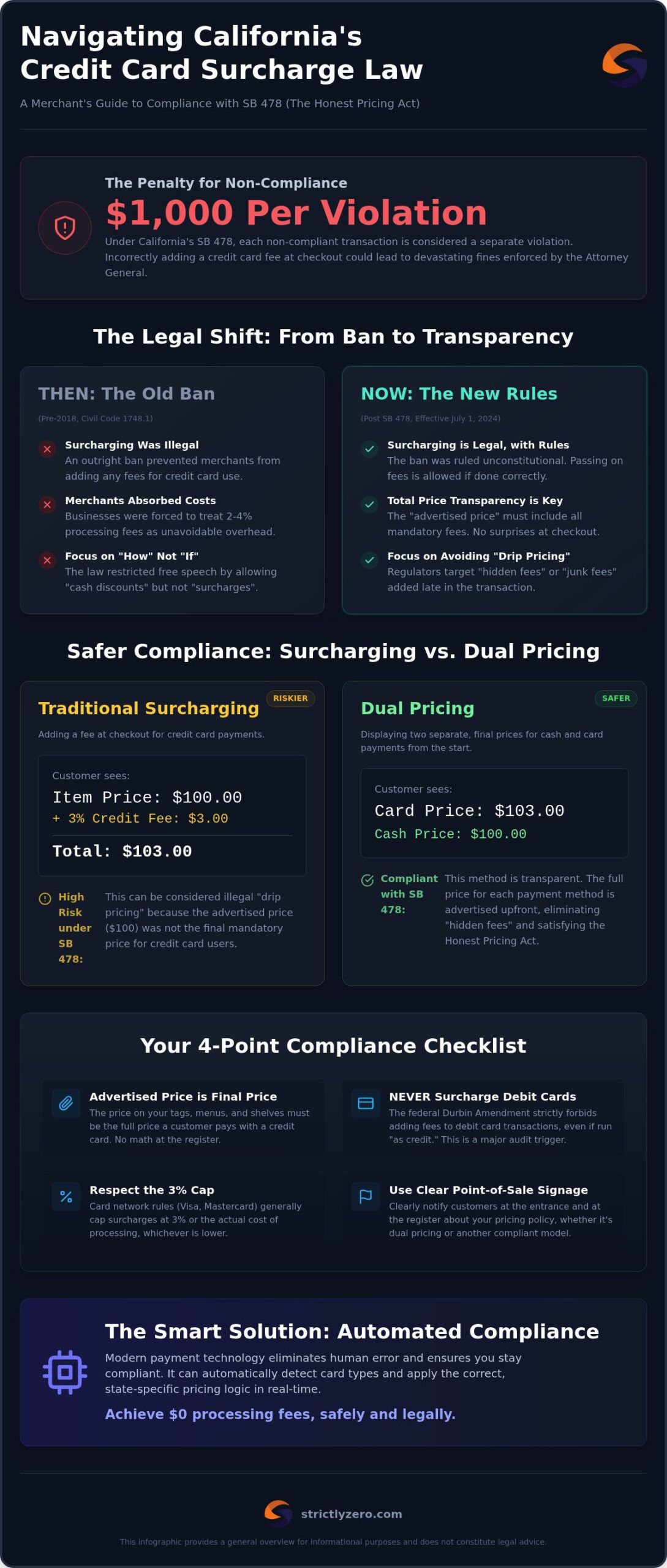
SB 478, known as the California Honest Pricing Act, redefined the landscape for merchants on July 1, 2024. While the court rulings discussed earlier confirmed your right to surcharge, this law dictates exactly how you must display those costs to the public. It specifically targets “drip pricing,” which is the practice of showing a low price initially and then adding mandatory fees during the final stages of a transaction. For many business owners, this means the traditional method of applying the california credit card surcharge law by adding a percentage at the register is now a significant legal liability.
The law’s primary goal is to eliminate “junk fees” that mislead consumers. If a fee is mandatory for a specific payment type, it must be part of the price the customer sees first. Penalties for non-compliance in 2026 remain severe. The California Attorney General’s Office has the authority to seek fines of up to $1,000 per violation. Since each transaction can count as an individual violation, a single day of non-compliant sales could result in devastating financial consequences for a small business.
The Advertised Price Requirement
You can’t just put a sticker on your terminal and assume you’re safe. SB 478 requires that any mandatory fee, including a credit card surcharge, is included in the total price displayed on menus, websites, and price tags. If an item is listed at $50, but a 3% surcharge is added at checkout, you’ve technically violated the law. Unless you’re a restaurant operating under the specific exemptions of SB 1524, the “advertised price” must be the final price the consumer pays. This shift requires a total overhaul of how you label products and services to ensure the surcharge is baked into the initial number shown to the buyer.
Consumer Rights and “Bait and Switch” Protections
The Attorney General defines “unfair competition” as any practice that lures a customer in with an artificially low price. At-the-register surprises are viewed as a form of “bait and switch” because the customer didn’t have the full pricing information when they decided to buy. This is especially critical for digital storefronts. Your online checkout process shouldn’t see a price jump in the final step due to a surcharge that wasn’t disclosed upfront. Upfront disclosure isn’t just a courtesy; it’s the only way to avoid being flagged for deceptive pricing practices.
Staying on top of these shifting transparency rules can be difficult for growing businesses. You might find it easier to implement a Surcharge & Dual Pricing Engine that automatically adjusts your displays and ensures every transaction meets state-specific disclosure requirements.
California Surcharge Requirements: A Merchant Checklist
Staying compliant with the california credit card surcharge law requires more than just a basic understanding of price transparency. While SB 478 mandates that you include mandatory fees in your advertised prices, you still have specific operational duties to perform at the point of sale. To avoid penalties, you must treat compliance as a multi-step process that involves physical signage, technical card detection, and precise receipt itemization. If you fail in even one of these areas, you risk opening your business to consumer litigation or card network fines.
Your primary objective is to ensure the customer never feels surprised. This starts with a maximum surcharge cap of 3%. Although some card networks allow up to 4%, California merchants should stick to a 3% limit because Visa caps fees at this level, and network rules generally require you to follow the lowest common denominator. You cannot profit from a surcharge; it must only cover your actual cost of acceptance. Additionally, you must itemize the fee on every receipt so the customer sees exactly what they paid for the convenience of using credit.
Signage and Disclosure Standards
Even with the new “advertised price” rules, clear signage remains a legal and contractual necessity. You must place notices at the point of entry and the point of sale to inform customers of your credit card policies before they reach the register. For e-commerce businesses, this disclosure must appear on the checkout page before the final “buy” button is clicked. The wording must be clear and conspicuous, stating that the business imposes a surcharge that is not greater than the cost of acceptance. Knowing how to tell customers you’re adding a surcharge fee without damaging your brand reputation is a critical skill for 2026 merchants.
The California Civil Code § 1748.1 provides the foundation for these requirements, emphasizing that merchants must not mislead the public. Your signage should be professionally printed and easily legible from a reasonable distance. Handwritten notes or small, obscured stickers are often cited as evidence of “hidden fees” during Attorney General audits.
Technical Enforcement of Debit Detection
The biggest legal trap in California is the surcharging of debit cards. Under the federal Durbin Amendment, it’s illegal to surcharge a debit card transaction, regardless of whether the customer chooses “debit” or “credit” on the terminal. Manual detection is impossible for staff; they cannot tell if a card is debit or credit just by looking at the plastic. If your system accidentally surcharges a debit card, you are in immediate violation of both state and federal law.
To stay safe, your POS system must use a real-time BIN (Bank Identification Number) lookup to identify the card type instantly. This technical enforcement ensures that the surcharge is automatically blocked for all debit and prepaid cards. This isn’t just about avoiding fees; it’s about adhering to the Truth in Lending Act (TILA), which requires absolute transparency in finance charges. Automated systems take the guesswork out of the hands of your employees, serving as your most reliable defense against a california credit card surcharge law violation.
Surcharging vs. Dual Pricing: Which is Safer in California?
The legal landscape in California makes traditional surcharging a high-stakes game. While you’ve learned that surcharging is technically legal, the disclosure requirements under SB 478 create a minefield for errors. This is why many 2026 merchants are turning to Dual Pricing. Unlike a surcharge, which adds a fee at the end of the transaction, Dual Pricing presents two distinct prices from the start: a “Cash Price” and a “Card Price.” By showing both values simultaneously, you eliminate the “hidden fee” argument entirely.
California regulators often prefer Dual Pricing because it provides the ultimate level of transparency. There’s no math for the customer to do at the register and no surprise percentage added to the total. This model naturally satisfies the SB 478 requirement that the advertised price must include all mandatory charges. When a customer sees the “Card Price” on a menu or price tag, they’re seeing the total cost upfront, which removes the risk of “drip pricing” violations that often plague traditional surcharge programs.
The Dual Pricing Advantage
Dual Pricing is technically not a surcharge. Because you’re displaying the full card price upfront, you aren’t adding a “mandatory fee” to an advertised price; the card price is the advertised price. This distinction is vital for staying in the good graces of the California Attorney General. It allows you to offer a lower price for cash or check users while ensuring your credit card margins remain protected. You aren’t “charging extra” for credit; you’re simply offering a discount for cash.
When you implement this model, you avoid the specific signage restrictions that haunt traditional surcharging. You don’t need to explain a complex percentage calculation at the register because the math is already done for the customer on the price tag or menu. If you’re weighing your options, reading about Surcharging vs. Dual Pricing: Which is Right for You? can help you decide which path fits your specific business model and customer base.
Compliance Comparison
From a regulatory standpoint, the risks vary significantly. Surcharging carries a high risk because it requires perfect execution of “advertised price” inclusion and debit card exclusion. If your POS fails to detect a debit card just once, you’re liable. Dual Pricing carries a much lower risk in California because it naturally satisfies the SB 478 “total price” requirement. Instead of managing complex signage and disclosure wording, you focus on clear price tagging. Dual Pricing is the legally safer and more consumer-friendly method for managing processing costs under the california credit card surcharge law.
The customer experience also tends to be smoother with Dual Pricing. “Sticker shock” happens when a customer sees a $100 item jump to $103 at the last second. With Dual Pricing, the customer sees $103 for credit and $100 for cash right away. This transparency builds trust and reduces friction at the point of sale. If you want to move away from the risks of manual fee management, you can implement a Surcharge & Dual Pricing Engine to automate your entire checkout flow and ensure 2026 compliance.
Automating California Compliance with Strictly
Manual compliance with the california credit card surcharge law is a full-time job that most business owners can’t afford. Between tracking the latest SB 478 enforcement trends and ensuring every terminal is updated, the margin for error is razor-thin. Strictly’s Smart Pricing Engine acts as a safety net, removing the burden of manual oversight by embedding state-specific logic directly into your payment flow. It’s designed to adapt as laws change, giving you peace of mind that your business stays on the right side of the Attorney General’s office without you having to read through hundreds of pages of legal text.
Our platform doesn’t just process payments; it manages the legal nuances of the California market in real-time. This includes the critical task of automated debit card detection. As we’ve discussed, surcharging a debit card is a fast track to a lawsuit. Strictly’s engine identifies these cards instantly via BIN lookup, ensuring that fees are only applied where they’re legally permitted. This protection extends across your entire operation, providing omni-channel consistency whether you’re taking a payment in-store, on a mobile device, or through a virtual terminal. You won’t have to worry about inconsistent pricing across different sales channels or accidental violations at the point of sale.
The Smart Pricing Engine Advantage
The regulatory environment in California is constantly shifting, especially as the Attorney General refines “Honest Pricing” standards in early 2026. Strictly stays ahead of these changes so you don’t have to. Our engine automatically generates compliant digital signage and ensures every receipt is itemized according to state requirements. You can eliminate fees with our smart surcharge program without worrying about the technicalities of disclosure or the 3% cap. This automation reduces the risk of human error at the register, which is where most california credit card surcharge law violations actually happen.
Getting Started with Zero-Fee Processing
Launching a compliant program shouldn’t take weeks of legal review or technical development. For California merchants, getting started is a simple three-step process: integrate the engine, configure your pricing model (choosing between surcharge or dual pricing), and go live with automated compliance. We also provide robust partner management tools and ClearSplit™ transparency for ISOs and developers who need to scale their offerings in the complex California market. Our tools ensure that everyone in the payment chain has visibility and stays protected from legal risks. If you’re ready to protect your margins while staying fully transparent, it’s time to scale your payments business with Strictly.
Secure Your Margins and Stay Compliant in 2026
The legal landscape in California has transitioned from a total ban to a strict transparency model. You now know that compliance with the california credit card surcharge law depends on eliminating “drip pricing” and ensuring every debit card is automatically excluded from fees. Whether you choose traditional surcharging or the safer path of dual pricing, your advertised totals must reflect the true cost to the consumer from the very first click or menu look.
Managing these shifting rules manually is a gamble your business doesn’t need to take. Strictly provides a Smart Pricing Engine with built-in CA compliance logic and AI-Driven Fraud Prevention, helping you navigate these regulations with total confidence. Trusted by thousands of US merchants, our platform handles the technical heavy lifting so you can focus on serving your customers. Don’t let processing costs or legal confusion hold your business back any longer.
Start Your $0 Processing Journey Today with Strictly
You have the roadmap to protect your revenue; now it’s time to build a more transparent and profitable future.
Frequently Asked Questions
Is it illegal to surcharge credit cards in California in 2026?
Surcharging is legal but subject to strict transparency rules that went into effect in 2024. While the original ban was struck down, you must now include the fee in your total advertised price to avoid “drip pricing” violations. Following the california credit card surcharge law means you can’t add the fee as a surprise at the end of the checkout process. It requires a clear, upfront explanation of costs for every customer.
Does the California Hidden Fees Law (SB 478) apply to credit card surcharges?
Yes, SB 478 applies directly to how surcharges are displayed to your customers. This law prohibits “drip pricing” by requiring merchants to include all mandatory fees in the advertised price of goods or services. If you intend to pass processing costs to the consumer, that fee must be baked into the price shown on your menu, website, or price tag. This prevents customers from seeing a final total higher than the initial quote.
Can I surcharge a debit card in California if the customer chooses “credit”?
No, surcharging a debit card is strictly prohibited by federal law under the Durbin Amendment. This rule applies even if the customer selects the “credit” option on your payment terminal. Because manual detection is nearly impossible for staff, you need a system that identifies the card type via Bank Identification Number (BIN) to block the fee automatically. Surcharging a debit card is a fast way to face an audit or consumer lawsuit.
What is the maximum surcharge fee allowed in California?
The maximum surcharge is generally capped at 3% in 2026. While some card networks previously allowed up to 4%, Visa’s 3% cap effectively sets the limit for merchants who accept all major brands. You are legally required to limit the surcharge to your actual cost of processing the transaction. You cannot use surcharges to generate additional profit; they are strictly for cost recovery of merchant service fees and actual processing expenses.
Do I need a sign in my window to surcharge in California?
Yes, clear and conspicuous signage is still a requirement at both the point of entry and the point of sale. Even though SB 478 focuses on the advertised price, card network rules and state disclosure standards mandate that you inform customers of the surcharge before they commit to a purchase. For online businesses, this disclosure must happen on the checkout page before the final payment is processed to avoid deceptive pricing claims and legal disputes.
What happens if I don’t disclose a surcharge upfront in California?
Failure to disclose a surcharge upfront can result in penalties of up to $1,000 per violation under SB 478. Each transaction where a fee was hidden or added late is considered a separate violation. Beyond state fines, you risk private consumer lawsuits and potential termination of your merchant account by card networks. The California Attorney General actively monitors for “junk fees” to ensure businesses maintain fair and honest pricing standards across all industries.
Is Dual Pricing legal in California?
Yes, Dual Pricing is legal and is frequently cited as the most compliant method for managing costs under the california credit card surcharge law. By displaying both a cash price and a credit price at the same time, you meet all transparency requirements without needing complex signage. This model eliminates the risk of “hidden fees” because the customer knows exactly what they will pay before they even reach the register or digital checkout page.
How does Strictly ensure my business stays compliant with CA law?
Strictly uses a Smart Pricing Engine that automates state-specific compliance and real-time debit card detection. Our platform applies the correct logic for California’s disclosure rules across all sales channels, including in-store, mobile, and online checkouts. By identifying card types instantly, we prevent illegal debit surcharges and help you manage dual pricing programs safely. This automation removes the risk of human error and protects you from regulatory audits or expensive consumer litigation.