
Cash Discount Program vs. Surcharge: Which is Better for Your Business in 2026?
Published:
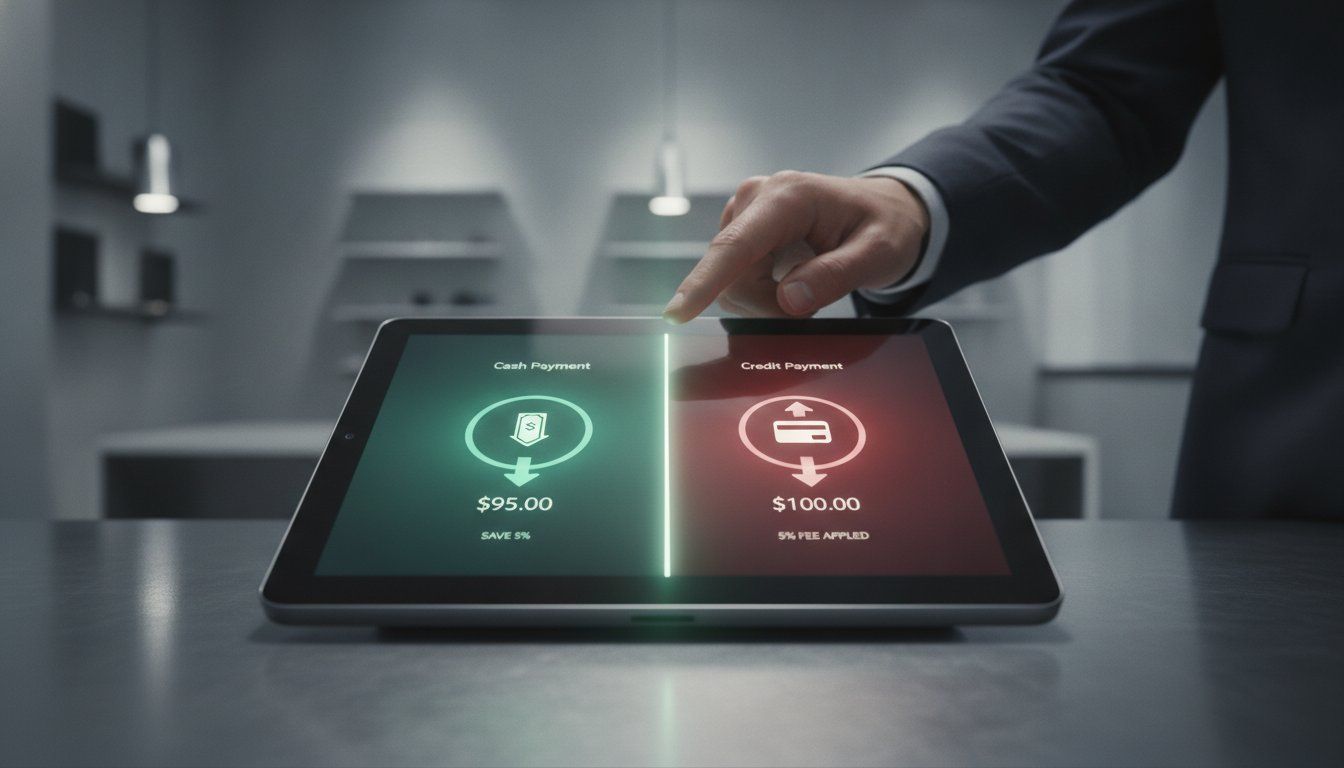
Did you know that 56% of consumers say they’re likely to switch to a different merchant just to avoid a credit card surcharge? It’s a brutal reality for business owners who are tired of losing 3% to 4% of every sale to processing fees but don’t want to drive loyal customers away. You’ve likely felt the pressure of choosing between absorbing those costs or risking a compliance nightmare. Understanding the nuances of a cash discount program vs surcharge is no longer optional; it’s a requirement for survival in 2026.
We know how confusing the landscape is, especially with Visa capping surcharges at 3% and the nationwide ban on surcharging debit cards still catching merchants off guard. This article will help you master the critical differences between these two models so you can eliminate processing fees while staying 100% compliant with state and network rules. We’ll explore how to automate your pricing engine to detect card types in real time, ensuring you never accidentally surcharge a debit user or violate state laws in places like Connecticut or Massachusetts.
Key Takeaways
- Understand the fundamental mechanics of a cash discount program vs surcharge to decide which pricing model best protects your margins and customer loyalty.
- Identify the high-risk compliance pitfalls of 2026, specifically the nationwide prohibition on surcharging debit cards and state-level restrictions in Connecticut, Maine, and Massachusetts.
- Discover why dual pricing is becoming the preferred alternative to traditional surcharges by reframing the transaction as a reward for cash users rather than a penalty for cardholders.
- Learn how to evaluate your business’s average ticket size and industry trends to choose the most effective zero-fee processing strategy.
- Explore how automated pricing engines can handle the compliance heavy lifting by detecting card types in real time to prevent illegal fees and costly fines.
Table of Contents
- Cash Discount Program vs. Surcharge: The Core Differences
- The Compliance Minefield: Debit Cards and State Laws
- Customer Psychology: Surcharge vs. Dual Pricing
- Which Program is Right for Your Business?
- Implementing a Zero-Fee Model with Strictly
Cash Discount Program vs. Surcharge: The Core Differences
Choosing between a cash discount program vs surcharge isn’t just a matter of semantics; it’s a strategic decision about your business’s “sticker price.” At its simplest, the difference lies in whether you’re adding a fee or offering a reward. A surcharge is an additional fee tacked onto a credit card transaction at the point of sale, while a cash discount is a reduction from the posted price for customers who pay with cash or check. In 2026, the shift is moving away from clunky manual signage toward automated systems that handle these calculations instantly.
To better understand this concept, watch this helpful video:
How Surcharging Works in Practice
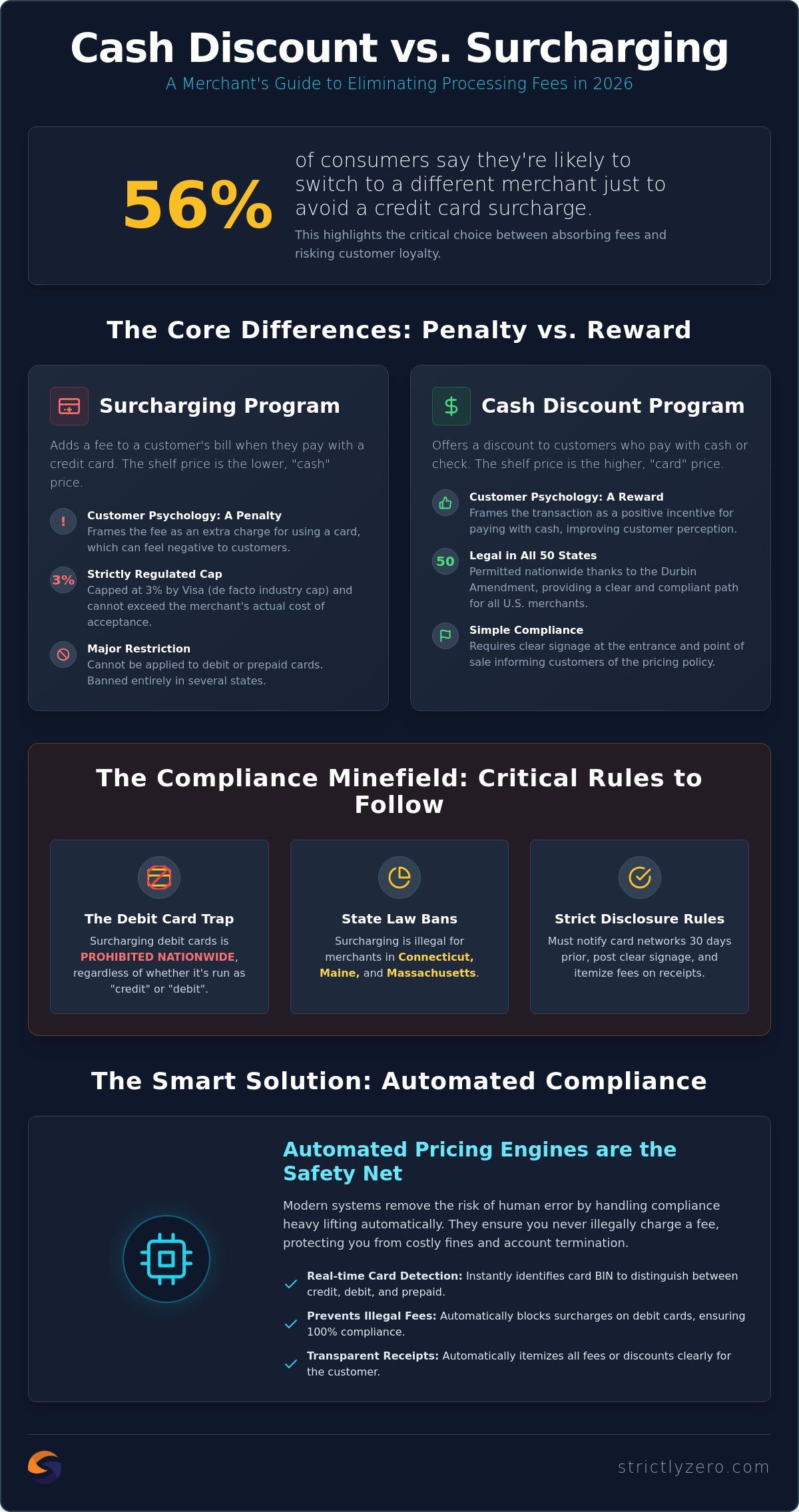
With a surcharge model, the customer sees your standard price on the shelf. If they choose to pay with a credit card, a fee is added to the total. This fee is strictly regulated; Visa currently imposes a 3% cap, while Mastercard allows up to 4%. Because most merchants accept both, the de facto cap for most businesses is 3%. Strictly’s Surcharge & Dual Pricing Engine ensures this fee never exceeds your actual cost of acceptance, protecting your margins without overcharging. A Surcharge (payment systems) must never be applied to debit or prepaid cards. Doing so is a major compliance violation that can lead to heavy fines or the loss of your merchant account.
The Mechanics of a Cash Discount Program
A cash discount program flips the script. All your posted prices are technically the “credit price.” When a customer pays with cash, they receive an immediate discount. This model is legally distinct from surcharging because it’s framed as an incentive rather than a penalty. It’s legal in all 50 states thanks to the Durbin Amendment. To remain compliant, you must display clear signage at your entrance and at the point of sale. Many modern businesses prefer this because it feels more positive to the customer. Instead of seeing an extra fee on their receipt, they see a “Cash Discount” line item that reduces their total.
The real challenge for 2026 merchants is managing the “starting price” distinction. Surcharges allow you to keep your advertised prices lower, which can be helpful for price-sensitive markets. Cash discounts require you to raise your base prices first so the “discounted” cash price still covers your costs. Using an automated Surcharge & Dual Pricing Engine removes the guesswork. It allows you to toggle between these models as your business grows while keeping your pricing transparent and your receipts fully itemized.
The Compliance Minefield: Debit Cards and State Laws
The biggest danger in the cash discount program vs surcharge debate is the “debit card trap.” Many merchants mistakenly believe they can surcharge any transaction if the customer selects “credit” on the terminal. This is a costly misconception. Under the Durbin Amendment and strict card network rules, surcharging a debit card is prohibited nationwide, regardless of how the transaction is processed. If you accidentally apply a fee to a debit card, you’re not just breaking a rule; you’re risking your merchant account and inviting heavy regulatory scrutiny.
Compliance also requires precise disclosures. You can’t just start charging extra without warning. You must notify card networks at least 30 days in advance and display clear signage at both the entrance and the point of sale. Your receipts must also show the surcharge as a separate line item. Failure to meet these transparency standards can lead to consumer protection lawsuits. This is why successful zero fee credit card processing relies on technology that handles these details automatically.
Automated Debit Detection: The Safety Net
Manual oversight fails in high-volume environments. Your staff can’t be expected to “eyeball” every card to determine if it’s a credit, debit, or prepaid card. Modern cards often look identical, yet the legal distinction is massive. A Smart Pricing Engine solves this by instantly identifying the Bank Identification Number (BIN) as soon as the card is swiped or dipped. If a debit card is detected, the system suppresses the surcharge immediately. This automation is vital because non-compliance fines are steep, often ranging from $5,000 to $25,000 per occurrence. Protecting your business requires more than just a sign; it requires a digital safeguard.
Navigating State-by-State Surcharge Rules
While federal law protects cash discounts in all 50 states, surcharging is a different story. In 2026, states like Connecticut, Massachusetts, and Maine still prohibit or heavily restrict credit card surcharges. Even in states where it’s legal, the rules are a moving target. For example, Colorado has historically capped surcharges at 2%, which is lower than the standard Visa cap of 3%. You can check NFIB’s guide to surcharge and cash discount laws for a broader perspective on these regional differences.
Because credit card surcharge rules by state change frequently, manual tracking is nearly impossible for multi-state operators. Strictly’s Surcharge & Dual Pricing Engine uses automated geo-fencing to adjust your program rules based on your business location. It ensures you’re always within the legal limits of your specific jurisdiction without you having to read through hundreds of pages of legislation. If you want to stop worrying about the legal fine print, it might be time to see how automated compliance can protect your margins.
Customer Psychology: Surcharge vs. Dual Pricing
The success of your pricing model depends on how your customers perceive the math at the register. Research from early 2026 shows that 56% of consumers are likely to switch merchants if they feel “penalized” by a surcharge fee. This highlights the psychological divide in the cash discount program vs surcharge debate. A surcharge is often viewed as an unexpected penalty, while a cash discount feels like a reward for choosing a specific payment method. To bridge this gap, many modern businesses are moving toward dual pricing, which displays both the credit price and the cash price side by side.
Transparency is the most effective trust-builder you have. When customers see two prices on every shelf tag or menu item, the “surprise” factor at checkout disappears. This level of clarity is why dual pricing is frequently cited as the best credit card processing for small business owners who want to protect their margins without alienating their base. While a high-end boutique might prefer the “reward” language of a cash discount, a high-volume retail environment often finds that dual pricing provides the most straightforward customer experience.
Why Dual Pricing is Winning in 2026
Dual pricing is quickly becoming the gold standard because it bypasses the legal complexities of traditional surcharging. Since both prices are presented upfront, it doesn’t technically “add” a fee at the end of the transaction, making it easier to stay compliant with various state-by-state surcharge statutes. Strictly’s omni-channel platform takes this a step further by syncing these dual prices across your physical store terminals and your online checkout, ensuring a consistent experience for your customers no matter where they shop.
Communicating Fees to Your Customers
Staff training is the “secret sauce” of a successful transition. Your team shouldn’t apologize for the pricing; they should explain it as a way to keep base prices low for everyone. Proper signage at the entrance and counter sets expectations before the customer even reaches for their wallet. By using zero fee merchant services, you can offset the rising costs of inflation without having to implement a store-wide price hike that affects your most loyal cash-paying customers. This approach keeps your business competitive while giving your customers the power of choice.
Which Program is Right for Your Business?
Determining the right fit between a cash discount program vs surcharge depends heavily on your transaction data and customer base. If your business handles high-volume, low-dollar transactions, such as a quick-service restaurant (QSR), a cash discount model often feels more natural. Customers are accustomed to seeing small discounts for cash at coffee shops or delis. Conversely, B2B services or high-ticket retailers often find surcharging more effective. In these industries, a 3% fee on a $5,000 invoice is a standard expectation, and customers are less likely to switch providers over a transparently disclosed cost of acceptance.
Before making the switch, auditing your current credit card processing services is essential. You need to know exactly where your margins are being eroded by interchange markups and hidden fees. Many merchants rely on their Independent Sales Organization (ISO) to help navigate this transition. A quality ISO won’t just sell you a program; they’ll provide a stable, long-term strategy that aligns with your specific industry norms and average ticket size.
Decision Matrix: Surcharge vs. Cash Discount
Implementation ease often tips the scale toward surcharging. It requires zero changes to your physical price tags or menu boards since the fee is added only at the register. However, the compliance burden is higher due to network rules and state-level bans discussed earlier. Cash discounting is generally easier to defend legally and is protected in all 50 states, but it requires you to list the “credit price” as your standard posted price. If reaching a true “$0 fee” goal is your priority, both models can get you there, provided your technology accurately accounts for every penny of the processing cost.
Software-Led vs. Manual Programs
Relying on manual “sticker-based” programs is a recipe for disaster in 2026. If your pricing system doesn’t integrate directly with your POS, you’re inviting human error and potential fines. This is especially true for ecommerce payment processing, where a dynamic engine must calculate fees based on card type and location in milliseconds. The total cost of ownership for a manual program often includes the price of non-compliance, which can quickly wipe out any savings. To avoid these risks, you can find the right pricing model for your business by leveraging a platform that automates the entire decision-making process.
Implementing a Zero-Fee Model with Strictly
Strictly’s Smart Pricing Engine takes the guesswork out of the cash discount program vs surcharge debate by automating the entire decision-making process at the point of sale. Instead of relying on your staff to memorize shifting state laws or network rules, our platform handles the compliance heavy lifting in the background. Whether you are using our Virtual Terminal for invoicing or an integrated website checkout, the engine identifies the card type and location in milliseconds to apply the correct pricing logic. This ensures you never accidentally surcharge a debit card or violate state-specific caps in places like Colorado or Maine.
Integration is seamless, allowing you to add zero-fee models to your existing omni-channel setup without a complete hardware overhaul. For ISO partners, this automation is a game changer. By providing a “set it and forget it” compliance engine, ISOs can scale their payments business faster than ever. Merchants gain the ability to eliminate processing fees entirely, while partners benefit from a stable, compliant platform that reduces the risk of merchant churn and regulatory fines.
Strictly’s Omni-Channel Advantage
Managing a zero-fee program shouldn’t mean dealing with fragmented data. Our platform provides unified reporting that tracks your savings across mobile, in-person, and online payments in one dashboard. To help you understand the long-term impact of your pricing strategy, we offer ChurnIQ™, which monitors how your fee program affects customer retention over time. Partners also benefit from ClearSplit™, our specialized tool for automated compensation. This ensures that every stakeholder in the payment chain is paid accurately and on time, reflecting the true value of the zero-fee model.
Getting Started Today
The transition to a $0 processing fee model is designed to be fast and frictionless. We follow a proven three-step onboarding process to ensure your business is protected from day one:
- Step 1: You’ll start with a consultation to determine if a cash discount or surcharge model is better for your specific state, industry, and average ticket size.
- Step 2: Our team handles the automated setup of the Smart Pricing Engine, ensuring your Virtual Terminal or website is configured for 100% compliance.
- Step 3: We provide comprehensive staff training materials and deliver compliant signage to your location, meeting all card network disclosure requirements.
Stop letting processing fees eat away at your hard-earned margins. It is time to take control of your revenue and provide a transparent payment experience for your customers. Eliminate your processing fees today with Strictly and join the zero-fee revolution.
Take Control of Your Profit Margins in 2026
Deciding between a cash discount program vs surcharge is no longer just a branding choice; it’s a vital move for your bottom line. You’ve seen that the real challenge isn’t just picking a model, but ensuring your technology can handle the complex compliance rules that vary by card type and state. By moving away from manual systems, you protect your business from the “debit card trap” and ensure your customers always receive a transparent, fair experience at the register.
Strictly provides the automated tools you need to eliminate fees without the legal headache. Our State-by-State Compliance Engine and Automated Debit Detection handle the heavy lifting for you, while our proprietary ClearSplit™ partner tools ensure seamless management for those scaling their payments business. You don’t have to settle for losing a percentage of every sale to processing costs when a smarter solution is ready to deploy.
Start Saving Today: Get a Zero-Fee Processing Quote
It’s time to stop letting interchange fees eat your profits and start reinvesting that capital back into your business’s future, whether that means expanding your reach or supporting vital community resources like Blessings Sober Living.
Frequently Asked Questions
Is a cash discount program legal in all 50 states?
Yes, a cash discount program is legal in all 50 U.S. states. The Durbin Amendment to the Dodd-Frank Act protects a merchant’s right to offer an incentive or discount to encourage customers to pay by cash, check, or debit card. Unlike surcharging, which faces restrictions in several states, cash discounting is a universally permitted practice as long as you follow proper disclosure rules and display your prices correctly.
Can I apply a surcharge to a debit card if the customer chooses ‘credit’ at the terminal?
No, you cannot legally apply a surcharge to a debit card under any circumstances. Card network rules and federal law prohibit adding fees to debit or prepaid cards, even if the transaction is processed as “credit” with a signature. This is one of the most common compliance traps for merchants. If you accidentally surcharge a debit user, you risk heavy fines from the card networks and potential legal action.
What is the maximum surcharge fee I can legally charge in 2026?
The de facto maximum surcharge fee is 3% in 2026. While Mastercard allows for a 4% cap, Visa maintains a strict 3% limit on surcharges. Because most businesses accept both card types, you must adhere to the lower 3% limit to remain compliant with both networks. You should also be aware that some states impose lower caps, such as Colorado, which has historically limited surcharges to 2%.
Do I need to notify my credit card processor before starting a surcharge program?
Yes, you must notify your acquiring bank and the card networks at least 30 days before you implement a surcharge program. This notification is a mandatory requirement for both Visa and Mastercard. It allows the networks to ensure your business is registered correctly and that your merchant account is configured for a compliant surcharge model. Skipping this step can lead to immediate account reviews or service suspensions.
What is the difference between a surcharge and a convenience fee?
A surcharge is a fee added specifically to credit card transactions to offset processing costs, while a convenience fee is charged for the privilege of using a non-standard payment channel. For example, a theater might charge a convenience fee for tickets bought online instead of at the box office. Surcharges are restricted to credit cards, but convenience fees often apply to all payment methods used within that specific channel.
How do I display dual pricing on my website or in my store?
To implement dual pricing correctly, you must show the “Cash Price” and the “Card Price” side by side on every shelf tag, menu item, or digital product page. This transparency ensures that the customer sees the total cost of the transaction before they reach the checkout. By presenting both options upfront, you avoid the “penalty” perception often associated with a cash discount program vs surcharge and provide a more honest shopping experience.
Will surcharging drive my customers to competitors?
Consumer data from 2026 indicates that 56% of shoppers are likely to switch merchants to avoid surcharge fees. This is why clear communication and transparency are vital. If your industry standard doesn’t typically include surcharges, you might see more friction at the register. Many businesses find that a cash discount model or dual pricing feels more like a reward to the customer, which helps maintain loyalty while still protecting your margins.
How does Strictly’s Smart Pricing Engine handle different state laws automatically?
Strictly’s Smart Pricing Engine uses real-time geo-fencing and Bank Identification Number (BIN) detection to manage compliance on your behalf. As soon as a transaction begins, the engine identifies the card type and the merchant’s location. If the system detects a debit card or finds that the transaction is occurring in a state where surcharging is prohibited, it automatically suppresses the fee. This automation removes the risk of human error and keeps your business 100% compliant without manual tracking.