
Compliant Credit Card Surcharging: The 2026 Merchant Guide
Published:

What if your monthly merchant statement arrived with a processing fee of exactly zero dollars? For most business owners, high processing costs are just an accepted tax on doing business. You’ve probably felt the sting of watching your margins evaporate with every swipe, yet the confusion over compliant credit card surcharging and the fear of network fines keeps you from taking action. It’s exhausting to keep up with which states allow fees and which ones don’t.
You aren’t alone in your frustration over these shifting rules. This guide will help you master the complex network rules and state laws to eliminate your processing fees without legal risk. We’ll explore the latest 2026 regulations, from the 3% surcharge cap enforced by Visa and Mastercard to California’s strict transparency requirements. You’ll learn how to use a Smart Pricing Engine to automate your compliance, ensuring you never accidentally surcharge a debit card or miss a state-specific disclosure. By the end, you’ll have a clear roadmap to zero-fee processing that keeps your customers happy and your business safe.
Key Takeaways
- Master the 2026 legal landscape to implement compliant credit card surcharging and eliminate processing fees without the risk of network penalties.
- Identify specific state-level restrictions in places like Maine and California that dictate how you must display and cap your transaction fees.
- Learn why surcharging debit cards is strictly prohibited and how to use automated detection to prevent costly compliance violations.
- Compare surcharging against dual pricing to find the most sustainable zero-fee model for your specific customer base and location.
- Discover how a Smart Pricing Engine handles real-time compliance, allowing you to focus on growth instead of monitoring changing card network rules.
Table of Contents
- What is Compliant Credit Card Surcharging in 2026?
- The 4 Pillars of a Compliant Surcharge Program
- Surcharging vs. Dual Pricing: Choosing Your Strategy
- Step-by-Step: Implementing Surcharges Without Customer Churn
- Automating Compliance with Strictly’s Smart Pricing Engine
What is Compliant Credit Card Surcharging in 2026?
In its simplest form, a surcharge is an additional fee a business adds to a transaction when a customer pays with a credit card. It’s designed to cover the merchant’s cost of processing that payment. If you’ve wondered, What is a credit card surcharge?, it’s essentially a way to shift the burden of interchange fees from the business owner to the consumer. By 2026, regulatory shifts moved this practice from a niche workaround to a solidified, standard business strategy. Legislators and card brands have worked to clarify the rules, making it easier for businesses to operate transparently.
Establishing compliant credit card surcharging is the only way to protect your business from network fines while aiming for a zero-fee model. Compliance isn’t just a suggestion; it’s the foundation of the entire system. Without following the strict rules set by card brands and state governments, you risk losing your merchant account or facing litigation. In the current market, transparency is the primary focus. Merchants must provide clear notification before the sale and on the final receipt to stay within the lines.
To better understand this concept, watch this helpful video:
The Economic Impact for Modern Merchants
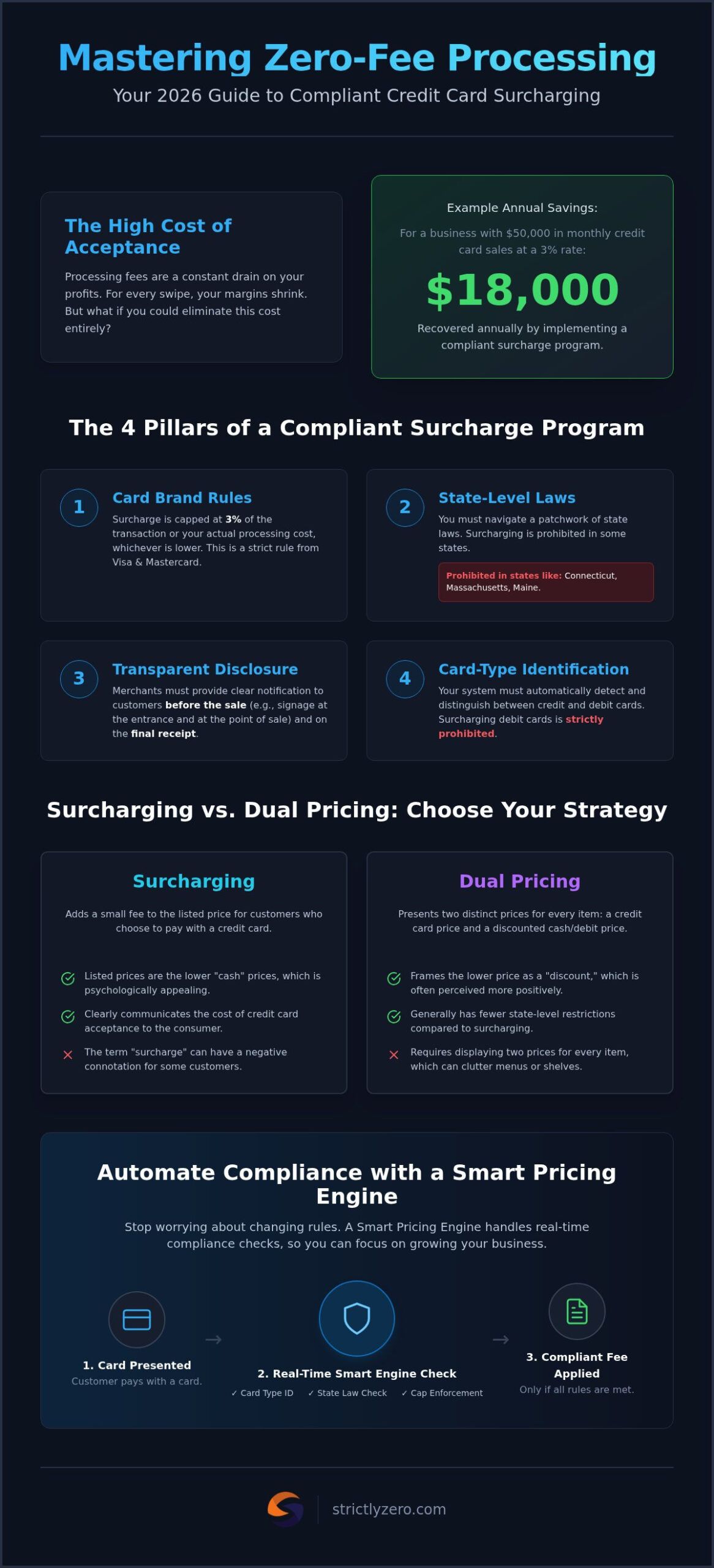
Interchange fees continue to climb, eating into the slim margins of small and mid-sized businesses. This is why more merchants are adopting zero fee credit card processing as a defensive measure. Consider a business processing $50,000 in monthly credit card sales. With an average effective rate of 3%, that merchant loses $1,500 every month to fees. Implementing a compliant surcharge program allows that business to keep that $1,500, which often covers a significant portion of their rent or payroll expenses. These savings go directly back into the business for hiring, inventory, or expansion.
Surcharge vs. Convenience Fees vs. Service Fees
Under current card brand rules, these terms aren’t interchangeable. Choosing the wrong label can lead to compliance failures and unexpected fines. Here’s how the industry distinguishes between them:
- Surcharge: A percentage-based fee added only to credit card transactions to cover processing costs.
- Service Fee: Typically used by government agencies or educational institutions and can apply to all payment types, including debit.
- Convenience Fee: A convenience fee is a flat fee charged for the privilege of using a non-standard payment channel, such as paying online for a business that usually takes payments in person.
Surcharges are the most common tool for retail and service businesses wanting to offset costs. However, you must ensure your terminal or software can distinguish between card types automatically. Achieving compliant credit card surcharging requires real-time BIN detection to avoid charging debit card users. If you accidentally charge a fee on a debit card, you’ve violated federal law and card network agreements, which can lead to immediate account suspension.
The 4 Pillars of a Compliant Surcharge Program
Building a compliant credit card surcharging program requires more than just adding a line item to your receipts. It rests on four critical pillars that protect you from both legal action and card network penalties. If you miss even one, your entire zero-fee strategy could collapse under the weight of fines or a terminated merchant account. Compliance is a multi-layered shield involving card brand rules, state laws, transparent disclosures, and strict card-type identification.
Card brands like Visa and Mastercard enforce strict caps, currently limiting surcharges to 3% of the transaction or your actual cost of acceptance, whichever is lower. Simultaneously, you must navigate a patchwork of state-by-state surcharge laws. As of August 2026, states like Connecticut, Massachusetts, and Maine still prohibit surcharging entirely. Other regions like Colorado and New York impose their own specific caps and disclosure requirements that often differ from the standard network rules. Keeping track of these variations is essential for any business operating across state lines.
Transparency is the third pillar and it’s non-negotiable. You must post clear signage at your point of entry and at the point of sale. Customers need to know about the fee before they even reach for their wallets. However, the most dangerous trap is the fourth pillar: the debit card ban. Under the Durbin Amendment, surcharging any debit or prepaid card is illegal nationwide. Doing so is the fastest way to lose your processing privileges and face federal scrutiny. To ensure your business stays protected, consider using an omni-channel payment processor that handles these rules automatically.
Card Brand Notification and Registration
Before you collect a single cent in surcharges, you must notify the card networks. Visa and Mastercard require a formal 30-day notice before you begin. While some merchants try to handle this paperwork manually, modern platforms often automate this registration process on your behalf. This ensures you’re registered correctly with every major network, including American Express and Discover, without the administrative headache. This notification period allows the networks to verify that your proposed surcharge percentage stays within the 3% limit.
The Critical Importance of Debit Card Detection
Human error is the primary cause of non-compliance. Your staff can’t always tell the difference between a credit card and a debit card just by looking at it. This is where a robust BIN database becomes essential. Automated detection systems check the card’s Bank Identification Number in real-time. If the system identifies a debit card, it automatically suppresses the surcharge, keeping your business on the right side of federal law. Relying on manual detection is a liability that can lead to illegal surcharges and immediate account suspension.
Surcharging vs. Dual Pricing: Choosing Your Strategy
Choosing between surcharging and dual pricing isn’t just about technical compliance; it’s about how you want your customers to perceive your brand. While compliant credit card surcharging is a powerful tool for recovering costs, it frames the transaction as adding an extra fee to the total. Dual pricing, on the other hand, presents the customer with two distinct prices from the start: one for cash and one for card. This shift in perspective can significantly reduce friction at the checkout counter because it feels like a choice rather than a penalty.
The landscape of credit card processing for small business has shifted toward radical transparency. In the past, simple cash discounting was the standard alternative, but it often led to messy accounting and confusing signage. Dual pricing has emerged as the most robust way to achieve a zero-fee model because it eliminates the surprise of a surcharge appearing at the final step of the payment process. By showing both prices upfront, you meet the highest standards of transparency while still protecting your bottom line.
The Dual Pricing Advantage
Dual pricing offers a unique legal advantage by bypassing many of the strict regulations that govern traditional surcharges. Because you’re displaying two set prices for every item, you aren’t technically “adding a fee” at the point of sale. Instead, you’re offering two different price points based on the payment method. This model is especially effective in states with complex disclosure laws because it clearly displays both the “Card Price” and the “Cash Price” on every receipt and price tag. In retail environments, this usually means using digital shelf tags or clear signage, while e-commerce platforms can use a simple toggle at checkout to show the price difference in real-time.
Which Model Fits Your Business Type?
The right choice often depends on your industry and how your customers typically pay. For B2B companies, surcharging is often the best fit. In these environments, processing fees are an industry standard, and professional buyers are accustomed to seeing a surcharge on their invoices. It’s a straightforward way to manage high-ticket transactions without rewriting your entire price list. However, for retail and food service businesses, dual pricing is generally the superior option. It preserves the customer experience by framing the cash price as a benefit, which helps maintain loyalty even as you eliminate your processing costs.
While dual pricing requires more initial effort to update your price lists and inventory systems, surcharging demands more rigorous real-time compliance monitoring to ensure you never accidentally charge a fee on a debit card.
Step-by-Step: Implementing Surcharges Without Customer Churn
Transitioning to a surcharge model doesn’t have to alienate your base. Success starts with a thorough audit of your current credit card processing services to ensure your hardware and software are technically capable of handling compliant credit card surcharging. Many legacy systems simply aren’t designed to split out fees or recognize card types in real-time. If your system can’t itemize the surcharge as a distinct line item on the customer’s receipt, you’re effectively out of compliance before you even begin.
Your receipt must clearly show the transaction subtotal, the surcharge amount, and the final total. This transparency prevents disputes and chargebacks. Beyond the technical setup, you must notify your acquiring bank and card networks like Visa and Mastercard at least 30 days in advance. Skipping this step is a common oversight that can lead to immediate fines. Once the technical and administrative foundations are set, focus on your physical and digital presence to maintain total transparency.
Signage and Disclosure Requirements
Compliance isn’t just about what happens at the terminal; it’s about what the customer sees before they pay. For physical storefronts, you must place clear signage at the entrance and at every point of sale. These disclosures shouldn’t be hidden in fine print. They must clearly state that a surcharge applies to credit card purchases and that this fee does not exceed your cost of acceptance, which is capped at 3% for major card networks like Visa and Mastercard. In an e-commerce environment, you must disclose the fee on the checkout page before the customer completes the transaction. A common mistake is waiting until the final “thank you” screen to show the fee, which violates network rules and frustrates buyers.
Communication Strategy for Customers
Staff training is the secret weapon for preventing churn. Your team should be prepared to answer objections with confidence and clarity. Instead of apologizing for the fee, frame it as a way to keep your base prices stable for everyone. Explain that credit card processing costs have risen, and the surcharge allows the business to avoid a store-wide price hike. Always offer a “fee-free” alternative, such as cash or debit, to give the customer control over their total cost. When customers understand that you’re being transparent rather than opportunistic, they’re far more likely to accept the change. If you want to eliminate the guesswork and ensure every transaction follows these rules, consider implementing an automated compliance engine that manages these disclosures for you.
Automating Compliance with Strictly’s Smart Pricing Engine
Running a business across state lines or even in a single location with complex rules makes manual compliance a serious liability. If your staff misses a single update to card network rules, you could face heavy fines or account termination. Strictly’s Smart Pricing Engine removes this risk by automating every step of the process. It doesn’t just calculate a fee; it manages the entire environment of compliant credit card surcharging by identifying card types and location-based rules in the background.
This technology is what defines the best credit card processing for small business in 2026. It handles the mandatory 30-day card brand notifications automatically, so you don’t have to spend hours on paperwork or worry about missing a deadline. You can focus on serving your customers while the software ensures your margins are protected legally. By moving compliance from a manual checklist to a software-driven standard, you eliminate the human error that leads to litigation.
Real-Time BIN Detection Technology
The most common compliance failure happens when a merchant accidentally surcharges a debit card. Our Smart Pricing Engine uses real-time BIN (Bank Identification Number) detection to identify the card type in milliseconds. If the system detects a debit or prepaid card, it suppresses the surcharge before the transaction is authorized. This feature serves as your best insurance policy, preventing illegal surcharges that could lead to federal penalties or the loss of your merchant account. You won’t have to rely on your cashier’s ability to spot a “debit” logo on a busy afternoon.
State-by-State Regulatory Mapping
State laws change frequently; keeping up with specific wording required in New York versus the caps in Colorado is a full-time job. The Smart Pricing Engine uses regulatory mapping to toggle rules based on your physical or nexus location. As regulations shift in 2026 and beyond, the platform updates automatically. You won’t need to manually change your signage or software settings every time a state legislature passes a new bill. This ensures your compliant credit card surcharging program remains current without any manual intervention. See how Strictly automates your compliance today.
Secure Your Margins and Simplify Your Operations
High processing fees don’t have to be a permanent drain on your business revenue. By mastering the four pillars of compliance and choosing the right strategy between surcharging and dual pricing, you can effectively reach a zero-fee model. The shift toward transparency in 2026 means that merchants who prioritize clear communication and automated tools will win customer trust while protecting their bottom line. Establishing a program for compliant credit card surcharging is now a standard business evolution rather than a legal risk.
You don’t need to be a legal expert to navigate these shifting state laws and network rules. Technology now handles the heavy lifting, ensuring you never accidentally surcharge a debit card or miss a mandatory disclosure. It’s time to stop letting interchange fees eat your profits and start using a system that works for you. Take control of your margins today.
Eliminate your processing fees with Strictly’s Compliant Surcharge Program. Our platform provides automated state-by-state compliance, real-time debit card detection, and a no-cost merchant account setup. You’ve built your business to succeed; don’t let processing fees hold you back any longer.
Frequently Asked Questions
Is credit card surcharging legal in all 50 states in 2026?
No, it isn’t legal everywhere. As of August 2026, you cannot surcharge in Connecticut, Massachusetts, or Maine. Puerto Rico also maintains a ban. Many other states have specific restrictions, such as Colorado’s 2% cap or California’s requirement to include fees in the advertised price. Always check local statutes before starting a program to ensure you’re following compliant credit card surcharging practices in every jurisdiction where you operate.
Can I add a surcharge to debit card transactions if they are processed as “credit”?
Absolutely not. Federal law under the Durbin Amendment prohibits surcharging debit cards, even if the customer runs them as “credit” at the terminal. Card network rules are equally strict on this point. If you accidentally charge a fee on a debit card, you risk immediate account suspension. This is why automated BIN detection is essential; it identifies the card type in milliseconds to prevent illegal fees before authorization occurs.
What is the maximum percentage I can legally surcharge?
The maximum legal surcharge is currently 3% of the transaction amount or your actual cost of processing, whichever is lower. While some older guides might mention a 4% cap, major networks like Visa and Mastercard enforced a 3% limit as of August 2026. Some states impose even tighter restrictions. For example, Colorado limits surcharges to 2%. You must never profit from the surcharge; it should only cover your actual acceptance costs.
Do I need to notify my customers before adding a surcharge?
Yes, transparency is a core requirement for compliant credit card surcharging. You must post clear signage at your business entrance and at the point of sale. For online stores, the disclosure must appear on the checkout page before the customer clicks the final “pay” button. Additionally, the surcharge must be listed as a separate line item on the final receipt so the customer knows exactly what they paid for processing.
What happens if I fail a card brand compliance audit?
Failing an audit can have severe consequences for your business. Card brands like Visa and Mastercard regularly monitor merchant activity for illegal debit surcharging or excessive fee percentages. If they find you’re out of compliance, they can levy thousands of dollars in fines per violation. In extreme cases, they may permanently terminate your ability to accept credit cards. Using an automated engine helps you stay within the rules and pass audits easily.
How does dual pricing differ from a standard surcharge?
Surcharging adds a percentage fee to the advertised price at the moment of checkout. Dual pricing is different because it displays two distinct prices for every item: a cash price and a card price. Because dual pricing shows the full cost upfront, it’s often viewed more favorably by regulators and is legal in states where traditional surcharging is restricted. It’s a transparent way to achieve zero-fee processing without adding “surprise” fees at the end.
Do I need to notify Visa and Mastercard before I start surcharging?
Yes, you must notify your merchant acquirer and the major card networks at least 30 days before you begin surcharging. This notification period allows the networks to verify that your program meets their specific guidelines. Many modern payment processors handle this registration on your behalf, ensuring that all paperwork is filed correctly with Visa, Mastercard, and other brands. Starting without this notice is a violation that can lead to immediate network fines.
Can I surcharge online and in-person transactions at the same time?
You can certainly surcharge across multiple channels, but you must follow the specific rules for each environment. Physical stores require signage at the door and the register, while digital storefronts must show the fee clearly on the checkout page. Using an omni-channel pricing engine ensures that your compliance rules stay consistent whether a customer pays on your website, through a mobile app, or at your physical checkout counter in person.