
Convincing Your Team to Switch Processors: A 2026 Strategic Guide
Published:

What if the biggest leak in your 2026 revenue isn’t a lack of sales, but the 3.5% you’re handing over to your current processor on every single transaction? You likely already know those fees are eating your margins. Still, the thought of a migration often makes IT leads worry about downtime and Finance teams fear workflow disruptions. It’s understandable why you’ve hesitated, but convincing your team to switch processors is no longer just a technical task; it’s a vital financial strategy to move toward a zero-fee payment infrastructure.
Traditional processing fees of 3% or more don’t just reduce net profit; they lock up capital that could fund your next big growth initiative. For high-volume merchants, these small percentages compound into hundreds of thousands of dollars in lost annual revenue. Specialized B2B solutions like P2EZPay help these organizations recapture that lost margin by streamlining corporate payment structures. You need to look closely at your effective rate. The effective rate is the total dollar amount of all processing fees divided by your total sales volume. When you see that number in black and white, the urgency for convincing your team to switch processors becomes undeniable.
We’re here to help you master the internal pitch and overcome every objection standing in your way. You’ll learn how to present a clear ROI roadmap that secures buy-in from both Finance and IT. By the end of this guide, you’ll have the tools to lead a seamless transition that eliminates fee impact without risking your operational stability. We’ll explore how to turn your payment processing from a cost center into a competitive advantage for your entire organization.
Key Takeaways
- Identify the cumulative costs of the legacy “Inertia Tax” and learn how a zero-fee model can immediately improve your profitability.
- Master the internal pitch for convincing your team to switch processors by aligning the transition with the specific goals of each department.
- Explore how compliant surcharge and dual pricing engines turn payment processing into a strategic asset rather than a recurring cost center.
- Follow a structured five-step roadmap to audit your current rates and migrate to a more agile, omni-channel payment infrastructure.
Table of Contents
- The Cost of Staying: Why Your Current Processor is a Liability
- Building the Business Case: ROI That Finance Cannot Ignore
- Navigating pushback: Addressing Every Department’s Concerns
- The 5-Step Migration Roadmap to a New Processor
- Strictly: The Logical Choice for Your Team’s Next Chapter
The Cost of Staying: Why Your Current Processor is a Liability
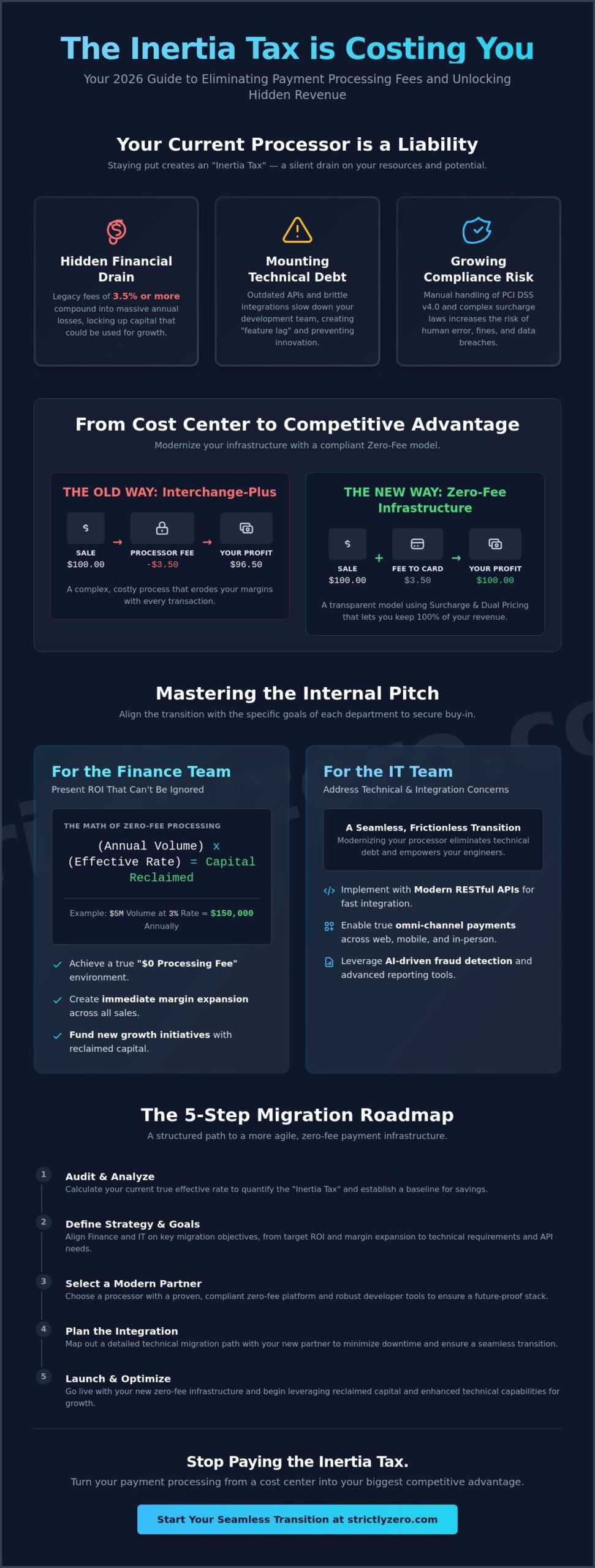
Many businesses treat their payment processor as a set-it-and-forget-it utility. In 2026, this complacency creates an “Inertia Tax.” This is the cumulative financial drain caused by staying with a provider that uses outdated interchange-plus pricing while your competitors move toward zero-fee models. Convincing your team to switch processors starts by highlighting how legacy systems lack the agility to handle modern omni-channel demands. If your infrastructure can’t adapt to real-time payment rails or AI-driven fraud detection, you aren’t just losing money on fees; you’re losing ground in the market.
To better understand the impact of upgrading your core infrastructure, watch this helpful video:
The 2026 regulatory landscape has also shifted the math on compliance. With the full implementation of PCI DSS v4.0 and new surcharge laws, manual compliance is a massive liability. Legacy processors often leave the heavy lifting to your internal teams, increasing the risk of human error. Modern platforms use automated surcharge and dual pricing engines to handle these complexities, ensuring legality while shifting the cost of processing away from your bottom line. This contrast between traditional fee structures and modern, compliant automation is the strongest argument for change.
The Hidden Drain of Transaction Fees
Technical Debt and Integration Friction
Old APIs and brittle integrations are a silent killer of productivity. They slow down your development team and create “feature lag,” preventing you from launching new payment methods or fraud prevention tools. If your tech stack is struggling to sync across web, mobile, and in-person channels, you’re dealing with technical debt that only grows over time. For a deeper look at building a stack that actually scales, see our ecommerce payment processing guide. Modernizing your processor isn’t just about saving money; it’s about giving your engineers the tools they need to innovate without friction.
Building the Business Case: ROI That Finance Cannot Ignore
The Finance department speaks the language of numbers. To get their attention, you must demonstrate how a modern payment infrastructure does more than just move money; it creates immediate margin expansion. By shifting to a Surcharge and Dual Pricing model, you can effectively reach a “$0 Processing Fee” environment. This isn’t just a minor optimization. It’s a fundamental shift that offsets the rising costs of doing business in 2026. While some fear that these models impact customer loyalty, transparent pricing actually builds trust. Customers often prefer a clear breakdown over hidden costs baked into product prices.
The initial effort of migration is quickly eclipsed by the savings generated. If your current processor takes a 3% cut, the first year of a surcharge program can save a high-volume business tens of thousands of dollars. Federal guidelines frequently highlight ways businesses can reduce your costs through smarter payment choices. When you present this data, the path forward becomes clear. Convincing your team to switch processors is much easier when the first-year savings outweigh the implementation costs within the first few months.
The Math of Zero-Fee Processing
Calculating the ROI is straightforward. Take your total annual credit card volume and multiply it by your current effective rate. That represents the capital you’ll reclaim every year. Implementing zero fee credit card processing relies on a Smart Pricing Engine. This technology automatically detects card types and applies the correct, compliant surcharge in real-time. It removes the guesswork and ensures you aren’t violating state-specific regulations while you reclaim your margins. You might want to review your recent statements to see exactly how much you’re leaving on the table.
AI-Driven Fraud Prevention as a Cost Saver
ROI isn’t just about what you save on fees. It’s also about what you don’t lose to fraud. Modern processors use AI-driven fraud prevention to analyze transaction patterns instantly. This reduces the time your finance team spends on manual reviews and drastically lowers chargeback rates. In a shifting regulatory environment, having a system that automates state-by-state compliance is a major risk mitigation asset. Convincing your team to switch processors is easier when you show that the new system protects the company from both high fees and expensive security lapses. The combination of fee elimination and reduced fraud risk makes the business case undeniable.
Navigating pushback: Addressing Every Department’s Concerns
Even when the financial benefits are undeniable, human resistance can stall a necessary migration. To succeed, you must align the “Stakeholder Trinity”: Finance, IT/Engineering, and Sales. Each department views a processor switch through a different lens. Finance worries about reconciliation gaps. IT fears technical debt and downtime. Sales and Customer Success worry about friction at the checkout. Successfully convincing your team to switch processors requires addressing these distinct anxieties with concrete solutions rather than vague promises.
When you prepare your pitch, remember that leaders are more likely to support a change that lightens their workload. You need to convince other leaders by demonstrating how modern infrastructure replaces manual chores with automation. For Finance, emphasize automated reconciliation tools that eliminate hours of monthly spreadsheet work. For Sales, focus on how omni-channel flexibility allows for faster, more diverse checkout experiences that can actually increase conversion rates.
Winning Over the Tech Team
Your engineering team’s biggest fear is “Downtime Phobia.” They don’t want to be responsible for a broken checkout on a Tuesday morning. Address this by proposing a parallel-run migration strategy. This allows the new system to be tested alongside the old one before a full cutover. Highlight the developer-friendly documentation and robust gateway integration that modern platforms offer. While legacy systems often rely on brittle code, moving to unified credit card processing services provides an API-first architecture. This reduces long-term maintenance and lets your developers focus on building features instead of fixing bugs.
Calming Customer Success Fears
The front-line staff often worries that new fee structures, like surcharging, will drive customers away. You can ease this concern by explaining how dual pricing provides customers with a clear choice. When customers see a “cash price” versus a “card price,” they feel in control of the transaction. Use tools like virtual terminals and payment links to simplify interactions for the staff. When convincing your team to switch processors, provide them with a simple talking point: “To keep our product prices low, we offer a discount for cash, but you are welcome to use your credit card for a small convenience fee.” This transparency usually turns a potential conflict into a standard business interaction.
The 5-Step Migration Roadmap to a New Processor
Transitioning to a new payment infrastructure doesn’t have to be a chaotic event. A successful migration depends on a structured rollout that proves value and stability at every stage. Convincing your team to switch processors is much simpler when you present a documented roadmap that mitigates risk and clearly defines the path to a zero-fee model. This five-step process ensures you move from a high-cost liability to a high-margin asset without losing a single transaction in the process.
Audit and Selection Phase
The first step is auditing your current processing statements to calculate your true effective rate. Legacy providers often hide extra costs behind complex line items that look like standard assessments. In 2026, a transparent processing contract should have zero hidden junk fees. Look for “Trust as a Payment Processor” as a core value in your selection criteria. It’s vital to choose a provider with a built-in, compliant surcharge engine to ensure you’re following local laws while reclaiming your revenue. For a deeper look at the top-rated providers this year, read our best credit card processing for small business roundup.
Technical Implementation and Testing
Once you’ve selected a partner, map your omni-channel needs across online, in-person, and mobile platforms. Engineering teams can test API calls in a sandbox environment to ensure the modern payment gateway communicates perfectly with your existing software. Execute a pilot program or a phased rollout with a small percentage of traffic to verify that everything works under real-world conditions. This is also the time to migrate recurring billing schedules and set up new payment links. Maintaining strict PCI DSS v4.0 compliance during this transition is essential to keep your data secure. If you want to see exactly how your current fees compare to a modern model, you should get a free statement analysis to uncover your true savings potential.
After the pilot proves successful, you can move to a full migration. This final stage involves moving all remaining volume to the new platform and training your staff on any new virtual terminal features. Only once the new system is fully operational and verified should you begin decommissioning the legacy high-fee account. By following this phased approach, you minimize downtime and provide the Finance team with immediate proof of ROI. Convincing your team to switch processors is no longer a hard sell when they can see the technical success and the financial gains happening in real-time.
Strictly: The Logical Choice for Your Team’s Next Chapter
Strictly isn’t just another utility; it’s a unified platform built to eliminate the friction points we’ve analyzed throughout this guide. When you reach the final stage of convincing your team to switch processors, you need a partner that offers more than just a lower rate. You need a system that integrates with your existing tech stack while providing the automation required to scale. Strictly provides that foundation through its Smart Pricing Engine, which handles the complexities of compliant surcharging without manual intervention from your staff. It transforms your payment setup from a recurring expense into a high-margin asset.
For businesses managing partner networks or complex revenue distributions, tools like ClearSplit™ and ChurnIQ™ offer a level of visibility that legacy systems simply can’t match. These features allow you to automate distributions and monitor customer churn in real-time. This turns your payment infrastructure into a source of genuine business intelligence. It’s about moving beyond simple transactions and toward a strategic model where every payment helps your organization grow. By choosing a partner that prioritizes transparency, you’re investing in the long-term health of your company’s bottom line.
A Platform Built for Growth
Modern development teams prioritize flexibility over everything else. Strictly’s API-first architecture ensures that your engineers aren’t fighting with brittle code or outdated documentation. This omni-channel approach future-proofs your business, allowing you to accept payments across web, mobile, and in-person environments without fragmented reporting. It aligns perfectly with the core credit card processing for small business pillars: efficiency, transparency, and scalability. When your tech stack is this agile, you can launch new products and enter new markets faster than the competition.
Support That Simplifies the Switch
One of the biggest hurdles in convincing your team to switch processors is the perceived workload of the transition. Strictly removes this barrier by providing comprehensive onboarding support that minimizes the burden on your internal staff. We handle the compliance heavy lifting, ensuring your systems meet the latest PCI DSS requirements and state-specific surcharge laws automatically. This proactive approach lets your IT and Finance teams focus on their core responsibilities instead of getting bogged down in regulatory details or migration troubleshooting. We don’t just provide the software; we provide the expertise to ensure your rollout is a success from day one.
The transition to a more profitable payment infrastructure is the most significant financial upgrade you can make this year. Ready to see the numbers for yourself? Schedule a demo with Strictly to see your potential savings and start your journey toward a more profitable, zero-fee future.
Take Control of Your Financial Future
Moving your business to a modern payment infrastructure is one of the most impactful decisions you’ll make for your 2026 bottom line. You now have the strategic framework to move beyond the “Inertia Tax” of legacy fees and outdated tech. By following a structured roadmap and addressing the specific concerns of Finance and IT, you can transform your checkout from a cost center into a profit driver. Successfully convincing your team to switch processors relies on demonstrating that operational stability and increased margins can coexist through smart automation.
Strictly provides the essential tools to make this transition seamless. Our Smart Pricing Engine handles automated compliance across all regions, while our API-first platform ensures your engineering team can integrate without friction. By leveraging zero-fee surcharge and dual pricing models, you’re not just cutting costs; you’re reclaiming your hard-earned revenue. It’s time to stop letting transaction fees eat your growth capital and start scaling with a partner that prioritizes your profitability.
Eliminate your processing fees today with Strictly and give your organization the financial freedom it deserves. The path to a zero-fee future is clear, and your team is ready for a more efficient way to work.
Frequently Asked Questions
How do I explain a new surcharge fee to my existing customers?
Transparency is the most effective approach when introducing a surcharge. Explain to your customers that by passing on the credit card processing costs, you’re able to keep your base product prices lower for everyone. You can also frame it as a choice by offering a cash or debit discount, which empowers the customer to choose their preferred way to pay without being forced into a single pricing tier.
Will switching processors cause my business to experience downtime?
No, a well-planned migration shouldn’t result in any service interruptions. By running your new payment gateway in a parallel test environment, your technical team can verify that everything is working perfectly before you make the final cutover. This phased approach ensures that your old processor remains active until the new system is fully validated and ready to handle live traffic.
How long does it typically take to integrate a new payment API?
For modern, API-first platforms, a basic integration can often be completed in 3 to 7 business days. While more complex omni-channel setups involving multiple sales touchpoints may take longer, the use of well-documented developer tools significantly reduces the timeline. Most of this period is spent on testing and verification rather than writing new code from scratch.
Is it legal to pass credit card processing fees to customers in 2026?
Yes, surcharging is legal in the vast majority of jurisdictions as of June 2026, provided you follow specific disclosure and registration requirements. Modern processing platforms include automated compliance engines that detect the customer’s location and card type in real-time. This ensures that fees are only applied where permitted by law and within the regulated percentage caps.
What is the difference between surcharging and dual pricing?
Surcharging adds a specific percentage fee to a transaction only when a customer chooses to pay with a credit card. Dual pricing is a more transparent model where every item or service has two distinct prices displayed: one for cash and one for card payments. Both methods help you reach a zero-fee processing environment while giving customers clear information about their payment options.
How can I convince my CFO that the migration cost is justified?
Focus on the immediate impact on net profit margins rather than the one-time setup effort. When convincing your team to switch processors, show the CFO that reclaiming 3% of your total annual volume usually pays for the migration within the first few months. The long-term gain of eliminating recurring fees far outweighs the temporary resource allocation required for the switch.
Can I keep my current POS hardware when switching processors?
It depends on whether your existing equipment is “unlocked” and compatible with modern payment gateways. Many software-based terminals can be easily reprogrammed to work with a new provider, but some proprietary hardware might be restricted. It’s best to have your new processor perform a compatibility audit of your current setup before you begin the formal migration process.
What happens to my recurring billing subscriptions during a switch?
Your existing subscription data can be moved securely using a process called token migration. This involves the secure transfer of encrypted payment data from your old provider to the new one, so your customers don’t have to re-enter their card information. This ensures that your recurring revenue continues to flow without interruption or the risk of losing subscribers during the transition.