
Credit Card Surcharge Compliance: The Complete 2026 Merchant Guide
Published:

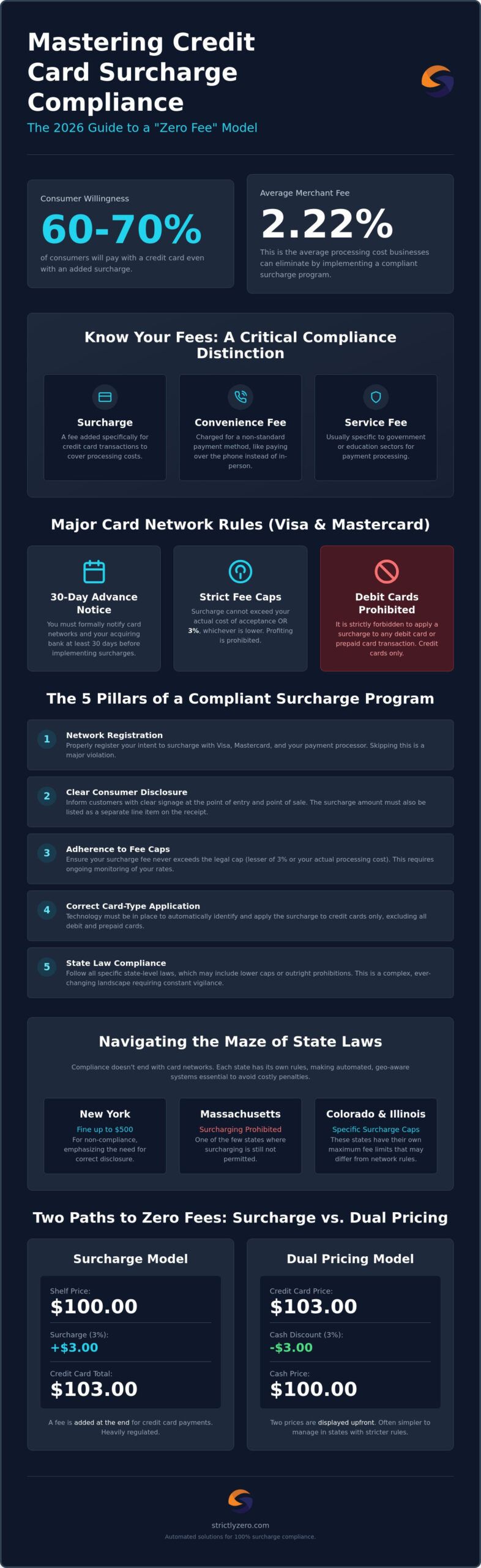
According to the National Retail Federation, 60-70% of consumers will still use a credit card even when a surcharge is applied. If you’ve been hesitant to offset your merchant discount rates, which currently average 2.22%, you’re likely worried about the legal fallout. Achieving total credit card surcharge compliance isn’t just about avoiding a $500 fine in New York or staying clear of prohibitions in Massachusetts. It’s about building a sustainable “Zero Fee” model that protects your business margins without driving away your loyal customer base.
We know how exhausting it is to juggle conflicting rules from Visa, Mastercard, and various state legislatures. You shouldn’t have to be a legal expert just to accept a payment. This guide will show you how to master the complex landscape of 2026 regulations so you can eliminate processing fees with total peace of mind. We’ll break down the specific surcharge caps in states like Illinois and Colorado, explain why you can’t surcharge debit cards, and show you how to implement a compliant program that automates the heavy lifting for you.
Key Takeaways
- Learn the mandatory 30-day notice requirements and maximum fee caps set by major card networks like Visa and Mastercard for 2026.
- Identify specific state-level restrictions and the current legal landscape to avoid heavy non-compliance penalties and fines.
- Master the five essential pillars of a compliant program, focusing on multi-point consumer disclosure and proper registration.
- Discover how to maintain 100% credit card surcharge compliance across all channels using automated tools that handle complex state-by-state logic.
- Understand the path to a sustainable “Zero Fee” model that eliminates processing costs while maintaining customer trust and transparency.
Table of Contents
- Understanding Credit Card Surcharge Compliance in 2026
- Network Rules: Navigating Visa, Mastercard, and Amex Requirements
- State Laws and Regional Variations: Where Can You Surcharge?
- The 5 Pillars of a Compliant Surcharge Program
- Scaling with Automated Compliance: The Strictly Advantage
Understanding Credit Card Surcharge Compliance in 2026
Credit card surcharge compliance is the specific set of rules and legal frameworks established by major card networks and state governments. When you apply a Surcharge (payment systems) to a transaction, you’re essentially shifting the cost of card acceptance from your business to the consumer. This helps protect your profit margins from being eroded by processing fees that currently average around 2.22%. However, this practice is only legal and safe if you adhere strictly to the guidelines set by Visa, Mastercard, and individual state legislatures.
Understanding the difference between various fees is crucial for staying compliant. A surcharge applies specifically to credit card transactions at any point of sale. In contrast, convenience fees are only for using a non-standard payment channel, like paying a bill over the phone rather than in person. Service fees are typically reserved for specific industries like government or education. Mixing these up or applying a surcharge to a debit card is a fast way to face audits and heavy fines.
To better understand this concept, watch this helpful video:
The Legal Evolution of Surcharging
The landscape for merchants changed significantly following a landmark 2013 class-action settlement. This legal victory effectively ended the absolute ban on surcharging, giving businesses the right to pass on processing costs. By 2026, the regulatory focus has moved away from prohibition and toward total transparency. Modern regulations ensure that customers aren’t surprised by hidden costs at the register. This shift has made the zero fee credit card processing model a standard choice for small businesses looking to eliminate processing overhead entirely.
Surcharge vs. Dual Pricing: A Compliance Distinction
Choosing between a surcharge and dual pricing is a major part of maintaining credit card surcharge compliance. While a surcharge adds a fee at the end of a transaction, dual pricing presents two distinct prices to the customer: one for cash and one for card. Dual pricing is often easier to manage in states with stricter rules because it’s framed as a cash discount rather than a credit penalty. Strictly provides a versatile Smart Pricing Engine that handles both models, automating the complex logic required to stay compliant across different regions and card types.
Network Rules: Navigating Visa, Mastercard, and Amex Requirements
Card networks like Visa and Mastercard don’t just allow surcharging; they regulate it with surgical precision. To maintain credit card surcharge compliance, you’ve got to play by their rules, which often operate independently from state-by-state surcharge laws. The most critical requirement is the 30 day notification period. You can’t simply flip a switch and start charging extra. You’re required to formally notify the networks and your acquiring bank at least one month before you collect your first surcharge dollar.
Notification and Registration Protocols
Visa and Mastercard require merchants to register their intent through specific portals or via their payment processor. Skipping this step leads to “stealth surcharging,” a practice card brands treat as a serious violation. This can result in immediate fines or the permanent loss of your merchant account. Strictly automates this notification for all new merchants, ensuring you’re registered correctly from day one without the manual paperwork. Failing to register is a common oversight that leaves businesses vulnerable to network audits.
Surcharge Caps and Fee Limitations
As of 2026, the maximum surcharge you can apply is capped at 3% of the transaction amount or your actual cost of acceptance, whichever is lower. This “lesser of” rule is designed to prevent merchants from profiting off the fee. If your effective processing rate is 2.2%, you can’t legally charge a 3% surcharge. Doing so is considered a “junk fee” and is a primary target for network enforcement. You must calculate your cost of acceptance based on your merchant statement to ensure your fees stay within legal bounds. If you want to avoid these manual calculations, you can explore how a dedicated surcharge engine keeps your business within these strict boundaries automatically.
Perhaps the most important rule is the absolute prohibition on surcharging debit cards. Under the Durbin Amendment, debit cards and prepaid cards are exempt from surcharging, even if the customer chooses to “run it as credit” at the terminal. Your point of sale system must be smart enough to detect the card type in real time. If your system applies a fee to a debit card, you’re in direct violation of federal law and card network agreements. This is why automated card detection is the backbone of any modern surcharge program.
State Laws and Regional Variations: Where Can You Surcharge?
While card networks set the foundation, state governments often have the final word on how you handle fees. In 2026, the map of state-by-state surcharge laws shows a complex patchwork of permissions and restrictions. Maintaining credit card surcharge compliance requires a deep understanding of where your business operates and where your customers live. Most states allow surcharging, but others like Colorado and Illinois have implemented specific caps at 2% and 1% respectively. These variations mean a one-size-fits-all approach is often a recipe for legal trouble.
For businesses operating across state lines, the “Merchant Location” rule usually dictates which laws apply. However, some states argue that the “Customer Location” should take precedence in digital transactions. This creates a compliance minefield for e-commerce brands. If you’re based in a state that allows surcharging but sell to a customer in Massachusetts, you might be in violation if your system doesn’t adjust its pricing logic dynamically. It’s a high-stakes balancing act that requires real-time data to get right.
The Legal Status of “No-Surcharge” States
Connecticut and Massachusetts remain the most restrictive regions in the country. In these states, adding a fee at checkout is still largely prohibited by state statute. However, many merchants in these areas have successfully pivoted to a Dual Pricing model. This allows you to offer a lower price for cash or debit while maintaining a standard price for credit, which is legally distinct from a surcharge. In New York, recent 2026 updates have clarified that the total credit card price must be displayed clearly before the transaction begins. Failing to show the full price upfront, rather than just the base price and a fee, can lead to a $500 fine per occurrence.
Mandatory Signage and Disclosures
Achieving credit card surcharge compliance depends heavily on transparency. You can’t hide the fee in fine print or wait until the receipt is printed to tell the customer. At physical locations, you need clear signage at the entry point and at the register. The wording must be explicit, stating that a surcharge is applied to credit card purchases and that it doesn’t exceed your cost of acceptance. For online checkouts, the disclosure must appear on the final payment page before the customer hits “submit.” Strictly’s platform handles this automatically by generating the correct digital disclosures based on the user’s location and card type, ensuring you never miss a required legal notice. For broader digital transparency, businesses often use tools like Conzent to manage cookie consent and meet GDPR or ePrivacy standards alongside their payment disclosures.
The 5 Pillars of a Compliant Surcharge Program
Building a robust program requires more than just adding a percentage to your checkout total. To achieve full credit card surcharge compliance, you must implement five specific operational pillars. These steps protect you from both network fines and consumer litigation. If you miss even one of these requirements, your entire program is at risk of being flagged during a card network audit.
- Network and State Registration: Formally notifying the card brands 30 days in advance and registering with state agencies where required.
- Multi-Point Disclosure: Placing clear signage at the business entrance and the point of sale.
- Precise Fee Calculation: Ensuring the surcharge never exceeds your actual cost of acceptance or the current 3% cap.
- Strict Itemization: Listing the fee clearly as a separate line item on every transaction record.
- Automated Debit Detection: Real-time card type identification to prevent illegal fees on non-credit cards.
The Debit Card Trap: Why Detection is Non-Negotiable
Surcharging a debit card is the most common reason for immediate merchant account termination. Even if a customer hits “credit” on a PIN pad, the card remains a debit card under federal law. You cannot legally surcharge these transactions, regardless of how they are processed. Compliant systems use Bank Identification Number (BIN) databases to check the first six to eight digits of a card. This happens in milliseconds. Strictly’s Smart Pricing Engine performs this check automatically, blocking surcharges on all debit and prepaid cards instantly. This automation removes the risk of human error at the register and ensures you stay on the right side of the Durbin Amendment.
Itemization and Receipt Requirements
Transparency doesn’t end at the signage. Your receipts must show the surcharge as a separate line item. It cannot be bundled into the “Transaction Total” or hidden within a generic service fee. This itemization serves as your primary defense during an audit or a chargeback dispute. If a customer claims they were overcharged, a compliant receipt proves you followed the proper protocols. Bundling fees often leads to “unauthorized charge” disputes, which are notoriously difficult to win without clear documentation. To see how these requirements look in practice, you can review our surcharge engine features to ensure your receipts meet every network standard.
Scaling with Automated Compliance: The Strictly Advantage
Manual implementation is a massive risk for any business in 2026. If you’re managing multiple storefronts and an online shop, trying to maintain credit card surcharge compliance by hand is nearly impossible. You’d need to track 50 state laws and thousands of BIN ranges in real time. One mistake on a single transaction could trigger a network audit or a consumer lawsuit. Automated systems remove this burden by integrating the logic directly into the transaction flow, ensuring every swipe or click is legally sound.
Strictly’s Smart Pricing Engine serves as the brain of your payment stack. It identifies the card type, confirms the merchant’s location, and applies the correct fee according to current regulations. This level of precision is especially critical for ecommerce payment processing, where customers might be buying from states with lower caps like Colorado or Illinois. By automating the detection and calculation phases, you eliminate the friction that usually comes with surcharging.
ISOs and partner organizations also prefer this pre-built infrastructure. Instead of building compliance logic from scratch, they rely on Strictly to handle the heavy lifting. This allows partners to offer a “set it and forget it” solution to their merchants, backed by a platform that handles network notifications and state-by-state rule updates automatically.
Eliminating Compliance Anxiety
Next Steps: Moving to a Zero-Fee Model
Moving from a traditional model to a zero-fee model is simpler than most business owners realize. It starts with a clear calculation of your current processing overhead. By using Strictly’s tools, you can see exactly how much of that 2.22% average merchant discount rate can be legally shifted to the consumer. This transition doesn’t just save money; it provides 100% regulatory peace of mind. You don’t have to worry about the “debit card trap” or disclosure wording because the system is designed to handle those requirements for you.
If you’re ready to stop losing thousands of dollars every month to processing fees, it’s time to switch to a platform built for the 2026 landscape. You can Eliminate your fees with our Smart Surcharge Program today and start focusing on growth instead of compliance paperwork.
Take Control of Your Processing Costs Today
Navigating the 2026 regulatory landscape doesn’t have to be a constant burden on your business operations. By mastering credit card surcharge compliance, you’ve taken the first step toward reclaiming your profit margins and eliminating unnecessary overhead. You now understand that staying safe requires more than just basic signage; it demands precise fee calculations, strict itemization, and the absolute avoidance of debit card surcharging.
Instead of tracking 50 different state statutes yourself, you can lean on technology that does the heavy lifting for you. Strictly provides the automated state-by-state compliance and real-time debit detection necessary to protect your merchant account across every sales channel. Our omni-channel support ensures your pricing remains transparent and legal, whether you’re selling in-person or through a digital storefront.
Don’t let processing fees erode your hard-earned revenue any longer. You have the tools and the knowledge to implement a “Zero Fee” model correctly and safely. Get Started with Strictly’s Compliant Zero-Fee Processing and start building a more profitable future for your business today.
Frequently Asked Questions
Is it legal to surcharge credit cards in all 50 states in 2026?
No, surcharging is not legal in every state. Connecticut, Massachusetts, Maine, and Puerto Rico still have prohibitions in place as of 2026. While courts have overturned bans in states like California and Texas, you must still navigate a complex patchwork of state-level restrictions. Using a system that identifies the customer’s location ensures you don’t accidentally violate local laws in prohibited jurisdictions or states with unique caps.
What is the maximum percentage I can charge as a surcharge fee?
The maximum surcharge is 3% of the transaction amount or your actual cost of card acceptance, whichever is lower. This 3% cap is the current standard set by major card networks like Visa. It’s important to remember that some states enforce even lower limits. For example, Colorado caps fees at 2%, and Illinois has a 1% limit. You can’t legally profit from these fees; they must only cover your processing costs.
Can I surcharge debit cards if the customer chooses “credit” at the terminal?
No, you cannot surcharge debit cards under any circumstances. Federal law under the Durbin Amendment prohibits surcharges on debit and prepaid cards, even if the customer chooses the “credit” option at the terminal. Failing to distinguish between card types is a leading cause of audits. Maintaining credit card surcharge compliance requires a point of sale system that uses real-time BIN detection to block fees on all debit transactions instantly.
Do I have to notify my customers before implementing a surcharge?
Yes, clear disclosure is mandatory for every merchant. You must provide clear and conspicuous signage at your store entrance and at every register. For digital sales, the fee must be disclosed on the final checkout page before the customer completes the purchase. Your receipts must also list the surcharge as a completely separate line item to ensure the customer understands exactly what they’re paying for before the transaction is finalized.
What happens if I fail a card brand compliance audit?
Failing an audit can lead to significant financial penalties and the loss of your ability to accept cards. In states like New York, violations can result in a $500 fine per occurrence. Card networks like Visa and Mastercard may also impose their own fines or terminate your merchant agreement entirely. These consequences make it vital to use an automated system that handles the technical requirements of credit card surcharge compliance for you.
How is a surcharge different from a convenience fee?
A surcharge is a fee added specifically for the use of a credit card to offset processing costs. A convenience fee is a charge for using an alternative or “convenient” payment method, such as paying a utility bill online instead of by mail. The rules for these fees are different. You generally can’t charge both on the same transaction, and convenience fees have their own specific network restrictions that don’t apply to standard surcharging.
Does Strictly handle the card brand notification process for me?
Yes, Strictly handles the mandatory 30-day notification process for you. Visa and Mastercard require merchants to register their intent to surcharge at least one month before they begin. While many processors leave this task to the merchant, Strictly automates these notifications. This ensures your business is properly registered with the card brands from day one, removing the administrative burden and the risk of “stealth surcharging” from your daily operations.
Can I use surcharging for both online and in-person transactions?
Yes, you can implement surcharging across all your sales channels. Whether you’re processing transactions through a physical terminal, a mobile app, or an e-commerce website, the same compliance rules apply. Strictly’s omni-channel platform ensures your pricing logic remains consistent and legal everywhere you sell. This unified approach prevents the compliance gaps that often occur when merchants try to manage different systems for in-person and online sales.