
Credit Card Surcharge Laws by State: The 2026 Merchant Compliance Guide
Published:

Did you know that 34% of small businesses in the U.S. now add a surcharge to credit card transactions to protect their bottom line? If you feel like processing fees are a tax on your hard work, you aren’t alone. It’s frustrating to watch an average of 2.3% of every sale vanish before it even hits your bank account. You want to pass those costs along, but the fear of heavy fines or accidentally breaking credit card surcharge laws by state keeps you stuck in the status quo.
We understand that the legal landscape feels like a moving target. Between Connecticut’s outright ban and New York’s strict upfront pricing rules, staying compliant feels like a full time job. This guide promises to clear the fog. You’ll discover exactly where surcharging is legal in 2026 and how to implement a compliance-focused strategy that eliminates your processing fees without risking your merchant account.
We’ll provide a definitive “Yes or No” list for all 50 states, a step by step compliance checklist, and a look at how our Smart Pricing Engine automates the rules so you never accidentally surcharge a debit card.
Key Takeaways
- Master the current credit card surcharge laws by state to identify exactly where you can legally recover costs and which states, like Connecticut and Massachusetts, still enforce bans.
- Understand the strict 3% surcharge cap imposed by major card brands and why you must provide 30 days’ notice before launching your program.
- Learn why surcharging debit and prepaid cards is prohibited nationwide and how to avoid the heavy fines associated with accidental non-compliance.
- Discover how a compliance-focused Smart Pricing Engine can automate state-level rules and detect debit cards instantly at the point of sale.
- Get a step-by-step implementation checklist to ensure your signage, receipts, and pricing models meet both state legislation and card network requirements.
Table of Contents
- What Are Credit Card Surcharges? Understanding the 2026 Landscape
- Credit Card Surcharge Laws by State: 2026 Reference Map
- Card Brand Rules: Beyond State Legislation
- How to Implement a Compliant Surcharge Program
- Automating Compliance with Strictly’s Smart Pricing Engine
What Are Credit Card Surcharges? Understanding the 2026 Landscape
A surcharge is a fee added to a transaction to cover the merchant’s cost of accepting a credit card. To answer the fundamental question, “What Are Credit Card Surcharges?“, they are legally defined as a way for businesses to pass through processing costs directly to the customer. This practice has become a vital tool for maintaining margins as average processing fees reached 2.3% in 2025. Understanding the credit card surcharge laws by state is the first step toward reclaiming your revenue and protecting your business from rising costs.
To better understand how these regulations play out in real-world business environments, watch this report on recent legislative shifts:
Terminology isn’t just semantics; it’s a legal shield. A surcharge applies to all credit transactions, while a convenience fee is restricted to non-standard payment channels like online portals. Meanwhile, a cash discount rewards customers for not using cards. Regulators watch these labels closely. Recent Supreme Court rulings have shifted the power back to merchants, framing the ability to disclose these costs as a matter of free speech. This legal momentum has made 2026 the year many businesses transition to a “Zero Fee” model to stay competitive.
The Legal Distinction Between Credit and Debit
You can never surcharge a debit card. This remains a hard rule across all 50 states, even if the customer chooses to run the transaction as “credit” at the terminal. The Durbin Amendment protects debit transactions by capping interchange fees and prohibiting surcharges on these cards. If you accidentally surcharge a debit user, you risk massive fines from Visa and Mastercard. Our Smart Pricing Engine solves this by using automatic debit detection to bypass the fee instantly, ensuring your process remains compliance-focused.
Why Surcharging is Gaining Popularity in 2026
With credit card debt reaching $1.35 trillion in early 2026, more consumers are using plastic than ever. Merchants are feeling the squeeze of rising interchange rates, leading 34% of small businesses to adopt surcharging as a defensive measure. Shoppers are also becoming more accustomed to seeing these fees, often preferring a transparent surcharge over a general price hike on all goods. This shift has paved the way for zero fee credit card processing to become a standard business practice for those looking to protect their bottom line.
Credit Card Surcharge Laws by State: 2026 Reference Map
The legal map for merchant processing has shifted significantly over the last few years. While federal courts have struck down many older prohibitions, a handful of states still maintain strict regulations or outright bans. Understanding the credit card surcharge laws by state is no longer just about knowing where you can add a fee; it’s about knowing how to display that fee to avoid consumer protection lawsuits. For a granular look at individual statutes, the Credit Card Surcharge Laws by State database provides a historical legislative backdrop for these local rules.
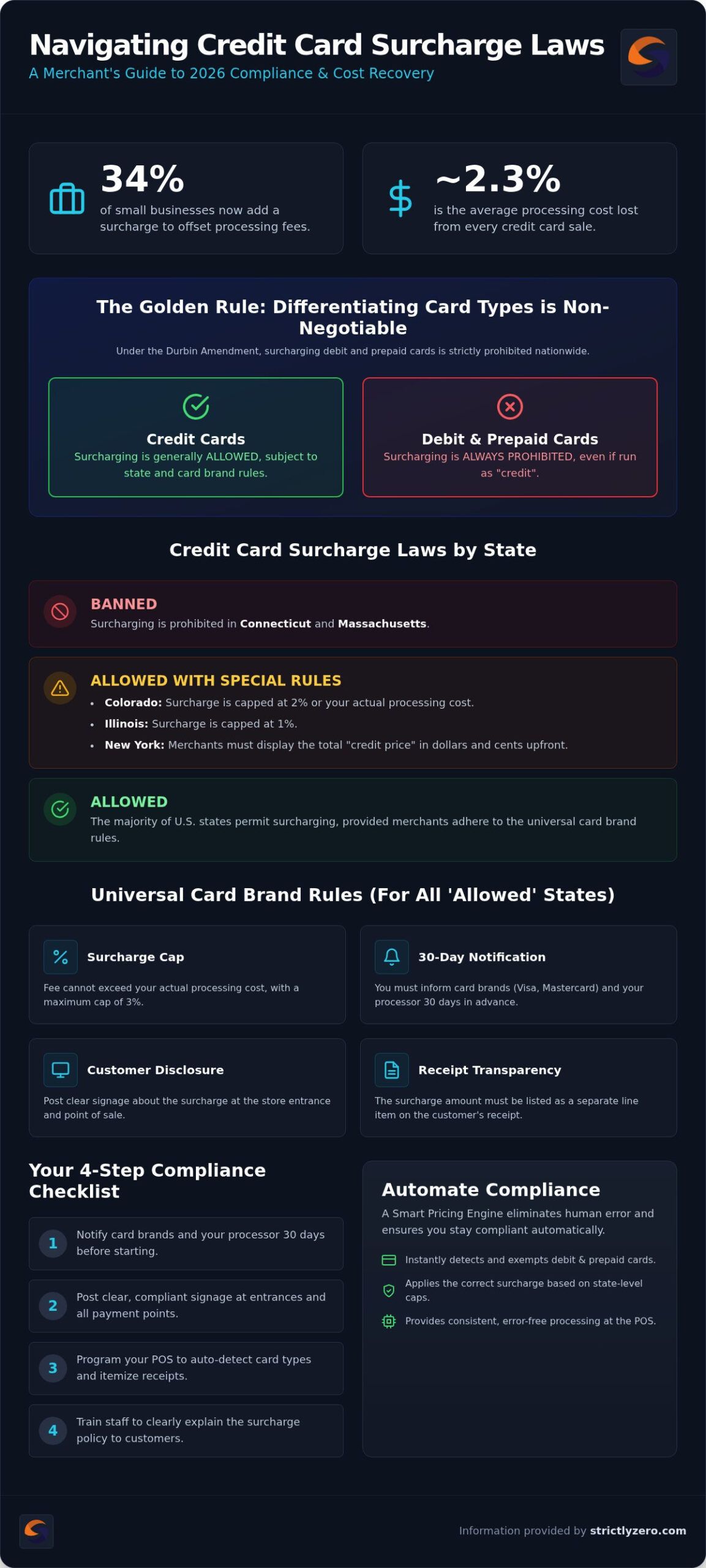
In 2026, the majority of the U.S. is considered a “green light” zone, where surcharging is legal as long as you follow card brand rules and provide clear disclosure. However, states like Colorado and Illinois have introduced specific caps. Colorado limits surcharges to 2% or the actual cost of processing, while Illinois has implemented a 1% cap. New York presents a unique challenge, requiring merchants to display the total “credit price” in dollars and cents upfront, rather than just a percentage at the bottom of a receipt. If you operate across multiple regions, you can simplify your workflow with a dual pricing engine that adapts to local rules automatically.
States with Total Surcharge Bans
As of September 2026, Connecticut and Massachusetts remain the primary holdouts with active and enforced bans on credit card surcharges. Connecticut’s statutes are particularly strict, and local regulators continue to monitor merchant compliance closely. Massachusetts still relies on its 1981 Consumer Protection Act to prohibit the practice. Maine also maintains an active ban, though legislative discussions regarding its future are ongoing. Merchants in these states cannot legally add a surcharge at the point of sale. Instead, many businesses have successfully pivoted to a dual pricing model or cash discount program, which remains a compliance-focused way to offset processing costs without violating state law.
States with Specific Disclosure Mandates
Transparency is the new standard in 2026. New York law requires a “Double-Pricing” display, meaning your shelf tags or menus must show the total credit card price alongside the cash price. You cannot simply list a cash price and a note about a 3% fee. California has followed a similar path with SB 478, the “Honest Pricing Law,” which took effect in July 2024. This law prohibits advertising a price that does not include all mandatory charges. In these states, adding a surcharge at the final step of checkout is generally considered non-compliant. To stay safe, merchants must ensure their pricing is clear from the moment a customer looks at a product. Maine also requires specific disclosures if you offer a cash discount, ensuring the consumer knows exactly what they are paying before the transaction begins.
Card Brand Rules: Beyond State Legislation
Even if you operate in a region where credit card surcharge laws by state are permissive, your business is still subject to the private contracts you signed with major card networks. Visa and Mastercard have their own set of Card Brand Rules that apply regardless of local statutes. These networks can penalize your account or even terminate your processing privileges if you fail to meet their specific standards. One of the most overlooked requirements is the mandatory registration period. You must notify both your acquirer and the card brands at least 30 days before you begin any surcharge program. Starting without this notice is a fast track to a compliance audit.
Following these credit card processing services guidelines is essential for long term account health. Beyond registration, brands differentiate between domestic and international cards. While you can surcharge domestic credit cards, some international regulations or specific card types may have different fee structures. Additionally, the federal Durbin Amendment creates a nationwide floor that no state law can override: you cannot surcharge debit cards. Because brand rules are updated frequently, many merchants rely on automated tools to stay within the lines of both state and network mandates.
The 3% Surcharge Cap Explained
The most significant shift in recent years occurred in 2023, when major card brands reduced the maximum allowable surcharge from 4% down to 3%. This cap is a hard limit. You cannot charge a flat 3% if your actual cost of acceptance is only 2.3%. Card brands strictly prohibit merchants from “profiting” from surcharge fees. Your surcharge must only cover the merchant discount rate for the specific transaction. If a merchant is caught charging 3% while only paying 2% in fees, they face steep penalty risks and potential clawbacks of the excess revenue.
Disclosure and Signage Requirements
Transparency is a cornerstone of brand compliance. You don’t just need to tell the customer at the register; you must provide notice at every stage of the journey. This starts with point of entry signage. A clear, visible notice must be posted at your front door or on your website’s homepage informing customers that a surcharge applies. Once the customer reaches the counter, point of sale signage must reiterate the fee percentage before the transaction is finalized. Finally, your receipt requirements are non-negotiable. The surcharge must appear as a separate line item, clearly labeled so the customer sees exactly how much was added to cover the credit processing cost. Failing to itemize this correctly is one of the most common reasons for consumer disputes and chargebacks.
How to Implement a Compliant Surcharge Program
Launching a surcharge program requires more than just flipping a switch. To stay within the boundaries of credit card surcharge laws by state, you must follow a precise sequence of actions. Skipping a single step can lead to chargebacks or audits from the card brands.
- Verify your state’s current legislative status for 2026. While most states are open for surcharging, specific caps in Colorado (2%) or New York’s double-pricing display requirement must be respected.
- Notify your payment processor and the card brands. This notification must happen at least 30 days before you collect your first fee.
- Update your signage at the entrance and the register. This is a non-negotiable transparency requirement.
- Configure your POS or Virtual Terminal to handle the math automatically. Manual calculations are the leading cause of compliance errors.
- Train staff on how to explain the fee professionally to reduce customer friction.
Staff Training and Customer Communication
Your team is your first line of defense against customer friction. When a shopper asks about the fee, staff should handle the question professionally. Train them to explain the choice: the price on the tag is the cash price, and the surcharge is an optional fee for the convenience of using a credit card. Explaining that the fee helps keep base prices low for everyone often resonates well with regular patrons. Clear, visible signage at the register supports your staff by ensuring the customer isn’t surprised at the final step of the transaction.
The Technology Requirement: Why Manual Math Fails
Staying compliant with credit card surcharge laws by state requires more than just knowing the rules; it requires the right tools. Manual math is a significant liability. If an employee accidentally applies a fee to a debit card, your business is in violation of the Durbin Amendment. This is why a compliance-focused system is mandatory. Our Smart Pricing Engine identifies the card type using BIN detection before the transaction is processed. This technology is especially important when integrating surcharges into ecommerce payment processing. For online sales, the system should automatically remove the fee the moment a customer enters a debit card number.
You can eliminate the guesswork and protect your margins by using a Surcharge & Dual Pricing Engine designed to handle these complexities for you.
Automating Compliance with Strictly’s Smart Pricing Engine
Managing credit card surcharge laws by state manually is a recipe for legal headaches. As we’ve seen, the rules in New York differ significantly from those in Illinois, and the bans in Connecticut and Massachusetts remain firm. Strictly’s Smart Pricing Engine removes the guesswork by putting compliance on autopilot. Our technology analyzes every transaction in real time to ensure you’re following both state statutes and card brand mandates without lifting a finger.
The most critical feature of our platform is Automatic Debit Detection. Since surcharging a debit card is illegal nationwide, our engine identifies the card type via its Bank Identification Number (BIN) the moment it’s swiped or entered online. If it’s a debit card, the surcharge is bypassed instantly. This prevents the accidental violations that lead to heavy fines and merchant account termination. Whether you’re processing in-store, on the web, or through a mobile app, our omni-channel flexibility keeps your business protected.
Surcharging vs. Dual Pricing: Which is Right for You?
While surcharging is a powerful tool, it isn’t always the best fit for every region. This is where Dual Pricing comes in as the ultimate safe harbor. Unlike a surcharge, which adds a fee at the end, Dual Pricing displays both a cash price and a credit price for every item. This model is generally considered compliant in all 50 states because it doesn’t involve adding a fee to a base price. For credit card processing for small business, Dual Pricing often provides a smoother customer experience. Customers appreciate the transparency of seeing two fixed prices rather than a percentage added at the register. Strictly helps you evaluate your local market and transaction volume to choose the program that maximizes your savings while minimizing friction.
Getting Started with Strictly
Transitioning to a zero-fee model shouldn’t be a hurdle. Our onboarding process is designed to be seamless, getting your business up and running with a compliance-focused engine in days, not weeks. We also provide a robust payment processing platform for ISOs, allowing our partners to scale their portfolios with confidence that their merchants are always following the latest rules. If you’re ready to stop letting processing fees eat your margins, it’s time to see our technology in action. Schedule a demo today to see how the Smart Pricing Engine can transform your bottom line.
Take Control of Your Processing Costs in 2026
Reclaiming your revenue shouldn’t involve a legal guessing game. You’ve seen that while most regions permit cost recovery, the nuances of credit card surcharge laws by state and strict card brand caps require a precise approach. Success in 2026 means moving beyond manual math and adopting a compliance-focused framework that protects your merchant account from costly audits. By combining clear transparency with the right technology, you can stop letting interchange rates dictate your margins and start scaling with confidence.
Our platform offers the exact tools you need to succeed. With Automated State-by-State Compliance and Instant Debit Card Detection, you can deploy Omni-Channel $0 Fee Solutions across your entire business without the fear of accidental violations. It’s time to transition from being squeezed by fees to operating a more profitable, modern enterprise. Eliminate your processing fees today with Strictly’s Smart Surcharge Program and start keeping more of what you earn. Your business deserves a partner that puts compliance and growth first.
Frequently Asked Questions
Is it legal to surcharge credit cards in New York in 2026?
Yes, surcharging is legal in New York in 2026, provided you follow strict transparency mandates. You must display the total price of a credit card transaction in dollars and cents upfront. Simply adding a percentage at the end of the transaction is not enough. This “double-pricing” requirement ensures customers aren’t surprised at the register. Failing to show the full credit price can lead to state enforcement actions and consumer complaints.
Can I add a surcharge to debit card transactions if they are run as credit?
No, you cannot add a surcharge to any debit card transaction, even if the customer chooses the “credit” option at the terminal. Federal regulations and card brand rules are very clear on this point. Surcharging a debit card is a major compliance violation that triggers heavy fines. Strictly’s Smart Pricing Engine prevents this error by using real-time BIN detection to identify debit cards and bypass the fee automatically before the sale is finalized.
What is the maximum percentage I can charge as a surcharge?
The maximum surcharge you can legally apply is 3% of the transaction total. This cap was lowered from 4% in 2023 by major card brands like Visa and Mastercard. Additionally, your surcharge cannot exceed your actual cost of card acceptance. If your processing rate is 2.5%, you shouldn’t charge the full 3%. Charging more than your actual costs is considered “profiting” from the fee, which is a violation of merchant service agreements.
Do I have to notify my customers before I start surcharging?
Yes, you must provide clear and conspicuous notice to your customers before they pay. This requires signage at your business entrance and at the point of sale. For online stores, notice must appear on the checkout page before the transaction is processed. You also need to itemize the surcharge as a separate line item on the final receipt. Proper disclosure is a core part of staying within credit card surcharge laws by state.
What is the difference between a surcharge and a cash discount?
A surcharge is an additional fee added to the advertised price when a customer uses a credit card. In contrast, a cash discount is a reduction from the regular price for customers who pay with cash or check. While they achieve similar financial results, regulators view them differently. Cash discounts are generally legal in all 50 states, including those with surcharge bans. Strictly’s dual pricing model uses this logic to help merchants eliminate fees everywhere.
Which states currently prohibit credit card surcharging?
As of September 2026, Connecticut, Massachusetts, and Maine are the three states that still enforce outright bans on credit card surcharging. Puerto Rico also prohibits the practice. If your business is located in these regions, adding a surcharge at checkout is illegal. However, you can still use a dual pricing or cash discount model to offset your processing costs. These alternative programs provide a compliance-focused way to reach a zero-fee processing goal.
How do card brands like Visa and Mastercard enforce surcharge rules?
Card brands enforce their rules through a combination of periodic audits, mystery shopper programs, and consumer reports. If they find you aren’t following the 3% cap or the 30-day registration requirement, they can issue significant fines. Repeated violations often lead to the termination of your merchant account. Using technology that automates compliance helps you avoid these risks by ensuring every transaction meets the specific standards set by Visa, Mastercard, and Discover.
What happens if I surcharge a customer in a state where it is banned?
Surcharging in a state where it is banned can lead to severe legal and financial consequences. State attorneys general may file lawsuits or impose civil penalties for consumer protection violations. Simultaneously, your payment processor may freeze your funds or close your account to avoid liability. It’s much safer to implement a dual pricing program that works within the credit card surcharge laws by state rather than risking your business’s ability to accept payments.