
Credit Card Surcharge Rules by State: The 2026 Merchant Compliance Guide
Published:

In 2026, manually tracking credit card surcharge rules by state is no longer just a headache; it’s a massive legal liability that could cost your business thousands in fines. You’ve probably noticed that rising merchant service costs are eating into your margins faster than ever before. It’s frustrating to deal with the confusion of conflicting state laws and court rulings, especially when you’re worried about the heavy penalties for accidentally surcharging a debit card. You want to recoup those fees, but the fear of a compliance slip-up often feels like it’s not worth the risk.
We’re here to change that. This guide will help you master the complex landscape of state-level laws and card network rules so you can eliminate processing fees legally and safely this year. We’ll give you a clear “Yes/No” for your specific state, a step-by-step compliance checklist, and a way to automate the entire process to remove human error. Whether you’re operating in a state with a 2% cap like Colorado or navigating the total bans in Massachusetts and Connecticut, you’ll learn how to reach $0 in processing fees without the legal guesswork. It’s time to stop letting fees drain your bottom line and start processing with total confidence.
Key Takeaways
- Identify the legal differences between surcharging and dual pricing to select the most profitable model for your storefront.
- Understand the 3% card network cap to ensure your fee structure doesn’t violate Visa and Mastercard merchant agreements.
- Master the 2026 credit card surcharge rules by state to determine where you can legally eliminate processing fees.
- Learn how to avoid the “debit trap” and federal fines by properly identifying and excluding debit cards from surcharge programs.
- Explore how a Smart Pricing Engine automates compliance by adjusting to local laws and card types at the point of sale.
Table of Contents
- Understanding Credit Card Surcharging and 2026 Compliance Standards
- Card Network Rules: Visa, Mastercard, and the 3% Cap
- Credit Card Surcharge Rules by State: The 2026 Legal Map
- Avoiding the 'Debit Trap': Why Surcharging Debit is Illegal
- Automating Compliance with a Smart Surcharge Program
Understanding Credit Card Surcharging and 2026 Compliance Standards
A surcharge is a fee that a merchant adds to a transaction specifically to cover the cost of credit card processing. For years, businesses absorbed these costs as a “price of doing business,” but as interchange fees have climbed, that’s no longer sustainable for most. Understanding Credit Card Surcharging is the first step toward reclaiming your margins. In 2026, the regulatory landscape has shifted. The Consumer Financial Protection Bureau (CFPB) has made transparency a top priority, scrutinizing what they call “junk fees.” This means your surcharging program can’t just be a hidden line item; it must be clearly communicated and legally sound.
Many forward-thinking businesses are moving toward a zero fee credit card processing model. This approach allows you to offset 100% of your processing costs by passing them to the cardholder, provided you follow the specific credit card surcharge rules by state. It’s a strategic move that requires a deep understanding of how different fee structures work and how they’re perceived by both customers and regulators.
Surcharge vs. Convenience Fee vs. Cash Discount
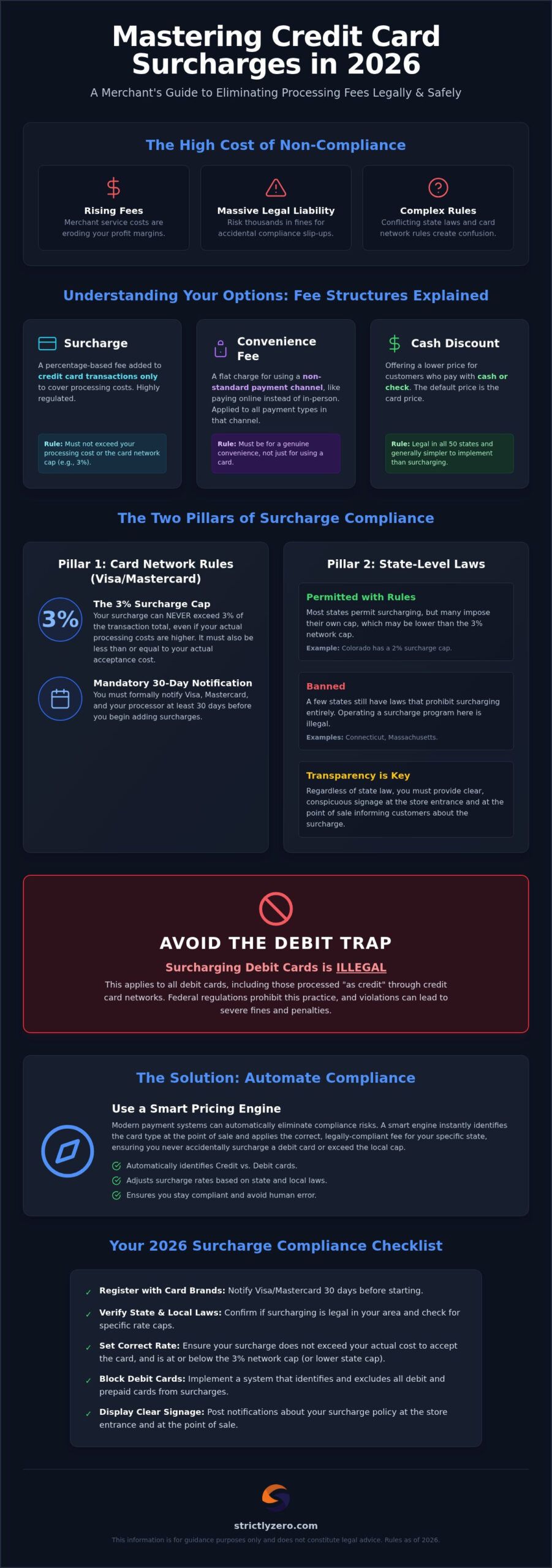
It’s easy to confuse these terms, but regulators and card networks treat them very differently. Surcharges are percentage-based fees applied only to credit card transactions. You cannot apply them to debit cards, even if the customer chooses to “run it as credit.” Convenience fees, on the other hand, are flat charges applied when a customer uses a non-standard payment channel, like paying an electric bill online instead of in person. Finally, cash discounts involve offering a lower price for those who pay with cash or check. While cash discounts are legal in all 50 states, surcharging requires much stricter adherence to credit card surcharge rules by state to avoid heavy fines.
The Legal Evolution: From Bans to Disclosure
The path to legal surcharging wasn’t easy. For decades, several states maintained outright bans on the practice. However, landmark court cases like Expressions Hair Design v. Schneiderman changed everything. The courts ruled that surcharge bans often violated a merchant’s right to free speech by dictates how they describe their pricing. This legal shift moved the focus from “is surcharging legal?” to “how is it disclosed?” Today, the priority is merchant transparency. In 2026, federal oversight focuses on ensuring customers know exactly what they’re paying before they swipe. If you fail to provide clear signage at the entrance and the point of sale, you’re at risk, regardless of your state’s specific laws.
Card Network Rules: Visa, Mastercard, and the 3% Cap
While state legislation often gets the headlines, the card networks actually dictate the day-to-day mechanics of your surcharge program. Visa and Mastercard have established a universal floor for compliance: you can never surcharge more than your actual cost of card acceptance. As of 2026, the maximum surcharge cap remains strictly set at 3%. Even if your total processing fees reach 3.5% or 4%, charging a customer anything above that 3% limit is a direct violation of your merchant agreement. Violating these caps doesn’t just result in a warning; it often leads to immediate account termination and inclusion on the MATCH list, which can prevent you from processing payments for years.
Staying compliant requires a balance between network mandates and the specific credit card surcharge rules by state that govern your local jurisdiction. Because these rules can change based on court rulings or network updates, relying on a static percentage for every transaction is a risky strategy.
Notification and Registration Protocols
Before you collect your first cent in surcharges, you must notify the card brands. Visa and Mastercard require a formal 30-day notice before a merchant begins surcharging. This isn’t a suggestion; it’s a mandatory registration process that links your merchant ID to an approved surcharge program. Attempting “shadow surcharging” without this registration is a fast track to heavy fines and the potential loss of your merchant account.
Most business owners find the manual registration process tedious and technically demanding. This is why your payment processor should handle these notifications for you. A processor that understands the nuances of credit card surcharge rules by state will ensure your registration is filed correctly and that your system only triggers fees on eligible credit transactions.
Signage and Receipt Requirements
Transparency is the cornerstone of network compliance. You must inform customers of the surcharge at the point of entry and the point of sale. For e-commerce, this means the disclosure must appear on the first page where card information is requested. On physical receipts, the surcharge cannot be “baked into” the item price. It must appear as a separate, clearly labeled line item so the customer knows exactly what they’re paying for the convenience of using credit.
- Point of Entry: Large, visible signage at the front door or website landing page.
- Point of Sale: Clear disclosure at the register or checkout page before the transaction is finalized.
- Receipt: A dedicated line item labeled “Surcharge” or “Credit Card Fee.”
Card brand rules generally require POS signage to be displayed in a font size no smaller than the surrounding text to ensure it remains clear and conspicuous to every customer. If you’re looking for a way to simplify this complex setup, you can automate your surcharge disclosures to ensure every receipt and digital checkout meets these strict 2026 standards without manual entry errors.
Credit Card Surcharge Rules by State: The 2026 Legal Map
The legal patchwork of 2026 makes it difficult to keep track of where you can and cannot pass on fees. While the majority of the country allows surcharging, the specific credit card surcharge rules by state vary wildly. You’ll find that in states like Florida, Texas, and Kansas, old bans are technically still in the law books. However, court rulings have rendered these “zombie bans” unenforceable. This creates a confusing situation where a quick search might tell you it’s illegal, but current legal precedents say otherwise. Staying updated on credit card surcharge rules by state is the only way to ensure you’re not leaving money on the table or walking into a courtroom.
Most states now follow the standard Card Network Rules: Visa, Mastercard, which allow surcharging as long as you provide proper disclosure. But you must be careful in states like Colorado, which has its own mandated cap of 2%. If you apply the standard 3% network cap there, you’re violating state law. Similarly, New Jersey and Nevada require that your surcharge never exceeds your actual cost of acceptance, even if that cost is lower than the network’s 3% limit.
States with Absolute Bans in 2026
As of August 2026, Connecticut and Massachusetts remain the primary holdouts where surcharging is prohibited by state statute. Puerto Rico also maintains a strict ban. If you’re looking for small business credit card processing in these jurisdictions, you can’t use a surcharge model. Instead, you’ll need to adopt a dual pricing or cash discount program. These models are legal in all 50 states because they offer a discount for cash rather than adding a fee for credit. Attempting to surcharge in these three jurisdictions carries significant legal risk, including state attorney general investigations and heavy consumer protection fines.
The ‘Display Law’ States: NY, CA, and ME
New York and Maine have pioneered a “Total Price” approach that’s becoming a national trend in 2026. In New York, you can’t just list a price and then add a surcharge at the end. You must display the highest price a consumer might pay (the credit price) clearly. California has followed suit with its 2026 transparency laws, requiring online checkout flows to show the final price inclusive of all fees before the customer enters their card details. In these states, dual pricing is often the safest path because it presents two distinct prices rather than a single price plus a fee. It removes the “surprise” element that regulators are currently targeting in their crackdown on hidden costs.
Avoiding the ‘Debit Trap’: Why Surcharging Debit is Illegal
Many merchants believe that if they master the credit card surcharge rules by state, they’re completely safe from legal trouble. That’s a dangerous assumption. While state laws govern how you surcharge credit cards, federal law dictates what you can surcharge. Surcharging a debit card is a violation of the Durbin Amendment, regardless of which state you’re in. The financial risk is staggering. Fines for a single mistake can range from $5,000 to $25,000 per occurrence. For a high-volume merchant, a few days of accidental debit surcharging could lead to bankruptcy. Finding the best credit card processing for small business involves more than just low rates; it requires a system that prevents these catastrophic errors automatically.
The Technical Difference: Credit vs. Debit BINs
A Bank Identification Number (BIN) consists of the first six to eight digits on a card. This number identifies the card type, the issuing bank, and the geographic location instantly. Manual identification is impossible for busy staff. Many modern “check cards” look identical to premium credit cards. Even worse, if a customer tells you to “run it as credit” to avoid using a PIN, the card’s legal status remains unchanged. It is still a debit product. A Smart Pricing Engine uses real-time BIN lookup to block surcharge logic the moment a debit card is detected. This automation is the only reliable way to stay compliant with credit card surcharge rules by state and federal mandates simultaneously. It takes the guesswork out of the hands of your employees and puts it into a secure, technical framework.
Consumer Protection and the Durbin Amendment
The Durbin Amendment was designed to protect consumers from paying extra to access their own money. Regulators view debit cards as a direct link to a checking account, making them functionally different from a line of credit. This protection extends to prepaid cards as well. You should treat every prepaid card under the same compliance framework as a standard debit card, even if the card doesn’t explicitly have the word “debit” printed on the front. These cards are often used by underbanked populations, and the CFPB has shown increased interest in 2026 in protecting these specific consumers from “junk fees.” Federal law, specifically 15 U.S.C. § 1693o-2, prohibits merchants from imposing surcharges on any transaction involving a debit card or an electronic benefit transfer card.
To avoid these risks and ensure you never accidentally surcharge the wrong card, you can integrate a Smart Pricing Engine that handles BIN detection for you in real-time.
Automating Compliance with a Smart Surcharge Program
Manual surcharge tables are a recipe for disaster in 2026. If you’re selling across state lines, keeping track of every individual update to credit card surcharge rules by state is nearly impossible. A change in Colorado’s cap or a new display requirement in New York can happen overnight. Relying on a spreadsheet or a cashier’s memory invites the kind of heavy fines we discussed in previous sections. This is where the Strictly Smart Pricing Engine changes the game. It automates the entire decision-making process, from identifying the card type to checking the customer’s jurisdiction, allowing you to reach a true $0 processing fee model without the legal headaches.
For ISOs and partners, offering this level of automation is a significant competitive advantage. Instead of just selling a merchant account, you’re providing a compliance shield. This builds long-term trust and drastically reduces the churn caused by merchants facing regulatory issues they didn’t understand. By removing the technical burden of compliance, you allow your merchants to focus on growth while the system handles the complexities of the law.
Real-Time Geo-Compliance for E-commerce
Online shopping doesn’t have borders, but surcharge laws certainly do. Our platform uses a combination of IP address detection and billing address verification to apply the correct local rules instantly. If a customer from Manhattan visits your site, the system automatically triggers the “Total Price” display required by New York law. This level of transparency actually helps reduce cart abandonment. When customers see a clear, compliant breakdown of fees early in the process, they don’t feel surprised at the final checkout screen. It’s about building a checkout flow that respects the local credit card surcharge rules by state while protecting your bottom line from regulatory scrutiny.
Eliminating Human Error at the POS
At the physical point of sale, the “debit trap” remains the biggest threat to your business. You shouldn’t expect a busy cashier to peer at a card’s BIN or remember the difference between a prepaid gift card and a premium credit card. By integrating surcharge logic directly into virtual terminals and payment links, the system makes the decision for them. The moment the card is entered, the engine runs a check. If it’s a debit card, the surcharge is blocked instantly. If it’s a credit card in a restricted state, the fee is adjusted to match the legal limit. This omni-channel approach ensures that your business stays safe whether you’re taking a payment in-person, over the phone, or via a digital invoice.
Ready to eliminate fees? Contact Strictly to set up your compliant surcharge program today.
Take Control of Your Processing Costs in 2026
Managing your bottom line shouldn’t feel like a legal gamble. You’ve learned that while surcharging is a powerful tool to reclaim your margins, success depends on navigating the 3% network cap and the specific credit card surcharge rules by state. The risk of the “debit trap” is real, but it’s a hurdle you can clear with the right technical framework. By moving away from manual tables and embracing transparency, you protect your business from federal fines and state-level scrutiny. It’s about working smarter, not harder, to keep your revenue where it belongs.
The most effective way to stay compliant is to let technology do the heavy lifting. Strictly provides an automated state-by-state compliance engine and instant debit card detection to prevent costly errors before they happen. It’s the same system trusted by ISOs and high-volume merchants nationwide to reach $0 in processing fees safely. You don’t have to choose between profitability and compliance when you have the right partner in your corner.
Eliminate your processing fees with Strictly’s Smart Surcharge Program and start keeping 100% of every sale today. Your business deserves a future free from unnecessary fees and full of growth.
Frequently Asked Questions
Are credit card surcharges legal in all 50 states in 2026?
No, surcharging is not legal in every state. As of August 2026, Connecticut and Massachusetts maintain active bans on credit card surcharges. While court rulings have overturned bans in states like Texas and Florida, you must still follow strict disclosure rules there. If you operate in a prohibited state, you should use a dual pricing model instead. This ensures you stay compliant with credit card surcharge rules by state while still managing your processing costs.
What is the maximum percentage I can charge as a surcharge?
The maximum surcharge allowed by Visa and Mastercard is currently 3% of the transaction amount. You can never charge more than your actual cost of acceptance. If your processing fee is 2.5%, your surcharge cannot exceed 2.5%. Additionally, some states have their own limits. For example, Colorado caps surcharges at 2%. You must always apply the lower of the two limits to remain fully compliant with both state and network regulations.
Can I apply a surcharge to debit card transactions if they are run as credit?
No, you can never surcharge a debit card transaction. Federal law, specifically the Durbin Amendment, prohibits adding fees to debit or prepaid card transactions. It doesn’t matter if the customer chooses to “run it as credit” or doesn’t enter a PIN. The card’s legal status as a debit product remains the same. Surcharging these cards can result in federal fines ranging from $5,000 to $25,000 per occurrence, making automated detection essential for high-volume merchants.
Do I have to notify my customers before adding a surcharge fee?
Yes, transparency is a core requirement for legal surcharging. You must notify customers of the surcharge at the point of entry to your business and at the point of sale. For e-commerce, this means the disclosure must appear on the checkout page before the transaction is finalized. Your receipt must also list the surcharge as a separate line item. Failure to provide these clear disclosures can lead to merchant account termination by the card networks.
What is the difference between a surcharge and a cash discount?
A surcharge is an additional fee added to a credit card transaction to cover processing costs. In contrast, a cash discount is a reduction in the posted price for customers who pay with cash or check. Cash discounts are legal in all 50 states because they don’t penalize card users; they reward cash users. Many businesses in states with surcharge bans choose dual pricing or cash discounts to legally eliminate their processing fees.
What happens if I accidentally surcharge a customer in a prohibited state?
Accidentally surcharging in a prohibited state like Massachusetts can lead to severe consequences. You may face investigations from the state attorney general and heavy fines under consumer protection laws. Beyond legal trouble, card networks like Visa can terminate your merchant agreement for non-compliance. This is why using a Smart Pricing Engine is critical. It automatically checks the credit card surcharge rules by state based on the customer’s location to prevent these errors before they happen.
Do these rules apply to online e-commerce transactions as well as in-person?
Yes, these rules apply to all omni-channel transactions, including e-commerce, mobile, and in-person payments. Online merchants must ensure their checkout flow includes the same disclosures required in physical stores. This includes showing the surcharge as a separate line item before the customer clicks “pay.” Some states, like New York and California, have specific 2026 transparency requirements that mandate displaying the total price inclusive of all fees early in the digital shopping experience.
How do I register my business for a surcharge program with Visa and Mastercard?
You are required to notify Visa and Mastercard at least 30 days before you begin surcharging. This involves a formal registration process that links your merchant ID to an approved surcharge program. While you can attempt to do this manually, it’s often easier to have your payment processor handle the registration for you. They will ensure all notification protocols are met and that your system is configured to stay within the mandatory 3% cap.