
Credit Card Surcharge Rules by State: The Complete 2026 Merchant Guide
Published:

Are you tired of watching nearly 4% of every sale vanish into thin air before it even hits your bank account? It’s frustrating to see credit card processing fees erode your hard-earned margins, especially when you know there’s a way to pass those costs along. However, trying to decipher the current credit card surcharge rules by state feels like reading a map that changes every time you cross a border. Between California’s strict all-in pricing and the 3% cap set by major card networks, one wrong move could lead to heavy fines or a lost merchant account.
You deserve a straightforward path to compliance. This complete 2026 guide gives you a definitive answer for your specific state and a step-by-step framework to implement surcharging legally. We’ll break down which states still hold onto outright bans, how to handle the tricky legal gray areas in places like Texas, and why manual debit card detection is a risk you don’t have to take. We also preview how a smart pricing engine can handle these shifting regulations automatically, so you can focus on your customers instead of studying law books.
Key Takeaways
- Identify the final three states that still ban surcharging and learn how to navigate California’s unique “all-in” pricing requirements.
- Understand the 3% maximum cap mandated by card networks and why surcharging debit cards remains strictly prohibited in every state.
- Master the current credit card surcharge rules by state to successfully recover processing costs while avoiding costly compliance fines.
- Follow a clear five-step framework for notifying card brands and setting up the required point-of-sale disclosures.
- Discover how a Smart Pricing Engine can automate the entire process by detecting card types and applying state-specific limits in real-time.
Table of Contents
- Why Credit Card Surcharge Rules Are Shifting in 2026
- Credit Card Surcharge Rules by State: The 2026 Map
- Card Brand Rules and Federal Compliance Mandates
- 5 Steps to Implementing a Compliant Surcharge Program
- How Strictly Automates Your 2026 Surcharge Compliance
Why Credit Card Surcharge Rules Are Shifting in 2026
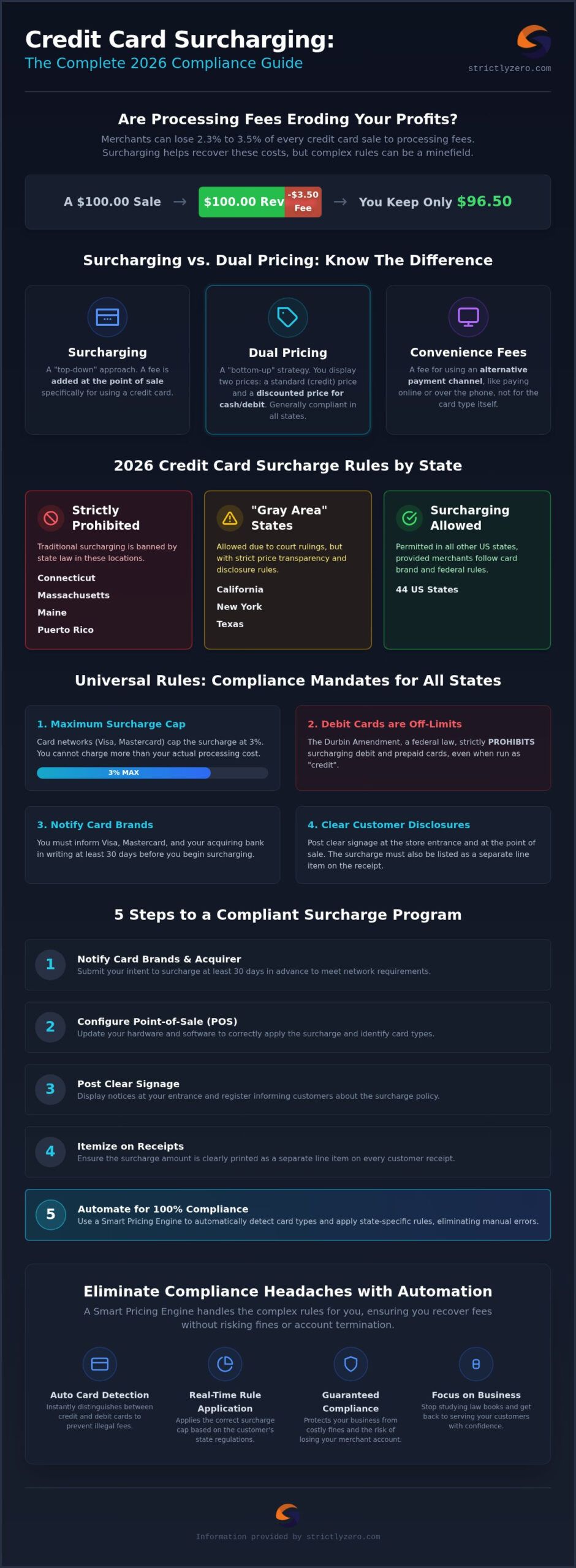
Credit card surcharging serves as a vital tool for merchant fee recovery. It allows you to pass the cost of processing a transaction directly to the customer who chooses to use a credit card. In 2026, we’re seeing a massive shift toward “zero-fee” processing models because inflation has squeezed profit margins to their breaking point. Merchants can’t easily absorb a 2.3% to 3.5% hit on every sale anymore. This economic pressure makes it essential to understand the current credit card surcharge rules by state to protect your bottom line without risking legal trouble.
It’s easy to mix up terminology, but the distinctions matter for compliance. A Surcharge (payment systems) is a fee added specifically for credit card use at the point of sale. Convenience fees are different; they’re charges for using an alternative payment channel, like an online portal or a phone system. Then there’s the Durbin Amendment, which heavily influences these rules. This federal law capped debit card interchange fees and established a strict rule: you can’t surcharge a debit card, even if it’s run through a credit network. This is a non-negotiable mandate that applies in every corner of the country.
To better understand this concept, watch this helpful video:
Surcharging vs. Dual Pricing: Key Differences
Surcharging is a “top-down” approach. You add a fee to the advertised price at the end of a transaction. Dual pricing is a “bottom-up” strategy. You present two distinct prices to the customer: a standard price for credit and a lower, discounted price for cash or debit. Because dual pricing is technically a discount for cash rather than a penalty for credit, it’s often the safer, “all-state” compliant alternative. It bypasses many of the restrictive credit card surcharge rules by state that make traditional surcharging difficult to manage across different locations.
The Legal Foundation: From Courtrooms to Cash Registers
The ability to surcharge didn’t happen by accident. It stems from a landmark 2013 merchant class action settlement that broke the card brands’ long-standing “no-surcharge” rules. Since that settlement, the legal battle has moved to the Supreme Court. Recent rulings have shifted the legal focus from “conduct” (how you charge) to “speech” (how you communicate prices). Courts have generally found that anti-surcharge laws infringe on a merchant’s right to tell customers about the actual cost of credit. This is why states can no longer flatly ban the practice without meeting incredibly high legal bars. Instead, states like California and New York have moved toward requiring total price transparency rather than banning the fees entirely.
Credit Card Surcharge Rules by State: The 2026 Map
Keeping up with credit card surcharge rules by state is a constant challenge for modern merchants. As of August 2026, the national landscape is split into three distinct categories. Most states allow surcharging if you follow card brand rules, but a handful of holdouts maintain strict bans. Others fall into a “gray area” where court rulings have overwritten state laws, yet local transparency requirements create a complex compliance hurdle. Understanding where your business sits on this map is the first step toward avoiding heavy fines or merchant account termination.
States Where Surcharging is Strictly Prohibited
If your business operates in Connecticut, Massachusetts, or Maine, traditional surcharging is off the table. These three states remain the final holdouts with outright statutory bans. Connecticut’s laws are particularly rigid, treating any added fee at the register as a violation of consumer protection statutes. Massachusetts follows a similar path under Chapter 140D, which bars retailers from imposing a surcharge on cardholders. Puerto Rico also maintains a strict prohibition on the practice. In these regions, you can’t simply add a 3% fee to a credit transaction. Instead, many businesses look toward dual pricing or cash discount programs to manage their overhead.
The “Speech” States: New York, California, and Texas
The most significant legal shifts have occurred in what experts call “speech” states. In New York, California, and Texas, previous bans were challenged on First Amendment grounds. Courts found that these laws unconstitutionally restricted how a merchant communicates pricing. While surcharging is now technically legal in these states, the rules are far from simple. New York, for example, requires you to display the “total price” of an item for credit card users rather than just adding a fee at the end.
California’s SB 478, also known as the “Honest Pricing Law,” has further complicated things by requiring that any advertised price include all mandatory fees. This means you can’t surprise a customer with a surcharge at the point of sale; the price they see on the shelf must be the price they pay. Texas remains a legal gray area because while a federal court enjoined the state from enforcing its ban, the Attorney General has suggested the law might still apply in specific scenarios. If you’re managing multiple locations across these regions, using a Smart Pricing Engine can help you stay compliant without manual updates. You can also reference the state-by-state surcharge laws compiled by the NCSL for a deep dive into specific statutes.
Beyond the outright bans and speech-based rulings, several states have implemented specific caps that are lower than the standard card brand limits. For instance, Colorado limits surcharges to 2%, while Illinois caps them at 1% or the actual processing fee, whichever is lower. Other states like New Jersey and Georgia don’t have a hard percentage cap but strictly limit the surcharge to your actual cost of processing. This variety in local “Consumer Protection” acts means you must be precise with your math. If you charge 3% but your actual cost is only 2.4%, you could be flagged for non-compliance in over a dozen states.
Card Brand Rules and Federal Compliance Mandates
Even if you’ve checked the credit card surcharge rules by state, you’re only halfway to full compliance. Federal mandates and card brand regulations create a second layer of rules that are often more aggressive than state enforcement. For example, the California credit card surcharge law highlights how state and network rules can overlap, creating a minefield for the unprepared. Before you process your first surcharged transaction, you must notify the card networks in writing at least 30 days in advance. Failure to do so can lead to immediate fines. Additionally, your receipts must clearly display the surcharge as a separate line item. You can’t hide it within the total or mislabel it as a generic “service fee.”
The 3% Surcharge Cap: A New 2026 Standard
For years, 4% was the industry standard for surcharging. That changed on April 15, 2023, when Visa reduced its maximum allowable surcharge to 3%. While Mastercard technically allows up to 4%, the reality is that most businesses accept both. Because you must apply a consistent policy, 3% is now the de facto ceiling for almost every merchant in the U.S. There’s another catch: you can never charge more than your actual cost of acceptance. If your effective rate is 2.5%, charging a flat 3% is a violation. Card brands regularly audit merchant statements. If they find you’re profiting from the surcharge, they can revoke your ability to process cards entirely.
The Debit Card Trap: Why Manual Detection Fails
The biggest risk in any surcharge program is the debit card. Thanks to the federal Durbin Amendment, surcharging debit cards or prepaid cards is illegal in all 50 states. It doesn’t matter if the customer chooses “credit” at the terminal; if the funds come from a bank account, it’s a debit transaction. This is where manual systems fail. Cashiers often can’t tell the difference between a high-end rewards credit card and a standard debit card just by looking at them. If a staff member accidentally surcharges a debit card, your business is liable for network fines that can reach thousands of dollars per occurrence. This complexity is why many merchants are moving away from manual entry. Using a Smart Pricing Engine solves this by automatically detecting the card type before the transaction is finalized, ensuring you only surcharge when it’s legal to do so.
5 Steps to Implementing a Compliant Surcharge Program
Launching a surcharge program requires precision. You can’t just flip a switch and start charging extra fees. If you don’t follow the specific credit card surcharge rules by state where you operate, you’re inviting a lawsuit or a permanent ban from the card networks. Follow this five-step framework to ensure your business stays on the right side of the law while recovering your processing costs.
- Verify Legality: Double-check the latest statutes for your specific business location. As discussed, rules in states like California or New York change frequently.
- Notify Networks: You must send a written notice to your payment processor and card brands like Visa and Mastercard at least 30 days before you begin.
- Install Signage: Clear disclosure is mandatory. You need physical signs at your entrance and at the point of sale.
- Automate Systems: Configure your terminal or virtual terminal to calculate fees and, most importantly, detect debit cards to prevent illegal surcharging.
- Train Your Team: Your staff is your first line of defense against customer confusion. They must be able to explain why the fee exists and how to avoid it.
Signage and Disclosure Requirements
Card brands are very specific about how you tell customers about fees. You must place a notice at the point of entry and at every point of sale. The wording must be clear. It should state the exact percentage being charged and clarify that the fee does not exceed your cost of acceptance. For e-commerce businesses, this disclosure must appear on the checkout page before the customer submits their payment information. If you’re using a virtual terminal, you must inform the customer verbally or via email before processing the transaction. Failing to provide this transparency is the fastest way to get flagged during an audit.
Staff Training and Customer Communication
Customer pushback is inevitable, but it’s manageable with the right approach. Your team shouldn’t be defensive. Instead, they should explain that the surcharge helps keep base prices lower for everyone. It’s vital to offer a no-fee alternative, such as cash or a debit card, to every customer. We’ve developed a guide on How to Tell Customers You’re Adding a Surcharge Fee to help your staff navigate these conversations smoothly. When employees understand the credit card surcharge rules by state, they can speak with more confidence and authority.
Managing these manual steps can be overwhelming, especially if you have multiple locations with different local laws. You can simplify this entire process and eliminate the risk of human error by switching to an automated surcharge and dual pricing engine.
How Strictly Automates Your 2026 Surcharge Compliance
Trying to manually manage credit card surcharge rules by state is a recipe for disaster. With laws in California, New York, and Colorado shifting constantly, a manual approach leaves your business vulnerable to massive network fines and legal challenges. Strictly eliminates this risk through its Smart Pricing Engine. This technology replaces the guesswork of traditional processing with a fully automated compliance framework that adapts in real-time to every transaction you process.
The most critical feature of our engine is automatic BIN detection. As we discussed earlier, surcharging a debit card is a federal violation that can cost you your merchant account. Our system identifies the card type at the moment of swipe, dip, or tap. If it’s a debit or prepaid card, the surcharge is instantly blocked. If it’s a credit card, the system applies the correct fee based on the specific credit card surcharge rules by state where your business is registered. This omni-channel support ensures that whether you’re selling in-store, via a virtual terminal, or through an online shop, your compliance is ironclad.
The Smart Pricing Engine Advantage
The 2026 landscape requires more than just a “yes or no” logic for fees. Since Visa reduced the maximum surcharge cap to 3%, our engine has been pre-configured to ensure no transaction ever exceeds this limit or your actual cost of acceptance. This precision protects your reputation and your wallet. For businesses with partners or multiple stakeholders, our ClearSplit™ tool provides transparent reporting on every fee recovered. We also prioritize your customer relationships. By using ChurnIQ™ for merchant retention, Strictly helps you monitor customer sentiment and transaction success rates, ensuring that your move to a zero-fee model doesn’t create friction that drives shoppers away.
Getting Started with $0 Processing Fees
Transitioning to a zero-fee model is simpler than most merchants realize. You don’t have to overhaul your entire business strategy to stop paying for your customers’ rewards points. By integrating Zero Fee Credit Card Processing, you can immediately begin reinvesting those recovered margins back into your growth. Whether you’re a local retailer or a high-volume omni-channel merchant, the goal is to reach a point where processing costs no longer dictate your profitability.
If you’re ready to leave the stress of compliance behind, it’s time to see Why Strictly Offers the Best Zero Fee Merchant Services. Our team handles the heavy lifting of notification and configuration, allowing you to focus on what you do best. Stop letting processing fees eat your profit and start using a system that knows the law so you don’t have to.
Take Control of Your Processing Margins
The days of absorbing high credit card fees are over, but the path to recovery requires absolute precision. You’ve seen how the landscape has shifted from outright bans to complex transparency mandates in states like California and New York. While most merchants can now legally pass on costs, the strict 3% card network cap and the federal prohibition on surcharging debit cards make manual compliance a dangerous game. One slip-up could mean heavy fines or losing your ability to accept payments entirely.
Staying ahead of the ever-changing credit card surcharge rules by state doesn’t have to be a full-time job. You can protect your profit margins while remaining 100% compliant by leveraging technology built for this specific challenge. Strictly is trusted by ISOs and merchants nationwide because our platform handles the heavy lifting for you. With an automated state-by-state compliance engine and real-time debit card detection, you can finally stop worrying about the legal fine print.
Ready to reclaim your profit? Eliminate your processing fees today with Strictly’s Smart Surcharge Program. You’ve worked hard to build your business; it’s time to keep the money you earn.
Frequently Asked Questions
Is it legal to surcharge credit cards in all 50 states in 2026?
No, it’s not legal in every state. As of early 2026, Connecticut, Massachusetts, and Maine maintain outright bans on the practice. Puerto Rico also prohibits surcharging. If you operate in these regions, you must look at alternatives like dual pricing. For everywhere else, you must still follow the specific credit card surcharge rules by state to ensure your disclosures and fee amounts meet both local and card brand standards.
What is the maximum percentage I can charge as a surcharge?
The maximum allowable surcharge is 3% of the transaction amount. While Mastercard previously allowed 4%, Visa’s reduction to 3% in April 2023 created a de facto industry ceiling. You’re also legally required to ensure the fee doesn’t exceed your actual cost of acceptance. If your processing rate is 2.4%, you can’t charge 3%. Charging more than your cost is considered profiting from the fee and is a major compliance violation.
Can I add a surcharge to debit card transactions if they are run as credit?
You can never surcharge a debit card, even if the customer chooses to run it as “credit” at the terminal. Federal law under the Durbin Amendment protects all debit and prepaid cards from these fees. This is a common area where manual errors lead to massive fines. To stay safe, you need a system that detects the Bank Identification Number (BIN) automatically to block surcharges on all debit-linked cards instantly.
Do I need to put up signs if I am only surcharging online?
Yes, signage is mandatory regardless of whether you sell in a physical store or online. For e-commerce, you must provide a clear disclosure on the checkout page before the customer completes their purchase. This digital “signage” must state the exact percentage of the fee and clarify that it’s a credit card surcharge. Failing to disclose this fee before the final “pay” button is pressed violates both state laws and card brand agreements.
How do I notify Visa and Mastercard about my surcharge program?
You must provide written notification to your payment processor and the major card networks at least 30 days before you start. This notification period allows the networks to ensure your account is properly flagged for surcharging. Most merchants handle this through their processor, but you’re ultimately responsible for verifying the notice was received. Skipping this step is a violation that often triggers audits and can result in the immediate suspension of your merchant account.
What is the difference between a surcharge and a convenience fee?
A surcharge is a fee added solely for the use of a credit card. A convenience fee is different because it’s charged for using a non-standard payment channel, like paying online instead of in-person. While credit card surcharge rules by state are very strict, convenience fees have their own set of card brand mandates. You generally can’t charge both on the same transaction, and convenience fees must be flat rather than a percentage.
What happens if I accidentally surcharge a customer in a prohibited state?
Accidentally surcharging in a prohibited state like Connecticut can lead to severe consequences. You could face heavy fines from state attorneys general and immediate termination of your merchant services by Visa or Mastercard. Even a single reported violation can trigger a full audit of your past transactions. This is why automated compliance engines are essential for businesses with multiple locations; they prevent human error from turning into a legal and financial nightmare.
How does dual pricing differ from surcharging in terms of legality?
Dual pricing is different because it presents two separate prices: one for cash or debit and one for credit. Because the credit price is considered the standard price and the cash price is a discount, this model is generally legal in all 50 states. It bypasses the restrictive laws that target surcharging. Many merchants find this a safer way to recover costs without worrying about the specific bans found in Connecticut or Massachusetts.