
CRM Payment Integration: The 2026 Guide to Integrated Profitability
Published:

What if your CRM stopped being a simple digital filing cabinet and started acting like your most profitable employee? For many businesses, the gap between a closed deal and a cleared payment is filled with manual reconciliation, fragmented data, and processing fees that can swallow up to 3.5% of every transaction. It’s frustrating to watch your hard-earned margins vanish into the pockets of middle-men while you’re stuck cross-referencing bank statements against customer records just to keep your books straight.
We agree that your technology should work for you, not the other way around. This guide will show you how a strategic crm payment integration can turn your existing database into a high-efficiency engine. You’ll discover how to automate complex billing workflows and achieve real-time financial reporting without ever leaving your platform. More importantly, we’ll explain how to use a compliant surcharge and dual pricing engine to effectively eliminate processing fees. By the end of this article, you’ll have a clear roadmap for 2026 to unify your tech stack, protect your revenue with AI-driven fraud prevention, and finally reclaim your profitability.
Key Takeaways
- Move from fragmented data silos to unified commerce by bridging the gap between your customer records and transaction processing.
- Discover how an API-first crm payment integration uses webhooks to trigger real-time financial updates and automated billing workflows.
- Learn to escape the flat-fee trap by implementing a compliant surcharge and dual pricing engine to reach $0 in processing fees.
- Follow a five-step checklist to audit your data structure and select a payment partner that supports automated, state-by-state compliance.
- Use advanced tools like ClearSplit™ to automate partner compensation and simplify complex financial management within your existing platform.
Table of Contents
- CRM Payment Integration: Why It's Essential in 2026
- How CRM Payment Integration Works: The Technical Architecture
- Integrated Payments vs. Traditional Processing: Choosing a Profit Model
- Strategic Implementation: A 5-Step Checklist for 2026
- Strictly: The Unified Platform for Integrated Payment Success
CRM Payment Integration: Why It’s Essential in 2026
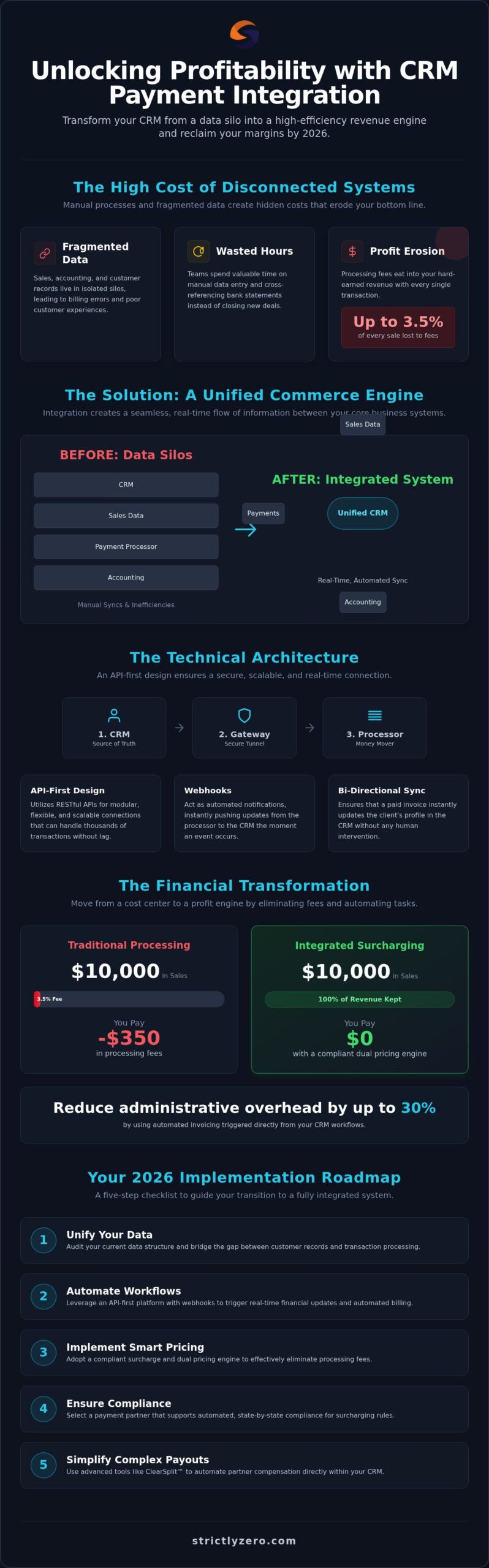
Think of crm payment integration as the central nervous system of a modern business. It is the seamless bridge between your Customer Relationship Management (CRM) and your transaction processing layers. In the past, these two systems lived in isolation, forcing staff to manually export CSV files or toggle between tabs just to see if a client had paid. That friction is a profit killer. By 2026, the standard has shifted from “data silos” to “unified commerce,” where every customer interaction and every dollar collected exist in a single, synchronized environment.
The shift to integration eliminates the hidden costs that plague unoptimized businesses. When your sales team spends hours on manual data reconciliation, you aren’t just losing time; you’re losing the opportunity to close new deals. Integration also provides a massive psychological benefit for your clients. A frictionless, one-click payment experience signals that your company is professional and tech-forward, which builds the trust necessary for long-term retention.
To better understand how these systems communicate, watch this helpful video:
The Core Components of an Integrated System
To build a high-efficiency engine, you need three parts working in harmony. First, the CRM serves as your source of truth, managing leads, accounts, and the entire communication history. Second, the payment gateway acts as a secure tunnel, transmitting encrypted transaction data to prevent breaches. Finally, the processor is the entity that actually moves the money and handles the final settlement. A true crm payment integration ensures these three components talk to each other in real time, so a “paid” status in your processor instantly updates the client’s profile in your CRM.
The Modern Business Case for Integration
The financial argument for unifying your stack is undeniable. Businesses often see a reduction in administrative overhead by up to 30% simply by using automated invoicing features. Instead of waiting for a billing department to send a manual request, your CRM can trigger payment links the moment a deal reaches a specific stage. This improves cash flow by getting funds into your account faster. It also enhances customer retention. By setting up personalized billing and recurring schedules within the CRM, you create a convenient experience that makes it easy for clients to keep doing business with you year after year.
How CRM Payment Integration Works: The Technical Architecture
A robust architecture isn’t just about writing code; it’s about building a reliable bridge for your revenue. Modern crm payment integration relies on an API-first design. This means the payment engine is built to be a modular, flexible part of your tech stack. Unlike rigid, pre-built plugins that offer limited customization, an API-first platform allows your developers to control exactly how data flows between systems. Webhooks are the secret sauce in this setup. They act as automated notifications that trigger the moment an event occurs, such as a successful transaction or a declined card. Instead of your CRM constantly asking the processor for updates, the processor pushes the information instantly, ensuring your records are always current.
This technical handshake creates bi-directional synchronization. When a customer pays an invoice through a virtual terminal or a payment link, the record in your CRM updates immediately without human intervention. Gaining a deep understanding of How CRM Systems Work helps clarify why this real-time data sync is so vital. Without it, your sales and accounting teams are forced to work with different numbers, leading to awkward customer conversations and billing errors.
The API Connection: Making Systems Talk
Modern integrations utilize RESTful APIs, which have become the industry standard for 2026. These APIs allow for scalable connections that can handle thousands of transactions without lag. Security is managed through OAuth 2.0 protocols, which use secure tokens rather than sharing raw login credentials between platforms. Before moving to a live environment, a high-quality sandbox is essential. This testing area lets your team simulate every possible scenario, from complex recurring billing cycles to edge-case failures, ensuring the system is bulletproof before it touches your actual bank account.
Security and PCI Compliance in the Integrated Stack
Security is often the primary concern when connecting financial data to a customer database. Tokenization effectively solves this by replacing sensitive card numbers with a unique digital identifier. You can bill a customer’s “card on file” for future orders without ever actually storing their 16-digit card number on your own servers. Hosted payment fields take this a step further by offloading PCI DSS liability. Since the payment data never touches your CRM server, your compliance burden is significantly reduced. Integrating AI-driven fraud prevention directly into this technical stack allows you to identify suspicious patterns based on CRM history, stopping fraudulent transactions before they hurt your bottom line.
Integrated Payments vs. Traditional Processing: Choosing a Profit Model
Many businesses fall into the “flat-fee” trap when setting up their first crm payment integration. These standard integrated processors often charge a single percentage for every transaction, which sounds simple but usually masks a significant markup. With average credit card processing fees in 2026 ranging between 1.5% and 3.5%, those small percentages quickly erode your bottom line. Online payments often see typical rates around 2.9% plus a fixed fee. Traditional processing relies on manual data entry and separate reconciliation, which adds administrative costs on top of the transaction fees. Choosing a profit model that prioritizes margin reclamation is the only way to scale efficiently in a high-volume environment.
The Impact of Surcharge and Dual Pricing Integration
Transitioning to a zero-fee model allows you to pass on credit card processing costs to customers directly within the CRM checkout. This isn’t just about adding a fee; it’s about transparency and choice. By automating dual pricing, your system shows a “Cash” price and a “Card” price on every invoice. This transparency helps maintain customer trust while protecting your margins. A critical component of this setup is a Smart Pricing Engine. This technology detects debit cards in real-time to ensure federal compliance, as surcharging debit cards is restricted under the Durbin Amendment. Moving from a traditional processor to a zero-fee integrated platform effectively turns a major expense into a neutral line item, significantly boosting your ROI.
Evaluating Platform vs. Processor Integrations
When selecting from the Top CRM Software, it’s vital to look beyond the user interface and evaluate the underlying financial architecture. Many “out-of-the-box” payment tools provided by CRM platforms come with higher, non-negotiable rates because the platform takes a cut of every transaction. While these are easy to set up, they lack long-term cost scalability. A dedicated processor with an API-first platform offers a more sophisticated alternative. You get the benefit of lower, more transparent rates while maintaining the seamless user experience of a built-in tool. This approach allows you to keep your favorite software while using a technical backbone designed to eliminate fees. Balancing ease of use with the ability to control your own pricing model is the key to sustainable growth in 2026.
Strategic Implementation: A 5-Step Checklist for 2026
Successful crm payment integration isn’t just about flipping a digital switch. It requires a deliberate alignment of your sales workflows and your financial infrastructure. By 2026, technical barriers have lowered, but compliance and operational hurdles remain significant. Following a structured checklist ensures that your transition to an integrated model is smooth, secure, and immediately profitable. This process starts with an audit of your current data structure to ensure every payment field maps correctly to your customer records.
Step 1: Assessing Technical Readiness
Before you begin the integration, you must verify that your system can handle the incoming data. Does your CRM support custom fields for transaction IDs and payment statuses? Without these, you’ll struggle to automate reconciliation. You should also identify the need for a virtual terminal to handle over-the-phone payments directly within the interface. Security is the final piece of technical readiness. Ensure your internet and network security meet the latest PCI DSS v4.0 requirements to protect sensitive customer data during the transmission process.
Step 2: Configuring Compliance and Pricing
Once the technical foundation is set, you need to configure your pricing logic. A modern Smart Pricing Engine is essential here, as it automatically applies state-by-state surcharge rules to keep your business compliant. You’ll also need to design compliant invoice templates that clearly disclose fee structures to your clients. For a deeper look at how this fits into your broader financial strategy, check out our guide on Credit Card Processing for Small Business. Setting these rules correctly from day one prevents legal headaches and ensures your zero-fee model remains bulletproof.
After configuring your pricing, you can start your integration journey today to see these automated workflows in action.
Step 3: Mapping the Journey and Training Your Team
The final steps focus on the human element of your crm payment integration. Map your customer journey from the initial lead generation to the final “Paid” status to ensure there are no friction points. Your team needs specific training on how to handle billing questions related to integrated surcharging. They should be able to explain the “Cash” versus “Card” pricing model confidently. Finally, monitor your ChurnIQ™ data closely. This intelligence allows you to see how the new billing model is being received and ensures that your move toward integrated profitability is actually improving merchant retention rather than hindering it.
Strictly: The Unified Platform for Integrated Payment Success
Strictly isn’t just another gateway; it’s an API-first omni-channel platform designed to be the technical backbone of your business. While previous sections of this guide explored the “how” and “why” of crm payment integration, Strictly provides the “what.” Our infrastructure allows you to maintain your preferred software environment while leveraging a robust financial engine. The core advantage lies in our industry-leading surcharge and dual pricing engine. By automating fee-offsetting programs, we help merchants effectively reach $0 in processing fees, reclaiming the margins that traditional processors usually consume.
Managing a modern business requires more than just moving money. It requires intelligence. ClearSplit™ allows for automated partner compensation, which is vital in integrated environments where multiple stakeholders might need a portion of a single transaction. To ensure long-term stability, ChurnIQ™ provides the merchant retention intelligence needed to keep your accounts engaged. This data-driven approach identifies risks before they lead to cancellations, allowing you to proactively manage your portfolio. By combining these tools, Strictly transforms your payment stack into a strategic asset rather than a simple utility.
Empowering Partners and Developers
We operate on a “Trust as a Processor” model, which is a significant shift from the standard vendor-client relationship. This model allows developers and ISOs to build their own unique brand identity on top of our secure, scalable infrastructure. We provide specialized tools for ISOs that cover every stage of the lifecycle, from rapid digital onboarding to the calculation of automated residuals. If you’re looking to expand your reach in the coming year, check out The Ultimate Payment Processing Platform for ISOs. This strategy ensures you aren’t just a reseller; you’re a technical partner providing genuine value through deep crm payment integration.
Ready to Scale Your Business?
Transitioning your financial operations doesn’t have to be a disruptive event for your team. Our API-first architecture is specifically designed for unified system integration. This means you can plug into our virtual terminals, payment links, and recurring billing tools with minimal friction. You can request a demo of our Smart Pricing Engine in action today to see how we handle state-by-state compliance automatically. For those looking to manage transactions across every digital touchpoint, read our Ecommerce Payment Processing: The Ultimate Omni-Channel Guide. It’s time to stop letting processing fees dictate your growth and start using a platform built for integrated profitability.
Future-Proof Your Revenue with Unified Payments
The transition from a static database to a dynamic, margin-protecting engine is no longer a luxury for businesses scaling in 2026. By bridging the gap between your customer records and financial transactions, you eliminate the administrative friction that stalls growth. A strategic crm payment integration does more than just sync data; it transforms how you capture and keep your revenue. You’ve seen how an API-first architecture ensures a seamless sync while a Smart Pricing Engine maintains 50-state compliance for your surcharging programs.
It’s time to stop letting high credit card fees erode your hard-earned profits. By implementing zero-fee processing via compliant surcharging, you can finally reclaim your margins and focus on expanding your client base. Strictly provides the technical backbone needed to unify your stack and protect your bottom line with AI-driven fraud prevention. You don’t have to settle for fragmented systems and high overhead any longer.
Eliminate your processing fees today with Strictly’s integrated payment platform.
Take the final step toward integrated profitability and watch your efficiency soar.
Frequently Asked Questions
Is CRM payment integration secure for my customers?
Yes, crm payment integration is highly secure when using modern standards like tokenization and PCI DSS v4.0. Strictly’s platform uses AI-driven fraud prevention to monitor transaction patterns in real-time. Sensitive cardholder data never touches your CRM server; instead, it’s replaced by a digital token. This offloads your security liability while ensuring that every customer payment is encrypted and protected against unauthorized access throughout the entire transaction lifecycle.
Can I use a surcharge program with integrated CRM payments?
Absolutely. You can use a compliant surcharge program by leveraging Strictly’s Smart Pricing Engine. This technology automatically identifies if a customer is using a credit card and applies the fee accordingly, while ensuring debit cards are processed without a surcharge to stay federally compliant. This setup allows you to reach $0 in processing fees while keeping your financial records fully synchronized within your existing database and customer profiles.
How long does it take to set up a CRM payment integration?
The timeline for setting up a crm payment integration varies based on the complexity of your current tech stack. While a basic connection using pre-built tools might take a few days, a custom enterprise setup using our API-first architecture typically takes one to two weeks. This period includes time for testing in a sandbox environment to ensure that webhooks and automated billing workflows function perfectly before you go live with real transactions.
What is the difference between a payment gateway and a CRM integration?
A payment gateway is the secure tunnel that transmits encrypted transaction data between the merchant and the processor. In contrast, a CRM integration is the technical bridge that connects that gateway to your customer database. While the gateway handles the security and transmission, the integration ensures that transaction results, such as “Paid” or “Declined,” are automatically recorded in the customer’s profile without any manual data entry or reconciliation.
Do I need a separate merchant account for integrated payments?
Yes, you still need a dedicated merchant account to receive funds from your transactions. Strictly acts as your payment processor, providing the infrastructure to move money from the customer’s bank to yours. Even though the payment interface lives inside your CRM, the actual financial settlement and risk management happen through your merchant account, which is unified with our omni-channel processing platform for easier financial reporting and management.
Will integrated payments work with my existing CRM like Salesforce or HubSpot?
Yes, integrated payments are designed to work with major platforms like Salesforce, HubSpot, and other modern CRMs. Because Strictly uses an API-first architecture, your developers can build a custom connection or use webhooks to sync data across these platforms. This flexibility ensures that your sales team can generate payment links and view real-time financial reporting without ever having to leave their primary workspace or toggle between different software applications.
How does dual pricing work on an integrated invoice?
Dual pricing works by presenting two distinct totals on a single integrated invoice: a “Card Price” and a “Cash Price.” When a customer chooses to pay via credit card, the system automatically applies the credit price. If they choose an alternative method like ACH, they receive the lower cash price. This model provides complete transparency and allows your business to offset processing costs while offering customers a clear choice at the point of sale.
What happens if a payment fails within the CRM system?
When a payment fails, webhooks instantly push a “Declined” status from the gateway back to your CRM. This triggers an automated update to the customer record; you can even set up automated workflows to notify the account owner or send a follow-up email to the client. This real-time feedback loop prevents service interruptions and ensures your sales team doesn’t waste time chasing payments that have already failed or been rejected by the bank.