
Developer Documentation for Payment API: The 2026 Integration Guide
Published:

Why are your developers still losing weeks to deciphering cryptic error codes when the payment industry has already moved toward agentic commerce and automated compliance? With PCI DSS 4.0 now the mandatory baseline and AI agents increasingly making purchases on behalf of users, your integration strategy can’t afford to be outdated. Finding high-quality developer documentation for payment API setups is no longer just a technical convenience. It’s the critical difference between a seamless launch and a month spent troubleshooting manual state-by-state surcharge compliance.
We know that managing complex regulations and hunting for visibility into partner residuals feels like a constant uphill battle. You need a system that scales across every channel without the technical debt of legacy APIs. This guide promises to help you master the essentials of modern payment API integration, from automated surcharge engines to omni-channel scaling. We’ll explore the latest standards in AI-driven fraud prevention and show you how to turn your payment stack into a profit-optimization engine that keeps your merchants happy and your data clear.
Key Takeaways
- Understand how the shift to logic-first architectures transforms modern payment APIs into proactive compliance and profit engines.
- Evaluate developer documentation for payment API features to ensure your sandbox environment perfectly mirrors production behavior for faster deployment.
- Learn to automate state-by-state surcharge and dual-pricing compliance through smart engines that identify card types in real time.
- Follow a structured integration roadmap to transition safely from secure authentication to a fully PCI-compliant checkout flow.
- Streamline complex partner residuals and gain better visibility into merchant data using advanced partner management tools.
Table of Contents
- What is a Payment API in 2026? Evolution of the Stack
- Essential Features of High-Quality Developer Documentation
- Logic-Driven API Architecture: Surcharging and Compliance
- Integration Roadmap: From Sandbox to Production
- Strictly’s API-First Platform: Building for Scale
What is a Payment API in 2026? Evolution of the Stack
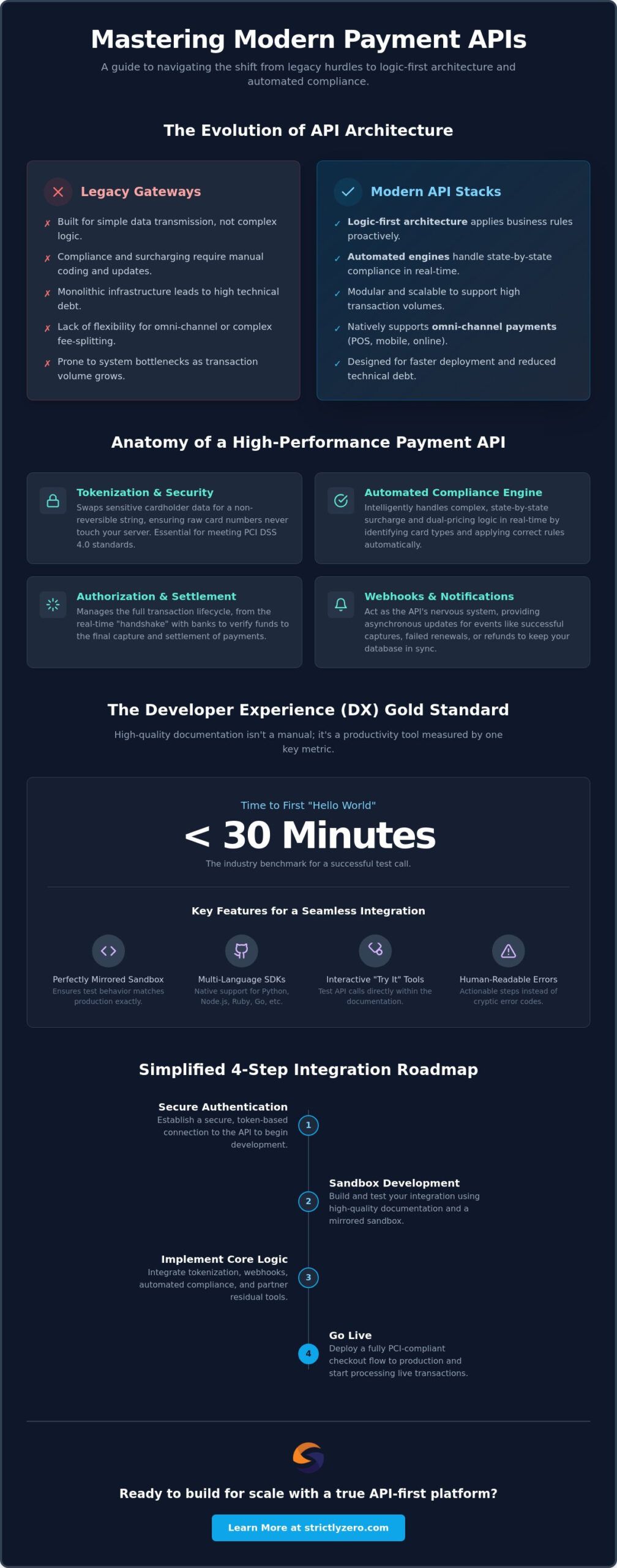
A payment API is a set of protocols that allows software to securely request, process, and manage financial transactions. In 2026, the definition has expanded beyond simple data transmission. Modern stacks have shifted from basic RESTful requests to logic-first architectures. This means the API doesn’t just move money; it applies complex business rules, such as real-time fraud checks and tax calculations, before a transaction even reaches the processor. Effective API management ensures these logic layers remain performant and secure across thousands of concurrent requests.
To better understand how these integrations function in a real-world environment, watch this helpful video:
The Core Functions of Modern Payment APIs
Security starts with tokenization. This process swaps sensitive cardholder data for a non-reversible string, ensuring that raw card numbers never touch your server. This is vital for meeting PCI DSS 4.0 standards. Beyond security, APIs manage the full lifecycle of authorization and settlement. They handle the real-time “handshake” with banks to verify funds and finalize the capture later. Webhooks serve as the nervous system of this process. They provide asynchronous notifications for events like successful captures, failed renewals, or processed refunds, keeping your database in sync without constant polling.
Why Developers are Moving Away from Legacy Gateways
Legacy systems often fail because they weren’t built for the modern regulatory environment. They lack the flexibility to handle complex fee-splitting or automated surcharge and dual-pricing logic. If you’re hard-coding fee calculations, you’re building a liability. Modern platforms provide better abstraction layers, allowing teams to deploy faster while the API handles the heavy lifting of state-by-state compliance. Scalability is another major hurdle for older, monolithic infrastructures. As your transaction volume grows, relying on developer documentation for payment API standards that prioritize modular, logic-driven design is the only way to avoid technical debt and system bottlenecks.
Essential Features of High-Quality Developer Documentation
Great documentation isn’t just a manual; it’s a productivity tool. The “Time to First Hello World” metric has become the industry gold standard for measuring developer experience (DX). If a developer can’t authenticate and make a successful test call within 30 minutes, the integration will likely face delays. High-quality developer documentation for payment API setups must prioritize this speed by offering clear onboarding paths. This includes providing pre-configured environments where code snippets can be copied and executed immediately.
Beyond speed, accuracy is paramount. A sandbox environment must mirror production behavior perfectly. If a specific fraud trigger works in the sandbox but fails in live testing, the documentation has failed the developer. Interactive “Try It Now” features within the API reference allow for real-time experimentation without writing a single line of local code. When things go wrong, robust error handling saves hours of debugging. Instead of cryptic codes, documentation should offer human-readable messages and actionable resolution steps. For instance, an error shouldn’t just say “Invalid Request,” it should specify that the currency code must be ISO 4217 compliant.
SDKs and Client Libraries
Native support for popular languages like Node.js, Python, Ruby, and Go is non-negotiable. These libraries abstract the underlying HTTP requests, allowing developers to work with familiar objects and methods. This is particularly important when managing security. By using pre-built UI components like hosted fields, developers can significantly reduce their compliance burden. These tools ensure sensitive data is sent directly to the processor, keeping it off the merchant’s server. This approach aligns with the best practices established by the PCI Security Standards Council to minimize data exposure. If you’re looking for a partner that prioritizes this level of technical support, you might explore payment processing solutions built with a developer-first mindset.
Testing and Simulation Tools
A comprehensive testing suite is the backbone of a stable integration. Documentation should provide a wide range of test card numbers to simulate specific outcomes. Developers need to trigger various decline scenarios, fraud alerts, and 3D Secure challenges to ensure their application handles every edge case gracefully. Idempotency keys are another critical feature. They prevent accidental duplicate charges during network timeouts by ensuring that a second request with the same key doesn’t process a new transaction. Finally, the ability to simulate complex post-transaction events, such as partial refunds or disputes, allows teams to build more resilient customer support workflows before they go live.
Logic-Driven API Architecture: Surcharging and Compliance
Hard-coding fee logic is a massive liability in 2026. Financial regulations change faster than software sprint cycles; if your developer documentation for payment API integration doesn’t explain how to automate these shifts, you’re building on a shaky foundation. Modern architectures have moved toward “compliance-as-code,” where the API itself manages the legal heavy lifting. Instead of your app trying to keep track of which states allow surcharging and which don’t, a logic-driven API handles the validation in real-time. This ensures every transaction remains compliant with the Electronic Fund Transfer Act (EFTA) and local jurisdiction rules without manual intervention.
A “Smart Pricing Engine” is the core of this logic-driven approach. By performing an instantaneous Bank Identification Number (BIN) lookup, the API identifies whether a card is debit or credit before the transaction is finalized. This is crucial because surcharging debit cards is often prohibited or heavily regulated. By automating this detection, you protect the merchant from accidental non-compliance. The API then returns the correct fee structure or dual-pricing options, allowing your UI to present clear, transparent choices to the customer. This transparency isn’t just a best practice; it’s a requirement for modern consumer disclosure standards.
Automating Surcharge and Dual Pricing
Calculating fees dynamically at the point of checkout allows businesses to offset costs without creating friction. When the API detects a credit card, it can automatically apply a surcharge or offer a dual-pricing model where the customer sees both the cash and credit price. This level of automation is essential for implementing zero fee credit card processing models effectively. By leveraging these API-driven responses, developers can build checkout flows that eliminate merchant costs while staying perfectly aligned with card brand rules and legal mandates.
Dynamic Load Management and Failover
Reliability is just as important as logic. During peak sales events, a payment API must handle high-volume traffic without latency spikes. High-quality developer documentation for payment API setups should detail how the system utilizes automatic routing to backup processors. This redundancy ensures 99.9% uptime, even if a primary processor experiences a regional outage. Developers can monitor this performance in real-time via integrated dashboards, which provide visibility into success rates, latency, and failover triggers. This proactive approach to load management prevents lost sales and maintains trust with both merchants and end-users.
Integration Roadmap: From Sandbox to Production
Moving from a local dev environment to a live production state requires more than just swapping API keys. It’s a structured transition that ensures security, scalability, and reliability. Your choice of developer documentation for payment API should provide a clear path through these stages, starting with secure authentication. In 2026, this typically means managing OAuth2 tokens or rotating secret keys to maintain a zero-trust architecture. Once your connection is secure, you’ll need to design your checkout flow using elements that keep sensitive data away from your backend servers.
The roadmap to a successful launch follows five critical steps:
- Step 1: API Key management. Set up secure authentication using OAuth2 or secret keys, ensuring environment variables are never committed to version control.
- Step 2: Checkout design. Implement PCI-compliant elements like hosted fields or secure iframes to minimize your data footprint.
- Step 3: AI fraud triggers. Configure AI-driven fraud prevention triggers at the transaction level to catch suspicious patterns before they process.
- Step 4: End-to-end testing. Use the sandbox environment to simulate every possible outcome, from successful captures to complex decline codes.
- Step 5: Production monitoring. Set up automated alerts and monitor production logs to catch latency issues or integration errors in real-time.
Security and PCI DSS Compliance
Reducing your compliance scope is the most efficient way to secure your application. By using hosted payment pages or specialized UI components, you ensure that raw card data never touches your infrastructure. This doesn’t mean you lose visibility. Modern APIs allow you to store non-sensitive customer metadata for reporting while the processor handles the high-risk data. AI plays a massive role here by detecting anomalous transaction patterns in real-time. If a single IP address attempts multiple transactions with different cards, the system can flag or block the activity automatically. If you want to build on a foundation of security and reliability, partner with a processor you can trust to handle the technical heavy lifting.
Post-Integration: Reporting and Reconciliation
Integration doesn’t end when the first payment is processed. You need a robust system for reconciliation and customer support. High-quality developer documentation for payment API setups includes detailed guides on pulling transaction reports via backend server-to-server calls. This allows you to automate refund workflows and sync your financial data with accounting software without manual exports. For businesses operating across multiple platforms, integrating with omni-channel payment processing systems provides a unified data stream. This ensures that whether a customer pays online or via a virtual terminal, the reporting remains consistent and accessible from a single dashboard.
Strictly’s API-First Platform: Building for Scale
Strictly isn’t just another gateway; it’s the preferred payment processing platform for ISOs and developers because it prioritizes the partner experience. While many providers focus solely on the merchant, our developer documentation for payment API environments provides specialized endpoints for managing an entire portfolio. This includes ClearSplit™, which automates complex partner residuals and compensation in real-time. Instead of waiting for monthly spreadsheets, partners get instant visibility into their earnings through the same API they use to manage transactions.
Retention is the lifeblood of any payment business. By leveraging ChurnIQ™, developers can use API data to predict and prevent merchant attrition before it happens. This tool analyzes transaction patterns to identify merchants at risk of leaving, allowing ISOs to intervene proactively. Combined with our “Zero Fee” advantage, you can build applications that save merchants money by design. This isn’t just about lower rates; it’s about using our surcharge and dual-pricing engine to eliminate processing costs entirely for the business owner. When evaluating developer documentation for payment API resources, the depth of these partner-centric tools is often the deciding factor for long-term scalability.
Advanced Tools for Partners and ISOs
Frictionless scaling requires programmatic merchant onboarding. Our API allows you to build custom signup flows that reduce the time from application to the first transaction. You can also take advantage of white-labeling opportunities, ensuring your brand stays at the forefront of the payment experience. When you hit a technical roadblock, you won’t be talking to a general support desk. You’ll have access to specialized support from developers who understand the nuances of the payments industry. This level of partnership ensures that your technical stack evolves alongside your business goals.
The Future of Payments with Strictly
Our API-first approach ensures your integration stays ahead of 2026 regulatory shifts without requiring a total rewrite. We’re already building for the next wave of commerce, including upcoming features for POS lending and crypto-settlement readiness. By staying aligned with our roadmap, you ensure your platform remains competitive as the industry evolves toward agentic commerce and decentralized settlement. If you’re ready to start building a more profitable and compliant payment experience, you can explore Strictly’s developer documentation today to see our logic-driven architecture in action.
Future-Proof Your Payment Integration
Integrating a payment stack in 2026 is no longer about simple connectivity. It’s about building a resilient, logic-driven engine that automates compliance and protects your revenue. By moving away from legacy systems and prioritizing high-quality developer documentation for payment API setups, you can deploy features like automated surcharging and AI-driven fraud prevention without the usual technical overhead. You’ve seen how the right sandbox environment and SDKs can slash deployment times while ensuring you meet the latest PCI DSS 4.0 standards.
Now, it’s time to put these tools to work for your portfolio. Whether you’re automating complex partner payouts or securing omni-channel transactions, the right platform makes all the difference in long-term scalability. Ready to take the next step? Scale your payments business with Strictly’s API-first platform today. You’ll gain access to our compliant smart surcharge engine, AI-driven fraud prevention, and ClearSplit™ automated residuals to keep your business growing efficiently. The landscape of commerce is changing fast. Don’t just keep up; lead the way with a stack built for the future.
Frequently Asked Questions
What is the difference between a payment gateway and a payment API?
A payment gateway is the broader service that authorizes credit card or direct payments for merchants. In contrast, a payment API is the specific set of technical protocols that allows your software to communicate with that gateway. While a gateway might include a web portal or virtual terminal, the API provides the programmatic flexibility to build custom checkout experiences directly into your own application.
How do I ensure my payment API integration is PCI compliant?
You ensure compliance by using hosted payment elements that prevent sensitive card data from ever touching your server. This approach significantly reduces your PCI DSS scope. By leveraging our secure tokenization and AI-driven fraud prevention, you maintain a high security standard while the processor handles the most rigorous data protection and compliance requirements on your behalf.
Does your API support automated surcharge and dual pricing?
Yes, our system features a native Surcharge and Dual Pricing Engine built directly into the core architecture. You can find specific instructions in our developer documentation for payment API to implement these models. The API calculates fees dynamically at the point of sale, ensuring your merchants stay compliant with various state laws and card brand rules automatically.
Can I test the API for free in a sandbox environment?
You can test every feature for free in our comprehensive sandbox environment. This environment perfectly mirrors our production system, allowing you to simulate successful transactions, declines, and fraud alerts. It’s the best way to validate your integration logic and webhooks before you ever process a live payment or sign up a real merchant.
What programming languages are supported by Strictly’s SDKs?
Strictly offers robust SDKs and client libraries for Node.js, Python, Ruby, and Go. These libraries abstract the complex HTTP requests, making it easier for your team to implement secure payments using their preferred tools. We also provide pre-built UI components to help you design a seamless, PCI-compliant checkout flow without writing everything from scratch.
How does the API handle debit card detection for surcharge compliance?
What is ClearSplit™ and how do I integrate it for partner residuals?
ClearSplit™ is our specialized tool for automating partner residuals and compensation. You integrate it by utilizing our partner management endpoints found in the developer documentation for payment API. This allows you to track transactions and distribute splits to your partners programmatically, eliminating the need for manual monthly spreadsheets or error-prone reconciliation processes.
How long does a typical payment API integration take?
A basic “Hello World” transaction can be achieved in about 30 minutes using our quick-start guides and pre-built libraries. However, a full production-ready integration usually takes between one to three weeks. This timeline includes designing the final UI, setting up AI fraud prevention triggers, and performing thorough end-to-end testing in the sandbox to ensure everything runs smoothly at scale.