
Dual Pricing Credit Card Processing: The 2026 Guide to $0 Fees
Published:

What if you could stop handing over a portion of every sale to card networks and instantly boost your bottom line by 3.5% without breaking a single law? You’ve likely felt the sting of seeing thousands of dollars vanish into processing fees every month, especially as total swipe fees across the U.S. climbed to $118.8 billion in 2025. It’s frustrating to feel like you’re working for the banks instead of your own business. The constant anxiety over shifting regulations in states like Connecticut or Maine only makes the situation more stressful.
This guide shows you how to implement dual pricing credit card processing to eliminate those expenses entirely while staying 100% compliant across all 50 states in 2026. You’ll learn the crucial legal distinctions between dual pricing and surcharging that protect your merchant account from fines. We will also cover how to use a Smart Pricing Engine to automate your compliance updates and maintain a transparent, trust-based relationship with every customer who walks through your door or visits your online store.
Key Takeaways
- Learn how offering two distinct prices allows you to offset merchant costs without the legal hurdles of traditional surcharging.
- Discover why dual pricing credit card processing remains 100% compliant in all 50 states, including those with strict surcharge bans.
- Find out how to configure your virtual terminal and online payment links for a seamless omni-channel experience.
- Understand how a Smart Pricing Engine automates state-level regulations and provides instant debit card detection to prevent fines.
- Get a clear roadmap for maintaining customer trust through transparent signage and receipt disclosures that explain their payment choices.
Table of Contents
- What is Dual Pricing Credit Card Processing? (The 2026 Definition)
- Dual Pricing vs. Surcharging: Choosing the Right $0 Fee Model
- Navigating Compliance: State Laws and Card Network Rules in 2026
- Implementing Dual Pricing Across Omni-Channel Platforms
- Eliminating Fees with Strictly’s Smart Dual Pricing Engine
What is Dual Pricing Credit Card Processing? (The 2026 Definition)
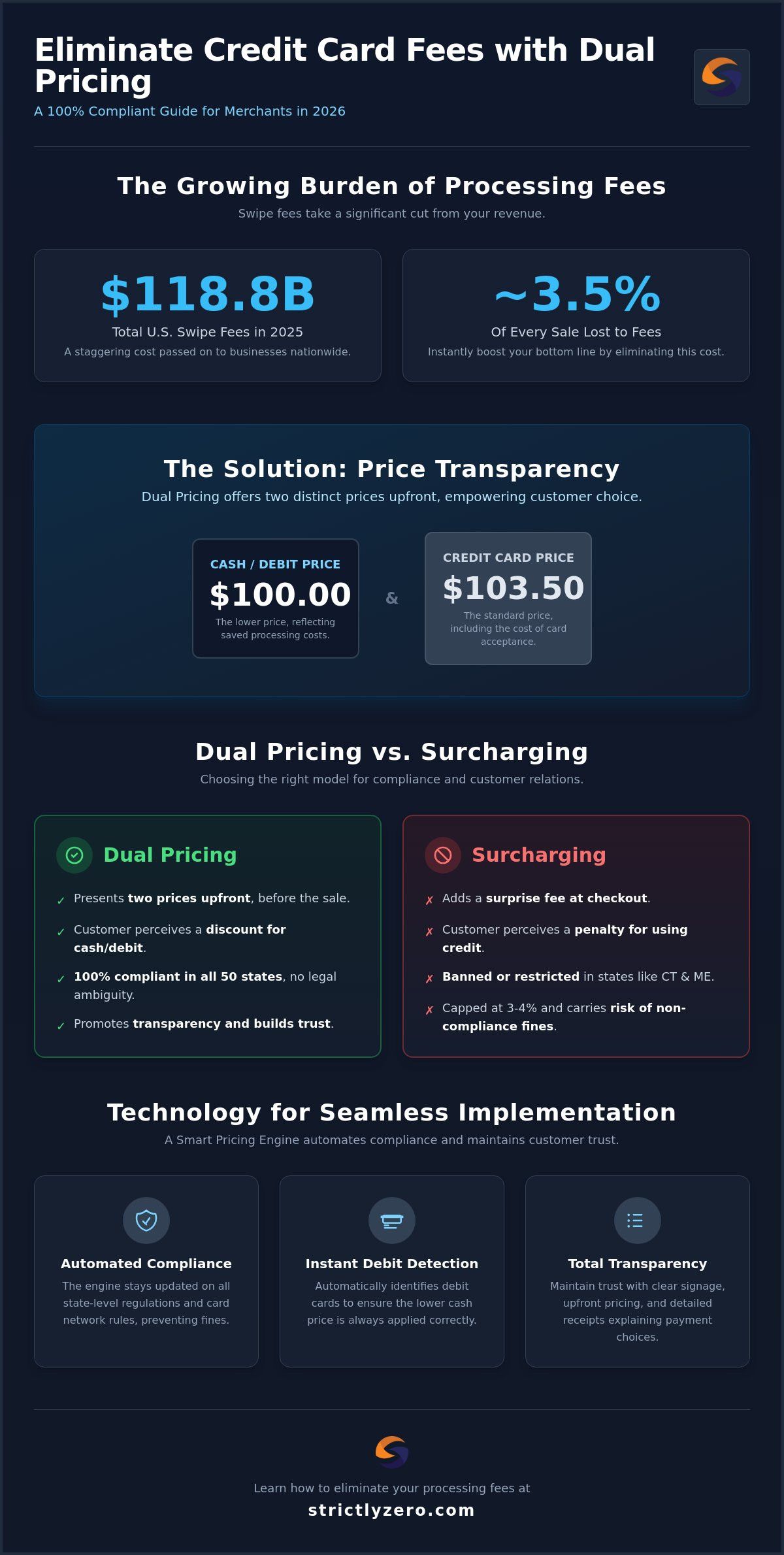
In 2026, the cost of doing business has hit an all-time high. Merchants saw average effective swipe fees for Visa and Mastercard reach 2.36% in 2025, contributing to a staggering $118.8 billion in total fees nationwide. While a recent antitrust settlement began reducing interchange rates by 0.10% for a five-year period starting in April 2026, these minor cuts aren’t enough to save most small businesses. This is where dual pricing credit card processing enters the picture. It’s a strategic pricing model that allows you to present two separate prices to your customers: one for credit card payments and a lower price for cash or check.
Unlike traditional surcharging, which tacks on a fee at the very end of a sale, dual pricing is built into the initial price tag. It’s a proactive approach to cost management that focuses on transparency rather than penalties. By showing both options upfront, you empower your customers to choose the payment method that fits their budget while ensuring your margins remain protected.
To better understand this concept, watch this helpful video:
The Core Mechanism: How It Works at Checkout
Dual pricing relies on a simple, two-tier structure. Price A is the standard price for customers who prefer the convenience of credit cards. Price B is the discounted price for those paying with cash or check. This system is essentially a form of price discrimination, an economic theory that allows businesses to offer different price points based on transaction costs. Using dual pricing credit card processing as a transparency-first model ensures you comply with all major card network rules because it presents the cost of acceptance as a clear choice rather than a surprise surcharge.
Dual Pricing vs. Cash Discounting: Are They the Same?
Many people use these terms interchangeably, but they aren’t the same. In the past, “Cash Discounting” was often a mislabeled surcharge where a fee was added to the receipt and then “discounted” back off if the customer paid cash. This approach often leads to “hidden fee” complaints and regulatory scrutiny. Dual pricing provides a cleaner legal shield because both prices are clearly displayed from the start. You’re not adding a fee to a base price; you’re offering two distinct base prices. This clarity eliminates the anxiety of non-compliance fines and keeps your customer relationships healthy and honest.
Dual Pricing vs. Surcharging: Choosing the Right $0 Fee Model
Choosing between surcharging and dual pricing credit card processing often feels like a choice between two identical paths. However, the legal and financial implications of each are vastly different. Surcharging involves adding a specific percentage fee to a transaction only when a customer uses a credit card. In contrast, dual pricing presents two separate prices for every item: a card price and a cash price. This distinction matters because customers generally react better to receiving a “cash discount” than being hit with a “credit penalty” at the finish line.
From a financial standpoint, your ROI varies significantly between the two models. Visa currently caps surcharges at 3% as of April 2026. While Mastercard allows up to 4%, most merchants must stick to the 3% limit to stay compliant with both networks since they usually accept both cards. If your effective processing rate is higher than 3%, surcharging won’t get you to a true $0 fee. Dual pricing doesn’t face these same artificial caps because it’s a pricing strategy, not an add-on fee. This allows for full cost recovery across your entire inventory.
The Debit Card Dilemma
One of the biggest risks in modern payments is the “Debit as Credit” trap. Federal law, specifically the Durbin Amendment, strictly prohibits surcharging debit cards, even when they’re run through a credit network. Mistakenly applying a surcharge to a debit transaction can result in massive fines or even the sudden termination of your merchant account. Using a Surcharge & Dual Pricing Engine solves this by providing automated detection at the point of sale. This technology identifies the card type instantly. It ensures you never accidentally charge a fee on a debit transaction, keeping your business safe from regulatory blowback.
Compliance Comparison Matrix
The regulatory landscape for 2026 is a patchwork of local and network rules. Surcharging remains a legal grey area in several regions. As of July 2026, it is expressly prohibited in Connecticut, Massachusetts, and Maine. Other states like Colorado and Illinois have implemented strict caps of 2% and 1% respectively. You can review the latest State-by-state credit card surcharge laws to see how your local jurisdiction handles these fees.
Visa and Mastercard have also updated their 2026 disclosure rules, requiring clear signage at both the entrance and the point of sale. Because dual pricing is legal in all 50 states, it offers a more stable long-term solution for businesses with national reach. For a deeper dive into these options, check out our guide on Zero Fee Credit Card Processing: The 2026 Merchant Guide to $0 Fees to find the best fit for your specific business model.
Navigating Compliance: State Laws and Card Network Rules in 2026
Compliance in 2026 is a moving target. You aren’t just dealing with federal mandates like the Durbin Amendment; you’re also juggling a complex web of state statutes and evolving card network policies. While dual pricing credit card processing is legal in all 50 states, the rules for how you display those prices are strict. For example, as of July 2026, surcharging remains expressly prohibited in Connecticut, Massachusetts, and Maine. If you operate in multiple regions and try to manage these updates manually, you’re opening yourself up to massive liability. One wrong receipt format can trigger a network audit or a state-level fine that quickly erases your savings.
The only way to stay safe without spending hours on legal research is through a Smart Pricing Engine. This technology automates compliance at the software level. It ensures every transaction follows the latest rules based on the customer’s location and the specific type of card they’re using. This hands-off approach lets you focus on growing your business while the software handles the fine print, preventing the risk of manual pricing errors that often lead to non-compliance penalties.
Automatic State-by-State Adjustments
For e-commerce merchants, location detection is vital. Strictly’s platform identifies where a customer is shopping from to apply the correct local rules instantly. This is especially important for states like California that have enacted “drip pricing” laws to restrict hidden fees. The system also automates surcharge caps based on the 2026 network updates from Visa and Mastercard. For instance, it recognizes when to apply Colorado’s 2% cap or Illinois’s 1% limit. By offloading this responsibility to an automated engine, you reduce the burden of monitoring legislative changes and ensure your $0 fee model remains fully protected.
Signage and Disclosure Requirements
Transparency isn’t just a legal requirement; it’s a customer service strategy. Card networks require clear communication so that customers aren’t surprised at the register. To stay compliant, you must implement the following disclosure practices:
- Display clear signage at your entrance and at every point of sale.
- Format receipts to show the “Cash Price” and the “Card Price” as distinct line items.
- Ensure your sales team is trained to explain that customers have a choice between two price points.
Don’t skip staff training. Your team needs to be able to explain the pricing model confidently. When your staff can clearly articulate that customers are receiving a discount for cash rather than paying a penalty for cards, you maintain trust and minimize pushback. This level of transparency is what separates a professional dual pricing credit card processing program from a poorly implemented surcharge plan.
Implementing Dual Pricing Across Omni-Channel Platforms
Many business owners mistakenly believe that dual pricing credit card processing is strictly for brick-and-mortar retail shops. In reality, a modern $0 fee strategy must span across every channel where you interact with customers. Whether you’re taking an order over the phone, sending an invoice, or selling through a web store, the logic remains the same. Shifting to an omni-channel model ensures you don’t leave money on the table when customers move from your physical storefront to your digital one.
To get started, follow these four foundational steps:
- Step 1: Audit your transaction data. Look at your average ticket size and monthly volume. If you’re seeing a high volume of credit transactions, the savings from dual pricing will be substantial.
- Step 2: Set up your virtual terminal. Configure your digital dashboard to display two distinct prices. This ensures that when you’re manually entering card details for a phone order, the compliance logic is already applied.
- Step 3: Integrate your checkout. Your e-commerce platform should show real-time price adjustments. When a customer selects their payment method, the price should clearly reflect the cash or card choice.
- Step 4: Train your team. Equip your staff with the knowledge to use the Smart Pricing Engine. While the software handles debit card detection automatically, your team should know how to explain the two-tier pricing to curious customers.
E-commerce and Mobile Integration
Your digital presence needs to be as transparent as your physical one. Use payment links that automatically display the cash versus card discount before the customer clicks “pay.” This level of clarity reduces cart abandonment because there are no surprise fees at the end. It’s also vital that your mobile app reflects the same pricing logic as your storefront. Consistency builds trust. For a deeper dive into managing these digital touchpoints, read our Ecommerce Payment Processing: The Ultimate Omni-Channel Guide.
For ISOs and Partners: Scaling the Dual Pricing Model
If you’re an ISO or a payment partner, dual pricing credit card processing is your most powerful retention tool. High-volume merchants are desperate to eliminate the 3% to 4% hit on their margins. By offering a unified solution that covers both in-person and online sales, you become an indispensable partner. You can also use ClearSplit™ to manage automated partner compensation. This ensures everyone is paid accurately even in a $0 fee environment. To learn more about growing your portfolio, see The Ultimate Payment Processing Platform for ISOs: Scale in 2026.
Ready to modernize your payment stack? Contact us today to implement a compliant dual pricing strategy.
Eliminating Fees with Strictly’s Smart Dual Pricing Engine
Adopting dual pricing credit card processing shouldn’t feel like taking on a second job as a compliance officer. Strictly provides a unified platform specifically built to achieve $0 processing fees while removing the heavy lifting from your daily operations. Our Smart Pricing Engine acts as a digital safeguard, automatically adjusting for the latest network rules and state regulations. You don’t have to worry about manual updates or accidental fines because the software handles the complexity for you.
This system offers true omni-channel flexibility. Whether your sales team is closing a deal in the field, your web store is taking midnight orders, or your retail staff is ringing up a customer in person, the pricing logic remains consistent. Transitioning your existing merchant account is a seamless process. Most businesses can switch to the Strictly platform without any operational downtime, ensuring that your savings begin from the very first transaction on the new system.
Unified Reporting and Analytics
Transparency extends to your back-office operations. The Strictly dashboard allows you to track your savings in real-time. You can see exactly how much you’ve saved by shifting costs away from your margins and monitor customer payment trends. By analyzing the split between cash and card payments, you can fine-tune your strategy to maximize profit. We also integrate ChurnIQ™ into our analytics suite. This tool helps you ensure your dual pricing strategy is boosting your bottom line without negatively impacting customer retention or loyalty.
Getting Started with Strictly
Our onboarding process is designed for speed and clarity. Whether you’re a single-location merchant or an ISO partner managing a large portfolio, we provide a structured path to implementation. You’ll have access to 24/7 support to answer any technical or compliance questions as you transition. Our team is dedicated to ensuring your dual pricing credit card processing setup is optimized for your specific industry and sales volume. Stop letting processing fees eat your profits and start keeping 100% of your hard-earned revenue.
Eliminate your processing fees today with Strictly’s Dual Pricing Engine.
Reclaim Your Revenue in 2026
The era of losing a significant portion of every sale to card networks is over. By implementing dual pricing credit card processing, you’re not just cutting costs; you’re building a more transparent business model that customers appreciate. You’ve seen how this strategy bypasses the legal hurdles of surcharging while keeping you compliant in every state. Success in 2026 requires more than just a new pricing sign. It requires a system that handles the heavy lifting of debit card detection and state-specific caps automatically.
With our Smart Pricing Engine, compliance is 100% automated. This allows you to focus on growth rather than fine print. Whether you sell in-person, on the web, or via mobile, a unified approach ensures your margins remain protected across every channel. Partners can also leverage ClearSplit™ for seamless residual management in this $0 fee environment. Don’t wait for the next interchange rate hike to protect your bottom line. Eliminate Your Processing Fees with Strictly today. It’s time to take control of your profit margins and start keeping what you earn.
Frequently Asked Questions
Is dual pricing legal in all 50 US states in 2026?
Yes, dual pricing credit card processing is 100% legal in all 50 states as of 2026. This is because it is classified as a pricing strategy that offers a discount for cash payments rather than an additional fee for credit cards. While surcharging faces bans in several jurisdictions, dual pricing remains a compliant way to manage your overhead nationwide.
What is the difference between dual pricing and a surcharge?
A surcharge is a fee added to the final total when a customer uses a credit card. In contrast, dual pricing presents two distinct prices for every item or service from the start. One price is for those paying with cash or check, and a slightly higher price is for those using any form of card. This transparency helps avoid the “hidden fee” complaints common with surcharging.
Does dual pricing apply to debit card transactions?
Dual pricing applies to the payment method rather than the specific card type. When a customer uses a debit card, they are typically charged the “card price” because the merchant still incurs a processing cost. However, because you are offering a discount for cash rather than adding a penalty for the card, you remain within the legal boundaries of federal regulations regarding debit transactions.
How do I explain dual pricing to my customers to avoid pushback?
The most effective way to communicate this is by framing it as a “Cash Discount” program. Customers respond much more positively to the idea of saving money by paying with cash than they do to being penalized for using a card. Clear signage and well-trained staff can explain that the cash price reflects the true cost of the item, while the card price covers the convenience of electronic payments.
Can I use dual pricing on my e-commerce website?
Yes, you can absolutely implement dual pricing credit card processing on an e-commerce platform. Modern virtual terminals and payment links are designed to display both the cash and card prices during the checkout process. This ensures that your online customers have the same transparency as those in your physical store, allowing you to maintain a consistent $0 fee model across all sales channels.
Do I need special hardware to implement dual pricing at my store?
You don’t need to purchase expensive proprietary hardware to start using this model. Most modern software-based payment platforms can be configured to support dual price points. You simply need a system that can handle the logic of displaying two prices and applying the correct one based on the customer’s choice at the point of sale.
How much money can my business save with a dual pricing program?
What happens if I accidentally surcharge a debit card?
Accidentally surcharging a debit card is a violation of the Durbin Amendment and can lead to severe consequences. Merchants found in violation may face heavy fines from card networks or even have their merchant accounts terminated. This is why using an automated engine is critical, as it detects the card type instantly and ensures that fees are only applied to eligible credit transactions.