
Dual Pricing for Credit Cards: 2026 Merchant Guide
Published:

U.S. merchants handed over a staggering $187 billion in processing fees in 2024, a figure that highlights just how much profit is lost to card networks every year. If you’re tired of watching your margins shrink, you’ve likely asked, what is dual pricing for credit cards and how can it protect your bottom line in 2026? Unlike standard surcharging, which is currently restricted in states like California and Massachusetts, dual pricing is a transparent model that remains legal in all 50 states, providing a clear path to reclaiming your revenue.
It’s frustrating to feel like you’re paying for your customers’ credit card rewards programs out of your own pocket. This guide will show you how to eliminate those merchant fees entirely while maintaining 100% compliance with ever-changing card brand rules. We’ll break down how a smart pricing engine can automate your compliance and explain how to present these choices to your customers so they feel empowered rather than penalized.
Key Takeaways
- Understand what is dual pricing for credit cards and how displaying two distinct prices—cash and card—removes the legal risks associated with traditional surcharging.
- Navigate complex state regulations by adopting a model that is legally protected across all 50 states, including those with strict consumer protection laws like Massachusetts and Connecticut.
- Learn how to frame pricing through the lens of “loss aversion” to ensure customers feel they are receiving a cash discount rather than paying a credit penalty.
- Simplify your operations with a Smart Pricing Engine that automatically applies the correct price based on the payment method used at the point of sale.
- Achieve the ultimate goal of $0 processing fees while maintaining full compliance with the latest 2026 Visa and Mastercard transparency requirements.
Table of Contents
- What is Dual Pricing for Credit Cards? Definition & Mechanism
- The Legal Landscape: Compliance Rules for 2026
- The Psychology of Choice: Managing the Customer Experience
- Implementing Dual Pricing Technology: The Smart Pricing Engine
- Maximizing Profitability: Why Strictly is the Partner for Zero-Fee Processing
What is Dual Pricing for Credit Cards? Definition & Mechanism
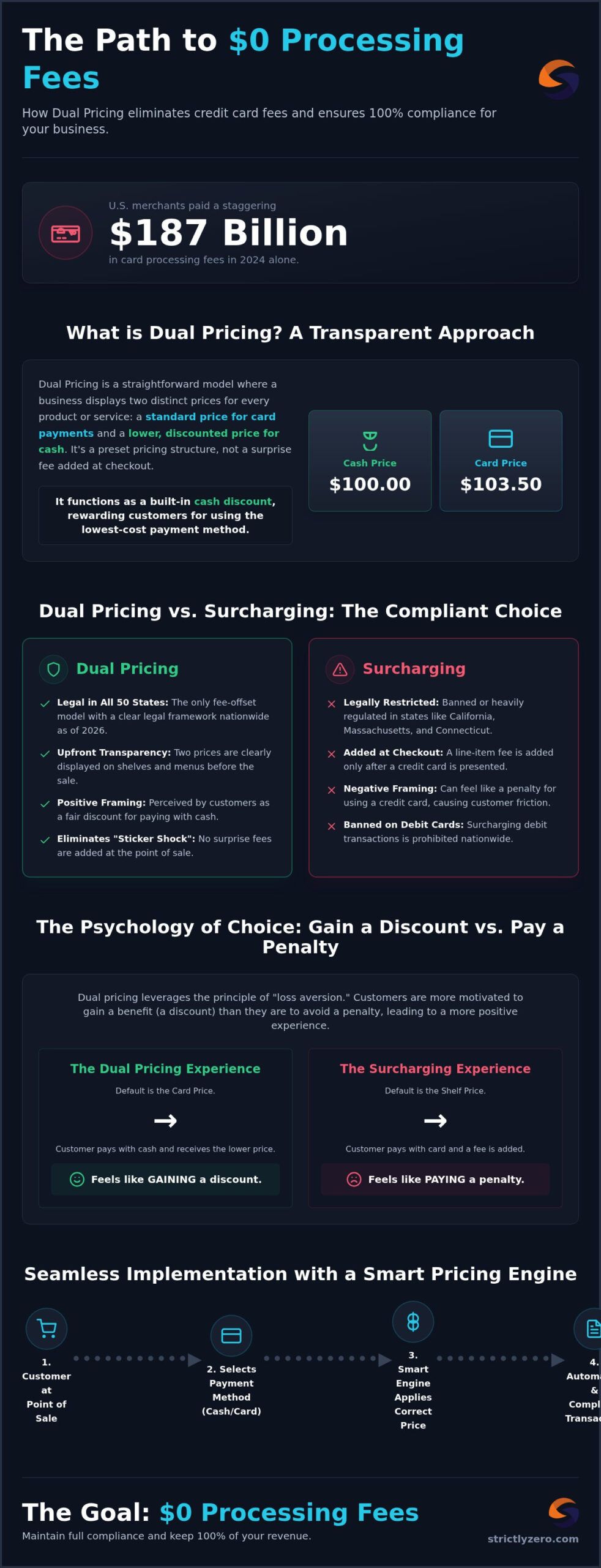
At its core, dual pricing is a straightforward model where a business displays two distinct prices for every product or service: one for card payments and a lower one for cash. If you’ve wondered what is dual pricing for credit cards and how it affects your checkout flow, it’s helpful to see it as a preset pricing structure rather than an added fee. Dual pricing is the only fee-offset model legal in all 50 US states as of 2026, making it the gold standard for merchants seeking long-term stability.
When business owners ask what is dual pricing for credit cards, they’re often looking for a way to stop the bleeding from merchant fees without alienating their base. The “card price” is designed to cover the overhead of processing, while the “cash price” represents the standard cost of goods. By presenting both options upfront, you give the customer the power to choose their preferred payment method based on the value they see in it. It’s a transparent value exchange that aligns your business costs with consumer choice.
How Dual Pricing Differs from Surcharging
Surcharging and dual pricing might seem similar, but they operate on very different legal and psychological tracks. Surcharging adds a line-item fee to the transaction only after a credit card is presented. This often leads to “sticker shock” and is strictly prohibited on debit card transactions nationwide. In contrast, dual pricing sets two separate base prices from the start. This distinction is vital for understanding the economics of surcharging versus price-setting. Because dual pricing isn’t an “add-on” fee, it avoids the regulatory traps that have made surcharging difficult to manage in states like New York or California.
Visual transparency is the biggest win here. When a customer sees two prices on a shelf tag or menu, they understand the cost of their choice immediately. It feels like a fair trade rather than a penalty. This clarity helps businesses maintain 100% compliance with card brand rules while protecting their reputation at the point of sale. You aren’t “charging extra” for cards; you’re offering a discount for cash.
The ‘Cash Discount’ Connection
Technically, dual pricing functions as a built-in cash discount. It rewards customers who choose to pay with cash, which is the least expensive payment method for a merchant to accept. This model is particularly effective at protecting your margins against high-reward cards, such as “Infinite” or “Signature” tiers, which carry much higher interchange rates than standard cards. By setting your “card price” as the default for those who want the convenience and rewards of plastic, you ensure your business isn’t the one subsidizing those perks. Your base price remains protected, and your profit stays where it belongs: in your business bank account.
The Legal Landscape: Compliance Rules for 2026
The regulatory environment for merchant fees has shifted dramatically over the last few years. While surcharging has faced intense scrutiny and legislative bans, dual pricing has emerged as a reliable safe haven for business owners. As of August 2026, dual pricing remains legal in all 50 states because it relies on the merchant’s fundamental right to set different prices for different payment methods. This distinction is vital for businesses in states like Connecticut or Massachusetts, where traditional surcharging is still prohibited. The 2026 regulatory shift, bolstered by recent legal settlements between card networks and merchants, has solidified the legal right to offer multi-tier pricing models that reflect the true cost of acceptance.
Visa and Mastercard have established clear transparency requirements that merchants must follow to stay compliant. You must provide clear disclosure at both the entrance of your establishment and the point of sale, ensuring the “card price” and “cash price” are both clearly visible to the consumer. Your receipts also need to reflect the specific pricing logic applied to the transaction. While credit card surcharges are strictly capped at 3% as of 2026, dual pricing operates under a different legal framework that focuses on base price setting rather than fee assessment. When asking what is dual pricing for credit cards from a legal perspective, it is best defined as a transparent pricing strategy rather than a post-sale penalty.
State-by-State Compliance Nuances
Navigating California’s law on credit card fees and similar regulations in other states requires technical precision. In 2024, California’s SB 478 effectively banned “drip pricing” or hidden fees, pushing more merchants toward the transparency of dual pricing. To succeed, your zero fee credit card processing strategy should include automated state-by-state compliance detection. This technology ensures you aren’t accidentally running afoul of local caps, such as Colorado’s 2% limit or Illinois’ 1% restriction on surcharges, by applying the correct dual pricing logic instead.
Debit Card Restrictions and Dual Pricing
The Durbin Amendment continues to be the primary regulator for debit card transactions. Federal law and card network rules strictly prohibit surcharging debit cards, even if they’re run as “credit” at the terminal. Applying a surcharge to these transactions is a massive compliance risk that can lead to heavy fines or account termination. Strictly’s Smart Pricing Engine solves this by identifying the card type in real-time. It ensures the correct pricing logic is applied instantly, allowing you to maintain a compliant program across all payment types. If you’re looking for a partner to manage these complexities, you can rely on Strictly’s expertise to keep your business protected while understanding what is dual pricing for credit cards in a real-world setting.
The Psychology of Choice: Managing the Customer Experience
Humans are hardwired to avoid losses more than they seek gains. Behavioral economists call this “loss aversion,” and it’s the primary reason why dual pricing succeeds where surcharging often fails. When a customer sees a fee added to their total at the end of a transaction, it feels like a penalty. However, when you explain what is dual pricing for credit cards as a choice between two preset prices, the psychological weight shifts. The customer no longer feels targeted; they feel empowered to choose the payment path that offers them the most value.
Transparency is the most effective trust builder in any retail or service environment. Being upfront about your pricing prevents the “sticker shock” that occurs when unexpected costs appear at the register. By 2026, consumer expectations have shifted toward total price clarity. Businesses that embrace this transparency see higher retention rates because customers appreciate the honesty. They’d rather know the cost of using a card at the start than discover it as a surprise line item during checkout.
Effective Signage and Communication
Your signage is your first line of defense against confusion. Best practices for 2026 involve clear, dual-column pricing on menus and shelf labels. This visual aid reinforces the idea of a value exchange: the card price covers the convenience and rewards of credit, while the cash price offers a direct discount for those avoiding processing overhead. If you’re currently using other models, you might want to learn how to tell customers you’re adding a surcharge fee to compare how different framing affects the buyer’s mood.
Training your team to use a “Value-Exchange” script is essential. Instead of apologizing for prices, staff should be prepared to explain the logic simply. Try these communication tips:
- Avoid words like “fee,” “penalty,” or “extra charge.”
- Use phrases like “incentive,” “cash discount,” and “standard card price.”
- Remind customers that dual pricing helps keep the business’s overall costs lower for the entire community.
Handling Objections at the Point of Sale
Even with great signage, some customers will have questions. When a curious shopper asks what is dual pricing for credit cards, your staff should have a confident, compliant answer ready. Explaining the reality of credit card processing fees helps bridge the gap between business necessity and customer perception. Most shoppers don’t realize that merchants pay a portion of every swipe to the banks; once they understand the “why,” their skepticism usually vanishes.
Turn these discussions into brand loyalty opportunities by focusing on fairness. You can explain that dual pricing ensures cash-paying customers aren’t subsidizing the rewards programs of credit card users. This narrative positions your brand as one that cares about equity and transparency. When handled with empathy and clear data, a pricing question can actually strengthen the bond between your business and your customers.
Implementing Dual Pricing Technology: The Smart Pricing Engine
Moving from a traditional fee model to a dual pricing structure requires more than just new signage. It demands a sophisticated technological stack that can handle complex pricing logic without slowing down your checkout line. When business owners ask what is dual pricing for credit cards from a technical perspective, they’re referring to the backend software that manages two distinct price points for every SKU in their inventory. Implementing this system effectively involves five critical steps:
- Step 1: Select a processor that supports multi-tier pricing logic at the gateway level rather than just adding fees at the terminal.
- Step 2: Configure your inventory or menu to reflect both cash and card prices across all sales channels.
- Step 3: Integrate a Smart Pricing Engine to handle real-time detection of card types, ensuring credit and debit are handled correctly.
- Step 4: Update your physical and digital receipts to show a compliant breakdown of the transaction.
- Step 5: Perform regular audits of the engine to ensure your pricing stays aligned with any fluctuations in interchange rates.
Omni-Channel Dual Pricing: Beyond the Storefront
Your pricing strategy shouldn’t be limited to your physical counter. To maintain a professional brand image, you must ensure a consistent experience whether a customer pays in person, online, or over the phone. Implementing dual pricing on a virtual terminal allows your team to provide accurate quotes for phone orders instantly. In the digital space, your shopping cart should display both the cash and card totals clearly before the final click. This transparency builds trust and prevents cart abandonment caused by unexpected costs at the final stage of the buyer’s journey.
The Role of the Smart Pricing Engine
The “engine” is the brain of your payment system. It automates the complex math required to calculate card prices based on current credit card processing services standards. Because card brand rules and state laws can change, having an automated system is safer than manual entry. In 2026, real-time compliance is a necessity; the engine should update its logic automatically as regulations evolve. Beyond compliance, these tools provide detailed reporting and analytics. You can track your exact savings and merchant-side ROI, giving you a clear picture of how much revenue you’ve reclaimed from processing fees. If you’re ready to automate your savings, explore how Strictly’s engine handles implementation for you.
Understanding what is dual pricing for credit cards means recognizing that the right technology makes the transition seamless. When the engine does the heavy lifting, your staff can focus on service instead of calculating discounts or explaining fees. This technical precision ensures your business stays profitable and protected in any regulatory climate.
Maximizing Profitability: Why Strictly is the Partner for Zero-Fee Processing
Reaching the goal of $0 in processing costs isn’t just a theoretical milestone; it’s the operational standard Strictly sets for modern merchants. While other processors focus on shaving off fractions of a percentage from interchange-plus rates, Strictly leverages technology to remove the burden of fees entirely. When you master what is dual pricing for credit cards, you gain the ability to protect every dollar of your revenue. Strictly’s compliance-first engine acts as your shield, ensuring that your transition to this model is handled with the highest level of trust and technical precision.
Strictly’s Smart Pricing Engine automates the heavy lifting of state-by-state regulations and real-time card detection. This is the safest choice for merchants and ISOs who cannot afford the legal risks of manual fee management. Beyond simply setting prices, Strictly provides a unified platform that manages your entire payment ecosystem. Tools like ClearSplit™ and ChurnIQ™ offer advanced partner management and data insights, allowing you to see exactly where your savings are coming from and how to optimize your growth. This isn’t just a short-term fix; it’s a sustainable business model for 2026 and the years to follow.
The Path to $0 Processing Fees
The transition from traditional credit card processing for small business to a zero-fee model is a transformative shift for your cash flow. Strictly’s dual pricing program effectively eliminates your monthly processing bill by ensuring the costs of card acceptance are covered by the card-using consumer. This reclaimed capital can be immediately reinvested into marketing, inventory, or employee benefits. Instead of writing a check to your processor every month, you’re building a more resilient business. Understanding what is dual pricing for credit cards is the first step toward reclaiming those thousands of dollars that used to vanish into the card networks.
Partnering for Success
Strictly doesn’t just serve individual merchants; it empowers the entire payments industry. ISOs and developers can leverage Strictly’s robust infrastructure to offer these same zero-fee benefits to their own client bases. With a dedicated support team that stays ahead of the 2026 legal landscape, partners can scale without worrying about compliance bottlenecks. You can scale your payments business with Strictly’s partner platform and provide the transparency that modern consumers demand. By choosing a partner that prioritizes trust and automation, you position your business at the forefront of the next era of commerce.
Future-Proof Your Business with Dual Pricing
The days of absorbing high processing costs as an unavoidable expense are over. By now, you understand what is dual pricing for credit cards and why it stands as the most transparent, legally sound way to protect your margins in 2026. This model doesn’t just save money; it builds trust by giving your customers a clear choice at the register. Whether you operate a single storefront or a complex omni-channel enterprise, the right technology makes this transition effortless.
Strictly provides the tools you need to achieve a true $0 processing fee model while staying compliant in all 50 states. Our Smart Pricing Engine handles the complex work of automated debit card detection and state-specific regulations so you don’t have to. You’ve worked hard to build your business, and you deserve to keep 100% of the revenue you earn. It’s time to stop letting merchant fees dictate your profitability.
Eliminate your processing fees today with Strictly’s Smart Pricing Engine and start reinvesting that capital back where it belongs: into your growth and your team. You’ve got the knowledge; now take the step toward a more profitable future.
Frequently Asked Questions
Is dual pricing for credit cards legal in all 50 states?
Yes, dual pricing is legal across all 50 U.S. states as of August 2026. This practice is protected under federal law, specifically the Durbin Amendment of the Dodd-Frank Act. While certain states like Massachusetts and Connecticut still have restrictions on traditional surcharging, dual pricing bypasses these hurdles because it involves setting two distinct base prices rather than adding a fee at checkout. It’s the most stable way to offset processing costs nationwide.
What is the difference between dual pricing and a cash discount?
The main difference lies in how prices are displayed to your customers. A cash discount program typically lists one price and applies a discount when cash is used. In contrast, when asking what is dual pricing for credit cards, you’ll find it requires displaying both the card price and the cash price simultaneously on every item or menu. This dual-display method provides higher transparency and meets the strictest state and card brand requirements.
Can I apply dual pricing to debit card transactions?
Yes, you can apply dual pricing to debit cards, provided your system is configured correctly. Federal law prohibits adding a surcharge to debit transactions, but dual pricing isn’t a surcharge; it’s a separate price tier. By using a Smart Pricing Engine, your terminal identifies the card type instantly. This ensures the card price is applied to all card payments, including debit, while cash users receive the lower price without violating Durbin Amendment rules.
Do I need special equipment to implement dual pricing?
You don’t necessarily need to purchase new physical hardware, but your current terminal or software must support multi-tier pricing logic. Many legacy systems can’t handle the math required for real-time card detection and dual-price display. You’ll need a processor that offers a specialized engine to automate these calculations. This software integration ensures your receipts and displays remain compliant without requiring you to manually calculate differences for every single sale.
How does dual pricing affect my business’s PCI compliance?
Dual pricing doesn’t fundamentally change your PCI compliance requirements, but using a modern pricing engine can simplify your security posture. Since the engine handles the transaction logic at the gateway level, it reduces the risk of manual errors that could lead to data vulnerabilities. You still need to follow standard PCI DSS protocols for handling cardholder data, but the pricing model itself is a separate operational layer that doesn’t increase your risk.
Will customers leave my business if I start using dual pricing?
Most merchants find that customers respond positively when the program is framed as a choice rather than a penalty. Industry data from early 2026 indicates that transparency actually builds brand loyalty. When shoppers understand what is dual pricing for credit cards and see the cash discount as a benefit, they appreciate the honesty. Clear signage and well-trained staff are the keys to ensuring your customers feel valued instead of surprised at the register.
How do I show dual pricing on my customer receipts?
Your receipts must clearly show the price associated with the payment method used. Ideally, the receipt should reflect the Card Price for card transactions and the Cash Price for cash payments. This ensures full transparency for the customer and provides an audit trail for card brand compliance. Modern pricing engines automate this process, printing the correct line items and totals based on the payment type detected at the point of sale.
Is there a limit to how much the card price can be higher than the cash price?
While Visa and Mastercard cap credit card surcharges at 3% as of 2026, dual pricing operates on a different legal framework. However, it’s standard industry practice to keep the card price within the range of your actual processing costs, which typically fall between 1.5% and 3.5%. Keeping the difference reasonable ensures you remain compliant with consumer protection laws and prevents negative customer reactions. Always check for specific caps in states like Colorado or Illinois.