
Flat Rate vs. Interchange Plus: Choosing the Best Processing Model in 2026
Published:

What if the simplicity of your payment processing is actually a mask for thousands of dollars in lost revenue? Many business owners gravitate toward flat-rate pricing because it feels predictable, but following the 2026 Visa and Mastercard settlement, that “safety” often comes at a steep premium. When comparing flat rate vs interchange plus, the choice usually comes down to whether you prefer a single high price or the transparency of over 300 different interchange categories.
You probably feel frustrated by opaque monthly statements and the rising costs of funding your customers’ credit card rewards. It’s exhausting to watch your margins shrink while fees grow more complex. This article will help you master the differences between these models to find the most cost-effective solution for your growth. We’ll provide a clear mathematical comparison of fees and show you how modern smart pricing engines can automate compliance while effectively eliminating your merchant fees.
Key Takeaways
- Compare the pros and cons of flat rate vs interchange plus to determine if you are overpaying for the convenience of a single fixed rate.
- Discover how the interchange-plus model reveals the true wholesale costs of transactions, allowing you to see exactly what card networks charge versus your processor’s markup.
- Identify the specific business volume thresholds and card-type mixes where switching models can save your business thousands in annual fees.
- Learn how to leverage the latest 2026 regulations to move beyond traditional models and implement a zero-fee surcharge strategy.
- See how automated pricing engines can manage state-by-state compliance for dual pricing, removing the manual complexity of merchant fee elimination.
Table of Contents
- Understanding the Foundations: Flat Rate vs. Interchange Plus
- Flat Rate Pricing: The Cost of Simplicity
- Interchange Plus: Transparency for the Growing Merchant
- Side-by-Side: Which Model Saves You More?
- The 2026 Evolution: Moving to a Zero-Fee Surcharge Model
Understanding the Foundations: Flat Rate vs. Interchange Plus
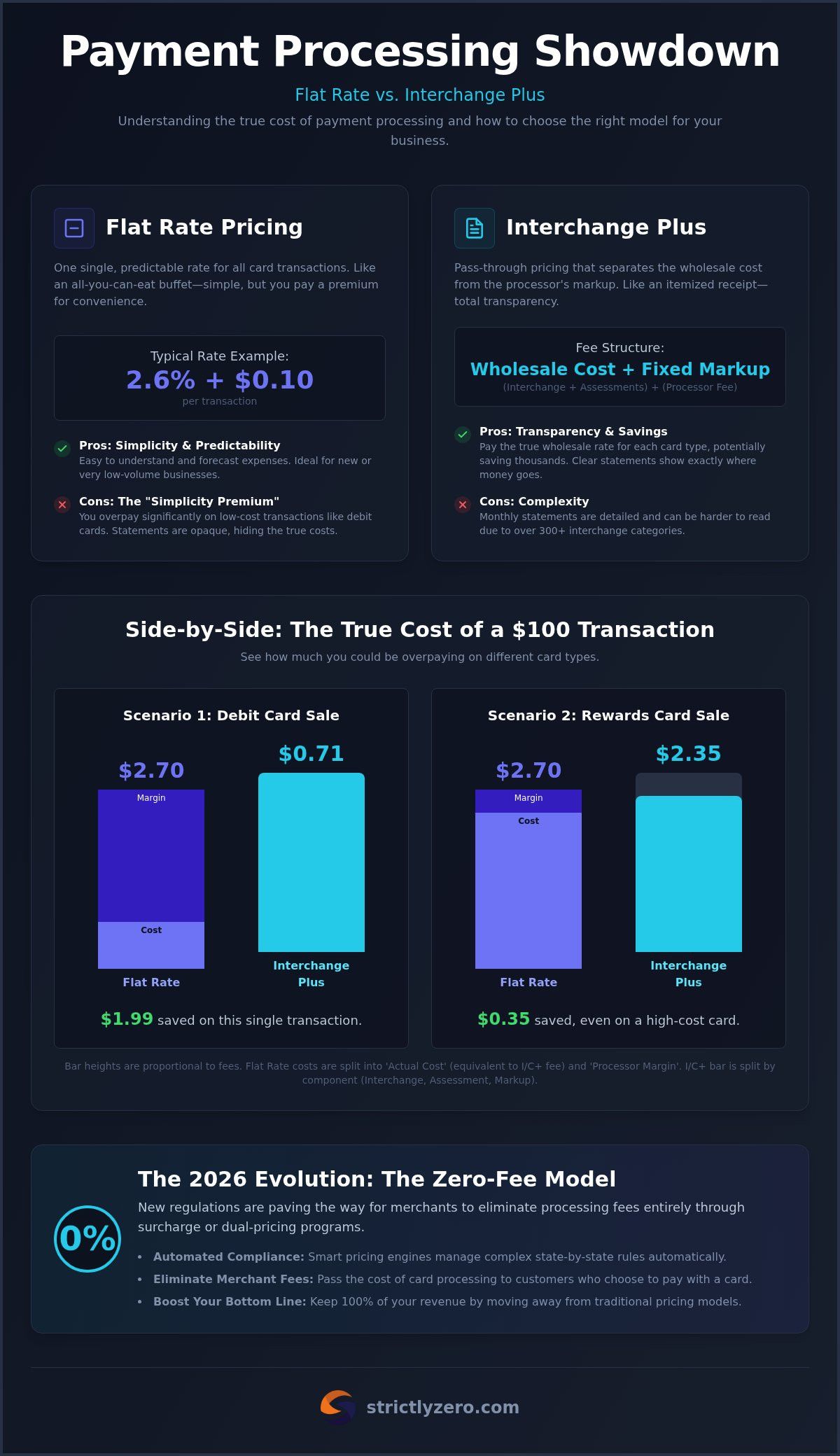
Choosing between flat rate vs interchange plus is like deciding between an all-you-can-eat buffet and an a la carte menu. Flat rate pricing charges you one fixed percentage for every transaction. It doesn’t matter if your customer uses a basic debit card or a high-tier travel rewards card; you pay the same fixed price. Interchange plus, on the other hand, passes the wholesale cost directly to you with a small, transparent markup on top. This model allows you to see exactly where every penny of your processing fee goes.
Card networks like Visa and Mastercard set the base rates for the entire industry. These rates fluctuate based on risk, the type of card used, and whether the transaction happens in person or online. While processors might package these costs differently for their marketing materials, they all start from the same wholesale foundation. Understanding this foundation is the first step toward lowering your monthly overhead.
The Three Components of Every Transaction Fee
Every fee you pay is built from three distinct layers. The first and largest is the Interchange fee. This is the non-negotiable wholesale rate paid to the bank that issued the customer’s card. These rates are updated twice a year and vary across over 300 different categories. Next are assessment fees, which are tiny percentages paid directly to card brands like Visa or Discover for the use of their networks. Finally, there is the processor markup. This is the only part of the fee where you have negotiating power, as it represents the specific margin your provider keeps for their services.
Why Pricing Models are Shifting in 2026
The payment landscape has changed significantly following the major 2026 antitrust settlement. High-reward premium cards are more popular than ever, and their higher wholesale costs make flat-rate models increasingly expensive for processors to maintain. This often leads to hidden fee hikes for merchants who stay on “simple” plans. Additionally, the explosion of ecommerce payment processing has pushed businesses toward more transparent models that can handle complex, multi-channel sales without sacrificing margins.
To truly understand your costs, you should ignore the flashy headline rates and focus on your effective rate. Your effective rate is the total processing fees divided by your total sales. It’s the only metric that reveals the true impact on your bottom line because it accounts for every hidden cost and markup in your statement.
Flat Rate Pricing: The Cost of Simplicity
Flat rate pricing is the “easy button” of the merchant services world. Popularized by various entry-level providers, this model charges a single, fixed percentage for every transaction regardless of the underlying costs. In 2026, these fixed-rate plans often carry a high premium to cover the processor’s risk. It’s predictable and easy to explain, making it a favorite for micro-merchants or hobbyists, but many growing businesses find better long-term value by switching to the Transaction-Based Processing Fees provided by Premier Payment Resources. Ultimately, when you weigh flat rate vs interchange plus, that initial predictability often comes at the expense of your bottom line.
The core issue is the “Simplicity Premium.” Because your processor has to cover the cost of every card, including expensive 3.5% premium rewards cards, they set their flat rate high enough to ensure they always make a profit. This means you pay the same high price for a low-cost debit card as you do for a luxury travel card. While this makes your monthly budgeting simple, it forces you to overpay for a large portion of your transactions.
The Hidden Danger of the Flat Rate Model
Processors pocket a massive margin on debit card transactions within a flat-rate plan. Under the Durbin Amendment, interchange for regulated debit cards is capped at 0.05% plus $0.21. If you’re paying a 2.6% flat rate on a $100 debit sale, your processor keeps nearly the entire fee as pure profit. This lack of transparency is why many experts suggest reviewing Credit Card Processing Fees to see the real wholesale costs. Flat-rate statements rarely break down these details, making it difficult to spot where you’re losing money.
B2B companies face an additional disadvantage. Flat-rate models rarely support Level 2 or Level 3 data optimization. These data tiers allow businesses to qualify for lower interchange rates on corporate and government cards by providing extra transaction details. Without this capability, flat-rate statements often obscure the real credit card processing for small business costs by bundling everything into a single, expensive line item.
When Should You Switch Away from Flat Rate?
Most growing businesses find their break-even point when monthly processing volume exceeds $5,000 to $10,000. At this stage, the pennies saved on each transaction through a more transparent model start to add up to hundreds of dollars in monthly savings. If your business has moved beyond the “startup” phase and you’re seeing consistent growth, it’s time to graduate from simple apps to a professional merchant account. You can explore pricing engines that automatically find the most cost-effective path for your specific transaction mix, ensuring you never pay more than necessary for simplicity.
Interchange Plus: Transparency for the Growing Merchant
If flat rate pricing is a black box, interchange plus is a glass house. This model is built on three distinct layers: the wholesale cost (interchange), the card brand assessment fees, and the processor’s markup. The markup is typically expressed as “basis points” plus a small per-transaction fee. When evaluating flat rate vs interchange plus, the primary advantage here is that you see exactly what the issuing banks charge versus what your processor keeps. This level of granular detail is why mid-market and enterprise businesses almost exclusively use this pricing structure.
One of the biggest wins for high-volume merchants is the ability to capture savings from the Durbin Amendment. For banks with over $10 billion in assets, the interchange fee for debit transactions is capped at 0.05% plus $0.21. On a flat-rate plan, your processor keeps the difference. On an interchange-plus plan, that savings stays in your bank account. Because interchange and assessment fees account for 85% to 90% of your total processing costs, seeing these line items allows you to verify that you aren’t being overcharged for low-risk transactions.
Interchange Optimization and B2B Savings
For businesses selling to other businesses or government agencies, the savings go even deeper through Level 2 and Level 3 data. These categories require you to submit extra information, like sales tax or purchase order numbers, in exchange for significantly lower interchange rates. A modern, unified platform handles these technical requirements automatically, ensuring your transactions qualify for the best possible rates without manual data entry. Interchange plus is the most defensible model for high-volume audits because every cost is tied back to a specific, verifiable network rate.
The Partner Perspective: Residuals and Retention
Transparency doesn’t just benefit the merchant; it’s the foundation for trust between Independent Sales Organizations (ISOs) and their clients. ISOs use interchange-plus models to build long-term relationships because the pricing is harder to manipulate than opaque tiered models. To manage these complex relationships, a professional payment processing platform for ISOs must support automated residuals via ClearSplit™. This ensures partners are compensated accurately while using retention tools like ChurnIQ™ to monitor merchant health. When everyone can see the math, it’s easier to prove the ongoing value of the processing partnership.
Side-by-Side: Which Model Saves You More?
Determining the winner in the flat rate vs interchange plus debate requires a hard look at your specific transaction data. No single model is universally the cheapest; instead, the right choice depends on your average ticket size, monthly volume, and the types of cards your customers prefer. In 2026, the 0.10% reduction in average interchange rates from the recent Visa and Mastercard settlement has made the “wholesale” approach even more attractive for many, while others still find value in the simplicity of bundled rates.
Consider these three common business scenarios to see where you fit:
- Scenario A: The Local Retailer. If you run a coffee shop or boutique where 70% of transactions are debit cards, interchange plus is the clear winner. While a flat-rate provider might charge you 2.6% plus $0.10, the regulated debit rate is capped at roughly 0.05% plus $0.21. You’re effectively paying a 2% “simplicity tax” on every debit swipe.
- Scenario B: The High-End Online Boutique. If your customers almost exclusively use premium travel rewards cards with interchange rates exceeding 3.00%, a flat rate of 2.9% might actually save you money. In this rare case, the processor absorbs the loss on high-cost cards.
- Scenario C: The B2B Wholesaler. For businesses with large ticket sizes and corporate clients, interchange plus paired with Level 3 data optimization is essential. The savings on a single $5,000 invoice can often cover an entire year of monthly subscription fees.
The Mathematical Breakdown
To find your true costs, you must calculate the “spread.” This is the difference between the wholesale interchange rate and the final price you pay. On a $100 transaction using a standard credit card (1.80% interchange), a flat-rate model at 2.6% leaves a $0.80 spread for the processor. An interchange-plus model with a 0.30% markup leaves only $0.30 for the processor. When you scale this across thousands of transactions, the gap becomes a chasm. Be vigilant about “junk fees” like statement fees or non-PCI compliance penalties that can quietly erode the benefits of a low markup.
Predicting Your 2026 Processing ROI
Modern processing is about more than just the rate; it’s about protecting your net profit. Factoring in the cost of gateway fees and the value of AI-driven fraud prevention is critical for a true ROI calculation. High-risk transactions that lead to chargebacks are far more expensive than any percentage point. The best credit card processing for small business in the current market focuses on total fee elimination. You can calculate your potential savings by comparing these traditional models against a modern surcharge engine that passes the cost of rewards programs back to the consumer.
The 2026 Evolution: Moving to a Zero-Fee Surcharge Model
While the choice between flat rate vs interchange plus focuses on minimizing your expenses, the most significant shift in 2026 is the widespread adoption of surcharge and dual pricing models. For years, merchants viewed processing fees as an unavoidable cost of doing business. Today, a Smart Pricing Engine can automate the decision-making process, allowing you to pass the cost of credit card rewards directly to the consumer. This isn’t just about choosing a better rate; it’s about a fundamental shift in how your business handles overhead.
Dual pricing offers the ultimate level of transparency. By presenting a “Cash Price” and a “Card Price,” you give your customers the power to choose their preferred payment method while protecting your margins. This approach effectively eliminates up to 100% of your processing fees legally. It moves your business beyond the traditional struggle of finding the lowest markup and places you in a position of total cost control.
Automated Compliance and Risk Management
Compliance is the biggest hurdle for merchants looking to move away from traditional models. As of August 2026, surcharge regulations vary significantly across the country. For instance, credit card surcharges remain prohibited in Connecticut, Massachusetts, and Maine. Our platform handles these legal variations automatically, ensuring your business stays compliant with state-by-state rules and the latest Visa 3% surcharge caps. It’s also vital to remember that surcharging debit cards is prohibited by the Durbin Amendment. A smart system uses automatic debit card detection to ensure fees are only applied where legally permitted, maintaining your zero fee credit card processing status without the risk of heavy fines.
Implementation: From Virtual Terminal to Mobile
Transitioning to a zero-fee model is seamless with the right technology. Whether you’re using a virtual terminal for back-office invoicing or sending payment links to clients, you can set your surcharge rules once and let the engine do the work. Transparency is the key to maintaining customer loyalty during this shift. Most customers understand the high cost of rewards programs and appreciate the choice that dual pricing provides. When you’re ready to see the real-world impact on your bottom line, you can estimate your savings with a processing cost calculator. Moving beyond the flat rate vs interchange plus debate is the first step toward reclaiming your revenue.
Take Control of Your Processing Margins
Choosing between flat rate vs interchange plus used to be the only decision that mattered for your bottom line. You’ve seen how flat rates trade simplicity for high hidden margins and how interchange plus finally reveals the wholesale truth behind your monthly statements. While transparency is a massive step forward, the ultimate goal for any growing business in 2026 is the total elimination of merchant overhead. Your business deserves a pricing model that scales with your ambition instead of taxing your growth.
It’s time to stop letting processing fees erode your hard-earned profits. Stop overpaying for processing—Switch to Strictly and eliminate your fees today. Our unified platform empowers you to eliminate up to 100% of processing fees using a real-time state-by-state compliance engine. From an omni-channel virtual terminal to secure payment links, we provide the modern tools you need to stay competitive and profitable. Take the next step toward a fee-free future and watch your margins flourish.
Frequently Asked Questions
Is interchange plus always cheaper than flat rate?
Interchange plus isn’t always the cheapest option, but it usually wins once a business processes more than $5,000 monthly. For micro-merchants with very low volume, the simplicity of a flat rate might save on monthly subscription fees. However, as your volume grows, the transparency of the flat rate vs interchange plus comparison usually favors the wholesale model. It prevents you from overpaying on low-cost debit transactions.
Can I switch from flat rate to interchange plus without changing my hardware?
Switching depends entirely on your current equipment and whether it’s proprietary. Most hardware from major flat-rate providers is locked to their specific network and won’t work with other processors. If you use a standalone, non-proprietary terminal, it can often be reprogrammed. For a truly flexible setup, many businesses shift to an omni-channel platform that uses a virtual terminal, which doesn’t require specific hardware at all.
How much does a typical interchange plus markup cost in 2026?
In 2026, a competitive processor markup on an interchange-plus plan is approximately 0.30% plus a $0.10 fee per transaction. This “plus” covers the processor’s service costs and profit. Remember that this is added to the non-negotiable wholesale rates set by banks and card networks. Always check for hidden monthly service fees that can inflate your effective rate and erode the savings from a low markup.
What is the Durbin Amendment and how does it affect my processing fees?
The Durbin Amendment is a federal law that caps the interchange fees banks can charge for debit card transactions. For large banks, the 2026 cap remains at 0.05% plus $0.21 per transaction. This is a massive cost-saver for businesses on interchange-plus plans. Flat-rate models often hide this discount, keeping the extra margin for the processor instead of passing the savings directly to your bank account.
Is surcharging legal in all 50 states in 2026?
No, surcharging isn’t legal everywhere in 2026. While most states allow it, credit card surcharges remain prohibited in Connecticut, Massachusetts, and Maine. Additionally, states like New York have strict disclosure requirements you must follow. Using a Smart Pricing Engine is the safest way to manage these variations. It automates compliance based on your physical location and the customer’s specific card type without manual intervention.
What is the difference between a surcharge and a convenience fee?
A surcharge is a percentage added specifically to credit card transactions to offset processing costs. In contrast, a convenience fee is a flat charge applied when a customer uses a specialized payment channel that isn’t the business’s standard method. For example, a utility company might charge a convenience fee for online payments but not for in-person checks. You cannot legally use both on the same transaction.
How do I read an interchange-plus merchant statement?
Reading an interchange-plus statement requires looking for the wholesale breakdown. You’ll see individual line items for different card types, showing the exact interchange rate paid to the issuing bank. Below that, you’ll find the card brand assessments and the processor’s markup. This transparency makes the flat rate vs interchange plus debate easier to settle because you can see exactly where every penny of your fee goes.
Can ISOs offer both flat rate and interchange plus on the same platform?
Yes, modern partner management tools allow ISOs to offer multiple pricing structures from a single dashboard. This flexibility is vital for merchant retention. Partners can start a small merchant on a flat rate for simplicity and then migrate them to interchange plus or a surcharge model as they scale. Automated tools like ClearSplit™ ensure that residuals are calculated accurately regardless of which pricing model the merchant uses.