
Fraud Detection Using Machine Learning: The 2026 Merchant’s Guide
Published:

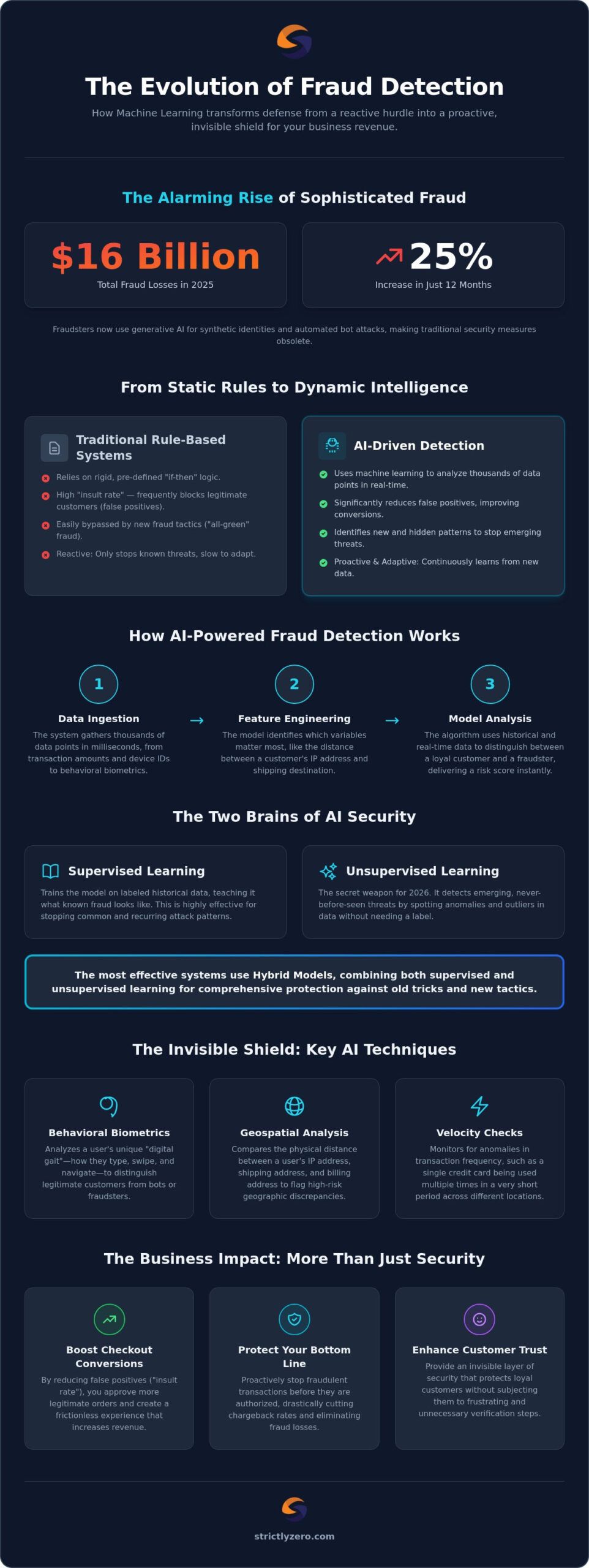
Did you know that fraud losses hit a staggering $16 billion in 2025? According to the FTC, that is a 25% jump in just twelve months. If you feel like you’re constantly playing catch-up with sophisticated smishing or business email compromise attacks, you aren’t alone. It’s frustrating to watch high chargeback rates eat your profits, but it’s even worse when “dumb” security rules block your most loyal customers. This is why fraud detection using machine learning has become the gold standard for merchants who refuse to choose between tight security and a smooth checkout experience.
This guide shows you how machine learning transforms your defense from a reactive hurdle into a proactive, invisible shield for your business revenue. We’ll explore how shifting to real-time behavioral analysis helps you stop “all-green” fraud while significantly improving checkout conversions. You’ll also discover how to navigate the 2026 regulatory landscape, including the EU AI Act’s August deadlines, to ensure your AI-driven security delivers a clear ROI without the compliance headaches.
Key Takeaways
- Learn why modern fraud detection using machine learning is essential for identifying “all-green” fraud that traditional static rules miss.
- Discover how behavioral biometrics, like typing speed and navigation patterns, create an invisible security layer without slowing down your customers.
- Understand the “insult rate” and how reducing false positives can immediately boost your checkout conversion and revenue.
- Find out how to integrate AI-driven protection directly into your payment processing to support zero-fee strategies like surcharge and dual pricing.
- Get a step-by-step roadmap for auditing your current chargeback ratios and upgrading to an omni-channel security stack.
Table of Contents
- What is Fraud Detection Using Machine Learning?
- How Machine Learning Models Detect Fraudulent Transactions
- Traditional Rules-Based Systems vs. AI-Driven Fraud Detection
- Implementing AI Fraud Prevention in Your E-commerce Strategy
- Securing Your Bottom Line with Strictly’s AI-Driven Fraud Prevention
What is Fraud Detection Using Machine Learning?
At its core, fraud detection using machine learning is a sophisticated method of using mathematical algorithms to scan every transaction for suspicious activity in real-time. Instead of relying on a human to spot a weird order, the system analyzes thousands of data points in milliseconds to identify anomalies that signal a potential threat. In the 2026 market, this isn’t just a luxury; it’s a survival tool. Fraudsters now use generative AI to create synthetic identities. They launch automated bot attacks that can overwhelm standard defenses. You need a system that learns as fast as the criminals do.
By moving away from static rules, businesses can better protect their ecommerce payment processing workflows. Modern Artificial intelligence in fraud detection doesn’t just look for “bad” transactions; it learns what “good” behavior looks like for your specific store. This shift from reactive blocking to proactive authentication is what keeps revenue flowing while keeping scammers at bay. To better understand how these algorithms function in a real-world setting, watch this helpful video:
The Core Components of ML-Based Security
Building an effective machine learning shield involves three critical steps. First is data ingestion, where the system gathers everything from transaction amounts to device IDs and behavioral biometrics. Next comes feature engineering. This is where the model identifies which variables actually matter, such as the physical distance between a customer’s IP address and their shipping destination. For example, if a customer who normally buys $50 items suddenly tries to purchase a $5,000 laptop from a new device, the system flags it instantly. Finally, model training uses vast amounts of historical data to teach the algorithm how to distinguish between a loyal customer on vacation and a fraudster using stolen credentials.
Supervised vs. Unsupervised Learning in Fraud
How Machine Learning Models Detect Fraudulent Transactions
Modern fraud detection using machine learning operates like a digital detective that never sleeps. While a human reviewer might look at five or six variables, an ML model evaluates hundreds of data points in the blink of an eye. During checkout, the system analyzes everything from the time of day to the specific way a user interacts with your website. This real-time processing ensures that high-risk transactions are flagged before the payment is even authorized, preventing the loss before it happens.
Behavioral biometrics represent one of the most significant shifts in 2026 security. The system tracks how a user types, swipes, or navigates your site. Since every person has a unique digital “gait,” the model can often distinguish between your loyal customer and a bot or a fraudster using stolen credentials. By using these patterns to Predict And Detect Fraud, merchants can stop attacks that look legitimate on the surface but fail the “human” test in execution.
Velocity checks and geospatial analysis add another layer of protection. If a single credit card is used ten times in five minutes across three different zip codes, the model recognizes this impossible speed. It compares shipping addresses to IP locations and historical card usage to ensure the purchase makes sense for that specific user. This prevents mass automated attacks from draining your inventory or merchant account.
The Data Points That Matter Most
To build an accurate profile, the model uses device fingerprinting to identify the specific hardware used for a purchase. It doesn’t just see a generic laptop; it sees the operating system, browser version, and even the battery level. Network data checks for VPNs, proxies, or known malicious IP ranges that might hide a fraudster’s true location. Finally, the system looks at transaction history. If a customer who usually buys $20 books suddenly orders a $2,000 designer handbag, the model identifies this as a high-risk outlier.
The Decision Engine: From Score to Action
Every transaction receives a numerical risk score based on the variables analyzed. A low score means the purchase is likely safe and moves directly to approval. A high score triggers an immediate decline to protect your bottom line. For those “gray area” transactions, the engine might flag the order for manual review or trigger Dynamic 3D Secure. This only asks for extra authentication when the risk warrants it, keeping the experience smooth for your legitimate customers. If you want to see how this works in practice, choosing a reliable payment processor with these tools built-in is the first step toward a secure checkout.
Traditional Rules-Based Systems vs. AI-Driven Fraud Detection
For years, merchants relied on “if-then” logic to protect their stores. These rules-based systems act like a security guard with a rigid checklist. If an order exceeds $500 and comes from a first-time customer, the system blocks it. While easy to understand, this approach is dangerously predictable. Fraudsters in 2026 use automated tools to “ping” your checkout, testing different amounts and locations until they find the exact gap in your rules. Once they find the threshold, they exploit it at scale before you even realize your settings are outdated.
The real power of fraud detection using machine learning lies in its adaptability. Unlike static rules that require a human to manually update them, AI models learn from every transaction. Research into Fraud Detection using Machine Learning highlights how models like Logistic Regression and Support Vector Machines identify complex relationships between data points that a human would never spot. This allows the system to evolve alongside new threats without constant manual intervention.
Why Traditional Rules Hurt Your Revenue
Rigid rules don’t just let some fraud through; they also stop your best customers. This creates a high “insult rate,” which is the percentage of legitimate shoppers you turn away. A false positive occurs when a legitimate transaction is incorrectly flagged as fraudulent, resulting in a declined payment that often drives the customer straight to a competitor. These errors kill your conversion rates and destroy the lifetime value of a customer. In fact, many merchants lose more money to false positives than they do to actual fraud. Static rules can’t distinguish between a fraudster and a loyal customer who happens to be shopping while traveling.
The Efficiency Gain of Machine Learning
Switching to an AI-driven model can reduce manual review queues by up to 80%. Instead of your team spending hours squinting at suspicious orders, the machine handles the bulk of the decision-making with higher accuracy. This efficiency is a game-changer for businesses looking to scale. By lowering the operational costs associated with risk, you can more easily implement programs like zero fee credit card processing. When your fraud losses and review times drop, the overall cost of processing transactions decreases, allowing you to keep more of every dollar you earn. Machine learning doesn’t just block bad actors; it clears the path for your business to grow without the friction of outdated security.
Implementing AI Fraud Prevention in Your E-commerce Strategy
Moving from manual reviews to an automated system requires a clear roadmap. The first step is to audit your current fraud losses and chargeback ratios. You can’t improve what you don’t measure. Take a hard look at your data from the past year to identify where most of your losses occur. Are they coming from specific geographic regions, or are they concentrated in high-ticket orders? Understanding these patterns allows you to set a baseline for success before you fully integrate fraud detection using machine learning into your stack.
Once you have your data, you must choose how to deploy the technology. Many merchants make the mistake of layering third-party add-ons over an old processor. This often creates data silos and slows down checkout speeds. A better approach is to partner with a processor that offers built-in AI-driven fraud prevention. This ensures the security layer is part of the transaction itself, not an afterthought. You also need to define your risk appetite. A luxury watch retailer might prefer a conservative approach to avoid even a single high-value loss, while a high-volume digital goods store might accept slightly more risk to ensure maximum growth and conversion.
Finally, implementation isn’t a “set it and forget it” task. You need to monitor and iterate. Tools like ChurnIQ™ provide the intelligence needed to see how your security settings impact merchant retention and customer lifetime value. If your “insult rate” is climbing, it’s time to dial back the sensitivity. If chargebacks are creeping up, you may need to tighten your behavioral biometrics thresholds. To get started with a platform that handles these complexities for you, contact Strictly today to learn about our integrated security solutions.
Integration for Developers and ISOs
For developers and ISOs, an API-first approach is essential. Modern security shouldn’t require a complete overhaul of your existing checkout flow. By using flexible APIs, you can embed fraud checks directly into the transaction path. Webhooks allow your system to receive real-time alerts the moment a transaction is flagged or declined. This level of integration is particularly important for high-ticket industries where custom decision engines are needed to handle unique purchasing behaviors. You can set specific parameters that trigger deeper analysis only when certain thresholds are met, keeping the rest of the flow frictionless.
Balancing Security and Friction
The ultimate goal of fraud detection using machine learning is to provide invisible authentication. Your customers should never feel like they’re being interrogated. When the ML model works correctly, it validates the user behind the scenes, keeping the “buy” button fast and responsive. Multi-Factor Authentication (MFA) is a powerful tool, but it can be a conversion killer if used too frequently. Smart systems only trigger MFA when the risk score is high. This balance keeps you in compliance with PCI DSS requirements while ensuring that security remains a proactive shield rather than a reactive hurdle for your revenue.
Securing Your Bottom Line with Strictly’s AI-Driven Fraud Prevention
Protecting your business in 2026 requires more than just a digital gatekeeper; it requires a partner that understands the delicate balance between security and growth. Strictly integrates Priority 2 AI-Driven Fraud Prevention into every transaction, ensuring that your revenue is shielded from the moment a customer clicks “buy.” This isn’t a separate add-on that slows down your system. It’s a core component of our credit card processing services, designed to provide a seamless experience across all your sales channels.
The real advantage comes from the synergy between high-level security and our surcharge and dual pricing programs. By using fraud detection using machine learning to lower your risk profile, you create a stable environment for zero-fee processing. When your chargeback rates are low and your “insult rates” are minimized, your business becomes more profitable and predictable. Whether you’re processing orders through a mobile app, an online storefront, or a virtual terminal, our platform provides a unified shield that protects your bottom line without adding unnecessary friction.
Comprehensive Protection for Every Merchant
Our real-time monitoring stops fraud before the authorization request ever reaches the bank. This proactive approach is vital because it prevents the operational headache of chargeback management before it starts. Instead of spending your days fighting disputes, you can focus on scaling your operations. For ISOs and partners, this means offering a safer, more reliable service to your clients. Our API-first architecture allows for deep integration, ensuring that fraud detection using machine learning is working behind the scenes to authenticate legitimate behavior while blocking sophisticated bot attacks and synthetic identity scams.
Ready to Eliminate Fees and Fraud?
There’s a direct connection between low-risk processing and the success of zero-fee models. When you eliminate the costs associated with fraud and high chargeback ratios, you can fully leverage the benefits of our surcharge and dual pricing engine. This holistic approach ensures you aren’t just saving on processing fees, but also protecting the money you’ve already earned. It’s time to move beyond reactive security and embrace a unified, omni-channel platform that prioritizes your growth and your peace of mind. Protect your revenue with Strictly’s AI-driven fraud prevention today.
Future-Proof Your Revenue with Intelligent Security
The transition toward fraud detection using machine learning represents a fundamental shift in how successful merchants operate in 2026. It is no longer enough to simply block suspicious IPs or high-value orders. You need a system that understands the nuances of human behavior to distinguish between a fraudster and a loyal customer. By reducing the “insult rate” caused by rigid rules, you’re not just stopping crime; you’re actively reclaiming revenue that was previously lost to false positives.
Choosing a partner that provides AI-driven fraud prevention built directly into your processing stack simplifies your operations across every channel. When this security is paired with a compliant surcharge and dual pricing engine, you effectively insulate your bottom line from both malicious attacks and the drain of traditional transaction fees. This unified omni-channel platform gives you the freedom to scale without the constant fear of evolving cyber threats.
Secure your business and eliminate fees with Strictly today. You now have the roadmap to transform your security from a reactive hurdle into a proactive growth engine. Let’s build a safer, more profitable future for your brand together.
Frequently Asked Questions
Is machine learning fraud detection better than human review?
Machine learning is superior for handling volume and speed, but human review still has its place for high-value outliers. While a person can only review a few dozen orders an hour, fraud detection using machine learning processes thousands of transactions in milliseconds. This allows your team to focus on strategic growth instead of manually squinting at every suspicious zip code. It’s about combining the machine’s speed with human intuition for the most complex cases.
How much does AI-driven fraud prevention cost for a small business?
Costs for AI-driven security are typically usage-based or included as part of your overall payment processing agreement. For small businesses, this model is often much cheaper than the alternative of losing even a few high-value sales to chargebacks. Since the technology scales with your volume, you don’t have to worry about a massive upfront investment. It’s a predictable expense that protects your bottom line as you grow.
Can machine learning prevent all chargebacks?
No technology can prevent 100% of chargebacks, particularly “friendly fraud” where a customer disputes a legitimate purchase they actually made. However, machine learning is incredibly effective at stopping criminal fraud, such as stolen card usage and account takeovers. By filtering out these high-risk attempts at the checkout stage, you dramatically lower your overall chargeback ratio and protect your standing with card networks.
Will AI fraud detection slow down my customer’s checkout experience?
No, modern AI-driven security is designed to be invisible and operates in the background during the authorization process. It analyzes hundreds of data points in the time it takes for a page to load. In many cases, it actually speeds up the experience for legitimate shoppers by removing the need for clunky security hurdles like CAPTCHAs or unnecessary multi-factor authentication triggers that can cause cart abandonment.
What is a ‘false positive’ in fraud detection and why does it matter?
A false positive occurs when your security system incorrectly flags and blocks a legitimate customer as a fraudster. This matters because it creates a high “insult rate,” often driving that customer to never shop with you again. By using fraud detection using machine learning, you can fine-tune your accuracy. This ensures you’re only stopping the bad actors while providing a frictionless path for your most valuable, honest shoppers.
Do I need to be a developer to use machine learning fraud detection?
You don’t need to be a developer to benefit from these tools. While we offer an API-first approach for technical teams who want deep integration, the platform is designed for ease of use. Most merchants can access these AI-driven protections directly through their payment gateway or virtual terminal settings. It’s a “plug-and-play” solution that brings enterprise-level security to businesses of all technical skill levels.
How does Strictly’s AI fraud prevention work with surcharge programs?
Strictly’s AI security lowers the inherent risk of your transaction flow, which is a critical component of a successful surcharge or dual pricing strategy. When you reduce fraud losses and chargebacks, the overall cost of processing decreases. This makes it much easier to sustain a zero-fee model because you aren’t constantly losing revenue to criminal activity. It turns security into a tool for better profit margins.
Is AI fraud detection compliant with PCI DSS standards?
Yes, AI-driven fraud detection is fully compliant with PCI DSS standards. The algorithms analyze metadata and behavioral patterns without compromising the encryption or security of sensitive cardholder data. In fact, using advanced machine learning often helps you exceed basic compliance requirements by providing a more robust defense against data breaches and unauthorized access attempts. It keeps your data secure while meeting all industry regulations.