
How Does a Dual Pricing Engine Work? The Mechanics of $0 Processing Fees
Published:

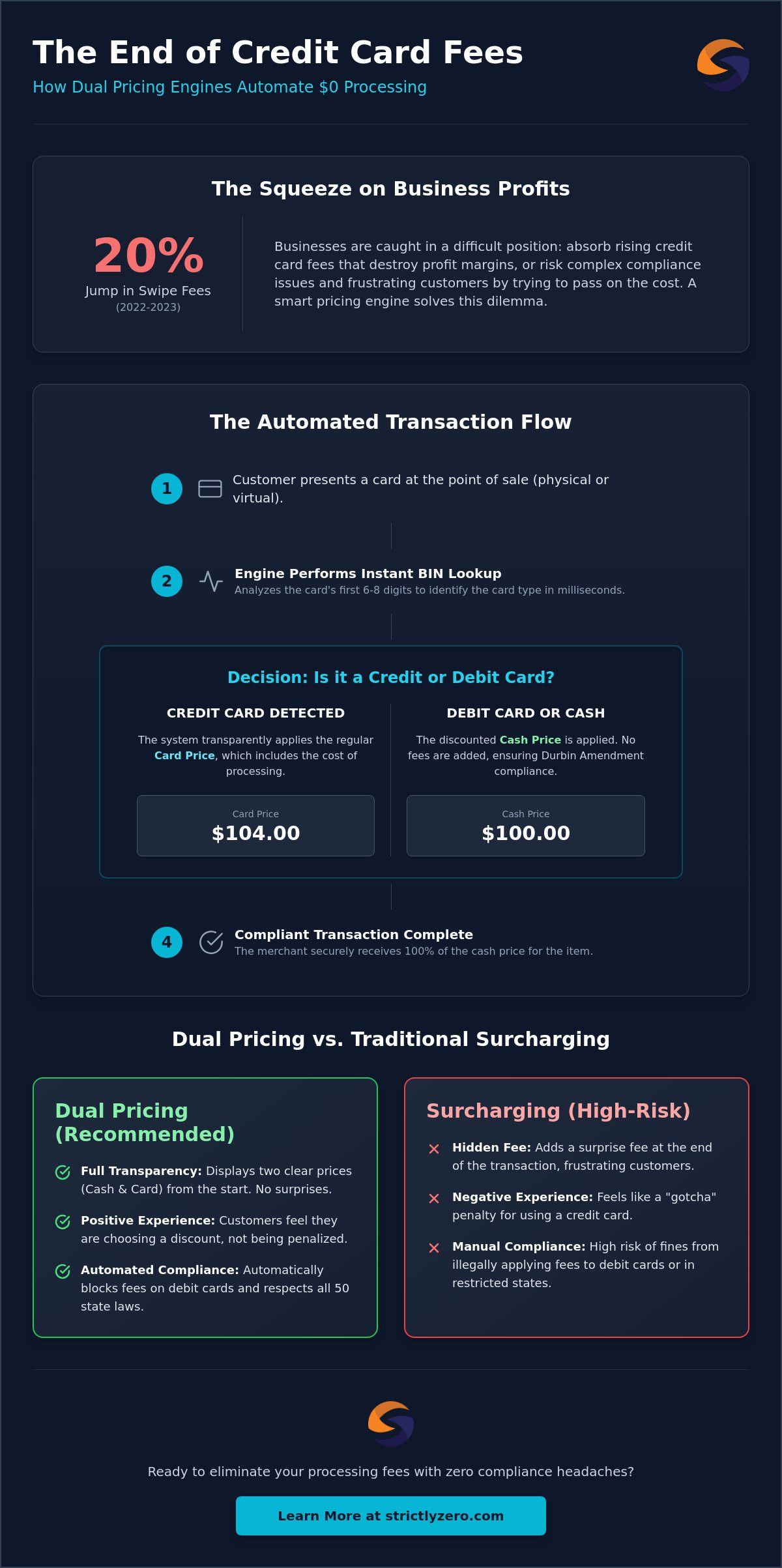
Credit card swipe fees jumped by 20% between 2022 and 2023, and they continue to erode the profit margins of small and large businesses alike. You’re likely frustrated by the constant drain on your revenue, but you’re also worried that trying to offset those costs will lead to a compliance nightmare or a confusing customer experience. It’s a common struggle to balance the need for $0 processing fees with the fear of violating complex state laws or card brand regulations.
Understanding how does a dual pricing engine work is the key to solving this dilemma without the risks associated with traditional surcharging. This technology acts as an automated gatekeeper, instantly calculating and displaying two clear prices for every transaction. In this article, we’ll explore the technical logic and real-time compliance features that allow you to eliminate merchant fees entirely. We’ll show you how modern engines navigate the legal landscape of all 50 states to provide a transparent checkout that protects your margins and keeps your customers satisfied.
Key Takeaways
- Learn how does a dual pricing engine work by using real-time BIN lookups to instantly distinguish between credit and debit cards at the point of sale.
- Understand the critical legal distinction between surcharging and dual pricing to ensure your business remains compliant with state laws and card brand rules.
- Discover the mechanical flow of funds that separates processing fees from your merchant revenue during settlement, effectively eliminating your processing costs.
- Identify the necessary software layers and hardware requirements to transition your retail or e-commerce store to a $0 processing fee model.
- Explore how automated engines handle state-specific regulations and partner residuals, removing the manual guesswork from your daily financial operations.
Table of Contents
- What is a Dual Pricing Engine? Definition and Core Purpose
- How the Engine Works: The Technical Logic and Flow
- Dual Pricing vs. Surcharge Programs: A Mechanical Comparison
- Implementing a Dual Pricing Engine in Your Business
- Why Strictly’s Smart Pricing Engine is the Standard for 2026
What is a Dual Pricing Engine? Definition and Core Purpose
A dual pricing engine is a sophisticated software layer that removes the guesswork from transaction costs. Instead of a single price tag, it automatically calculates and displays two distinct options: a Card Price and a Cash Price. This isn’t just about labels; it’s about shifting the burden of the Interchange fee and other processing costs directly to the customer who chooses the convenience of credit. By presenting these choices clearly, merchants can protect their margins without alienating their customer base.
How does a dual pricing engine work in practice? It functions by ensuring every item in your inventory has two values assigned to it at the moment of checkout. This approach aligns perfectly with the 2023-2026 card brand rules that demand clear price transparency. By showing both prices upfront, you avoid the regulatory pitfalls of hidden fees or surprise surcharges that often lead to consumer complaints. It’s a proactive way to manage costs while staying within the legal boundaries of all 50 states.
To better understand this concept, watch this helpful video:
The “Two-Price” Model vs. Traditional Surcharging
Regulators often prefer dual pricing over surcharging because it eliminates the “gotcha” moment at the end of a transaction. Surcharging adds a fee at the final step, which can feel like a penalty to the consumer. In contrast, dual pricing presents a “Cash Price” and a “Card Price” from the start. This subtle psychological shift makes the customer feel they’re choosing a savings option rather than being punished for using a card. The engine ensures the merchant receives 100% of the listed cash price, protecting the bottom line regardless of the payment method. It’s a transparent system where the cost of the credit card reward points is paid by the person earning them, not the business owner.
The Role of the Smart Pricing Engine
If you run a high-volume retail shop or an omni-channel online store, manual price calculation is a recipe for disaster. A smart pricing engine acts as a real-time calculator across all your sales channels. It automates the zero fee credit card processing model so you don’t have to manually update every SKU or train staff on complex math. Whether a transaction happens at a mobile terminal or a virtual checkout, the engine handles the calculations and compliance instantly. This automation is what makes the system scalable and reliable for modern businesses looking to reclaim their revenue from processing fees.
How the Engine Works: The Technical Logic and Flow
To understand how does a dual pricing engine work, you have to look beyond the checkout screen. It isn’t just a simple calculator; it’s a real-time decision engine that operates in the background of every sale. When a card is swiped or entered into a virtual terminal, the software immediately initiates a series of API calls to determine the exact nature of the payment method and the legal jurisdiction of the transaction. This happens in less than a second, ensuring your checkout speed remains fast while your compliance remains perfect.
Step 1: Card Identification and BIN Detection
The first step in the sequence is the Bank Identification Number (BIN) lookup. The engine analyzes the first six to eight digits of the card to identify whether it’s a high-reward credit card or a standard debit card. This distinction is vital for your protection. Under the Durbin Amendment, merchants are prohibited from applying surcharges or credit-based price adjustments to debit cards, even if they’re processed as “credit” on the network. A “dumb” terminal that simply adds a flat percentage to every transaction risks massive fines and merchant account termination. The engine automatically blocks price adjustments on debit cards, treating them as cash to keep you compliant with federal law.
Step 2: Automated Compliance and State Logic
Compliance isn’t a static target. In 2026, keeping track of state-by-state surcharge laws is a full-time job for a human, but it’s an instant task for an engine. For example, while Florida and New York allow dual pricing, they have strict rules about how those prices must be displayed to the consumer. The engine references a cloud-based database that updates as state regulations shift. It ensures the following rules are met for every transaction:
- Price Caps: The “Card Price” never exceeds the actual cost of acceptance or the standard 3% cap mandated by major card brands.
- Disclosure: The system ensures that the dual price is clearly visible at the point of sale, meeting transparency requirements in states like California.
- Real-Time Updates: If a state legislature changes its stance on merchant fees, the engine updates its logic automatically without requiring a hardware swap.
Finally, the engine integrates with your payment gateway to handle the settlement logic. It splits the transaction amount before the funds ever hit your bank account. The “cash price” of the item is routed to your business ledger, while the portion covering the processing fees is separated to satisfy the transaction costs. This automation creates a seamless $0 fee environment that requires zero manual accounting on your part. If you’re ready to see this in your own business, you can explore how automated pricing works for your specific industry.
Dual Pricing vs. Surcharge Programs: A Mechanical Comparison
While both models aim to reduce costs, the mechanical differences between surcharging and dual pricing are significant. Surcharging is a reactive process where a fee is added at the final step of a transaction. Dual pricing is a proactive strategy where the engine presents two distinct price points from the moment a customer looks at a product or service. Understanding how does a dual pricing engine work requires looking at how these two models handle the flow of data and funds differently during the checkout process.
Checkout Experience Comparison
The visual difference on a customer receipt is the most immediate distinction. In a surcharge program, the receipt shows the subtotal followed by a separate line item labeled “Surcharge” or “Credit Card Fee.” This often triggers a negative reaction from customers who feel penalized for their payment choice. With a dual pricing engine, the receipt reflects the specific price chosen by the customer: either the “Card Price” or the “Cash Price.” There are no surprise fees at the bottom because the price was transparent from the start.
This clarity extends to digital environments like payment links and virtual terminals. In these scenarios, the engine dynamically updates the total based on the card type entered. If you want to dive deeper into the strategic differences for your business, check out our guide on surcharging vs. dual pricing. By managing these options through a centralized software layer, you ensure a consistent experience across all sales channels, whether in-person or online.
The Settlement Advantage
The backend settlement process is where the dual pricing engine truly outperforms traditional surcharging. In a surcharge model, you often receive the full amount and are then billed for processing fees at the end of the month. This creates a reconciliation headache for your accounting team. A dual pricing engine automates the settlement by splitting the transaction at the point of capture. The portion representing the item cost goes to your bank account, while the processing fee portion is routed separately to cover the transaction costs. This “netting out” process is what allows for a “Strictly Zero” fee environment.
This automated splitting also reduces merchant liability during audits. Because the engine references current credit and debit card surcharge statutes in real-time, it ensures you never overcharge or misapply fees to prohibited card types. Your month-end statements become much simpler to read because the processing costs have already been accounted for. Instead of seeing a massive bill for swipe fees, your statements show a clean balance of your actual revenue, significantly reducing merchant churn and financial stress.
Implementing a Dual Pricing Engine in Your Business
Transitioning to a zero-fee model requires more than just a mindset shift; it involves a strategic rollout across your entire payment infrastructure. While the technical logic of how does a dual pricing engine work remains consistent, the physical and digital execution varies depending on your business model. You’ll need to audit your current environment to ensure your hardware and software can handle the real-time calculations required to display two prices simultaneously without slowing down your checkout line.
Hardware and Software Integration
Many business owners mistakenly believe they must replace every piece of equipment to adopt this technology. In reality, most modern systems only require a software layer to enable the engine. For service-based businesses or those operating remotely, using a virtual gateway is the most efficient way to manage dual pricing. This allows you to send payment links or use a web-based terminal that automatically applies the correct logic based on the card type entered by the client.
Legal Signage and Transparency
The engine handles the complex math and card identification, but the merchant is responsible for the physical disclosure. To meet the “Clear and Conspicuous” legal standard, you must display standardized signage at both the point of entry and the point of sale. These notifications inform customers that all listed prices reflect a cash discount, and a separate price applies to credit card transactions. This isn’t just a courtesy; it’s a requirement to stay compliant with state laws and card brand regulations.
Employee training is the final piece of the puzzle. Your staff needs to be prepared for the “debit is cash” conversation. Since the engine recognizes debit cards and processes them at the lower cash price, employees should be able to explain this benefit to customers. It turns a potential point of confusion into a positive customer service moment. When your team understands how does a dual pricing engine work to save the customer money on debit transactions, they become advocates for the new system. If you’re ready to modernize your checkout process, you can get started with our dual pricing engine today to see the impact on your bottom line.
Why Strictly’s Smart Pricing Engine is the Standard for 2026
As we’ve explored throughout this guide, the underlying question of how does a dual pricing engine work involves a complex dance of data, card detection, and legal logic. In the competitive environment of 2026, business owners don’t have the bandwidth to act as compliance officers or manual accountants. Strictly’s Smart Pricing Engine sets the industry standard by transforming these technical necessities into a seamless, automated advantage. It isn’t just about showing two prices; it’s about providing a robust framework that protects your business while eliminating processing costs.
Compliance as a Service
Strictly operates on a “Compliance as a Service” model that recognizes the legal landscape for merchant fees is a moving target. State legislatures frequently update their statutes, and card brands like Visa and Mastercard often adjust their merchant rules. We monitor this 2026 legal map in real-time so you don’t have to. Our “Trust as a Payment Processor” philosophy means we take on the burden of regulatory shifts. The engine’s automated debit detection is a critical component of this protection. By identifying debit cards instantly and ensuring they are processed at the cash price, the system prevents the illegal surcharging that often leads to heavy fines and merchant account termination.
Scale Your Business with Strictly
The path to true $0 processing fees is paved with intelligent automation. This level of technical sophistication is why Strictly is considered the best credit card processing for small business in the zero-fee era. We provide more than just a software layer; we provide a partnership that prioritizes your profit margins. By leveraging our Smart Pricing Engine, you can reclaim your revenue and offer a transparent, modern experience to your customers. The era of high merchant service fees eating into your margins is finally over. Contact Strictly today to see the Smart Pricing Engine in action.
Reclaim Your Revenue with Automated Precision
The days of letting merchant service fees erode your hard-earned margins are finally over. You’ve seen that understanding how does a dual pricing engine work is more than just a technical exercise; it’s a strategic shift toward total financial transparency. By leveraging real-time BIN detection and automated compliance logic, you can offer your customers clear choices while ensuring your business receives 100% of the cash price for every sale. This technology removes the manual guesswork and legal risks often associated with traditional surcharging.
Whether you operate a single storefront or a complex omni-channel enterprise, the path to $0 fees is now fully automated. Our platform is compliant in all 50 states and features an API-first design for seamless integration. Plus, tools like ClearSplit™ ensure automated residuals for partners, making it the most scalable solution for the 2026 market. It’s time to stop settling for high costs and start prioritizing your profit realization.
Ready to see the difference for yourself? Eliminate your processing fees with our Smart Pricing Engine and join the zero-fee revolution today. Your bottom line will thank you.
Frequently Asked Questions
Is a dual pricing engine legal in all 50 states?
Yes, dual pricing is legal in all 50 U.S. states as of 2026. It’s protected under the Durbin Amendment, which explicitly allows merchants to offer discounts for cash payments. While traditional surcharging faces complex bans in states like California, dual pricing remains a compliant way to offset costs because it presents two clear prices upfront rather than adding an unexpected fee at the final step of a transaction.
How does a dual pricing engine handle debit card transactions?
The engine uses real-time BIN lookups to identify debit cards instantly and automatically processes them at the lower “Cash Price.” Federal law and card network rules prohibit surcharging debit cards, even if they’re processed as credit on the network. By automating this detection, the engine ensures you don’t accidentally violate compliance rules that could lead to heavy fines or the loss of your merchant account.
What is the difference between a cash discount and dual pricing?
Dual pricing displays two distinct prices for every item, whereas a traditional cash discount usually shows one price and applies a deduction during the checkout process. Dual pricing is often preferred for its transparency because it eliminates the need for customers to do mental math. It’s a key part of how does a dual pricing engine work to provide a clear, “what you see is what you pay” experience for every shopper.
Do I need special hardware to use a dual pricing engine?
You don’t necessarily need brand-new hardware, but your current terminal must support a dual pricing software layer to display both prices correctly. Many modern POS systems can be updated remotely to enable these features without a physical swap. If you’re a service-based business, you can often use a virtual terminal or payment links without any physical hardware at all, making the transition quick and cost-effective.
Will my customers be upset by dual pricing at checkout?
Most customers appreciate the transparency and the option to save money by paying with cash or a debit card. Unlike surcharging, which feels like a penalty at the end of a transaction, dual pricing offers a clear choice from the start. When the “Cash Price” is presented as a benefit rather than a penalty for using credit, it creates a much more positive psychological response than an unexpected fee.
How does the engine handle e-commerce and online payments?
The engine integrates directly with your online checkout or virtual gateway to apply the same two-price logic used in physical stores. When a customer enters their card details, the system identifies the card type and displays the corresponding total in real-time. This ensures a consistent omni-channel experience, maintaining your $0 processing fee model across both your digital and physical sales channels without any manual effort.
Can I switch from a surcharge program to dual pricing easily?
Yes, switching from a surcharge program to dual pricing is usually a simple matter of updating your software configuration and store signage. Since dual pricing is legal in more jurisdictions and has fewer reporting requirements than surcharging, many merchants find it’s a safer and more scalable option. Understanding how does a dual pricing engine work makes this transition smoother by automating the compliance side of the move for you.
What happens if card brand rules change in 2026?
The engine is designed to update automatically as state laws and card brand regulations shift throughout 2026. Because it’s a cloud-based software layer, updates are pushed to your system in real-time without requiring manual intervention. This “Compliance as a Service” model protects your business from the risk of non-compliance fines even as the regulatory landscape for merchant fees continues to evolve in the coming years.