
How to Build a Payments Business as an ISO: The 2026 Growth Guide
Published:

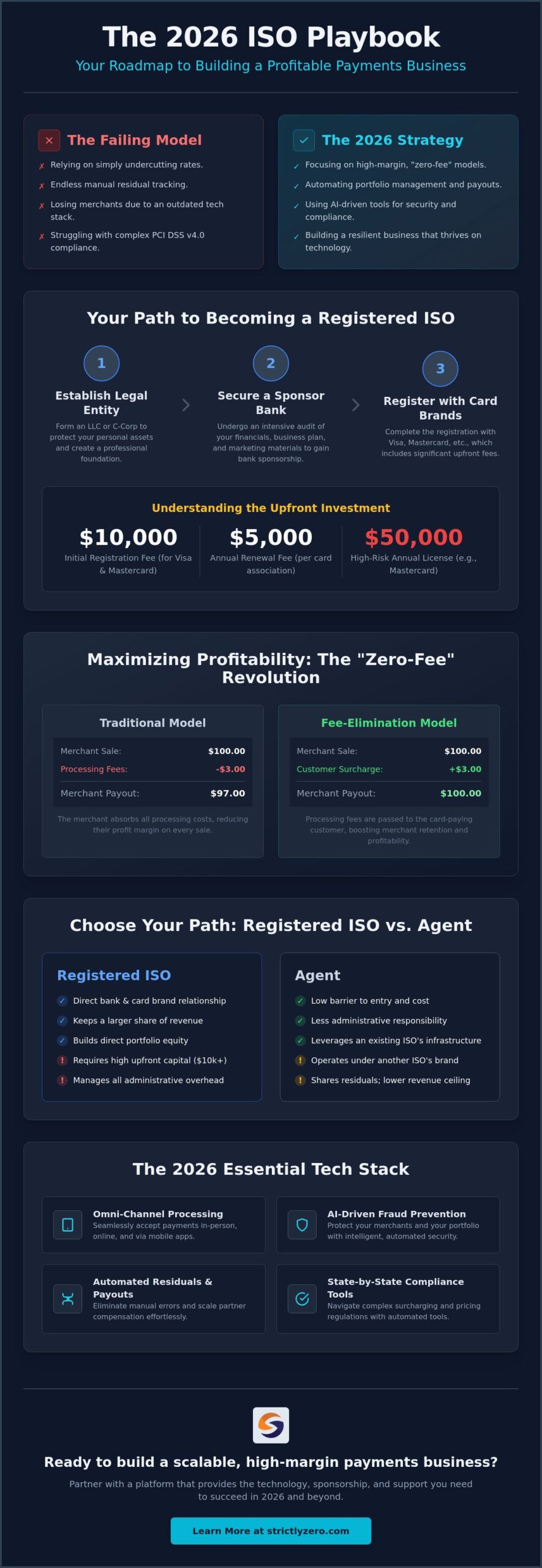
Why are so many payment professionals still struggling to scale when global transaction volumes are hitting record highs? If you want to build a payments business as an ISO in 2026, you’ve likely realized that the old strategy of simply undercutting rates no longer works. Between the $10,000 initial registration fees for card brands and the recent jump to $50,000 for high-risk licenses, the barrier to entry feels higher than ever.
You’re probably tired of the manual grind involved in tracking monthly residuals or losing sleep over the latest PCI DSS v4.0 compliance updates. It’s frustrating to watch high-margin accounts churn because your tech stack can’t keep up with modern demands. We promise to show you a better way. This guide offers a clear path to launching a profitable organization by focusing on fee-elimination models like dual pricing and surcharging, which are now essential for merchant retention.
We’ll walk through the specific steps to secure your sponsorship, automate your portfolio management, and use AI-driven fraud prevention to keep your merchants secure. By the end of this article, you’ll have a complete roadmap to scaling a resilient payments business that thrives on automation and high-margin revenue.
Key Takeaways
- Understand the mandatory registration steps and card brand fees required to transition from a sub-agent to a fully registered ISO.
- Discover the specific strategies to build a payments business as an ISO using “zero-fee” processing models that boost merchant retention and your bottom line.
- Learn how to automate your residual tracking and partner compensation to eliminate manual errors and focus on scaling your portfolio.
- Gain insights into the 2026 tech stack essentials, from omni-channel processing to automated state-by-state compliance tools.
Table of Contents
- What is an ISO and How Does the Business Model Work in 2026?
- Steps to Register and Establish Your Payments Business
- Maximizing Profitability: Residuals, Surcharging, and Dual Pricing
- Essential Tech Stack: Tools for Modern ISO Management
- Partnering with Strictly: Your Path to a Scalable Payments Business
What is an ISO and How Does the Business Model Work in 2026?
An Independent Sales Organization (ISO) acts as the vital link between merchants and the massive financial institutions that move money. While banks handle the heavy lifting of settlement, they often lack the specialized sales teams needed to reach local businesses effectively. This is where you step in. To build a payments business as an ISO, you create a bridge that offers merchants personalized service while leveraging the infrastructure of a sponsoring acquiring bank.
The payments industry has moved far beyond simple card swipes. In 2026, the revenue landscape is defined by omni-channel processing, where merchants need to accept payments in person, online, and via mobile apps simultaneously. Understanding What is a Payment Processor? is the first step in realizing that your role isn’t just selling a terminal; it’s providing a comprehensive financial ecosystem that includes AI-driven fraud prevention and automated invoicing tools.
To better understand how this model functions in a real-world setting, watch this helpful video:
The distinction between a Registered ISO and an agent is critical for your long-term growth strategy. A Registered ISO has a direct relationship with a sponsoring bank and card brands like Visa and Mastercard. This path requires a significant upfront investment, including a $10,000 initial registration fee and $5,000 annual renewals per card association. Agents, however, operate under the umbrella of a Registered ISO, trading a portion of their residuals for lower entry costs and less administrative overhead. If you want to build a payments business as an ISO, you must decide whether to start as an agent or dive straight into the full registration process.
The Relationship Between ISOs and Sponsoring Banks
You can’t process a single cent without a sponsoring financial institution. The bank provides the “rails” for the transaction, but you provide the engine. While the bank manages backend settlement and risk, your business focuses on sales, merchant support, and hardware setup. For 2026, card brands have tightened compliance, requiring ISOs to be more diligent than ever about monitoring merchant activity and adhering to PCI DSS v4.0 standards to maintain their sponsorship status.
ISO vs. Payment Processor: Defining Your Territory
Large processors are often slow and bureaucratic. ISOs win because they’re agile. You can offer industry-specific solutions, like specialized surcharge engines for restaurants or POS lending for retail shops. A “wholesale” ISO takes on more risk and keeps a larger share of the revenue, while a “retail” ISO focuses on volume with less liability. Choosing your territory depends on your available capital and your appetite for managing merchant risk profiles.
Steps to Register and Establish Your Payments Business
Setting up a legal entity is your first move. Most founders opt for an LLC or a C-Corp to protect personal assets and establish a professional footprint. Once your entity is live, the heavy lifting begins with card brand registration. To build a payments business as an ISO, you must apply through a sponsoring bank. This process is intensive. It involves a deep audit of your financials, your business plan, and even your marketing materials. You’ll need at least $10,000 upfront to cover the first year of registration fees for Visa and Mastercard. If you plan to work with high-risk merchants, be prepared for much higher costs. Mastercard implemented a $50,000 annual license fee for specialty merchant acquirers on May 1, 2026.
Industry groups like the Electronic Transactions Association (ETA) provide excellent resources to help you stay compliant during this phase. Beyond the paperwork, you need a marketing strategy that prioritizes transparency. Gone are the days of hiding fees in the fine print. Modern merchants expect clear, upfront value propositions. A compliant sales strategy focuses on how you can solve their specific pain points, like reducing churn or automating their backend reporting.
Navigating Legal and Compliance Frameworks
Compliance is a moving target. By July 2026, every ISO must be fully validated under PCI DSS v4.0, a standard that became mandatory on March 31, 2025. You also need to navigate a patchwork of state laws. For instance, credit card surcharges remain prohibited in Connecticut, Massachusetts, and Maine as of April 2026. Colorado caps these fees at 2%. Your merchant agreements must be crystal clear to avoid regulatory scrutiny. Failing to disclose how fees are calculated can lead to heavy fines and the loss of your registration status.
Selecting the Right Sponsoring Partner
Your choice of a platform partner determines your ceiling. You need a system that offers robust API capabilities for custom integrations and real-time data access. For a deeper look at what to look for in a partner, check out our guide on The Ultimate Payment Processing Platform for ISOs: Scale in 2026. Finding a partner that offers an omni-channel payment processing engine will ensure you can support merchants across all sales channels, from ecommerce to in-person retail. This flexibility is what allows you to build a payments business as an ISO that can withstand market shifts and technological disruptions.
Maximizing Profitability: Residuals, Surcharging, and Dual Pricing
Profitability in the payments world isn’t just about the volume you process; it’s about the “spread” you keep. Residual income is the lifeblood of your organization. It represents the difference between the wholesale rate provided by your sponsoring bank and the retail rate you charge the merchant. While a few basis points might seem small, they compound into massive long-term wealth as your portfolio grows. To build a payments business as an ISO that lasts, you must shift your focus from one-time equipment sales to these recurring monthly residuals.
The “Zero Fee” movement has completely changed the sales conversation in 2026. Traditional processing models, where merchants pay 2% to 3.5% in fees, are becoming a harder sell for small businesses with tight margins. By offering surcharge and dual pricing programs, you can walk into a business and show them how to eliminate their processing costs entirely. This isn’t just a sales pitch; it’s a fundamental shift in how businesses handle overhead. Using a Smart Pricing Engine allows you to automate these complex calculations, ensuring every transaction remains profitable while staying within legal limits.
Traditional Processing vs. Zero-Fee Models
In a traditional model, the merchant bears the cost of every swipe. With zero fee credit card processing, that cost is passed to the consumer as a small convenience fee or accounted for through dual pricing. Dual pricing is particularly effective because it’s legal in all 50 states and gives customers a clear choice between a cash price and a card price. When you position these models to skeptical merchants, focus on the math. A business doing $100,000 a month could save $3,000 or more in fees. That’s money they can reinvest in their staff or marketing, making you a hero rather than just another vendor. This high-value proposition significantly lowers merchant churn, keeping your residuals stable for years.
Building a Residual-Heavy Portfolio
Scaling from your first ten merchants to over a thousand requires a strategic approach to portfolio management. While local retail shops are great for building a foundation, high-volume ecommerce accounts are often seen as the “holy grail” because of their scalability and higher transaction counts. To build a payments business as an ISO with a high valuation, you need to diversify. Don’t put all your eggs in one industry basket. Mix low-risk retail with mid-risk professional services and high-volume online stores. This diversification protects your income if a specific sector faces a downturn. By using automated partner management tools, you can track these diverse revenue streams in real-time without getting buried in spreadsheets. You can also explore Commission-based performance marketing to leverage influencer networks and reach new merchant segments more effectively.
Essential Tech Stack: Tools for Modern ISO Management
In the past, an ISO could get by with a simple CRM and a few spreadsheets. That’s no longer enough. To build a payments business as an ISO in 2026, your tech stack must be the backbone of your operations. It starts with an omni-channel payment processing platform. Merchants today don’t just sell in a store; they sell on social media, via mobile apps, and through virtual terminals. If your platform can’t unify these streams, you’ll lose clients to more modern competitors.
Security is the other side of the coin. With the rise of sophisticated cyber-attacks, AI-driven fraud prevention is a requirement, not an option. Real-time adaptive risk scoring can reduce fraud by up to 75% for businesses using these advanced models. By protecting your merchants from chargebacks and fraudulent transactions, you protect your own reputation with sponsoring banks. This tech-first approach ensures that your portfolio remains healthy and your residual streams stay uninterrupted.
Automating Residual Payouts with ClearSplit™
Managing a growing team of sub-agents is a logistical nightmare without automation. Many founders start by tracking residuals in manual spreadsheets, but this leads to errors and distrust. ClearSplit™ removes this friction by automating complex partner and agent compensation. It handles the math of various splits and tiers instantly. This transparency builds trust with your sales force. When agents see their earnings clearly and get paid on time, they’re more motivated to hunt for new business. You can scale your sales team to hundreds of agents without hiring extra administrative staff to handle the books.
Merchant Retention with ChurnIQ™
Your portfolio’s value is tied directly to its stability. High churn rates destroy the valuation of your business when it comes time to exit or seek funding. ChurnIQ™ uses intelligence to identify “at-risk” merchants before they ever call to cancel. By analyzing processing patterns, such as a sudden drop in volume or a spike in support tickets, you can provide proactive support. If you can save just a few high-volume accounts each month, the impact on your long-term revenue is massive. Modern ISO management is about being a proactive consultant rather than a reactive service provider.
Ready to streamline your operations? Explore our suite of partner management tools to see how automation can transform your growth trajectory.
Partnering with Strictly: Your Path to a Scalable Payments Business
Choosing the right platform is the single most important decision you’ll make when you build a payments business as an ISO. You need more than just a gateway; you need an ecosystem that handles the heavy lifting of compliance, risk management, and partner payouts. Strictly provides a unified platform designed specifically for the 2026 payments landscape. By centralizing your operations, you can spend less time on administrative tasks and more time on high-level sales strategy.
One of the biggest hurdles for modern ISOs is the patchwork of state regulations. Our Smart Pricing Engine solves this by providing instant, state-by-state compliance. Whether you’re onboarding a merchant in Colorado, where surcharges are capped at 2%, or in Maine, where they’re prohibited, the system adjusts automatically. This level of automation protects your business from legal risks and ensures your merchants always stay within card brand rules. Offering the best credit card processing for small business becomes easy when you can guarantee a zero-fee model that actually follows the law.
From Onboarding to Scale
The Strictly onboarding process is built for speed. We know that every day a merchant isn’t processing is a day you aren’t earning residuals. We provide comprehensive training and resources to help your team close deals faster. If you want to establish your own brand identity, our white-label opportunities allow you to put your logo on the tools your merchants use every day. This builds long-term equity in your brand while you leverage our backend AI-driven fraud prevention and virtual terminal technology.
Taking the Next Step
If you’ve been working as an agent for years, 2026 is the year to transition. The tools available now make it possible to build a payments business as an ISO with a level of efficiency that wasn’t possible five years ago. You don’t have to navigate the complex card brand registration process alone. Our team of payments experts is ready to consult with you and map out your business goals, from your first ten accounts to your first thousand.
Don’t let technical complexity or manual residual tracking hold your growth back. It’s time to leverage a platform that works as hard as you do. Join the Strictly partner network today and start scaling your payments empire with the industry’s most advanced surcharge and dual pricing engine.
Own the Future of Merchant Services
The payments industry is evolving at a breakneck pace. You’ve seen how the combination of fee-elimination models and automated intelligence is redefining what it means to be successful. To build a payments business as an ISO that thrives in 2026, you must prioritize tech-driven retention and high-margin revenue streams like dual pricing. The days of manual spreadsheets and high churn are officially over when you have the right tools.
Strictly provides the infrastructure you need to lead the market. From the ClearSplit automated residual management system to ChurnIQ retention intelligence, every tool is designed to protect your portfolio. You can offer a Compliant Smart Pricing Engine that delivers $0 fees while staying within state regulations. This isn’t just about processing. It’s about building a scalable asset that lasts for the long term.
Scale your payments business today, Partner with Strictly. Your roadmap to a profitable, scalable organization is ready. Take the first step and secure your future in the payments world today. You’ve got this.
Frequently Asked Questions
How much does it cost to start an ISO business in 2026?
Registration with card brands like Visa and Mastercard typically requires an initial fee of approximately $10,000 for the first year. You should also budget for annual renewal fees, which are around $5,000 per card association. These are industry-standard costs paid directly to the networks. If you plan to target high-risk industries, expect significantly higher licensing costs. You’ll also need capital for legal setup, insurance, and initial marketing efforts.
Do I need a background in finance to become a successful ISO?
A formal finance degree isn’t a requirement, but you must understand the mechanics of transaction flows and risk management. Successful founders often come from sales or business operations backgrounds. What matters most is your ability to sell merchant services and manage a sales team. You can always partner with a platform that handles the technical financial backend, allowing you to focus entirely on growth.
What is the difference between a Registered ISO and an MLS (Merchant Level Sales) agent?
A Registered ISO has a direct sponsorship agreement with an acquiring bank and is registered with the card brands. This allows you to build a payments business as an ISO with full control over your branding and residuals. An MLS agent, or sub-agent, works under a registered ISO. Agents have lower entry costs but usually take a smaller percentage of the residual income and have less operational control.
How do ISOs make money with zero-fee processing models?
ISO revenue in zero-fee models comes from the margin between the wholesale processing cost and the convenience fee charged to the consumer. Even when the merchant pays $0, the transaction still generates a profit for you. You can also earn through monthly software fees for the surcharge engine or dual pricing technology. This model often leads to higher lifetime value because merchants are less likely to switch when their processing costs are eliminated.
Can I build a payments business without a sponsoring bank?
No, it’s impossible to process card transactions without a sponsoring financial institution that provides access to the card networks. The bank acts as the regulated entity that handles the actual movement of funds. To build a payments business as an ISO, your first major milestone is securing this sponsorship. Without it, you are essentially a referral partner rather than a registered organization with its own portfolio.
How long does the ISO registration process typically take?
The registration process usually takes between three to six months from the time you submit your application. This timeline includes the bank’s due diligence, card brand reviews, and technical integration. It’s a rigorous process where your business plan, financials, and marketing materials are scrutinized. Working with an established platform partner can sometimes help streamline the administrative requirements and help you prepare for the audit.
What are the biggest risks of running an ISO business?
Is it better to focus on a specific niche or be a generalist ISO?
Focusing on a specific niche is generally more profitable because it allows you to provide specialized, high-value solutions. Generalist ISOs often face more competition and lower margins. By targeting a vertical like ecommerce, healthcare, or professional services, you can tailor your tech stack and marketing. Niche expertise makes you a consultant rather than just a commodity provider, which justifies better pricing and improves merchant retention.