
How to Calculate Credit Card Processing Fees: A 2026 Merchant Guide
Published:

What if your merchant statement wasn’t a puzzle designed to keep you overpaying? Most business owners dread the arrival of their monthly processing report. It’s usually filled with cryptic codes and unexpected mid-month fee increases that make you feel like you’re losing money to a black hole. You aren’t alone in your frustration. As network rates fluctuate and new assessment fees emerge, staying profitable requires constant vigilance. Learning how to calculate credit card processing fees is the first step to taking back control of your revenue and protecting your hard-earned margins.
This guide will help you master the math behind every transaction and show you how to spot hidden markups before they drain your bank account. You’ll gain the confidence to compare processor quotes without feeling like you’re being misled or trapped by fine print. More importantly, we’ll show you how to use these calculations to justify a move toward a model where you pay nothing at all. We’ll break down the latest 2026 interchange updates, explain the “Effective Rate” formula, and explore how modern surcharge engines can finally eliminate these costs for good.
Key Takeaways
- Understand the three components of processing costs, including non-negotiable interchange rates and the markups you can actually control.
- Master the universal formula for how to calculate credit card processing fees to see exactly what percentage of your revenue is going to your processor.
- Compare popular pricing models like interchange-plus and flat-rate to find the most transparent and cost-effective structure for your business volume.
- Identify hidden fees on your merchant statement, such as gateway minimums and unnecessary compliance charges, that inflate your monthly bill.
- Explore how to transition to a zero-fee model by using a Smart Pricing Engine to implement compliant surcharge or dual pricing programs.
Table of Contents
- Breaking Down the Components of Credit Card Processing Fees
- The Step-by-Step Formula: How to Calculate Your Effective Rate
- Interchange Plus vs. Flat Rate: Comparing Your Pricing Models
- Analyzing Your Merchant Statement for Hidden Costs
- Beyond Calculation: How to Eliminate Processing Fees Entirely
Breaking Down the Components of Credit Card Processing Fees
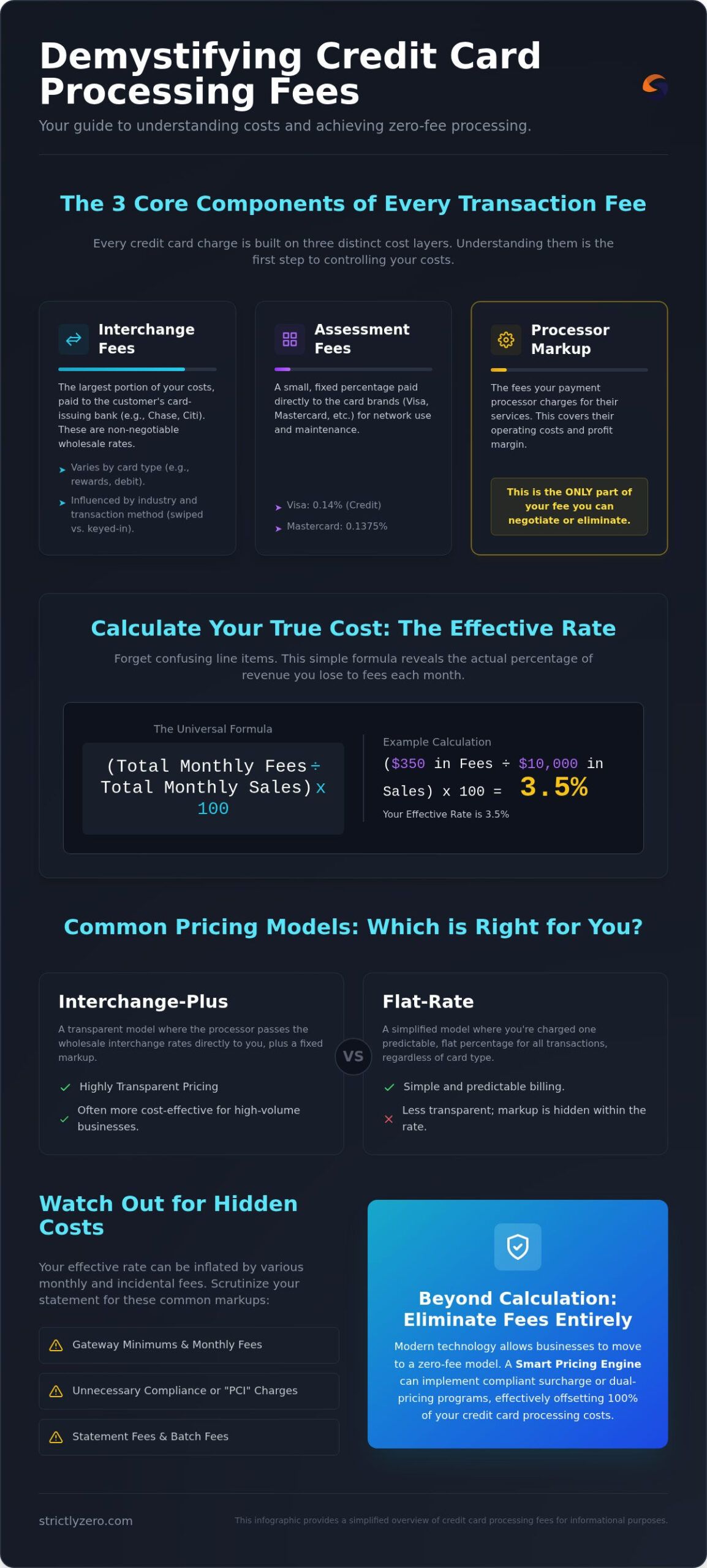
To understand your monthly statement, you have to look at it like a three-legged stool. Every transaction fee is built from three distinct parts: interchange, assessments, and the processor markup. If you’re trying to figure out how to calculate credit card processing fees, you’ll quickly realize that most of these costs are fixed. Card networks and issuing banks take their cut before your processor even touches the money. Knowing which parts are set in stone and which parts are negotiable is the key to reducing your overhead.
The largest portion of your bill comes from Interchange Fees. These are the wholesale costs paid directly to the bank that issued your customer’s card. As of April 2026, Visa and Mastercard have introduced even more granular categories for these rates, making statements look more complex than ever. While interchange is non-negotiable, knowing how it works helps you spot if your processor is adding extra padding on top of the base rates.
To better understand this concept, watch this helpful video:
Interchange vs. Assessment Fees
Interchange represents the raw cost of moving money from the customer’s bank to yours. It’s highly variable. For instance, a high-tier rewards card usually carries a higher rate than a basic debit card. Other factors like your industry type and whether the card was swiped or keyed-in also shift these numbers. Assessments, on the other hand, are small fees paid to the card brands like Visa and Mastercard for network maintenance. For 2026, Visa assessment fees sit at 0.14% for credit, while Mastercard charges 0.1375%. Unlike interchange, these assessments are generally static across every processor you might talk to.
The Role of the Payment Processor
The third leg of the stool is the processor markup. This is where your provider makes their profit and covers their own operating costs. Processors act as the bridge between your business and the global financial networks. They bundle the interchange and assessment costs into a single report for you. In an omni-channel environment, these credit card processing services act as a unified utility, handling everything from online checkouts to in-store transactions. Understanding how to calculate credit card processing fees allows you to isolate this markup. It’s the only part of the equation where you have the power to negotiate or, with the right pricing engine, eliminate the cost entirely.
The Step-by-Step Formula: How to Calculate Your Effective Rate
Don’t get bogged down in the minutiae of every 0.10 percent network update or individual transaction fee. While those details matter for auditing, they often distract from the only number that truly impacts your bottom line: the Effective Rate. This figure represents the actual percentage of your total revenue lost to processing costs. Learning how to calculate credit card processing fees manually ensures you aren’t relying on a processor’s biased dashboard. The math is simple. Just as government agencies use specific formulas for calculating the best time to pay bills to maximize cash flow, merchants must use a standardized math approach to evaluate their processors.
To find this number, use the Universal Formula: (Total Monthly Fees ÷ Total Monthly Sales) x 100. For example, if your business generated $10,000 in total sales and your statement shows $350 in total fees, your effective rate is exactly 3.5 percent. Looking at individual transactions is misleading because it ignores the fixed monthly costs and gateway fees that quietly inflate your overhead. The effective rate brings everything into the light.
Gathering Your Data
To get an accurate result, you need to pull specific numbers from your 2026 merchant statement. Look for the “Total Fees Charged” section, which is usually located at the very end of the document. You must use your “Gross Sales” figure, the total amount before any refunds or fees were deducted. If you only look at “Net Sales,” your calculation will be skewed. Don’t forget to include monthly subscription costs, PCI compliance charges, and gateway minimums. These are real expenses that belong in your formula. If your effective rate is higher than you’d like, it might be time to explore a zero-fee model that shifts these costs away from your bottom line.
Interpreting Your Results
Once you have your percentage, you need to know where you stand against industry benchmarks. In 2026, the average total processing rate for U.S. merchants is approximately 2.24 percent for credit cards and 1.17 percent for debit cards. While enterprise-level companies negotiate custom deals, credit card processing for small business typically falls into a higher bracket due to lower transaction volume. If your effective rate exceeds 4 percent, it’s a major red flag. This usually indicates that your processor has layered on excessive markups or that you’re being hit with “non-qualified” surcharges for every rewards card your customers use. Understanding how to calculate credit card processing fees gives you the leverage to demand a better deal or switch providers entirely.
Interchange Plus vs. Flat Rate: Comparing Your Pricing Models
Choosing the right pricing structure is just as important as knowing how to calculate credit card processing fees. Your model determines whether your monthly statement is easy to read or a total nightmare. Flat-rate pricing offers predictability. You pay a single percentage for every transaction, regardless of the card type. While this sounds simple, it often includes a “convenience tax” on small transactions and debit cards that would otherwise cost much less. It’s a trade-off between simplicity and actual cost savings.
Interchange-plus is the gold standard for transparency. It passes the wholesale cost directly to you with a small, separate markup. This makes it easier to audit your expenses and ensures you benefit from lower debit rates. Membership or subscription pricing takes this further by charging a flat monthly fee for direct access to wholesale rates. On the other end of the spectrum, tiered pricing is frequently considered predatory. It lumps transactions into “qualified,” “mid-qualified,” and “non-qualified” buckets, allowing processors to hide massive markups in those lower tiers. When Comparing Your Pricing Models, transparency should be your top priority.
Which Model Is Right for Your Volume?
Micro-merchants processing under $5,000 per month usually find flat rates the most cost-effective. The simplicity outweighs the slightly higher per-transaction cost. However, once you cross that $5,000 threshold, interchange-plus typically becomes significantly cheaper. Your choice also depends on your sales environment. For instance, ecommerce payment processing often involves higher interchange rates due to increased fraud risks, making a transparent model even more vital for protecting your margins.
The Transparency Trap
Don’t assume that a transparent statement automatically leads to lower costs. Even the most honest interchange-plus report still represents a significant cost center for your business. Tiered pricing is the worst offender here, using “non-qualified” categories to mask high fees on rewards or corporate cards. Understanding how to calculate credit card processing fees across these models reveals a simple truth. Even the most transparent model is still an expense unless you implement a surcharge strategy to shift those costs away from your business entirely.
Analyzing Your Merchant Statement for Hidden Costs
Mastering the basic formula for how to calculate credit card processing fees is only half the battle. The real challenge lies in identifying the “junk fees” that processors hide deep in the fine print of your monthly statement. These charges often appear under vague names, making it difficult to tell if you’re paying for a legitimate service or simply padding your provider’s profit margin. In 2026, the complexity of these statements has reached a new high, requiring a keen eye to keep your effective rate from creeping upward month after month.
PCI compliance fees are among the most common offenders. Many processors charge a monthly fee for “compliance assistance,” yet they’ll hit you with an even larger “non-compliance fee” if you haven’t filled out your annual questionnaire. You shouldn’t be paying for both. Similarly, statement fees and gateway minimums represent the “death by a thousand cuts” that plagues small merchants. If you don’t process enough volume to meet a specific threshold, your processor might charge you the difference, essentially penalizing you for having a slow month.
Batch header fees are another quiet drain on your revenue. Every time you close out your terminal at the end of the day, you’re likely being charged a small fee. While a few cents might seem negligible, it adds up over a full year. Additionally, chargeback and retrieval fees have become significantly more expensive. For example, Mastercard introduced a new “Force Post Transaction Fee” of nine cents per transaction as of April 1, 2026. These small network additions can quickly inflate your overhead if you aren’t paying attention.
Common ‘Junk Fees’ to Negotiate
Business owners often don’t realize that many of these line items are entirely negotiable. If you’re working with a competitive provider, you can often have the following fees waived:
- Annual fees
- Monthly minimums
- Statement fees
- Online reporting fees
- PCI non-compliance fees (by becoming compliant)
Watch out for “Interchange Padding” as well. This happens when a processor adds a few extra basis points to the raw network rate before presenting it to you. It’s a subtle way to increase their markup without changing their quoted “plus” rate. If you see a Visa assessment higher than the standard 0.14 percent, your processor is likely skimming extra off the top. Knowing how to calculate credit card processing fees down to the basis point gives you the leverage to call out these discrepancies.
Audit Checklist for 2026
Perform a monthly audit of your “Discount Rate” section to keep your costs in check. This is where the bulk of your variable costs live. Cross-reference your effective rate month-over-month to spot “bracket creep,” where your costs slowly rise despite no change in your sales volume. By comparing your statement against best credit card processing for small business benchmarks, you can gain the leverage needed to demand more transparency. If your current provider refuses to budge on these hidden costs, it’s time to request a free statement analysis to see how much you could save with a zero-fee model.
Beyond Calculation: How to Eliminate Processing Fees Entirely
Once you’ve mastered how to calculate credit card processing fees, the resulting number is often a wake-up call. Seeing thousands of dollars leave your business every year makes the “cost of doing business” feel more like a preventable leak. The 2026 merchant landscape has shifted significantly. The June 9, 2026, preliminary approval of the $38 billion Visa and Mastercard settlement has expanded merchant rights to surcharge and loosened “honor-all-cards” rules. This makes it the ideal time to move beyond calculation and into total fee elimination.
A Smart Pricing Engine takes the manual math out of the equation. Instead of you crunching numbers every month, the software calculates the exact cost of each transaction at the point of sale in real-time. By shifting these costs to the cardholder, your effective rate drops to zero. This isn’t just about saving money. It’s about using technology to maintain your margins in an economy where interchange rates continue to climb. Strictly’s omni-channel platform manages this complexity for you, whether you’re selling online or in-person, ensuring that your business remains profitable regardless of how a customer chooses to pay.
Surcharging vs. Dual Pricing
Surcharging is a specific model where a percentage is added only to credit card transactions. It’s a direct way to offset the merchant’s cost for that specific payment method. On the other hand, dual pricing presents two clear options to the customer: a “cash price” and a “card price.” Both models are designed to protect your bottom line, but they require strict adherence to network rules and state regulations. For a deeper dive into how these strategies work in practice, see our guide on zero fee credit card processing.
Implementing a Zero-Fee Model
You don’t need expensive new hardware to make this work. A hardware-free approach using a virtual terminal allows you to process compliant surcharges directly from your computer or tablet. The key to success is clear communication. Most customers understand that processing costs are rising and appreciate the transparency of a dual pricing model. Automated state-by-state compliance ensures you stay on the right side of the law. This is vital since credit card surcharges remain prohibited in Connecticut, Massachusetts, and Maine as of 2026. Having a system that knows these rules automatically prevents legal headaches.
When you finally understand how to calculate credit card processing fees, you realize that every dollar saved is a dollar of pure profit. The “aha moment” happens when you see your first statement with $0 in processing costs. If you’re ready to stop paying for the privilege of accepting payments, it’s time to act. Calculate your potential savings and switch to Strictly’s surcharge program today.
Reclaim Your Revenue and Eliminate Processing Overhead
You’ve moved from confusion to clarity by mastering the components of your merchant statement. Understanding the difference between interchange and processor markups is the only way to stop overpaying for every swipe. Now that you know how to calculate credit card processing fees using the effective rate formula, you can spot the hidden junk fees that drain your margins. You have the diagnostic tools to identify exactly where your revenue is leaking and the leverage to demand better terms.
Identifying these costs is the first step toward reclaiming your profits. Instead of just managing these expenses, you can choose to eliminate them entirely. Strictly provides a platform that stays compliant in all 50 states while including AI-driven fraud prevention to protect your transactions. For those managing complex payouts, ClearSplit™ automated partner residuals simplify your back-office work. Don’t let processing costs dictate your growth. Stop paying for your customers’ rewards; switch to Strictly’s Zero-Fee model today. Your business deserves to keep every dollar it earns.
Frequently Asked Questions
What is a typical credit card processing fee for small businesses in 2026?
The average total processing rate for U.S. merchants in 2026 is approximately 2.24 percent for credit cards and 1.17 percent for debit transactions. Small businesses often pay slightly more due to lower processing volumes. These costs include interchange fees, network assessments, and the processor markup. Understanding these benchmarks helps you determine if your current provider is giving you a fair deal or hiding excessive profits in your monthly statement.
How do I calculate the effective rate on my merchant statement?
To learn how to calculate credit card processing fees as a single percentage, you need to find your effective rate. Divide your total monthly fees by your total gross sales, then multiply that number by 100. For example, if you paid $400 in fees on $10,000 in sales, your effective rate is 4 percent. This number is the most accurate way to measure the true cost of accepting payments across all card types.
Is it legal to pass credit card processing fees to the customer?
Yes, surcharging is legal in 47 states as of 2026, though it remains prohibited in Connecticut, Massachusetts, and Maine. Merchants must follow specific card brand rules, which include providing clear signage at the entrance and point of sale. You also have to notify the card networks before you start. Using a compliant surcharge engine ensures that these fees are applied correctly and only to eligible credit card transactions to avoid legal penalties.
What is the difference between interchange-plus and flat-rate pricing?
Flat-rate pricing charges one consistent percentage for every transaction, which offers predictability but often costs more for debit cards. Interchange-plus pricing is more transparent, as it passes the wholesale cost of the transaction directly to you with a separate, fixed markup. While interchange-plus is usually cheaper for high-volume businesses, knowing how to calculate credit card processing fees on either model is necessary to ensure you aren’t paying for hidden junk fees.
How can I tell if my payment processor is charging hidden fees?
Check your statement for vague line items like service fees, admin fees, or non-compliance charges. If your effective rate is significantly higher than your quoted percentage, hidden markups are likely the cause. Some processors also add interchange padding, where they increase the raw network rates. Comparing your monthly statements side by side can help you spot bracket creep, where costs slowly rise over time without any change in your processing volume or card mix.
Does surcharging apply to debit card transactions?
No, you cannot legally apply a surcharge to debit card transactions. This rule applies even if the customer chooses to run their debit card as credit at the terminal. Federal regulations and card brand agreements strictly prohibit these fees on debit cards. A smart pricing engine automatically detects the card type in real time. This ensures that a surcharge is only added to credit transactions, keeping your business compliant with current 2026 payment laws.
How much can a business save by switching to a zero-fee processing model?
Most businesses can save between 2.5 percent and 4 percent of their total gross revenue by switching to a zero-fee model. For a merchant processing $50,000 a month, this translates to roughly $1,250 to $2,000 in monthly savings. By shifting the cost of convenience to the cardholder through a compliant surcharge program, you effectively eliminate the processor markup and interchange costs that usually eat into your profit margins every single month.
What are the new 2026 regulations regarding credit card surcharges?
The 2026 regulatory landscape is defined by a major $38 billion settlement that received preliminary approval in June. This settlement includes a 10-basis-point reduction in credit interchange rates for five years and expands the rights of merchants to surcharge. Additionally, the Credit Card Competition Act was reintroduced in early 2026 to increase network competition. These changes give merchants more power to steer customers toward lower-cost payment methods while automating compliance through modern pricing engines.