
How to Implement a Surcharge Program: A Step-by-Step Merchant Guide (2026)
Published:

What if your monthly merchant statement arrived with a processing fee of exactly zero dollars? For most business owners, those recurring costs feel like an unavoidable tax on growth, especially when state regulations and card brand rules seem to change every other month. You’ve likely spent hours wondering if there’s a way to stop subsidizing your customers’ travel rewards without risking a legal headache or a brand audit. If you’re looking for a way to reclaim your margins, learning how to implement a surcharge program is the most effective strategy available in 2026.
You don’t have to choose between profitability and compliance anymore. It’s possible to protect your bottom line while keeping your customers happy. This guide provides the exact legal, technical, and operational roadmap you need to eliminate credit card fees for good. We’ll explore how to automate 50-state compliance using smart pricing technology, the critical difference between credit and debit card detection, and the specific steps to launch your program without ever compromising the customer experience.
Key Takeaways
- Understand how a surcharge program shifts credit card processing costs to the buyer while keeping your business profitable.
- Navigate the complex legal landscape by distinguishing between state-specific restrictions and card brand requirements.
- Master how to implement a surcharge program through a five-step technical process that integrates with your existing virtual terminal or omni-channel platform.
- Protect customer relationships by using transparent communication strategies that explain the “why” behind the pricing change.
- Leverage automation technology to handle the critical distinction between debit and credit cards at the point of sale.
Table of Contents
- Understanding the Surcharge Model: Why Businesses are Moving to Zero-Fee Processing
- Legal Requirements and Compliance: Navigating State Laws and Card Brand Rules
- The 5-Step Technical Implementation Process for Your Business
- Managing the Customer Experience: Transparency and Communication Strategies
- Automating Your Surcharge Program with Strictly’s Smart Pricing Engine
Understanding the Surcharge Model: Why Businesses are Moving to Zero-Fee Processing
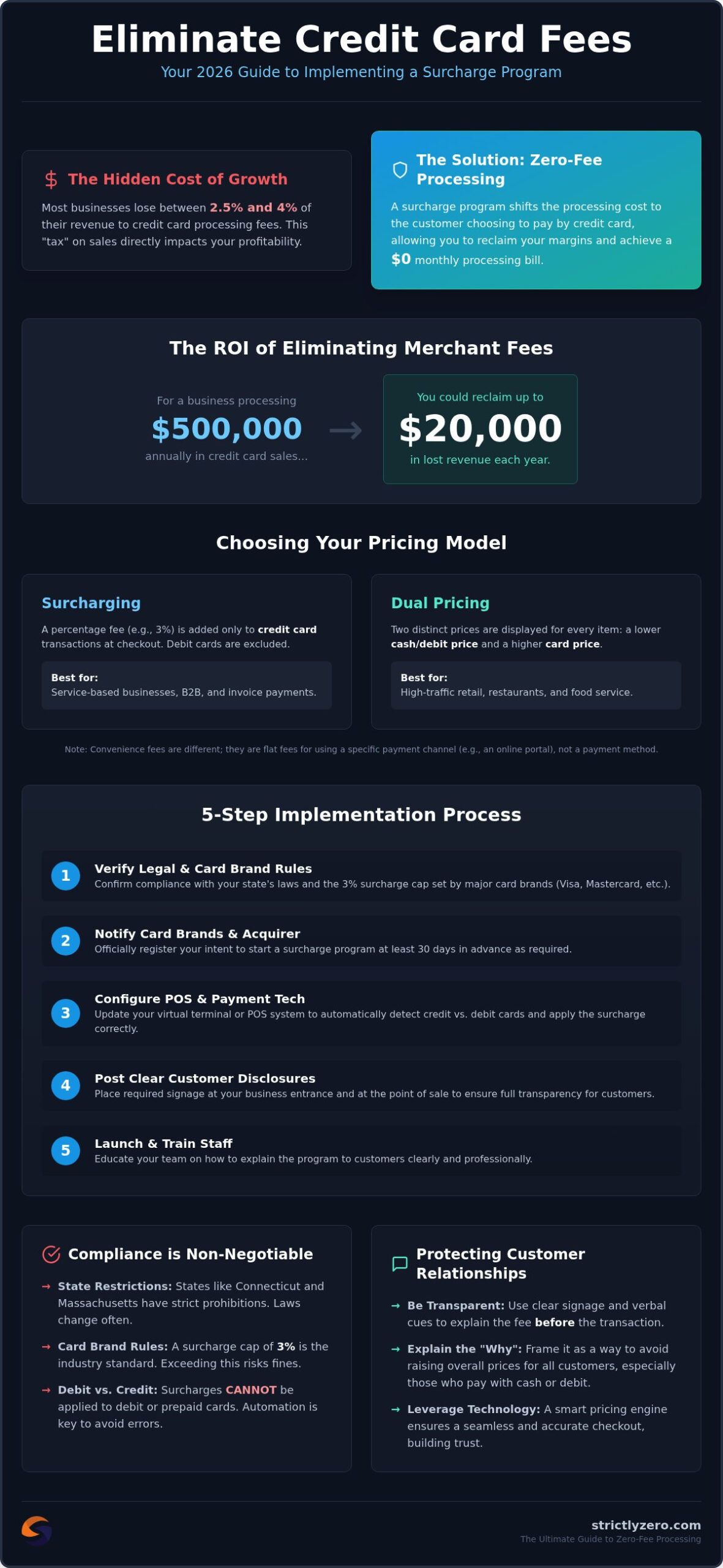
A credit card surcharge program is a straightforward mechanism where the cost of processing a credit transaction is passed directly to the customer at the point of sale. Historically, merchants absorbed these fees as an unavoidable cost of doing business. However, as processing rates have climbed toward the 4% mark, staying profitable requires a more strategic approach. Learning how to implement a surcharge program allows you to protect your margins without raising your base prices for every customer, including those who pay with cash.
In 2026, this model has become a standard business practice rather than an outlier. Businesses face significantly higher labor and supply costs; they can no longer afford to pay for their customers’ credit card rewards. By shifting the processing fee to the person choosing the convenience of credit, you align your costs with your revenue more accurately. It’s a transparent way to maintain competitive pricing while ensuring your business doesn’t lose a percentage of every sale to a bank.
Surcharging vs. Dual Pricing: Key Differences
Surcharging and dual pricing are often confused, but they function differently at the point of sale. A surcharge is a percentage added specifically to credit card transactions at the moment of checkout. It’s highly transparent but requires careful technical handling to ensure it isn’t applied to debit cards, which is a common compliance pitfall. This method is often best for service-based businesses or B2B companies where invoices are the primary payment method.
Dual pricing displays two distinct prices for every item: a cash price and a card price. This method is often preferred in high-traffic retail or food service environments because it simplifies the decision for the customer before they reach the register. Convenience fees are another category entirely. These are flat fees charged for the “convenience” of using a specific payment channel, like an online portal, rather than the payment method itself. Choosing the right model depends on your specific industry and how your customers prefer to shop.
The ROI of Eliminating Merchant Fees
Legal Requirements and Compliance: Navigating State Laws and Card Brand Rules
Compliance is the most daunting hurdle when learning how to implement a surcharge program. You aren’t just dealing with local laws; you’re answering to the major card brands. Visa, Mastercard, Discover, and American Express each have specific operating regulations that dictate how you can pass fees to consumers. As of 2026, the industry standard cap for surcharging is 3%. Charging more than this, or applying it to the wrong card type, can trigger heavy fines or the loss of your processing privileges. These rules exist to protect the consumer experience while allowing you to offset legitimate business costs.
State-Specific Restrictions to Watch For
While surcharging is legal in most of the United States, several states maintain strict limitations. Connecticut and Massachusetts, for instance, have historically prohibited or heavily restricted the practice. Even in states where it’s allowed, you must follow disclosure requirements. This includes posting clear signage at the entry and the point of sale. Failing to meet these standards can lead to legal action from state attorneys general. The legal landscape changes quickly. A law that was in effect last month might be overturned tomorrow. It’s often safer to use a surcharge engine that automates state-by-state compliance to avoid these regional pitfalls. This technology ensures you aren’t accidentally breaking the law when a customer from another state shops on your website.
Card Brand Notification and Registration
You can’t simply flip a switch and start charging extra. The card brands require a formal notification period. Usually, you must notify Visa and Mastercard at least 30 days before you begin surcharging. This gives them time to ensure your merchant account is properly categorized. This notification must include your business details and the specific percentage you plan to charge. While you can handle this paperwork yourself, it’s a tedious process that leaves room for error. Most modern processors handle this registration on your behalf. This ensures your business is registered correctly in their databases, protecting you during future audits. If you skip this step, you risk a card brand audit that could shut down your ability to accept credit cards entirely. Automating this registration is the most reliable way to learn how to implement a surcharge program without the constant fear of a compliance failure.
The 5-Step Technical Implementation Process for Your Business
Moving from legal theory to active execution requires a precise technical roadmap. If you’re wondering how to implement a surcharge program without disrupting your daily operations, following a structured five-step process is essential. This ensures your systems handle the heavy lifting of compliance while you focus on running your business. The goal is to create a seamless experience where the technology identifies the card type and applies the correct pricing logic instantly without manual input from your staff.
Step 1: Selecting the Right Technology Partner
Most traditional banks aren’t equipped for compliant surcharging. They often lack the sophisticated “Smart Pricing” logic needed to instantly identify if a card is a debit or credit card. Surcharging a debit card, even if it’s run as credit, is a major violation of federal regulations. You need a partner that offers an API-first platform. This allows for seamless integration into your existing website or mobile app. Look for a processor that specializes in omni-channel environments so your pricing stays consistent across every sales channel.
Step 2: Signage and Disclosure Requirements
Transparency isn’t just a best practice; it’s a legal mandate. You must provide clear notice to your customers before they pay. For digital checkouts, this means including a clear disclosure on your virtual terminal or e-commerce page before the final transaction button. The language must be standardized, usually stating that the fee does not exceed your cost of acceptance. You must place physical signage at both the entrance of your store and at the point of purchase to remain compliant with card brand rules.
Once your hardware and software are ready, the final steps involve configuration and verification. You’ll need to:
- Update your POS settings: Ensure your software is configured to recognize the surcharge as a separate line item.
- Activate the Smart Pricing Engine: This tool acts as a gatekeeper, automatically detecting debit cards and ensuring no extra fees are applied to them.
- Perform a test transaction: Run a real credit card to verify that the surcharge appears correctly on the receipt. The fee must be clearly labeled and excluded from the tax calculation.
By following these steps, you eliminate the risk of human error. Your team won’t have to guess which cards to surcharge or worry about outdated state laws. The technology handles the complexity, allowing you to enjoy the benefits of zero-fee processing immediately. When you understand how to implement a surcharge program through the lens of automation, the transition becomes a simple software update rather than a logistical nightmare.
Managing the Customer Experience: Transparency and Communication Strategies
Many owners worry that adding a fee will drive customers away. In reality, most consumers understand that inflation and rising operational costs affect small businesses. If you’re transparent about how to implement a surcharge program, you’ll find that customers value your honesty more than the few cents they might save elsewhere. The key is to frame the fee as a way to keep your base prices low for everyone. When you communicate clearly, you turn a potential point of friction into a demonstration of business integrity.
Transparency builds long-term trust. When you implement a surcharge, include a small note on your receipts or a clear sign at the register explaining that these fees go directly to the credit card companies, not into your pocket. Most people are aware that rewards cards come with high merchant costs. By being open about these expenses, you invite your customers to support your business’s sustainability. This level of communication is a critical part of knowing how to implement a surcharge program successfully without damaging your reputation.
Staff Training and Scripting
Your employees are on the front lines. They need to be confident when explaining the new pricing structure. Instead of saying “we are charging you extra,” train them to explain it as a choice. A simple script might be: “To keep our prices as low as possible, we offer a discount for cash and debit payments. Credit card transactions include a small fee to cover the processing costs.” This empowers the customer to choose their preferred payment method. If a customer objects, staff should be ready to offer alternatives like ACH or cash. This prevents tension and shows you’re providing options rather than just imposing a penalty.
Framing the Surcharge as an Incentive
Psychology plays a massive role in how customers perceive fees. Many businesses find success by framing the program as a “cash discount” rather than a “credit penalty.” Even though the math is often identical, the word “discount” feels like a reward. This is where surcharging vs. dual pricing comes into play. Dual pricing allows customers to see both prices upfront, which gives them a sense of control over their spending. When they see a lower price for cash, they feel they’re getting a deal. If you want to ensure this transition is smooth, you can automate your customer-facing disclosures through a platform that handles the signage and receipt logic for you.
Automating Your Surcharge Program with Strictly’s Smart Pricing Engine
Implementing a manual system is risky and often leads to compliance failures. If you’re figuring out how to implement a surcharge program that actually lasts, automation is your only real path to success. Strictly’s Smart Pricing Engine removes the guesswork by instantly identifying card types at the moment of swipe, dip, or manual entry. It doesn’t matter if the customer is using a rewards-heavy credit card or a standard debit card; the system knows the difference. This ensures you never accidentally surcharge a debit card, which is the fastest way to get flagged by card brands.
Compliance isn’t a one-time setup. Laws in states across the country can shift, and keeping up with every legislative update is a full-time job. Strictly’s platform handles these state-by-state updates automatically. If a state changes its rules, the engine adjusts your settings in real-time. You also get unified reporting that tracks every surcharge dollar alongside your standard processing costs. This level of clarity makes bookkeeping simple and ensures your business remains audit-proof year-round. By integrating this technology, you’re not just adding a fee; you’re installing a long-term financial strategy.
Why Automation is Non-Negotiable
Relying on staff to manually check card types is a recipe for disaster. One mistake can lead to significant fines from Visa or Mastercard. Strictly’s Smart Pricing Engine acts as a fail-safe, preventing illegal surcharges before they happen. By using this technology, you achieve the goal of zero-fee processing without the administrative burden. Ultimately, using Strictly results in a $0 cost for the merchant, as the processing fees are fully covered by the program logic and the surcharge engine.
Next Steps: Launching Your Program
You don’t have to overhaul your entire business to start saving. Getting started is as simple as requesting a demo of the Strictly virtual terminal to see the automation in action. For ISOs and partners, our onboarding process is designed to help you offer these zero-fee solutions to your own merchant portfolios quickly. If you’re ready to stop paying for your customers’ credit card points, the tools are already built and waiting for you. Learning how to implement a surcharge program is the first step; choosing the right engine is the second.
Ready to eliminate fees? Implement your surcharge program with Strictly
Reclaim Your Revenue and Scale Your Business
Eliminating credit card fees is no longer a complex legal maze reserved for large corporations. By following the steps in this guide, you now understand exactly how to implement a surcharge program that protects your margins while remaining fully compliant. Success relies on a balance of transparent customer communication and robust technical automation. You don’t have to worry about manual errors or shifting state laws when you have the right infrastructure in place.
Strictly provides the tools to make this shift effortless. With automated debit detection and a built-in state-by-state compliance engine, your business stays protected. Our omni-channel ready platform ensures a seamless experience for you and your customers across every sales channel. Stop letting processing fees eat into your hard-earned profits and start reinvesting that capital back into your company’s growth.
Eliminate your processing fees today with Strictly’s Smart Surcharge Program
Your path to zero-fee processing is ready. Take the first step toward a more profitable future today.
Frequently Asked Questions
Is it legal to surcharge credit card transactions in all 50 states?
No, surcharging is not legal in every state. While the majority of the U.S. allows it, states like Connecticut and Massachusetts maintain specific restrictions or outright prohibitions. You must verify local statutes before you learn how to implement a surcharge program in these regions. Using a processor with geo-fencing capabilities is the most reliable way to stay compliant as laws change.
Can I apply a surcharge to debit card transactions?
No, you cannot legally surcharge debit card transactions. Federal regulations strictly prohibit adding fees to debit cards, regardless of whether the customer chooses “debit” or “credit” at the terminal. Violating this rule can lead to significant fines and the loss of your merchant account. Reliable detection technology is essential to filter these cards out automatically at the point of sale.
What is the maximum percentage I can charge as a surcharge?
The maximum surcharge allowed by major card brands is currently capped at 3%. You cannot charge a fee that exceeds your actual cost of acceptance for that specific credit card. If your processing rate is lower than 3%, your surcharge must reflect that lower cost. Setting a flat rate higher than the brand limit will trigger non-compliance flags during a card brand audit.
Do I need to notify my customers before implementing a surcharge?
Yes, clear customer notification is a mandatory requirement. You must post visible signage at the entrance of your business and at the point of sale. For online stores, the disclosure must appear on the checkout page before the final transaction is submitted. These notices must inform the customer that a fee applies to credit transactions and that it doesn’t exceed your cost of acceptance.
What is the difference between a surcharge and a convenience fee?
A surcharge is a fee based on the payment method, specifically credit cards. A convenience fee is charged for the privilege of using a non-standard payment channel, such as paying online instead of in person. While surcharges are percentages, convenience fees are typically flat rates. You can’t apply both to the same transaction, so choosing the right model for your workflow is vital for staying compliant.
How do I register my surcharge program with Visa and Mastercard?
You must notify Visa and Mastercard of your intent to surcharge at least 30 days before the program begins. This registration process involves submitting your business details and intended fee percentage through their official portals. Many modern payment processors handle this registration on your behalf. Automating this step is often the easiest way to understand how to implement a surcharge program without missing critical deadlines.
Will surcharging affect my PCI DSS compliance status?
Surcharging itself doesn’t change your PCI DSS compliance level, but your implementation must follow secure standards. The surcharge must be a separate line item on the receipt and shouldn’t interfere with the secure transmission of cardholder data. Using a PCI-compliant virtual terminal or POS system ensures that your fee calculation doesn’t create new security vulnerabilities for your business or your customers during the checkout process.
What happens if I accidentally surcharge a debit card?
Accidentally surcharging a debit card is a serious compliance violation. If a card brand discovers the error during an audit, you could face heavy financial penalties or have your merchant account terminated. This is why manual detection is so risky for staff. Using an automated engine that detects the card’s BIN number instantly is the only way to prevent these costly mistakes and keep your account in good standing.