
How to Increase Average Order Value with Financing: The 2026 Merchant Guide
Published:
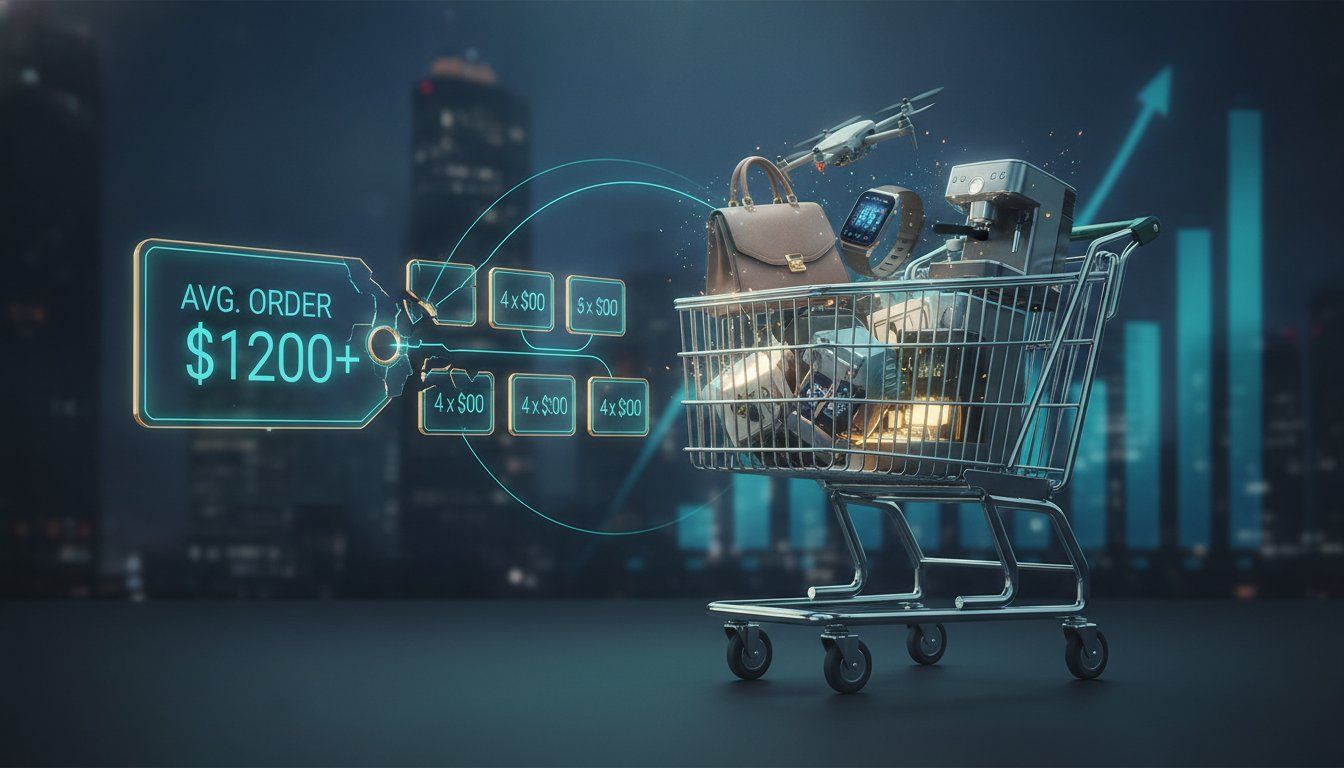
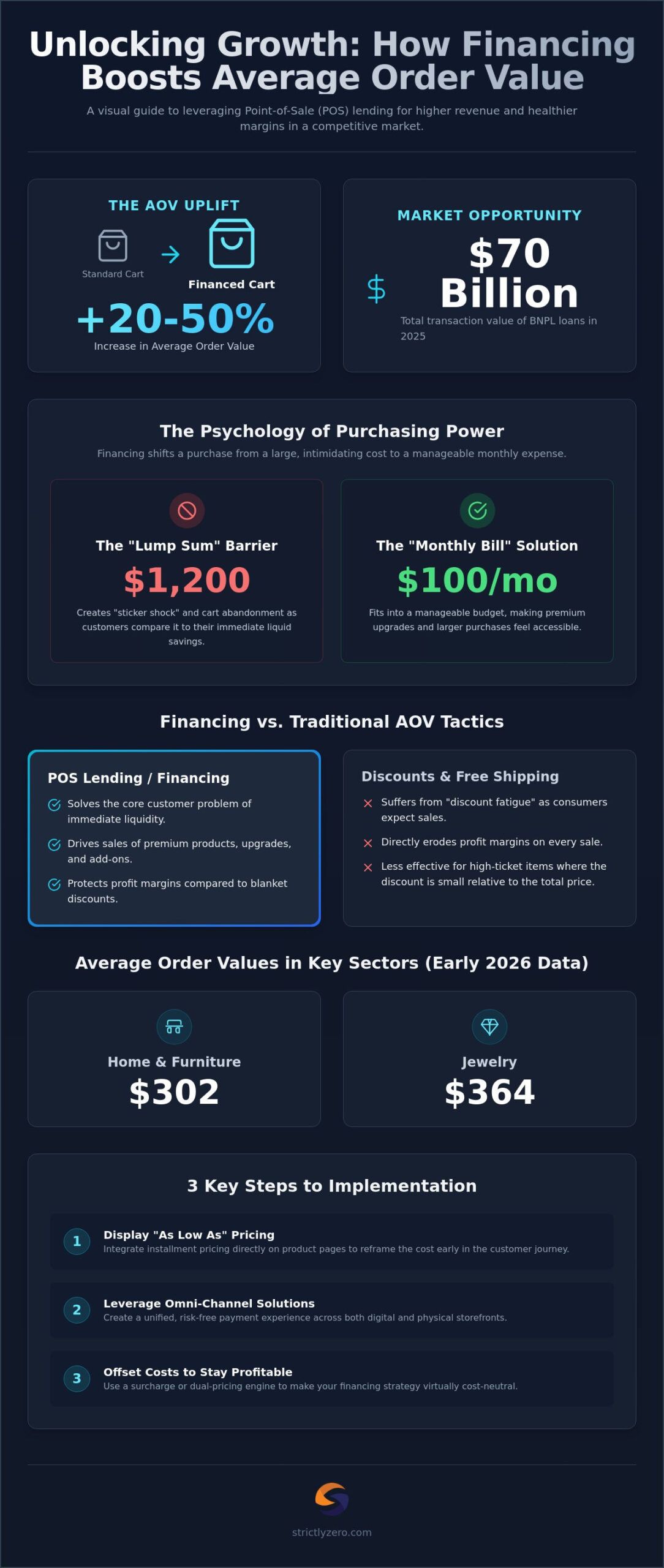
Did you know that retailers offering installment options see an average order value increase of 20% to 50%? In a market where the total transaction value of these loans hit $70 billion in 2025, learning how to increase average order value with financing is no longer just a luxury; it’s a necessity for survival. You likely see the same pattern every day. Customer acquisition costs are rising faster than your revenue, and your most premium products often stall at the finish line because of price sensitivity. It’s frustrating to watch a perfect lead vanish at the final payment step simply because their desire doesn’t match their immediate bank balance.
We agree that your business deserves a way to capture that revenue without taking on the risk of the loan yourself. This guide will show you how to bridge the gap between customer desire and budget using integrated POS lending solutions. We’ll preview the latest 2026 regulatory shifts, including the impact of the Illinois Buy-Now-Pay-Later Loan Consumer Protection Act, and explain how flexible payments create a seamless path to higher conversion rates and bigger baskets.
Key Takeaways
- Understand the “Mental Accounting” theory and how breaking down costs helps customers justify purchasing premium upgrades and add-ons.
- Compare financing to traditional tactics like product bundling to see which strategy better protects your profit margins while driving growth.
- Learn the technical steps to increase average order value with financing by integrating “As Low As” pricing displays directly on your product detail pages.
- Discover how to leverage an omni-channel payment processor to create a unified, risk-free experience across both digital and physical storefronts.
- Explore how a surcharge and dual pricing engine can offset the costs of offering POS lending, making your growth strategy virtually cost-neutral.
Table of Contents
- What Is Average Order Value (AOV) and Why Does It Matter in 2026?
- The Psychology of Purchasing Power: How Financing Drives Larger Carts
- Financing vs. Traditional Tactics: Which Is Best for Your Business?
- How to Implement Financing to Increase AOV: A 5-Step Guide
- The Strictly Advantage: Boosting AOV with Zero-Fee Financing
What Is Average Order Value (AOV) and Why Does It Matter in 2026?
Average Order Value, or AOV, represents the average dollar amount spent each time a customer places an order. It’s a simple but vital calculation: AOV is the total revenue divided by the number of orders over a specific period. In 2026, this metric has become the heartbeat of retail health. With customer acquisition costs rising faster than revenue for many brands, the old strategy of simply buying more traffic is no longer sustainable. Smart merchants now focus on getting more value from the traffic they already have. Learning how to increase average order value with financing is the most direct path to staying profitable when ad costs are at an all-time high.
To better understand this concept, watch this helpful video:
The Mathematical Impact of AOV on Your Bottom Line
Small shifts in AOV create massive ripples in your net profit. Think about your fixed costs per order. Whether a customer spends $100 or $300, your shipping labor, packaging, and base processing fees often stay relatively stable. When you increase the order size, that extra revenue doesn’t have the same “fixed” weights pulling it down. For example, a 10% increase in AOV doesn’t just mean 10% more revenue; it often leads to a disproportionate jump in net profit because you’ve already cleared your break-even point. This margin expansion is what makes expensive advertising channels viable again. If your AOV is $302, which was the average for home and furniture in early 2026, a slight bump can be the difference between a failing ad campaign and a scaling one.
Why Traditional AOV Tactics Are Failing in 2026
Traditional tricks like “10% off your first order” or free shipping thresholds are losing their edge. In 2026, consumers are experiencing deep discount fatigue. They know a sale is always around the corner, and a small percentage off doesn’t move the needle for high-ticket items. More importantly, inflation has fundamentally changed consumer behavior and immediate liquidity. Even when shoppers want a premium item, they often lack the “lump sum” cash to buy it outright. This has shifted the market from impulse buys to “considered purchases.” If you want to increase average order value with financing, you have to solve the liquidity problem. People aren’t necessarily looking for a small discount; they’re looking for a way to fit a luxury purchase, like the $364 average seen in the jewelry sector, into a manageable monthly budget.
The Psychology of Purchasing Power: How Financing Drives Larger Carts
Understanding the psychological levers behind a purchase is key to unlocking growth. One of the most powerful concepts in modern retail is ‘Mental Accounting.’ This theory suggests that consumers don’t view money as a single, fungible pool. Instead, they categorize it into different “buckets” like utilities, entertainment, or savings. When a shopper sees a $1,200 price tag, they often compare it to their immediate liquid savings. This comparison creates instant sticker shock. However, when you break that cost down into monthly installments, the purchase moves into the “monthly bills” bucket. It’s much easier for a customer to justify a $100 monthly payment than a one-time $1,200 hit to their bank account.
This shift in perspective is exactly how you increase average order value with financing. Verified data from July 2026 shows that retailers who offer buy now, pay later options see an average order value increase of 20% to 50%. By removing the barrier of a large lump sum, you aren’t just making a sale possible; you’re making a larger sale probable. You’re effectively changing the internal customer question from “Can I afford this today?” to “Can I afford this per month?”
Breaking Down the Barrier of Immediate Liquidity
Financing allows customers to bridge the gap between what they need and what they want. Often, a shopper might need a basic replacement but want the premium version. If they lack immediate liquidity, they’ll settle for the cheaper option or abandon the cart entirely. POS lending provides a safety net that reduces buyer’s remorse. Because the payments are structured and predictable, the customer feels in control of their budget. While implementing these systems, merchants must stay informed on Consumer credit law to ensure they’re providing transparent terms that build long-term trust rather than just a quick transaction.
Financing as a Tool for Premium Upselling
The ‘Upgrade Effect’ is a measurable phenomenon in high-ticket retail. Imagine a customer looking at a standard $500 item. They see a ‘Pro’ version for $1,200. Without financing, that $700 gap feels insurmountable. With financing, that gap might only represent an extra $40 per month. This makes the high-margin, premium inventory much more accessible. You can use this strategy to move inventory that typically sits on the shelf due to its price point. If you want to see how these tools look in practice, exploring omni-channel payment processing solutions can help you integrate these psychological triggers into every sales channel you own.
Financing vs. Traditional Tactics: Which Is Best for Your Business?
Traditional growth tactics like product bundling or free shipping thresholds have been the standard for years, but they often force you to sacrifice your hard-earned margins. When you bundle products, you risk lowering the perceived value of each individual item in the eyes of the consumer. For a premium brand like Zero Give that focuses on high-performance athletic stability, maintaining that perceived value is essential. In contrast, choosing to increase average order value with financing allows you to maintain your premium price points while making the total cost feel manageable. While manual upselling relies on the inconsistent performance of sales staff, financing provides a scalable, automated engine that works for every customer without additional labor costs.
For industries with high-ticket price points, such as home improvement, luxury retail, and professional services, financing is the clear winner. In early 2026, the average order value for home and furniture reached $302, while luxury and jewelry sat at $364. This trend is mirrored in the wellness sector, where companies like Pureffect use flexible payments to make advanced health technology more accessible to a wider audience. At these levels, a free shipping offer rarely provides enough incentive to double a cart size. However, a monthly payment option can easily turn a $300 purchase into a $600 upgrade because the immediate impact on the customer’s wallet is minimal. This flexibility is particularly effective for professional services where the “all-in” cost might otherwise be a barrier to entry.
Bundling and Cross-Selling: The Limitations
Bundling can be a double-edged sword. If you pack too many items together, you might trigger “decision fatigue,” where the customer becomes overwhelmed by choices and abandons the cart entirely. Financing simplifies this process. Instead of forcing the customer to evaluate the value of five different items in a bundle, you present them with one high-quality solution and a simple monthly price. This clarity speeds up the path to purchase and reduces the cognitive load on the shopper.
The ROI of Financing vs. Discounts
The math of financing is often more attractive than the math of discounting. In 2026, many merchants find that a 15% discount is the minimum required to move the needle on AOV. However, BNPL merchant fees typically range from 4% to 9%. By opting for financing over a deep discount, you preserve a larger portion of your margin while protecting your brand from the “perpetual sale” cycle that can erode long-term value. To further protect these margins, smart merchants are looking at Zero Fee Credit Card Processing to reclaim the costs associated with standard transactions. This strategy ensures that as you increase average order value with financing, you aren’t losing those gains to hidden processing overhead.
How to Implement Financing to Increase AOV: A 5-Step Guide
Moving from theory to execution requires a clear roadmap. When you’re ready to increase average order value with financing, the first step is infrastructure. You need a partner that handles the complexity of lending while you focus on the sale. Follow these five steps to build a high-converting financing engine.
- Step 1: Choose your partner. Select an omni-channel payment processor that supports POS lending natively. You don’t want a fragmented system where online and in-store data live in separate silos.
- Step 2: Display “As Low As” pricing. Integrate these dynamic price points directly on your product detail pages. This simple visual cue is one of the fastest ways to increase average order value with financing because it shifts the focus from the total cost to a manageable monthly number.
- Step 3: Train your sales team. Your staff should lead with monthly payment options rather than waiting for the customer to ask. This approach normalizes financing and makes premium upgrades feel accessible from the start.
- Step 4: Optimize the checkout. Ensure financing is a visible, one-click option alongside standard credit cards. Friction at this stage is the primary cause of cart abandonment.
- Step 5: Send payment links. For high-ticket quotes or custom orders, use payment links that allow customers to review their financing terms in the comfort of their own home.
Optimizing the Digital Checkout Flow
Your digital storefront needs to signal flexibility long before the final click. Place a “Financing Available” badge near the “Add to Cart” button for maximum impact. This placement catches the shopper at the peak of their interest. By using advanced ecommerce payment processing, you can sync your financing offers with your real-time inventory. This ensures that only eligible, high-margin items trigger the financing prompt. Instant approval is also non-negotiable. In the 2026 mobile-first economy, a customer won’t wait more than a few seconds for a credit decision.
In-Person and Mobile Financing Strategies
Bridging the gap between physical and digital is where most merchants struggle. You can solve this by placing QR codes on physical price tags. When scanned, these codes link directly to a pre-filled financing application. For service providers working on-site, virtual terminals turn any tablet or smartphone into a lending kiosk. This “hybrid approach” allows a customer to browse in your showroom but complete their financing via a texted link on their own device. It’s private, fast, and significantly reduces the pressure of a traditional credit application.
If you’re ready to transform your checkout experience and capture more revenue, it’s time to get started with Strictly Zero today.
The Strictly Advantage: Boosting AOV with Zero-Fee Financing
While offering installments is a proven way to increase average order value with financing, many merchants hesitate because of the associated service fees. Strictly solves this by providing a unified platform where POS lending lives alongside our powerful Surcharge and Dual Pricing Engine. This synergy allows you to recover the costs of traditional credit card processing, effectively creating a “budget” to fund your financing programs. By eliminating standard merchant fees on every transaction, you can offer more flexible terms to your customers without eroding your bottom line. It’s a strategic shift that turns your payment processor from a cost center into a growth engine.
Omni-channel flexibility is at the core of the Strictly experience. Whether your customer is shopping on your website, browsing via a mobile app, or receiving a quote through a virtual terminal, the financing experience remains consistent and professional. High-ticket items naturally attract more scrutiny from bad actors, which is why we’ve integrated AI-driven fraud prevention into every financed transaction. You get the benefit of larger carts with the peace of mind that comes from enterprise-grade security. This unified approach ensures that as you increase average order value with financing, your operations remain lean and your data stays in one place.
Eliminate Fees While Growing Sales
The real secret to scaling in 2026 is the zero-fee revolution. By utilizing zero fee merchant services, you aren’t just saving pennies; you’re reclaiming a significant percentage of your gross revenue. Our Strictly Smart Pricing Engine handles the heavy lifting by ensuring automated compliance for your surcharge and dual pricing programs across different states and jurisdictions. This allows you to reinvest those savings into better customer terms or more aggressive marketing. For those looking to build their own ecosystem, our payment processing platform for ISOs provides the residuals and management tools needed to support multiple merchants under one roof with ease.
Getting Started with Strictly
Integration doesn’t have to be a months-long headache. Our API-first platform is designed for rapid deployment, allowing you to plug POS lending into your existing checkout flow with minimal code. We operate on a “Trust as a Processor” model, meaning we prioritize the safety and stability of your high-value transactions above all else. We don’t just provide the tools; we provide the infrastructure that makes high-ticket sales possible. Don’t let premium products languish in abandoned carts because of a lack of payment options. Scale your business and increase AOV with Strictly’s financing solutions today.
Future-Proof Your Revenue with Flexible Payments
The retail landscape of 2026 demands more than just a great product. It requires a payment strategy that aligns with how modern shoppers manage their cash flow. By shifting the conversation from a single lump sum to manageable installments, you remove the primary barrier to your most expensive inventory. This isn’t just about making sales. It’s about building an accessible brand that respects the customer’s budget and liquidity.
Integrating these tools is the most effective way to increase average order value with financing while protecting your bottom line from rising acquisition costs. You’ve seen how psychological pricing and seamless checkout flows work together to create larger carts and more loyal customers. Now, it’s time to put these strategies into action with a partner that understands the intersection of lending and margin preservation. Your biggest sales are just one flexible payment option away.
Ready to transform your checkout experience? Boost your AOV with Strictly’s Zero-Fee Financing Solutions today. With our all-in-one omni-channel platform, AI-driven fraud prevention, and compliant surcharge and dual pricing engine, you can scale with total confidence. Start capturing the revenue you’ve been leaving behind and give your customers the purchasing power they deserve.
Frequently Asked Questions
How much does offering financing typically increase average order value?
Retailers who offer buy now, pay later options see an average order value increase of 20% to 50%. This significant growth happens because customers feel comfortable adding premium upgrades or additional items once the total cost is divided into smaller payments. It’s a proven strategy to increase average order value with financing without needing to lower your base prices or run constant holiday sales. You’re effectively expanding the customer’s mental budget for that specific shopping session.
Is POS lending risky for the merchant if the customer doesn’t pay?
POS lending is generally risk-free for the merchant because the financing provider pays you the full amount of the sale upfront, minus their fee. The lender takes on the responsibility of collecting payments and managing the credit risk. If a customer defaults, it doesn’t impact your revenue or require you to chase down the debt yourself. This allows you to focus on sales while the payment processor handles the financial liability and collections.
Can I offer financing and still use a zero-fee surcharge program?
You can absolutely combine these two powerful tools. A surcharge and dual pricing engine allows you to offset the costs of standard credit card transactions, while POS lending provides the flexibility customers need for larger purchases. Using an all-in-one platform ensures both systems work together compliantly. This combination helps you protect your profit margins while simultaneously giving your shoppers more purchasing power at the checkout without increasing your overhead.
What industries see the biggest jump in AOV from financing?
Industries with high-ticket prices like home improvement, luxury retail, and professional services see the most significant impact. In April 2026, the consumer goods sector reported an average order value of $418. When a purchase exceeds a few hundred dollars, the “sticker shock” becomes a major barrier for the average shopper. Financing bridges this gap, making it much easier for customers in these fields to commit to comprehensive projects or luxury versions of products.
Does adding financing options slow down the checkout process?
Modern financing integrations are designed for speed and typically offer instant approvals within seconds. In the 2026 mobile-first economy, a slow application is a dealbreaker for most users. By using an API-first platform, the credit decision happens in real-time during the checkout flow. This ensures that offering payment flexibility doesn’t create friction or lead to higher cart abandonment rates. Instead, it provides a smooth, professional experience that encourages the final click.
How do I explain financing options to my customers without sounding pushy?
The best approach is to frame financing as a helpful tool for budget management rather than a hard sales pitch. Use “as low as” pricing on your product pages to introduce the concept early in the browsing phase. When speaking with customers, mention that you offer flexible payment plans to help them get exactly what they want without a large upfront cost. This positions you as a partner in their journey rather than just someone trying to increase average order value with financing.
What is the difference between BNPL and traditional POS lending?
BNPL usually refers to short-term “Pay in 4” models that are often interest-free for the consumer. Traditional POS lending typically covers longer-term installment loans for much larger purchases and may involve interest rates. While BNPL is great for smaller retail items, longer-term financing is better for high-ticket projects. Both options are becoming more regulated. The Illinois Buy-Now-Pay-Later Loan Consumer Protection Act, enacted on June 25, 2026, now sets new standards for transparency and licensing in the industry.