
How to Increase Profit Margins by Eliminating Processing Fees in 2026
Published:

What if your merchant statement didn’t feel like a monthly tax on your hard work? In 2026, the average U.S. interchange fee for Visa is 1.97%, yet total costs often climb as high as 3.5% per transaction. You’ve likely noticed your processing fees growing faster than your actual revenue. It’s a common struggle to increase profit margins by eliminating processing fees when hidden junk charges and complex statements keep your bottom line in a chokehold. You want to protect your earnings, but the fear of customer backlash if you pass those costs on is a constant concern.
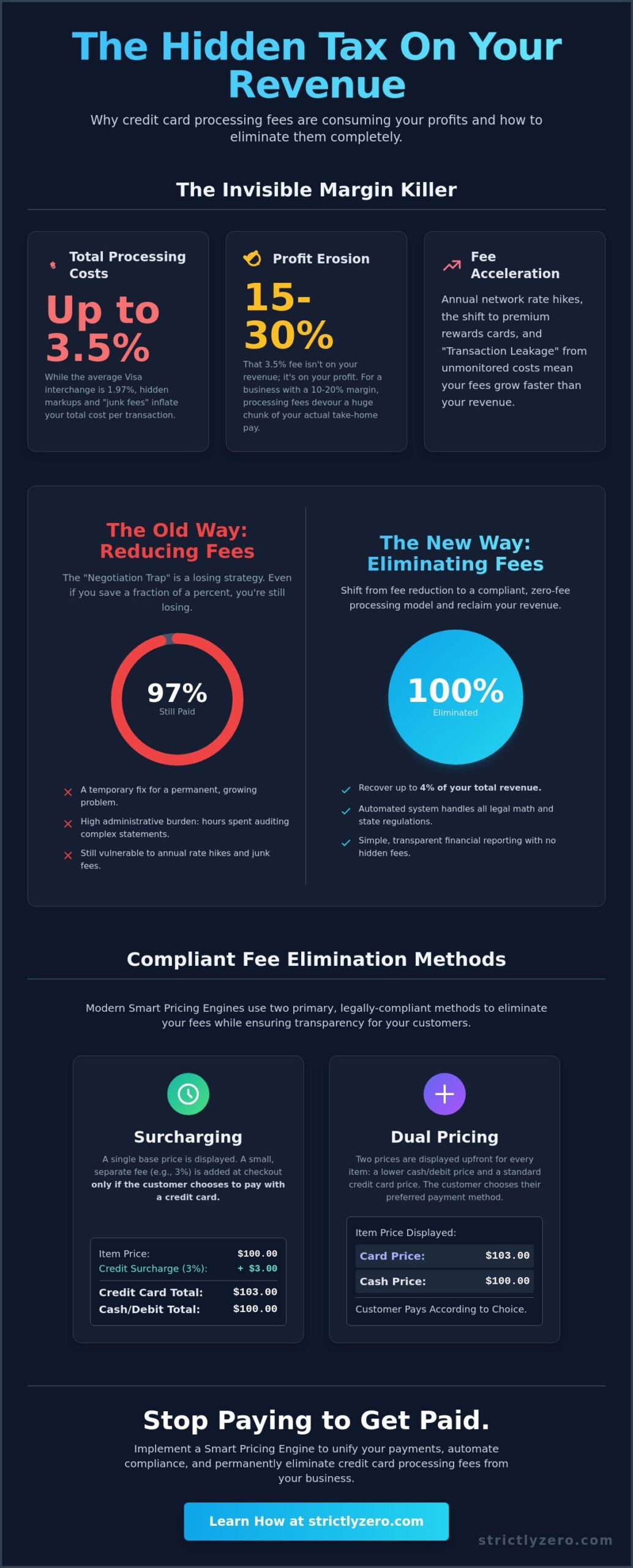
There’s a better way to operate that doesn’t involve constant negotiation with processors. You can reclaim up to 4% of your total revenue by shifting from traditional fee reduction to a compliant, zero-fee processing model. This article will show you how to implement an automated system that handles the legal math and state-specific regulations for you. We’ll explore how modern surcharge and dual pricing engines provide 100% elimination of credit card costs while keeping your financial reporting simple and transparent.
Key Takeaways
- Identify “Transaction Leakage” and why annual network rate hikes mean traditional fee negotiation is no longer enough to protect your margins.
- Discover how to increase profit margins by eliminating processing fees through a strategic shift from simple cost-reduction to a total zero-fee model.
- Master the legal distinctions between surcharges and dual pricing to ensure your business stays compliant with 2026 state regulations and card network rules.
- Implement proven communication techniques to address customer concerns and maintain brand loyalty while transitioning to a more profitable pricing structure.
- Learn how an automated Smart Pricing Engine can unify your omni-channel payments and handle complex fee calculations without manual oversight.
Table of Contents
- The Invisible Margin Killer: Why Processing Fees Outpace Revenue
- Reducing vs. Eliminating: Why Negotiation Is a Losing Strategy
- The Mechanics of Compliant Surcharging and Dual Pricing
- Protecting the Customer Experience While Increasing Profits
- Strategic Margin Recovery with Strictly’s Unified Platform
The Invisible Margin Killer: Why Processing Fees Outpace Revenue
Many business owners watch their top-line revenue grow while their bottom line stays flat. It’s a frustrating paradox. The primary culprit is often “Fee Acceleration,” where network rate hikes compound annually, silently siphoning off cash. Small, unmonitored costs known as “Transaction Leakage” often bypass traditional audits. While a 3% processing fee sounds small, it’s actually massive when viewed in context. If your net profit margin is between 10% and 20%, that 3% processing fee is actually devouring 15% to 30% of your actual take-home pay. To effectively increase profit margins by eliminating processing fees, you have to see these costs for what they are: a direct tax on your profitability.
To better understand the basics of how these costs are structured, watch this helpful video:
The Hidden Mechanics of Fee Growth
Most merchants use either flat-rate models or interchange-plus pricing. Flat-rate models offer simplicity but often hide a significant markup. Interchange-plus is more transparent, but it exposes you to the fluctuating Interchange fee set by card networks. As consumers shift toward premium rewards cards, those underlying costs rise. Processors also engage in transaction reclassification, where a “standard” transaction is suddenly billed at a higher rate. These “junk” fees are designed to be confusing, making it harder to spot where your money is going.
The Compounding Impact on Your Bottom Line
Doing nothing about fee growth is an expensive choice. Over a five-year period, compounding rate hikes can cost a mid-sized business tens of thousands of dollars in lost potential. Traditional credit card processing for small business models simply weren’t built for high-inflation environments. When your overhead rises, you can’t afford to let a percentage of every sale vanish. This constant “Revenue Erosion” takes a psychological toll. It makes you feel like you’re running on a treadmill that’s slowly speeding up. By 2026, the industry reached a tipping point. Business owners realized that negotiating for a few basis points is a losing game. The only way to truly win is to increase profit margins by eliminating processing fees entirely through a smarter, technology-driven approach.
Reducing vs. Eliminating: Why Negotiation Is a Losing Strategy
Most business consultants suggest that the first step to cost-cutting is negotiation. They tell you to call your processor, threaten to leave, and demand a lower markup. This is the “Negotiation Trap.” Even if you successfully shave off 10 or 20 basis points, you’re still paying the lion’s share of the transaction cost. If your total effective rate is 3.5%, saving 0.1% doesn’t change your financial reality. It’s a temporary fix for a permanent problem. To effectively increase profit margins by eliminating processing fees, you have to stop looking for a better deal and start looking for a different model.
The administrative burden of these traditional models is another hidden cost. Business owners often find themselves spending hours every month decoding complex statements to spot “bracket creep” or new junk fees. This constant auditing is a drain on your time and energy. Instead of managing your team or serving customers, you’re acting as an unpaid forensic accountant for your payment processor. Transitioning to zero fee credit card processing represents a permanent structural change that removes this burden entirely.
Limitations of Traditional Optimization
Optimization techniques like Level 2 and Level 3 data processing are often touted as the ultimate solution. While these can lower rates, they’re primarily viable for B2B enterprises dealing with corporate or government cards. For the average retail or service business, the data entry requirements are too high for the modest savings provided. Similarly, trying to move customers to ACH or wire transfers often creates friction at the point of sale. Customers want their rewards points and the protection credit cards offer. Forcing them into a different payment method can lead to abandoned carts and lost sales. The “cheapest” merchant account isn’t the best one if it costs you a customer’s loyalty.
The Zero-Fee Revolution
The real shift happens when you move from seeing processing as a vendor expense to an operational efficiency. Surcharge and dual pricing models allow you to pass the cost of credit card acceptance directly to the consumer who chooses that convenience. Modern technology makes this process seamless and automated. A smart pricing engine identifies the card type instantly and applies the correct fee based on state-by-state surcharging laws, ensuring you remain compliant without manual calculations. This isn’t just about saving money; it’s about reclaiming the 3% to 4% of your gross revenue that currently vanishes every month. If you’re ready to see how this looks in practice, you might want to explore the Strictly platform for a more streamlined approach.
The Mechanics of Compliant Surcharging and Dual Pricing
To truly increase profit margins by eliminating processing fees, you must understand the technical and legal frameworks that make it possible. While many people use the terms interchangeably, surcharging, cash discounting, and dual pricing are distinct strategies with different compliance requirements. A surcharge is an additional fee added specifically to a credit card transaction to cover the cost of acceptance. A cash discount is a reduction from the stated price for customers who pay with cash or check. In 2026, navigating credit card surcharge rules requires precision. For instance, as of July 2026, Illinois law prohibits charging interchange fees on the tax or gratuity portion of a transaction. Without an automated system, staying compliant with these granular changes is nearly impossible.
Transparency is the foundation of any successful program. You can’t simply add a fee at the end of a transaction and hope for the best. Card networks like Visa and Mastercard require specific signage at the point of entry and at the point of sale. Receipts must also clearly itemize the surcharge as a separate line item. Adhering to FTC rules on payment processing ensures your business avoids deceptive pricing claims. When you provide clear, upfront information, you build trust while protecting your revenue.
Dual Pricing: The Ultimate Transparency Tool
Dual pricing is the gold standard for transparency because it removes the “surprise” at the register. It involves displaying two distinct prices for every item: one for cash and one for credit. This method is generally permissible in all 50 states, making it a safer bet for businesses operating across state lines or in states with strict surcharging caps like Colorado. From a customer perspective, it feels like a choice rather than a penalty. Technically, this requires a system capable of syncing with a dual pricing engine to update digital displays or invoices in real-time.
Automating Compliance Across 50 States
The risk of manual surcharging is too high for most small businesses. Fines for non-compliance or failing a card network audit can quickly erase any savings you’ve gained. Cloud-based systems solve this by updating rules instantly as state laws or network policies change. A critical component of this is “Debit Detection.” Federal law prohibits surcharges on debit cards, regardless of whether they are processed with a PIN or a signature. A smart pricing engine identifies the card type in milliseconds. If it’s a debit card, the system automatically bypasses the fee. This automation is the only way to safely increase profit margins by eliminating processing fees while protecting yourself from legal liability.
Protecting the Customer Experience While Increasing Profits
The secret to retention lies in the psychology of choice. When you implement a flat surcharge at the end of a transaction, it feels like a penalty. However, dual pricing changes the narrative. By presenting a cash price and a credit price side-by-side, you empower the customer. They aren’t being forced to pay more; they’re choosing between the convenience of credit or the savings of cash. This sense of agency is why dual pricing is often perceived as more “customer-friendly” than a traditional surcharge. It aligns with the 81% of cardholders who report they will use a different payment method to avoid a fee if given the option.
Communication Strategies for Success
Successful implementation starts with a clear “Value Statement.” You aren’t just adding a fee; you’re protecting your ability to provide high-quality service without raising base prices for everyone. Train your staff to handle questions with confidence. Instead of being defensive, they should explain that these fees go to the card-issuing banks and networks, not the business’s pocket. Clear signage at the point of entry and the checkout counter ensures there are no surprises. When expectations are set early, the “sticker shock” that leads to abandoned purchases is significantly reduced.
Monitoring Customer Sentiment
Once you’ve made the shift, it’s vital to track your results beyond just the savings on your merchant statement. Monitor your churn rates and customer feedback closely. Some businesses use loyalty programs to offset the impact for their most frequent shoppers, offering “member-only” pricing that mirrors the cash discount. This rewards your best customers while still allowing you to increase profit margins by eliminating processing fees for the broader market. If you want to see how a modern system can manage these customer-facing details automatically, consider exploring the Strictly platform to streamline your transition.
Strategic Margin Recovery with Strictly’s Unified Platform
Margin recovery isn’t just a financial goal; it’s a structural necessity for businesses that want to thrive in a high-inflation environment. While previous sections of this guide explored the legal and psychological aspects of fee elimination, the actual execution requires a robust technological foundation. Strictly provides an omni-channel platform that unifies your online and in-person payments, ensuring that your data isn’t fragmented across different vendors. This unified approach is why Strictly is the preferred choice for ISOs and high-growth merchants who need a reliable partner as they scale. By centralizing your operations, you can finally increase profit margins by eliminating processing fees without managing multiple, disconnected systems; similarly, you can streamline your billing correspondence by using Postal Methods to automate your physical mailing needs.
The heart of this transition is the Smart Pricing Engine. This technology powers our zero fee merchant services, handling the complex, real-time calculations required for compliant surcharging and dual pricing. Whether you’re using a virtual terminal for phone orders, sending digital payment links to clients, or managing recurring billing for a subscription model, the engine ensures every transaction is optimized for zero-cost acceptance. It identifies card types instantly, applies the correct state-regulated fees, and provides the transparency your customers expect. This level of automation allows you to focus on growth rather than the minutiae of payment regulations.
Beyond Zero Fees: The Strictly Ecosystem
Strictly offers more than just a way to increase profit margins by eliminating processing fees; it provides a comprehensive ecosystem designed for merchant longevity. Our AI-driven fraud prevention works in the background to stop suspicious transactions and chargebacks before they can damage your bottom line. To help you grow your average order value (AOV), we offer POS lending options that allow your customers to pay over time while you get paid upfront. Additionally, our real-time reporting features include “ChurnIQ,” a specialized tool for merchant retention that helps you monitor customer patterns and stay ahead of potential revenue loss. These tools turn your payment processing from a passive expense into an active growth engine.
Getting Started: The Path to $0 Fees
The journey to zero fees is simpler than most business owners imagine. The onboarding process is designed to be frictionless, allowing you to integrate Strictly into your existing e-commerce or retail workflows with minimal downtime. You don’t need to be a technical expert to make the switch. Our team handles the heavy lifting of configuration and compliance setup, ensuring your signage and receipts meet all 2026 standards from day one. If you’re ready to stop letting processing fees erode your hard-earned revenue, it’s time to make a permanent change. Eliminate your processing fees today with Strictly and start keeping 100% of your credit card sales.
Take Control of Your Revenue in 2026
The era of accepting high merchant costs as an unavoidable expense is over. You’ve seen why simple negotiation fails to stop the compounding effect of network rate hikes and why a structural shift is the only way to protect your earnings. By adopting a compliant dual pricing or surcharge model, you can finally increase profit margins by eliminating processing fees while empowering your customers with transparent payment choices. It’s about more than just saving money; it’s about building a business that’s resilient against inflation and hidden costs.
Strictly provides the technological foundation to make this transition effortless. Our Smart Pricing Engine handles the complex math to ensure 100% compliance with state regulations, while our omni-channel support unifies your online and in-person sales. With AI-driven fraud prevention included, your business stays protected as it scales. You don’t have to settle for eroding margins anymore. Your business deserves to keep every dollar it earns.
Start Eliminating Your Processing Fees with Strictly Today
Frequently Asked Questions
Is it legal to pass credit card processing fees to customers in 2026?
Yes, it is legal in most of the United States, though specific restrictions vary by state. As of 2026, surcharging is prohibited in Connecticut, Maine, Massachusetts, and Puerto Rico. Other states like Colorado cap these fees at 2%. You must always follow card network rules, including providing proper signage and notifying Visa and Mastercard before you begin your program.
What is the difference between surcharging and dual pricing?
Surcharging adds a specific percentage fee to a credit card transaction at the point of sale. Dual pricing displays two separate prices for every item: a lower price for cash and a higher price for credit. Dual pricing is often viewed as more transparent by consumers and is generally legal in all 50 states, making it a popular choice for businesses with national footprints.
Will I lose customers if I start charging a processing fee?
While some customers may react negatively, data shows that many will simply switch payment methods to avoid the fee. Statistics from 2025 indicate that 81% of cardholders who encountered a surcharge chose a different way to pay rather than abandoning the purchase. Clear communication and offering a “cash price” through dual pricing can help you increase profit margins by eliminating processing fees without damaging customer loyalty.
Does a zero-fee model work for online e-commerce stores?
Yes, zero-fee models are highly effective for e-commerce and remote billing. You can use virtual terminals and secure payment links that automatically calculate and apply the correct surcharge or dual price during the digital checkout process. This ensures your online margins are protected just as effectively as your in-person transactions, regardless of where your customers are located.
How do I ensure I don’t accidentally surcharge a debit card?
You must use a payment processor with a built-in Smart Pricing Engine that includes real-time debit detection. Federal law and card network rules strictly prohibit surcharging debit cards, even if they are processed as “credit” without a PIN. Modern software identifies the card type instantly during the transaction and automatically suppresses the fee if a debit card is used.
How much can a typical small business save by eliminating processing fees?
Most businesses can reclaim between 2.5% and 4% of their total credit card volume. For a business doing $1 million in annual credit card sales, this represents a direct bottom-line increase of $25,000 to $40,000. It’s one of the fastest ways to increase profit margins by eliminating processing fees that would otherwise go to banks and payment networks.
What kind of hardware or software do I need to implement a surcharge program?
You primarily need specialized software and a compliant surcharge engine that integrates with your existing workflows. This software handles the complex task of identifying card types, calculating state-specific caps, and itemizing the fee on receipts. While you don’t need to purchase specific physical POS hardware from your processor, your current interface must be compatible with a modern dual-pricing or surcharge engine.
Can I switch back to traditional processing if my customers complain?
Yes, you have the flexibility to adjust your pricing model at any time. If you find that your specific customer base prefers a traditional flat-rate or interchange-plus model, you can revert back. However, many merchants find that once they explain the “value statement” behind the change, customers are understanding. The significant boost to profitability often makes the switch permanent once the initial transition period ends.