
How to Integrate a Payment API with Surcharge: The 2026 Developer Guide
Published:

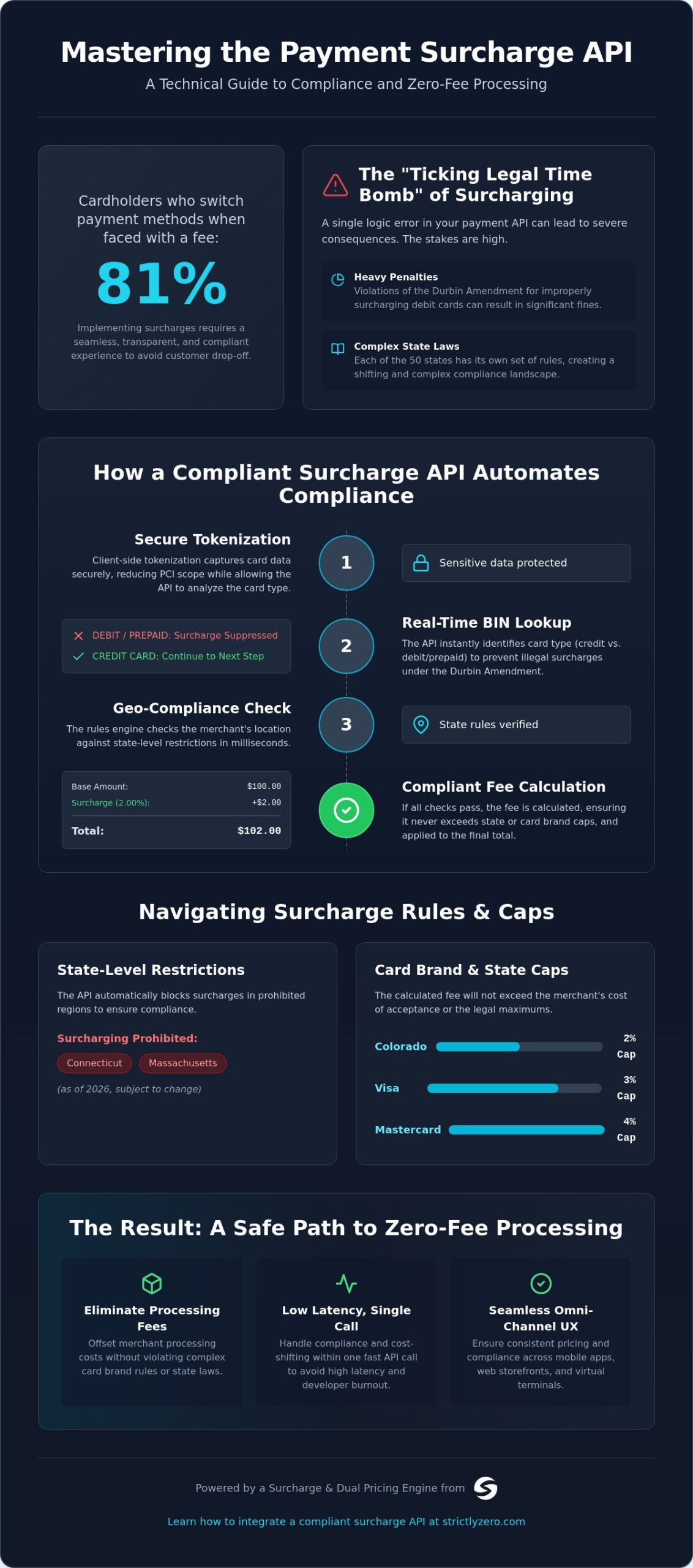
What if your automated “zero-fee” processing logic is actually a ticking legal time bomb? With 81% of cardholders switching payment methods when faced with a fee, implementing a payment API with surcharge requires more than just adding a line item to a checkout session. You’re likely already feeling the pressure of managing 50 different sets of state laws while trying to avoid the illegal practice of surcharging debit cards. It’s a high-stakes balancing act where a single logic error could lead to heavy penalties under the Durbin Amendment or card brand violations.
We know that maintaining complex real-time calculations for shifting caps, like Visa’s 3% limit or Colorado’s 2% restriction, often leads to high API latency and developer burnout. This guide will show you how to master a technical integration that handles compliance and cost-shifting within a single, low-latency call. You’ll learn how to automate card-type detection, stay ahead of 2026 regulatory updates, and finally eliminate processing fees for your platform without the manual overhead.
Key Takeaways
- Learn how a RESTful interface uses real-time BIN lookups and a geo-compliance engine to automate fee application at the point of sale.
- Master the technical steps to integrate a payment API with surcharge that distinguishes between credit and debit cards to ensure compliance with the Durbin Amendment.
- Discover the streamlined workflow for setting up a developer sandbox and deploying secure client-side tokenization to protect sensitive card data.
- Understand how to programmatically navigate state-specific restrictions to prevent illegal surcharging in prohibited regions like Connecticut and Massachusetts.
- Explore how leveraging a surcharge and dual pricing engine can eliminate merchant processing fees while maintaining a seamless omni-channel payment experience.
Table of Contents
- What is a Payment API with Surcharge and How Does it Work?
- Core Features of a Compliant Surcharge API
- Step-by-Step: Integrating the Surcharge API into Your Checkout
- Solving the 'Debit Card Problem' and State Restrictions
- Why Strictly is the Ultimate API for Modern Merchants and ISOs
What is a Payment API with Surcharge and How Does it Work?
A payment API with surcharge isn’t just a simple data pipe for moving money. It’s a RESTful interface designed to programmatically apply credit card fees to a transaction total before the final authorization occurs. While a standard payment gateway simply accepts card data and returns a success or failure message, a surcharge-capable API functions as an intelligence layer. It evaluates the transaction in real time to determine if a fee is legally and contractually permitted.
Understanding the basic concept of a Surcharge (payment systems) is the first step for any developer. The core difference lies in the integration of a Surcharge & Dual Pricing Engine. This engine automates the decision-making process, ensuring that the merchant offsets their processing costs without violating complex card brand rules or state-level legislation.
To better understand how these fees impact global and local transactions, watch this helpful video:
The logic relies on a rapid “handshake” between several components. When a customer enters their card details, the system immediately performs a BIN (Bank Identification Number) lookup. This identifies the card type, which is critical because surcharging debit cards is illegal under the Durbin Amendment. Simultaneously, the state rules engine checks the merchant’s location to ensure they aren’t operating in a prohibited state like Connecticut or Massachusetts. Only after these checks pass does the gateway calculate the specific fee and update the transaction total.
The Mechanics of a Surcharge-Capable Transaction
- Step 1: Tokenization. You must implement client-side tokenization to capture card data securely. This keeps sensitive information out of your servers and reduces your PCI scope while allowing the payment API with surcharge to analyze the card type.
- Step 2: BIN Identification. The API performs a real-time lookup to distinguish between credit and debit cards. If the system detects a debit or prepaid card, the surcharge is automatically suppressed to maintain compliance.
- Step 3: Compliant Calculation. The engine calculates the fee based on the merchant’s specific cost of acceptance. It ensures the charge stays under the 3% Visa cap or the 4% Mastercard limit while adjusting for state-specific restrictions, such as Colorado’s 2% cap.
Why API-First Surcharging is the Gold Standard
Integrating this logic directly into your code eliminates the high risk of manual entry errors at the point of sale. Developers can create a seamless checkout experience where the surcharge appears as a clear line item, meeting transparency requirements without adding friction to the user journey. By using an API-first approach, you ensure consistent pricing and compliance across all channels, whether the payment happens on a mobile app, a web storefront, or through a virtual terminal. For businesses looking to grow their digital presence, you can visit ROVEXO to explore a marketplace that simplifies buying and selling across a wide range of products. This programmatic control is the only way to scale a zero-fee processing model safely in 2026.
Core Features of a Compliant Surcharge API
To build a reliable payment API with surcharge, you need more than just a static field to hold a fee amount. You need a dynamic logic engine that acts as a gatekeeper. Unlike some platforms that require merchants to manually set fee percentages, a high-performance API automates the entire decision tree to protect you from network fines and legal challenges. This automation is what separates a basic data pipe from a true compliance-as-a-service solution.
Automated BIN detection is your first line of defense. The API must instantly recognize the difference between a credit card and a debit card. Because surcharging debit cards is prohibited nationwide under the Durbin Amendment, the system must suppress the fee the moment a debit or prepaid BIN is identified. This check happens in milliseconds, ensuring that the user experience remains fast while your platform stays on the right side of federal law.
Geography adds another layer of complexity. As of 2026, states like Connecticut, Maine, and Massachusetts, along with Puerto Rico, prohibit credit card surcharges entirely. A compliant API uses the merchant’s business address to check against state-by-state surcharge laws. In Colorado, for instance, the engine must cap the fee at 2% or the actual processing cost, whichever is lower. This real-time adjustment is critical for businesses operating across state lines.
Real-Time Card Brand Identification
Card brands have strict, varying requirements that can change without much notice. Visa currently caps surcharges at 3%, while Mastercard allows up to 4%. If you accept both, the lower cap usually dictates the rule for your platform to ensure you don’t overcharge. Real-time identification ensures your payment API with surcharge adjusts these values dynamically based on the specific card brand presented at checkout. This isn’t just about compliance. It’s about avoiding the “junk fee” labels that regulators and consumers are increasingly scrutinizing in 2026.
Compliance-as-a-Service
Laws are constantly evolving. In early 2026, several states updated their disclosure requirements for point-of-sale and online transactions. A robust API shouldn’t just calculate the fee. It should provide the exact disclosure text in the response payload. This allows you to display the required legal notices at the point of entry and the point of sale automatically. Maintaining a digital audit trail of these disclosures is vital for defending against potential disputes. Using a single API key to manage both ecommerce payment processing and in-person virtual terminal flows ensures your accounting stays clean. If you’re ready to automate this complexity, exploring a Surcharge & Dual Pricing Engine is the most efficient way to scale safely.
Step-by-Step: Integrating the Surcharge API into Your Checkout
Setting up a sandbox environment isn’t just a formality; it’s where you’ll map the logic that protects your business from non-compliance fines. A modern payment API with surcharge provides a testing ground that mirrors real-world 2026 regulations. This allows you to simulate transactions from different states and with various card types without moving actual funds. By the time you move to production, your integration should be a hardened, fail-safe system.
Setting Up the Sandbox and Authentication
Your first step is generating API logins and application keys through the merchant dashboard. For the 2026 environment, security is paramount. You’ll need to white-list your production and test server IP addresses to prevent unauthorized access. All communication must happen over TLS 1.2 or higher. This ensures that the handshake between your checkout page and the gateway remains encrypted, meeting the latest industry standards for data protection.
Once authenticated, you’ll implement the client-side tokenization script. This script is vital because it captures sensitive card data directly from the user’s browser, returning a secure token to your server. This process keeps raw card numbers off your infrastructure, significantly reducing your PCI scope. After tokenization, your backend executes a POST request to the surcharge endpoint. This request includes the base transaction amount and the card token, triggering the engine to calculate the appropriate fee dynamically.
Handling the Response and Displaying Fees
The JSON response from the API provides the specific fields you need to update your UI. You’ll typically map surcharge_amount and total_amount to your checkout summary. Transparency isn’t just a best practice; it’s a legal requirement. You must display the fee clearly to the customer before they click the final authorization button. If the API detects a card from a region with restrictive state credit card surcharge laws, it will return a zero-fee response or a specific error code. Your code should handle this gracefully by defaulting to a standard payment flow.
Error handling is where many developers struggle. If a BIN lookup fails or a state restriction is triggered, your system shouldn’t crash. Instead, it should log the event and proceed with a non-surcharged transaction to ensure you don’t lose the sale. Finally, configure webhooks to receive real-time updates on transaction status and settlement. This ensures your database stays in sync with the gateway’s ledger without constant polling. If you’re looking for a platform that simplifies these complex workflows, exploring a fully managed surcharge engine can save your team months of development time.
Solving the ‘Debit Card Problem’ and State Restrictions
The biggest technical hurdle in any surcharge integration is the Durbin Amendment. This federal regulation makes it illegal to surcharge debit cards, regardless of whether they are processed as “debit” or “credit” at the terminal. If your payment API with surcharge fails to distinguish between a credit card and a debit card, your platform is immediately non-compliant. This isn’t just a minor oversight. It’s a high-risk violation that can lead to massive fines from card brands and federal regulators.
Beyond federal laws, your code must account for the complex 2026 state-level landscape. As of April 2026, states like Connecticut, Maine, and Massachusetts, along with Puerto Rico, maintain strict bans on credit card surcharging. In these jurisdictions, your API logic must identify the merchant’s location and automatically suppress the fee. For transactions involving tax-exempt organizations, your system should also prevent “double-dipping” by ensuring no additional fees are layered onto a tax-free total, maintaining clean accounting and legal standing.
The Technical Mechanism of BIN Filtering
To solve the debit card problem, your integration must use Bank Identification Number (BIN) filtering. The BIN consists of the first six to eight digits of a card. It contains the data necessary to identify the card’s funding source. A static list of BINs is no longer sufficient for modern development. Because card brands issue new BIN ranges almost daily, your API needs access to a cloud-updated database that refreshes in real time. The Smart Pricing Engine from Strictly automates this filtering by instantly matching card data against a global BIN database to suppress fees on all debit transactions. This ensures that only eligible credit cards are ever surcharged, keeping your platform safe from Durbin Amendment violations.
Managing State-by-State Legal Logic
Coding for geographic restrictions requires a robust conditional logic block within your checkout flow. If the merchant’s zip code falls within a restricted state, the API should return a response that pivots the transaction model. In these scenarios, many developers choose to pivot from surcharging to zero fee credit card processing via dual pricing. Dual pricing is legal in all 50 states because it offers a “cash price” and a “card price” rather than adding a penalty fee at the end. This fallback logic ensures that your merchant can still offset costs without breaking local laws.
Transparency is the final piece of the puzzle. Federal and state laws require clear disclosure at the point of entry and the point of sale. Your payment API with surcharge should provide the specific data needed to generate a compliant receipt. This receipt must show the base price, the surcharge amount as a separate line item, and the final total. If you’re using a virtual terminal, the messaging must be presented before the payment is finalized. If you want to eliminate the headache of managing these shifting regulations manually, you can implement a Surcharge & Dual Pricing Engine to handle the heavy lifting for you.
Why Strictly is the Ultimate API for Modern Merchants and ISOs
Strictly’s architecture is built specifically for the developer who needs a robust payment API with surcharge that can be dropped into any custom SaaS platform. Most processors offer surcharge features as an afterthought, often as a static field that requires manual oversight. We built ours from the ground up as an intelligence layer. The Smart Pricing Engine doesn’t just calculate a fee. It automates the entire compliance cycle we’ve explored in this guide. This means your platform can offer zero-fee processing without your team having to write thousands of lines of conditional logic for state-level bans or BIN detection.
Scaling with Partner-First Infrastructure
Retention is just as critical as acquisition in a competitive market. ChurnIQ™ uses AI-driven intelligence to monitor merchant behavior and identify accounts at risk of leaving before they actually cancel. If you’re building a platform that wants to offer “Zero-Fee” processing as a flagship feature, our white-labeling opportunities allow you to brand the experience as your own. This makes Strictly the payment processing platform for ISOs who want to scale aggressively through 2026 and beyond.
Future-Proofing Your Payments Strategy
The regulatory landscape is moving fast. Our payment API with surcharge is designed to adapt to the 2026 PCI DSS requirements automatically. You won’t need to re-engineer your checkout flow every time a new data security standard is released. We handle the heavy lifting of encryption and tokenization at the gateway level, keeping your infrastructure out of the line of fire for audits.
The true power of this integration is its omni-channel unity. You get a single API key that manages web storefronts, mobile apps, and virtual terminal flows. This creates a single source of truth for your data, making reconciliation simple for your accounting team. Whether you’re an independent developer or a massive payment organization, the path to zero-fee processing is through automation. It’s time to Partner with Strictly to scale your payments business and leave the complexity of manual compliance behind.
Future-Proof Your Platform with Automated Surcharge Compliance
Building a compliant payment infrastructure doesn’t have to be a manual burden for your engineering team. By mastering the integration of a payment API with surcharge, you’ve moved beyond simple payment pipes to a sophisticated intelligence layer. You now know how to automate BIN detection to protect against illegal debit surcharging and navigate the shifting landscape of state-level restrictions in 2026. These technical safeguards are the only way to scale a zero-fee processing model while maintaining total transparency for your customers.
Strictly provides the tools you need to turn these complex requirements into a competitive advantage. Our Smart Pricing Engine handles real-time state compliance automatically, while ClearSplit™ simplifies residual management for ISOs and partners. With AI-driven ChurnIQ™ working to keep your merchants active and profitable, you can focus on growth instead of maintenance. Start building your zero-fee payment experience with Strictly’s API today. The era of manual fee management is over, and your platform is ready to lead the way.
Frequently Asked Questions
Is it legal to use a payment API with surcharge in all 50 states?
No, credit card surcharges are currently prohibited in Connecticut, Maine, and Massachusetts. Puerto Rico also maintains a ban as of April 2026. Other states have specific restrictions; for instance, Colorado limits surcharges to 2% or the actual processing cost. A compliant payment API with surcharge automatically detects the merchant’s location to suppress fees in jurisdictions where they aren’t legally permitted.
How does the API distinguish between a credit card and a debit card?
The API uses a real-time Bank Identification Number (BIN) lookup to identify the card type instantly. By checking the first six to eight digits of the card, the system determines if it’s a credit, debit, or prepaid card. This check is vital because surcharging debit cards is illegal nationwide. If a debit card is detected, the engine automatically removes the fee before authorization occurs.
What is the maximum surcharge percentage allowed by card networks in 2026?
Visa currently caps credit card surcharges at 3% of the total transaction amount. While Mastercard allows up to 4%, most merchants stick to a 3% limit to stay consistent across all card networks. You must also ensure the surcharge doesn’t exceed your actual cost of processing. States like New York and New Jersey strictly limit the fee to the merchant’s exact cost of acceptance.
Do I need a separate merchant account to use a surcharge API?
You can typically use your existing merchant account as long as it’s registered for a surcharge program. You’re required to notify your acquirer and the card brands at least 30 days before you begin. Using a payment API with surcharge simplifies this process by ensuring your transaction data is formatted correctly for card brand audits. It’s a matter of configuration rather than opening new banking services.
How does surcharging impact my PCI compliance scope?
Integrating an API-first surcharge solution helps minimize your PCI scope through client-side tokenization. Because sensitive cardholder data is captured by the gateway’s secure script rather than your servers, you avoid handling raw card numbers. The API calculates the fee and processes the transaction using secure tokens. This setup allows you to meet PCI DSS requirements more easily while automating complex compliance logic.
Can I apply a surcharge to phone or mail orders using a virtual terminal?
Yes, surcharging is supported for phone and mail orders through a virtual terminal interface. The same federal and state regulations apply to these card-not-present transactions. You must verbally disclose the fee to the customer and ensure the card isn’t a debit card. The virtual terminal typically handles the BIN lookup and disclosure messaging for you to maintain compliance during the checkout process.
What happens if a customer disputes a surcharge fee (chargeback)?
If a customer disputes a surcharge, the burden of proof is on the merchant to show they followed all transparency rules. You’ll need to provide a receipt showing the surcharge as a distinct line item separate from the subtotal. Having a digital audit trail of the customer’s notice or opt-in at the point of sale is the best defense against these types of disputes.
How quickly can I integrate the Strictly surcharge API into my platform?
Most development teams can move from a sandbox environment to production in just a few days. Since the core logic for BIN detection and geographic restrictions is already built into our engine, you won’t spend weeks coding complex compliance rules. We provide the documentation and API keys needed to get your test environment live quickly, allowing you to focus on your platform’s user experience.