
How to Lower Clover Fees: 2026 Guide to $0 Costs
Published:

You are likely paying a “Clover Tax” that is quietly draining thousands of dollars from your bottom line every single year. Between the 3.5% fees for keyed-in transactions and the rigid 36-month contracts, it’s easy to feel like your processor is a partner in your profits rather than a tool for your growth. If you’ve been searching for how to lower clover processing fees, you’ve probably realized that the sleek hardware comes with a heavy price tag. You deserve a payment structure that doesn’t hide behind confusing monthly statements or lock you into expensive proprietary setups.
We understand the frustration of seeing your margins shrink while you’re stuck in a long-term commitment with high early termination fees. This 2026 guide reveals the exact strategies to reduce your merchant costs and discover how to eliminate processing fees entirely using a compliant zero-fee model. We’ll walk you through the transition to a dual pricing engine that legally passes transaction costs to customers. You’ll learn how to reclaim your revenue with transparent pricing and tech-forward alternatives that prioritize your bottom line over legacy fee structures.
Key Takeaways
- Identify the hidden “Clover Tax” by auditing your software plans and reseller markups that often inflate your monthly effective rate.
- Discover how a dual pricing engine allows you to legally pass transaction costs to customers, effectively reaching a zero-fee processing model.
- Learn exactly how to lower clover processing fees by utilizing virtual terminals and payment links to bypass expensive, proprietary hardware leases.
- Compare legacy hardware bundles with tech-forward omni-channel platforms to find a solution that scales without high monthly overhead.
- Check your current contract for early termination fees to plan a strategic and profitable transition to a more transparent processing partner.
Table of Contents
- Understanding the "Clover Tax": Why Your Processing Fees Are So High
- The Zero-Fee Revolution: Lowering Costs by Eliminating Them
- Clover vs. Strictly: A 2026 Side-by-Side Comparison
- Beyond Hardware: Reducing Fees with Virtual Terminals
- How to Transition from Clover to a Zero-Fee Model
Understanding the “Clover Tax”: Why Your Processing Fees Are So High
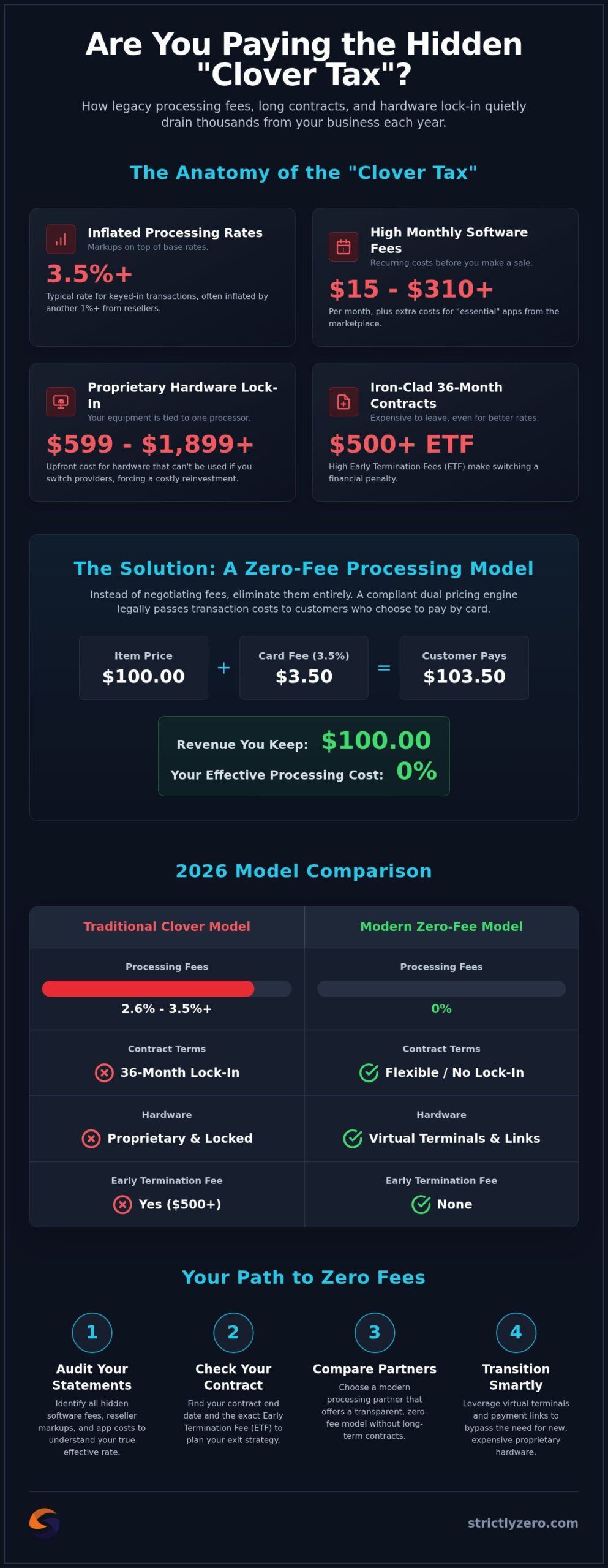
Many merchants choose Clover for its sleek design and user-friendly interface, only to find themselves drowning in what’s colloquially known as the “Clover Tax.” This isn’t just one fee; it’s a stack of costs that includes software subscriptions, transaction markups, and hardware leases. If you’re wondering how to lower clover processing fees, the first step is identifying where the leakage happens. Clover software plans range from $14.95 for a basic virtual terminal to over $310 per month for advanced restaurant systems. These recurring costs exist before you even process your first dollar in sales.
Beyond the monthly software bill, your effective rate is often inflated by reseller markups. While Clover’s base rates for retail start at 2.6% + $0.10, purchasing through a bank or independent reseller can add 1% or more to that total. Flat-rate pricing might seem simple, but for a business doing high volume, it’s often the most expensive option. As your sales grow, the lack of transparency means you’re overpaying on every single swipe compared to more modern, flexible models.
To better understand this concept, watch this helpful video:
The Rising Cost of Traditional Merchant Services
As we move through 2026, the landscape of credit card processing for small business has shifted toward more complex fee structures. A major driver of this is the steady rise in interchange fees set by card networks, which processors often pass on with an additional margin. There is also the issue of “App Marketplace Creep.” While the Clover App Market offers great functionality, many of those “essential” apps come with their own monthly subscriptions, quietly ballooning your overhead until your POS system costs as much as a small employee’s salary.
Proprietary Hardware: A Costly Anchor
Clover hardware is beautiful, but it’s also a closed ecosystem. When you buy a Clover Station Duo for $1,899 or a Flex for $599, that device is locked to the specific processor you bought it from. This hardware lock-in is a strategic move that makes it incredibly difficult to shop for better rates elsewhere. If you want to switch to more transparent credit card processing services, you often have to scrap your expensive equipment and start over.
Most Clover agreements also include a 36-month contract with early termination fees that average $500 or more. When you add in mandatory “protection” or maintenance fees bundled into hardware leases, the total cost of ownership can be double the initial sticker price. Understanding these layers is vital for any merchant looking for how to lower clover processing fees and regain control over their profit margins.
The Zero-Fee Revolution: Lowering Costs by Eliminating Them
Most business owners spend hours on the phone with support reps asking how to lower clover processing fees. Usually, you’re offered a tiny reduction that barely makes a dent in your monthly statement. The real revolution in 2026 isn’t about negotiating for pennies; it’s about eliminating the expense entirely through surcharging. By shifting the transaction cost to the cardholder, you can keep 100% of your sticker price. This model has become the standard for high-margin small businesses that are tired of seeing their profits eroded by bank fees.
Understanding the math behind these costs is the first step toward financial freedom. You can find a comprehensive guide to processing fees that breaks down why traditional models are so expensive. Instead of absorbing those costs, a zero-fee model uses a Smart Pricing Engine to manage the math for you. It’s a tech-forward approach that turns a variable expense into a predictable, zero-dollar line item on your ledger. This shift is why so many merchants are moving away from legacy processors that profit from every swipe.
Surcharging vs. Dual Pricing: Finding Your Balance
The way you present these costs matters for customer satisfaction. Surcharging adds a small percentage to the total at checkout, while dual pricing shows two distinct prices: one for cash and one for credit. Dual pricing is often viewed more favorably because it offers the customer a choice and a “discount” for paying cash. Both methods result in zero fee credit card processing for the merchant. Strictly’s platform automates the detection of debit cards, which is crucial because surcharging debit cards is illegal under federal law. This automation ensures you never accidentally violate network rules while trying to save money. If you’re ready to stop paying for your customers’ rewards points, you might want to explore a more modern pricing strategy.
Automated Compliance in 2026
Navigating the legal landscape of surcharging is a major hurdle for many. In 2026, states like Connecticut, Massachusetts, and Maine still prohibit surcharging, while Colorado maintains a 2% cap. If you operate across state lines or in a restricted area, manual compliance is a nightmare. Our Smart Pricing Engine solves this by automatically adjusting rules based on your physical or digital location. This system handles debit card exclusions by instantly identifying the card type and removing the surcharge before the transaction completes. This level of precision protects you from heavy fines and ensures your business stays on the right side of the law without you having to become a legal expert.
Clover vs. Strictly: A 2026 Side-by-Side Comparison
Choosing between Clover and Strictly isn’t just about the hardware on your counter; it’s about how much of your revenue you actually keep at the end of the month. Clover is a legacy giant that excels if you need specific, heavy-duty hardware bundles for a high-traffic restaurant or retail floor. However, if you’re investigating how to lower clover processing fees, you’ve likely noticed that the sleek equipment acts as a gateway to high swipe costs. Strictly positions itself as the tech-forward alternative, focusing on profit preservation through a zero-fee model and omni-channel flexibility.
When you run the “Hidden Fee” test, the differences become stark. Clover users often face layered costs like PCI compliance fees, statement fees, and “protection” plans that can add $20 to $50 to your monthly bill before you process a single card. This Forbes report explains the impact of swipe fees and how they compound over time. For businesses looking to scale, Strictly is often the best credit card processing for small business because it eliminates the variable cost of processing. As your volume increases, your savings grow exponentially rather than your fees.
The Real Math: Percentage vs. Zero
Let’s look at a typical merchant processing $10,000 in monthly volume. On a standard Clover retail plan, you’re likely paying 2.6% + $0.10 per transaction. This equals roughly $260 in percentage fees plus another $30 to $50 in per-transaction costs, software fees, and statement fees. Your total monthly cost could easily exceed $300. With Strictly’s zero-fee model, that $10,000 in sales results in zero dollars in processing fees. Even when you factor in platform access, the savings are massive. This avoids the “effective rate” trap where hidden markups make your real cost much higher than the quoted 2.6%.
Omni-Channel Capabilities
Modern businesses don’t just sell in person. While Clover Go offers a basic mobile solution, it lacks the deep integration needed for complex digital growth. Strictly provides robust ecommerce payment processing tools and an API-first platform that connects your website, mobile sales, and virtual terminal into one unified dashboard. You aren’t tethered to proprietary hardware to get the best rates. Additionally, Strictly includes advanced tools like ChurnIQ™ for predicting customer behavior, giving you data-driven insights that go far beyond what a traditional POS provides. This allows you to manage your entire payment ecosystem without the “Clover Tax” weighing you down.
Beyond Hardware: Reducing Fees with Virtual Terminals
A major profit killer in the legacy ecosystem is the 3.5% + $0.10 fee for keyed-in transactions. You can bypass this penalty by using secure payment links sent via text or email. When customers enter their own card details into a secure portal, the transaction is treated as a secure online payment rather than a high-risk manual entry. Our surcharge engine then applies the transaction cost to the buyer, bringing your cost to zero. This hardware-free approach is reinforced by AI-driven fraud prevention, which analyzes transaction patterns in real time to block suspicious activity before it hits your ledger.
If you’re ready to stop paying for expensive equipment leases, you can get started with a hardware-free virtual terminal today.
Virtual Gateways and Recurring Billing
For service-based businesses or B2B operations, cloud-based gateways provide a level of stability that a standard counter-top POS cannot match. Strictly’s platform utilizes robust, secure gateway integrations to manage complex payment flows. You can easily set up recurring billing cycles to stabilize your monthly cash flow without manually invoicing every client. This is particularly valuable for office-based businesses that need to collect professional fees or subscription dues. By moving these payments to a virtual environment, you eliminate the need for physical card readers and the maintenance fees that come with them.
Data Intelligence as a Saving Tool
Reducing costs isn’t just about transaction fees; it’s about operational efficiency. Our platform includes ChurnIQ™, a data intelligence tool that helps you identify and retain your most profitable customers by predicting behavior patterns. This prevents revenue loss from customer attrition. For businesses with partners or multiple stakeholders, ClearSplit™ automates partner payouts, removing the need for manual accounting and reducing the risk of human error. All transaction data can be exported directly into your accounting software, ensuring that your books remain accurate while you focus on growing your business without the weight of unnecessary overhead.
How to Transition from Clover to a Zero-Fee Model
Switching processors doesn’t have to be the logistical nightmare that legacy providers claim it is. While you’ve likely spent months looking for ways on how to lower clover processing fees, the most sustainable path is a clean break to a zero-fee structure. This transition is a five-step process designed to protect your cash flow and ensure your customers feel valued throughout the change. By moving away from a system that profits from your volume, you reclaim control over your margins.
- Step 1: Audit your current statement. Look for “fee leakage” in your latest Clover report. Identify the exact amount spent on software subscriptions, app marketplace fees, and transaction markups to see your true potential savings.
- Step 2: Check your contract status. Most Clover agreements carry a 36-month term. Confirm your end date and be prepared for an early termination fee, which averages $500 in 2026. Often, the savings from a zero-fee model will cover this cost in just a few months.
- Step 3: Configure your new engine. Set up your Strictly account and activate the Smart Pricing Engine. This ensures your surcharging or dual pricing remains compliant with 2026 state regulations automatically.
- Step 4: Train your team. Your staff needs to feel comfortable explaining the “Cash vs. Credit” choice. Focus on the value: customers who pay cash save money, while those who use credit continue to enjoy their rewards.
- Step 5: Process in parallel. Run your new system alongside your Clover account for 48 hours. This ensures everything is working perfectly before you officially close the old account.
Minimizing the Friction of Switching
Leaving a provider often triggers a call from a retention department promising temporary discounts. Don’t fall for short-term fixes that don’t address the underlying fee structure. Strictly’s onboarding team assists with your data migration to make the move seamless. In 2026, new accounts typically receive an approval window within 24 hours, meaning you can start saving almost immediately. We handle the technical heavy lifting so you don’t experience the downtime that legacy processors often use as a scare tactic.
Customer Communication Templates
Transparency is the foundation of brand trust. When explaining the new model, use a simple script: “To keep our prices low and avoid a general price increase, we now offer a cash discount. The price you see on the tag is our cash price, while credit card transactions include a small processing fee.” This approach shifts the narrative from a “penalty” to a “choice.” Most customers understand that processing costs are a reality of doing business. You can eliminate your processing fees today with Strictly and start reinvesting that “Clover Tax” back into your company’s growth.
Reclaim Your Revenue and Eliminate the Clover Tax
Staying with a legacy processor out of habit is one of the most expensive mistakes a business can make in 2026. You’ve seen the breakdown of software plans, hardware lock-ins, and the hidden markups that inflate your monthly bill. While many merchants search for how to lower clover processing fees by negotiating small percentage drops, the real breakthrough lies in eliminating those fees entirely. By adopting a zero-fee model, you turn a major overhead expense into a source of pure profit without sacrificing the customer experience.
The transition to a more transparent platform is seamless and secure. Strictly offers a solution that is compliant in all 50 states and includes AI-driven fraud prevention to protect every transaction. Best of all, there is no proprietary hardware required; you can stop paying for equipment you don’t actually need. It’s time to stop letting your processor take a cut of your hard-earned growth and start keeping 100% of your sales price. Start saving today with Strictly’s Zero-Fee processing and take the first step toward a more profitable future for your business.
Frequently Asked Questions
Is it legal to pass credit card fees to customers in 2026?
Yes, it is legal in all 50 states when implemented as a cash discount or dual pricing program. While states like Connecticut and Massachusetts still prohibit surcharging, these alternative models provide a compliant way to offset your costs. You must follow specific card network rules from Visa and Mastercard, which include providing clear signage at the point of sale and detailed disclosures on every customer receipt.
How much can I save by switching from Clover to Strictly?
Merchants typically save their entire processing percentage, which often ranges from 2.6% to 3.5% of their total sales volume. By learning how to lower clover processing fees through a zero-fee model, you eliminate the variable monthly expense that grows as your business scales. This allows you to retain 100% of your sticker price on every credit card transaction you process throughout the year.
What is the “Smart Pricing Engine” and how does it help?
The Smart Pricing Engine is an automated tool that ensures your business remains compliant with shifting state and federal regulations. It identifies the card type in real time and automatically applies or removes fees based on local laws and card network rules. This technology removes the manual guesswork and protects your business from potential fines associated with surcharging errors or improper debit card handling.
Can I keep my Clover hardware and use Strictly?
Does a surcharge program apply to debit card transactions?
No, federal law prohibits surcharging on debit and prepaid cards, even if the customer chooses to process them as “credit” at the terminal. Our platform automatically detects debit cards during the transaction and ensures no surcharge is applied, keeping your business fully compliant. To offset costs on these specific transactions, many merchants choose a dual pricing model that offers a clear discount for cash payments.
How do I handle the 36-month Clover contract if I want to switch?
You should first review your merchant agreement to confirm your early termination fee, which averages $500 in 2026. Many business owners find that the monthly savings from a zero-fee model cover this exit cost in just a few months. It’s best to have your new account active and tested before notifying Clover’s retention department of your intent to cancel your current service.
How long does it take to get approved for a zero-fee merchant account?
Most new accounts in 2026 receive an approval decision within 24 hours of submitting a completed digital application. Our onboarding team focuses on a fast, tech-forward process to minimize any potential downtime for your business. Once approved, you can immediately begin using virtual terminals and payment links to understand how to lower clover processing fees by transitioning your sales volume to our platform.
What happens if a customer disputes a charge on a surcharge program?
The dispute process remains the same as a traditional transaction, but your financial risk is lower because you haven’t lost the processing fee on top of the sale. Our platform includes AI-driven fraud prevention to help block suspicious transactions before they turn into expensive chargebacks. If a dispute does occur, our system provides comprehensive transaction data to help you respond to the card issuer effectively.