
How to Notify Customers of a Surcharge: A 2026 Compliance Guide
Published:

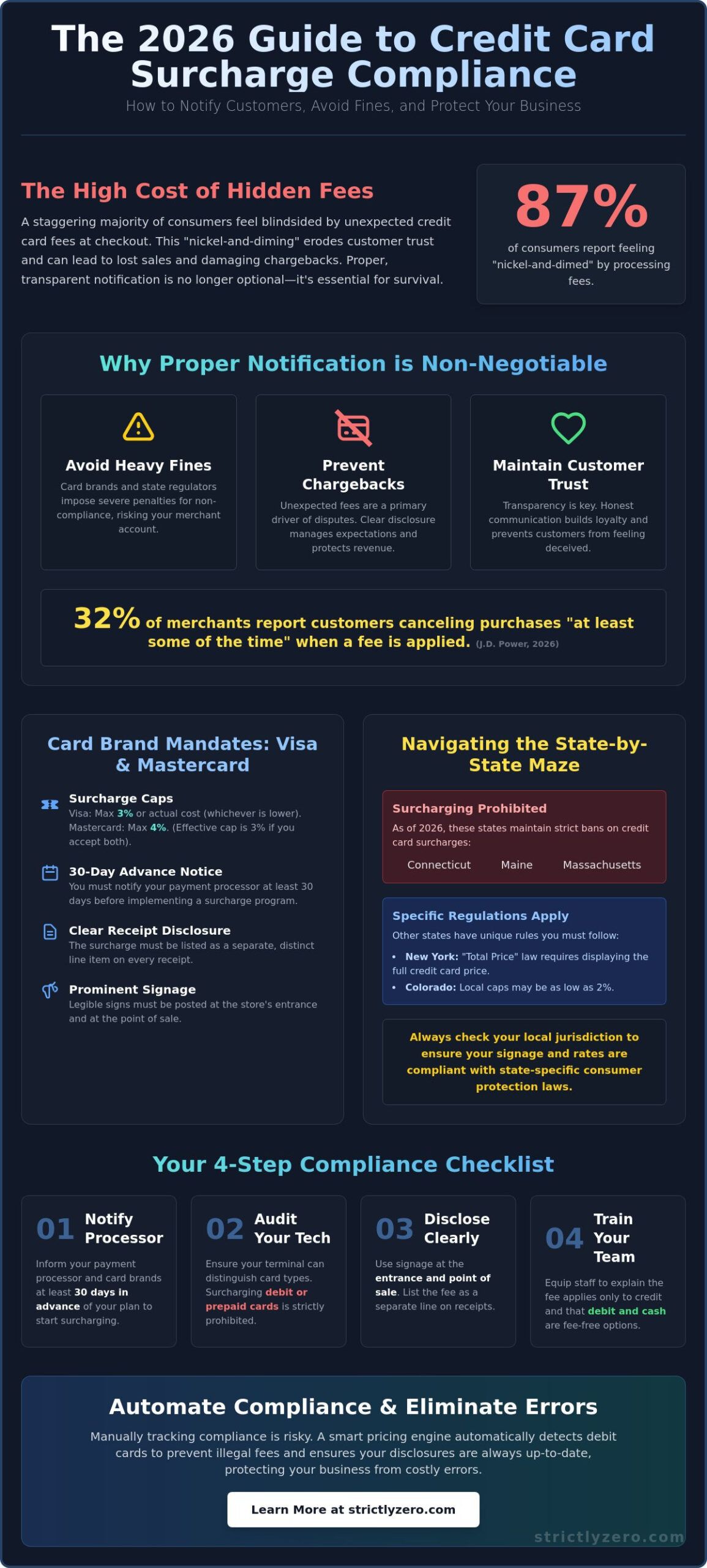
A staggering 87% of consumers report feeling “nickel-and-dimed” when they encounter a credit card processing fee at checkout. This is exactly why knowing how to notify customers of a surcharge is the most critical part of your payment strategy. You want to protect your bottom line, but you don’t want to lose the hard-earned trust of your loyal clientele or face a hefty PCI non-compliance fine.
Mastering these notifications doesn’t have to be a gamble with your brand’s reputation. This 2026 compliance guide will help you navigate legal requirements and best practices to eliminate processing fees while keeping your customers happy. We’ll walk through the current state-specific bans, provide a checklist for legal signage, and show you how to automate the entire process so you can focus on your business instead of worrying about the fine print.
Key Takeaways
- Understand the mandatory 30-day processor notification rule and the card brand standards that keep your business compliant.
- Learn exactly how to notify customers of a surcharge at every touchpoint, from physical entry points to digital checkout screens.
- Access professional wording templates that explain fees transparently to minimize customer friction and “fee fatigue.”
- Compare disclosure requirements for surcharging versus dual pricing to see which model offers the best transparency for your brand.
- Discover how a surcharge and dual pricing engine can automate debit card detection to prevent illegal fees and costly compliance errors.
Table of Contents
- Why Proper Surcharge Notification is Mandatory in 2026
- Step-by-Step: How to Notify Customers of a Surcharge
- Surcharge Wording and Templates for 2026
- Surcharging vs. Dual Pricing: Notification Differences
- Automating Compliance with a Smart Pricing Engine
Why Proper Surcharge Notification is Mandatory in 2026
In 2026, passing on credit card processing costs isn’t just a business decision; it’s a strictly regulated legal process. Understanding the historical and legal context of a Surcharge (payment systems) is the only way to protect your merchant account. Failure to follow these protocols doesn’t just annoy shoppers; it invites heavy fines from card brands and potential legal action from state regulators. If you’re wondering how to notify customers of a surcharge, you must start with the premise that transparency is your best defense against chargebacks.
To better understand this concept, watch this helpful video:
The regulatory landscape has shifted significantly since the Durbin Amendment first targeted interchange fees. Today, federal and state courts have clarified that while you have the right to surcharge, you don’t have the right to hide it. When a customer sees an unexpected fee on their statement, they’re far more likely to dispute the transaction. These disputes often lead to account suspension or higher processing rates. Clear notification manages expectations before the customer reaches for their wallet, which is vital since a 2026 J.D. Power study found that 32% of merchants report customers canceling purchases “at least some of the time” when a fee is applied.
Card Brand Rules: Visa and Mastercard Requirements
Visa and Mastercard have set clear boundaries for 2026. You’re required to provide your payment processor with at least 30 days’ notice before you begin any surcharging program. For Visa, the maximum surcharge is capped at 3% of the transaction or your actual cost of acceptance, whichever is lower. Mastercard allows up to 4%, but if you accept both brands, you’re effectively limited to the 3% Visa cap. Every receipt must show the surcharge as a distinct line item, and signage must be placed at the point of entry and the point of sale in a font size that’s easily legible.
State-Level Legal Nuances
Compliance isn’t a one-size-fits-all map. As of 2026, states like Connecticut, Maine, and Massachusetts maintain strict prohibitions on credit card surcharges. In New York, the “Total Price” law requires businesses to display the full credit card price alongside any cash discounts, making “adequate disclosure” a moving target depending on where you operate. Even in states where surcharging is legal, such as Colorado, you may face local caps as low as 2%. Learning how to notify customers of a surcharge requires checking your local jurisdiction to ensure your signage doesn’t accidentally violate state-specific consumer protection laws.
Step-by-Step: How to Notify Customers of a Surcharge
Implementing a new fee without a clear roadmap is a recipe for customer friction and legal trouble. Successfully mastering how to notify customers of a surcharge requires a multi-layered approach that starts long before the first transaction. You must first notify your payment processor at least 30 days in advance. Once that technical hurdle is cleared, your focus should shift to the customer experience and ensuring every touchpoint meets card brand standards.
Follow these steps to ensure a compliant rollout:
- Audit your hardware: Ensure your terminal can distinguish between credit and debit cards. Surcharging debit or prepaid cards is strictly prohibited and can lead to massive fines.
- Draft your language: Use neutral, professional wording. Avoid sounding defensive or greedy; instead, focus on transparency regarding the cost of credit card acceptance.
- Update receipt templates: The surcharge must appear as a separate line item. It cannot be bundled into the total price or hidden in tax calculations.
- Train your team: Your staff are on the front lines. They should be prepared to explain that the fee only applies to credit cards and that cash or debit remains a fee-free option.
To formalize this process and maintain proof of regulatory knowledge, businesses can use Certifada to issue and verify digital certificates for employees who complete their compliance training.
Because some merchants worry about the potential business impact of surcharges, it’s vital to use a Surcharge & Dual Pricing Engine that automates these disclosures and ensures you never accidentally charge a debit card user.
Physical Storefront Requirements
In a brick-and-mortar setting, the law requires “prominent” disclosure. This means placing signage at your entrance so customers aren’t surprised at the register. A second sign must be visible at the point of sale. These signs should be at eye level and use a font size that’s easily readable from several feet away. The goal is to set expectations early, reducing the 32% chance that a customer might abandon their purchase once they see the fee.
E-commerce and Digital Checkout
For online businesses, knowing how to notify customers of a surcharge involves dynamic web elements. You shouldn’t wait until the final “Pay Now” button to show the fee. Instead, include the disclosure on the “Review Order” page. The best digital systems use real-time BIN (Bank Identification Number) detection to identify the card type as the customer types. If they enter a debit card number, the surcharge should disappear instantly to maintain compliance and keep the user’s trust.
Surcharge Wording and Templates for 2026
The way you frame your surcharge can mean the difference between a compliant transaction and a lost customer. While the law requires specific language, your brand’s voice determines how that message is received. Knowing how to notify customers of a surcharge involves balancing the rigid requirements of card brands with the need to maintain a positive shopping experience. Dry, aggressive templates often lead to “fee fatigue,” but clear, transparent communication can actually build trust.
Consider these three templates for your 2026 rollout:
- The Compliance First Template: “We impose a surcharge of 3% on credit card transactions, which is not greater than our cost of card acceptance. We do not surcharge debit cards.”
- The Transparency Template: “In an effort to keep our prices low for all customers, a 3% surcharge will be applied to all credit card purchases to cover rising processing costs.”
- The Incentive Template: “Pay with cash or debit and save! A 3% surcharge applies to credit card transactions only. Debit cards and cash remain fee-free.”
Precision in your wording is non-negotiable. Avoid using terms like “tax,” “convenience fee,” or “service charge.” These terms have specific legal definitions that don’t apply to credit card surcharging. Using the wrong term can trigger a card brand audit or lead to a consumer protection complaint. Always stick to the word “surcharge” to remain on the right side of the law. This is particularly important since a WalletHub survey found that 87% of people feel they are being “nickel-and-dimed” when fees aren’t clearly explained.
Standard Signage Wording
Your physical signs must be clear and impossible to miss. A standard compliant sign should state the exact percentage being charged and explicitly mention that this fee is not greater than your actual cost of acceptance. In 2026, the maximum allowed for Visa is 3%, so your signage should reflect this reality. If you operate in a state like New York, your wording must also comply with “Total Price” transparency, showing the final cost for credit users alongside the cash price to ensure “adequate disclosure.”
Customer Service Scripts for Staff
Staff training is where most surcharging programs succeed or fail. When a customer asks, “Why are you charging me extra?” your team shouldn’t be defensive. Instead, they should use a script focused on fairness. “To keep our shelf prices as low as possible for everyone, we’ve separated the cost of credit card processing. You can avoid this fee entirely by using a debit card or cash.” This approach reframes the surcharge as a choice the customer makes rather than an arbitrary penalty imposed by the business.
Surcharging vs. Dual Pricing: Notification Differences
Many merchants use the terms “surcharging” and “dual pricing” interchangeably, but from a compliance standpoint, they’re entirely different animals. While both strategies help you achieve zero fee credit card processing, the way you communicate these costs to your customers changes significantly. Surcharging is the act of adding a fee on top of a listed price at the moment of checkout. Dual pricing, however, involves displaying two separate prices for every item: one for cash and one for card. This distinction is vital because it changes the legal “how” of your disclosure process.
When you’re figuring out how to notify customers of a surcharge, you’re dealing with a rigid set of card brand rules that require specific signage and a 30-day waiting period. Dual pricing often provides a smoother path. Because you’re presenting two distinct prices upfront, it’s generally viewed as more transparent by consumers. In fact, a 2026 J.D. Power study suggests that while 87% of people feel “nickel-and-dimed” by surcharges, they’re much more accepting of dual pricing models because the “choice” is clearly visible before they reach the register.
Choosing the right model depends on your business type and your tolerance for administrative hurdles. If you want to eliminate the guesswork and ensure your business stays on the right side of state laws, consider using a Surcharge & Dual Pricing Engine to handle these complex notification rules automatically.
The Dual Pricing Disclosure Advantage
Dual pricing has a major regulatory benefit: it often bypasses the mandatory 30-day notice required by card networks for surcharge programs. Instead of a “penalty” added at the end, the customer sees a “Card Price” and a “Cash Price” on every shelf tag or menu item. This model is currently allowed in all 50 states, making it a safer bet for businesses with locations in Connecticut or Massachusetts where traditional surcharging remains prohibited. Compliant shelf tags must be clear, legible, and show both values with equal prominence to avoid “bait and switch” accusations.
Receipt Compliance for Both Models
The final receipt is your last line of defense in a card brand audit. For a surcharge program, the fee must be itemized as a separate line called “Surcharge” or “Credit Card Fee.” You cannot simply bake it into the subtotal. In a dual pricing or cash discount model, the receipt should reflect the price associated with the payment method used. If a customer pays with cash, the receipt must clearly show the discount applied. Accuracy here is critical to avoid “double dipping” errors, where a business accidentally applies a surcharge to an already higher “card price,” which can lead to immediate merchant account suspension.
Automating Compliance with a Smart Pricing Engine
Manual signage is often the single biggest point of failure in a merchant’s compliance strategy. Signs get knocked down, employees forget to point them out, or the wording becomes outdated as state laws shift. This is where automation changes the game. By using a Surcharge & Dual Pricing Engine, you move the burden of compliance from your staff to your software. This technology doesn’t just display a price; it intelligently manages how to notify customers of a surcharge based on the specific card in their hand and the state where your business operates.
Integrating a credit card processing with surcharge program into your daily workflow shouldn’t feel like a legal tightrope walk. Automated systems handle the complex logic of identifying card types and applying the correct fees instantly. This level of precision is the only way to scale a zero-fee model without risking merchant account suspension or expensive card brand audits. Don’t leave your business’s legal standing to a printed piece of paper taped to a register.
Smart Pricing: Real-Time Compliance
The core of a smart system is real-time BIN (Bank Identification Number) detection. As soon as a customer swipes, dips, or types their card number, the engine identifies whether it’s a credit or debit card. Because surcharging debit cards is strictly prohibited, the system must disable the fee instantly if a debit card is detected. Furthermore, these engines are programmed with geographic boundaries. If your business operates in a restricted jurisdiction like Connecticut or Massachusetts, the surcharge is automatically suppressed. This ensures your digital checkout and dynamic receipts always meet the “adequate disclosure” standards required by law.
Seamless Integration with Virtual Terminals
Compliance isn’t just for physical storefronts. When you use virtual gateway tools to handle phone or mail orders, the notification rules still apply. A smart pricing engine integrates directly with your virtual terminal and invoicing software. When you send an electronic invoice, the surcharge disclosure is built into the payment link. This provides the customer with a clear breakdown of the credit card price versus the cash or debit price before they hit “pay.” It’s a professional, automated way to maintain transparency across every sales channel you own.
Ready to eliminate fees? Get your custom surcharge quote today.
Future-Proof Your Payment Strategy
Transitioning to a zero-fee model is one of the fastest ways to increase your profit margins in 2026. You don’t have to choose between profitability and customer trust. By following a clear notification roadmap and using transparent wording, you can offset processing costs without alienating your clientele. Mastering how to notify customers of a surcharge is no longer a manual chore; it’s a strategic advantage for any modern business.
To maximize this advantage, many merchants pair their payment strategy with a comprehensive marketing and CRM platform like ClicToom to streamline customer outreach and maintain brand loyalty during pricing transitions.
Don’t leave your compliance to chance or outdated paper signs. Our Surcharge & Dual Pricing Engine provides real-time debit card detection and automated state-by-state compliance to keep your account safe. With an API-first platform designed for seamless integration, you can automate your disclosures across every channel. Eliminate your processing fees with our Smart Surcharge Program today. You’ve worked hard to build your brand, and a compliant payment strategy is the best way to protect your revenue and your reputation.
Frequently Asked Questions
Is it legal to charge a credit card surcharge in every state in 2026?
No, surcharging isn’t legal everywhere. As of June 2026, Connecticut, Maine, and Massachusetts maintain bans on credit card surcharges, as does Puerto Rico. While courts in California and Texas have made surcharging generally permissible, you should still consult with legal counsel before starting. Operating in a prohibited state can lead to immediate legal action and merchant account termination.
Do I have to notify my merchant processor before I start surcharging?
Yes, you must notify your payment processor at least 30 days before you start. This mandatory window gives your processor time to update your terminal software and verify your compliance status. This step is a core part of the card brand rules. If you fail to provide this notice, you risk having your processing privileges revoked or facing hefty fines.
Can I add a surcharge to debit card transactions if they are run as “credit”?
No, you can’t surcharge debit cards under any circumstances. Even if a customer chooses “credit” at the terminal, the underlying card is still a debit product. Surcharging these transactions is a major violation of federal law and card brand rules. A smart pricing engine is the best way to ensure your system automatically detects and excludes these cards from fees.
What is the maximum percentage I can charge for a surcharge fee?
The maximum surcharge is capped at 3% for Visa and 4% for Mastercard. If your business accepts both brands, you’re effectively limited to the 3% Visa cap. You also can’t charge more than your actual cost of card acceptance. Additionally, states like Colorado have their own caps, currently set at 2%, which override the higher card network limits.
What happens if a customer complains about the surcharge notification?
Customer complaints often lead to card brand audits or state investigations. This is why knowing how to notify customers of a surcharge through clear signage and itemized receipts is so important. If an audit reveals that your notifications were hidden or misleading, you’ll likely face significant fines and may be forced to refund the fees to all affected customers.
Do I need a physical sign if I only sell products online?
Physical signs aren’t necessary for online-only businesses, but digital transparency is mandatory. You must disclose the surcharge on your checkout page before the customer submits their payment. The fee has to be clearly listed as a separate line item in the order summary. This ensures the customer is fully aware of the total cost before they commit to the purchase.
What is the difference between a surcharge and a convenience fee in terms of notification?
The main difference lies in why the fee is charged. A surcharge is a fee for the payment method, while a convenience fee is for the payment channel, like an online portal. Surcharges have much stricter notification rules, including the 30-day processor notice. Convenience fees are typically allowed in all states if you provide a free alternative payment method like an in-person check.
Can I use a “Service Fee” instead of a surcharge to avoid these rules?
Attempting to relabel a surcharge as a “Service Fee” to bypass regulations is a dangerous strategy. Card brands have caught on to this tactic and will treat any fee tied to credit card usage as a surcharge. If you don’t follow the proper disclosure rules, you’ll be in violation of your merchant agreement, which can lead to your account being blacklisted.