
How to Offer Point of Sale Financing: A Complete 2026 Merchant Guide
Published:

Did you know that 63% of Buy Now, Pay Later transactions now carry a 0% APR for consumers? This massive shift in buyer expectations means that if you aren’t already looking at how to offer point of sale financing, you’re likely leaving high-ticket sales on the table. It’s frustrating to watch potential customers walk away because of a price tag, especially when you’re worried that high merchant fees or complex technical integrations will eat your profits.
You deserve a checkout experience that converts without the headache of credit risk or integration nightmares. This 2026 guide shows you how to implement a seamless financing program that provides your business with immediate funding while offering customers the flexibility they crave. We’ll cover everything from AI-driven fraud protection to the latest regulatory updates in Illinois and the UK, ensuring your path to increased revenue is both profitable and compliant. By the time you finish reading, you’ll have a clear roadmap to boost conversion rates across every channel without draining your hard-earned margins.
Key Takeaways
- Discover how the 2026 lending landscape has evolved beyond basic BNPL into sophisticated, multi-lender orchestration models.
- Master the five-step process for how to offer point of sale financing across online, in-person, and virtual terminal channels.
- Identify strategies to offset high merchant discount rates by integrating surcharge programs that protect your profit margins.
- Learn how AI-driven fraud prevention tools can mitigate the unique credit risks associated with high-ticket installment payments.
- Understand the technical requirements for a seamless omni-channel integration that provides immediate funding for your business.
Table of Contents
- What is Point of Sale (POS) Financing in 2026?
- Choosing the Right POS Financing Model for Your Business
- 5 Steps to Offer Point of Sale Financing
- Optimizing Margins: How to Offset Financing Costs
- The Future of POS Lending with Strictly
What is Point of Sale (POS) Financing in 2026?
POS financing is the process of extending credit to your customers at the exact moment they’re ready to buy. It replaces the “save up for later” mindset with “take it home today.” By 2026, this technology has moved far beyond simple retail buttons. It’s now a sophisticated system that allows for instant installment payments across online stores, in-person counters, and virtual terminals.
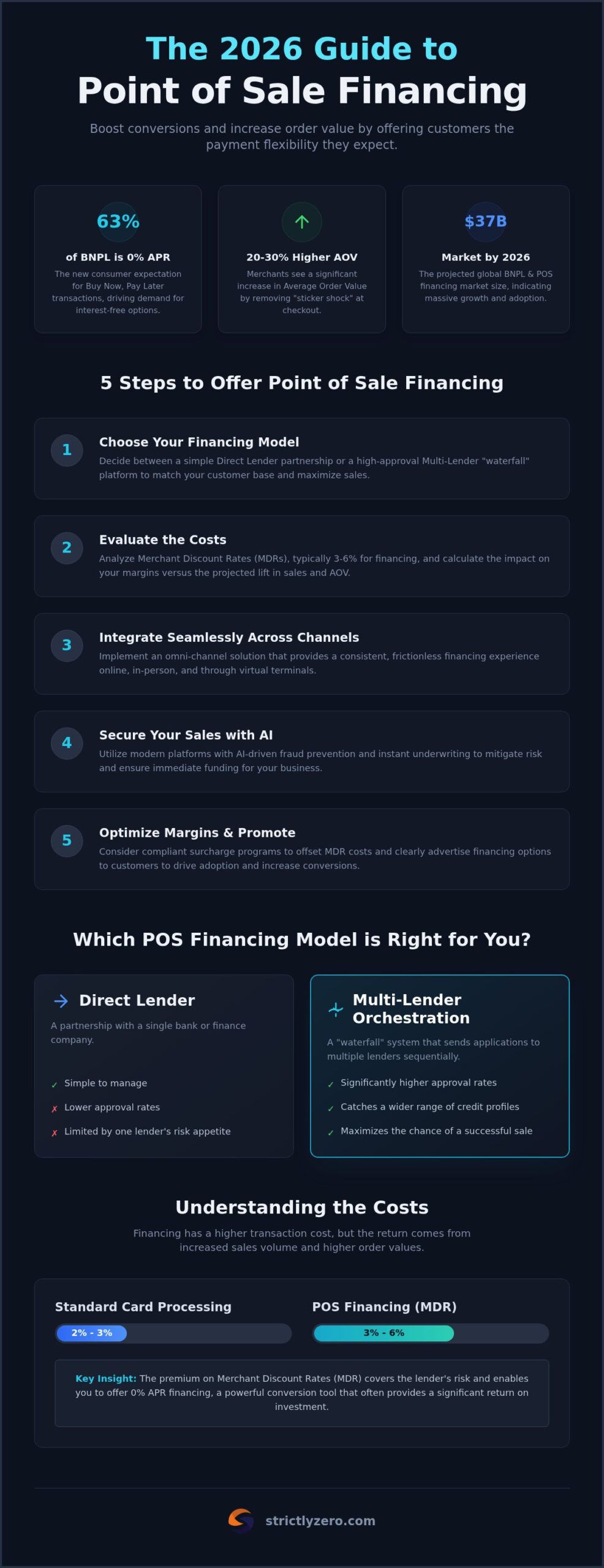
The market has exploded, with the global BNPL POS financing market projected to reach USD 37.46 billion in 2026. Consumers no longer view this as a luxury. For any purchase exceeding $250, shoppers now expect a variety of payment options. If you’re wondering how to offer point of sale financing effectively, you have to look past the old “store card” model. Modern systems use AI-driven underwriting to provide credit decisions in milliseconds. This ensures a frictionless experience that doesn’t slow down your checkout line, whether you’re selling online or through a virtual terminal.
POS Lending vs. BNPL vs. Installment Loans
While people often use these terms interchangeably, they represent different financial tools. POS lending serves as the umbrella term for all credit extended to a consumer at the point of purchase. Understanding the nuances helps you choose the right fit for your specific inventory and price points.
- Buy Now, Pay Later (BNPL): Typically short-term, “pay-in-4” models that often carry 0% APR. These are ideal for lower-ticket items.
- Installment Loans: Longer-term credit, often for higher amounts, which may include interest rates ranging from 0% to 35.99% depending on the provider and the buyer’s credit score.
- Revolving Credit: Similar to a traditional credit card but tied to a specific merchant network or platform.
Choosing between these depends on your average ticket size. If you sell $100 items, BNPL is your best friend. If you’re moving $5,000 equipment, a fixed-term installment loan provides the structure your customers need to manage their cash flow.
The Business Case: Why Offer Financing Now?
The primary reason to learn how to offer point of sale financing is the immediate impact on your bottom line. Industry data suggests that merchants implementing these programs can see an Average Order Value (AOV) increase of 20% to 30%. When a customer sees they can pay $50 a month instead of $600 upfront, the “sticker shock” vanishes instantly.
Choosing the Right POS Financing Model for Your Business
Deciding how to offer point of sale financing starts with choosing a structure that matches your sales volume and customer profile. You generally have two paths: direct lender partnerships or multi-lender orchestration. A direct partnership connects you with one specific bank or finance company. While this is simple to manage, it often leads to lower approval rates because you’re limited to that single lender’s risk appetite. In contrast, multi-lender orchestration uses a “waterfall” approach. If the first lender declines a customer, the application automatically moves to a second or third tier, significantly increasing the chances of a successful sale.
You also need to decide between merchant-funded and lender-funded models. In most 2026 setups, the lender funds the purchase upfront, minus a fee, and assumes all credit risk. This protects your cash flow and removes the burden of debt collection. To maximize these benefits, your chosen model must be omni-channel. Whether a customer is using your virtual gateway from home or standing at your checkout counter, the financing experience should feel identical and frictionless.
Evaluating Merchant Discount Rates (MDR)
The “cost of money” is usually higher for financing than for standard credit card processing. While a typical card transaction might cost 2% to 3%, merchant discount rates for POS lending often range between 3% and 6%. This premium covers the lender’s risk and the cost of providing 0% APR options to your customers. It’s vital to calculate your break-even point before offering interest-free terms. The Consumer Financial Protection Bureau continues to monitor these costs and disclosure practices, so transparency with your customers isn’t just good business; it’s a regulatory necessity.
Integration Depth: API vs. Hosted Checkout
How you deploy your financing solution impacts both your brand and your technical workload. API-first integrations offer deep control, allowing you to embed the financing application directly into your branded checkout flow. This is excellent for high-volume merchants who want a bespoke look. For a faster rollout, low-code options like hosted payment links or pre-built checkout pages can get you up and running in days. Regardless of the depth, ensure your financing solution integrates perfectly with your existing ecommerce payment processing system to keep your reporting unified. If you’re looking for a platform that handles both processing and lending under one roof, you might find that exploring a unified technology partner simplifies your entire operation.
5 Steps to Offer Point of Sale Financing
Implementing a lending program requires more than just flipping a switch. It’s a strategic rollout that touches your data, your staff, and your digital infrastructure. If you’re ready to learn how to offer point of sale financing, follow this five-step roadmap to ensure a smooth launch.
- Step 1: Audit Your Sales Data. Identify which products or services have the highest abandonment rates. Items priced between $250 and $2,500 often see the biggest conversion lift from installment options.
- Step 2: Select a Unified Provider. Look for a partner that combines omni-channel payment processing with integrated lending technology. This prevents you from having to manage multiple fragmented dashboards.
- Step 3: Technical Integration. Connect the lending API to your ecommerce checkout or configure your physical terminal. The goal is a “one-click” application process for the customer.
- Step 4: Staff Training. Your team should mention financing early. Instead of waiting for checkout, teach them to say, “This unit is $1,200, or about $105 a month with our financing options.”
- Step 5: Marketing and Disclosure. Update your product pages to show estimated monthly payments. Transparency builds trust and helps customers justify higher-quality purchases.
Technical Integration Best Practices
Friction is the enemy of the sale. When figuring out how to offer point of sale financing, prioritize “instant decisioning.” A customer shouldn’t wait more than a few seconds for a credit approval. Your system must also handle down-payments gracefully. If a customer is approved for $800 on a $1,000 purchase, the software should automatically prompt for the $200 balance. For service-based businesses or B2B sales, ensure these workflows are integrated into your virtual terminal. This allows your team to send a secure financing link via email or text while still on the phone with the lead.
Compliance and Legal Disclosures
The regulatory environment is tightening. In June 2026, Illinois enacted the Buy-Now-Pay-Later Loan Consumer Protection Act, establishing a strict licensing framework. While the lending partner usually carries the legal weight of the loan, you are responsible for how those terms are displayed. You must follow Truth in Lending Act (TILA) requirements by clearly showing the APR, total finance charges, and payment schedule. Compliance is the lender’s responsibility, but clear and honest disclosure is the merchant’s duty to the customer. Always verify that your marketing materials match the latest state-specific regulations to avoid heavy fines or reputational damage.
Optimizing Margins: How to Offset Financing Costs
While the revenue boost from lending is undeniable, the merchant discount rate (MDR) can be a silent profit killer. Many business owners discover too late that they’re losing between 3% and 8% on every financed transaction. This fee is significantly higher than standard credit card processing because the lender absorbs the risk of non-payment and the cost of capital. If you want to master how to offer point of sale financing without gutting your bottom line, you need a strategy to neutralize these costs before they eat your profit.
One effective method is implementing a dual pricing model. By offering a “Cash or Debit Price” alongside a “Credit or Financing Price,” you ensure that the costs of providing credit are covered by the customers who choose to use those services. This protects your core margins while still giving shoppers the flexibility they want. When you balance this MDR with the projected 20% to 30% increase in sales volume, the math usually favors the merchant; however, this only works if your overhead is managed with precision.
Leveraging Surcharge Programs
The most powerful tool in your arsenal is zero fee credit card processing. By using a compliant surcharge fee program, you can eliminate standard processing costs on traditional card swipes. This creates a margin cushion that helps absorb the higher fees associated with POS lending. Modern platforms use a Smart Pricing Engine to automatically detect card types and apply the correct surcharge, ensuring you stay compliant with state laws and card brand rules. Communicating this value to your customers is simple. Most appreciate having the choice between a discounted cash price and the convenience of credit or monthly installments.
Analyzing Net Profit per Transaction
You must look past the top-line revenue and calculate your “Real Cost of Acceptance.” A financed sale with a 5% fee might seem expensive, but if that sale wouldn’t have happened otherwise, it represents 95% of a profit you never would’ve seen. Using advanced credit card processing for small business tools allows you to track these metrics in real-time. You can see exactly how much each financing provider is costing you versus the volume they bring in. If you’re ready to stop losing money to hidden transaction fees, switching to a zero-fee processing platform is the smartest move you can make for your 2026 growth strategy.
The Future of POS Lending with Strictly
Strictly represents the next evolution in merchant services by merging high-performance processing with integrated lending. Most businesses struggle with fragmented systems where their credit card processor doesn’t talk to their financing provider. Strictly solves this by offering a unified platform that combines zero fee merchant services with instant POS lending. This integration ensures that when you’re looking at how to offer point of sale financing, you aren’t just adding another bill. You’re adding a growth engine that works across payment links, virtual terminals, and standard e-commerce checkouts.
Fraud remains a primary concern for merchants in 2026. Strictly addresses this with AI-driven fraud prevention that analyzes transaction patterns in real-time. This technology protects your business from sophisticated credit fraud, which is especially vital for high-ticket items. By choosing a partner that prioritizes security alongside conversion, you can scale your lending options with confidence. This comprehensive approach is why Strictly is recognized as a top cc processing company for businesses ready to dominate their market.
Unified Management for Partners and ISOs
For ISOs and partners, POS lending is a powerful tool for merchant retention. When a merchant relies on your platform for both their daily processing and their customer financing, they’re much less likely to switch providers. Strictly automates the complexity of these relationships with ClearSplit™, which handles partner commissions for financing-heavy accounts without manual intervention. Partners can also use ChurnIQ™ to monitor how the introduction of financing options impacts merchant longevity and overall account health. It’s a “sticky” feature that provides value to everyone in the payment ecosystem.
Getting Started with Strictly POS Lending
Starting your journey is straightforward. The application process to add lending to your existing merchant account is designed for speed, allowing you to go from setup to sales in record time. If your business requires a custom setup, you can access comprehensive API documentation to build a tailored experience. This allows you to control every pixel of the user journey while Strictly handles the backend heavy lifting. It’s time to stop letting price be a barrier to your growth. Scale your business with Strictly’s integrated POS lending today!
Take Control of Your 2026 Growth Strategy
By now, you understand that POS financing is more than just a payment option; it’s a strategic necessity for capturing high-ticket sales in 2026. You’ve seen how a multi-lender model maximizes approvals and how surcharge programs protect your hard-earned margins from high merchant discount rates. Mastering how to offer point of sale financing doesn’t have to be a technical or financial burden when you have the right technology partner to manage the complexity.
Strictly provides a unified solution that bridges the gap between payment processing and customer credit. With our Smart Pricing Engine for compliant surcharging and built-in AI-Driven Fraud Prevention, you can scale safely across web, mobile, and phone sales with full omni-channel support. It’s time to stop letting “sticker shock” derail your conversions and start providing the flexibility your customers expect. Boost your sales and eliminate fees with Strictly POS Lending and start seeing the difference in your bottom line today. Your business is ready for the next level of revenue growth.
Frequently Asked Questions
How does point of sale financing work for the merchant?
When you learn how to offer point of sale financing, the process is actually quite simple for your business. Once a customer is approved at checkout, a third-party lender pays you the full purchase amount upfront, minus a merchant discount fee. You don’t have to worry about collecting monthly payments or managing debt. The lender handles the entire loan lifecycle while you receive immediate funding to maintain your cash flow.
Is POS financing safe for small businesses?
Yes, POS financing is very safe because the lender carries the credit risk. If a customer fails to pay their installments, your business keeps the initial funding. To enhance security, modern platforms include AI-driven fraud prevention to verify identities and detect suspicious patterns in real-time. This technology ensures you aren’t held liable for identity theft or fraudulent applications made through your virtual terminal or website.
What are the typical fees for offering POS financing?
Typical merchant fees for POS financing usually range between 3% and 6% of the transaction value. These rates are higher than standard credit card processing fees because they cover the lender’s risk and the cost of providing 0% APR options. While these costs vary by provider and loan term, most businesses find the expense is offset by the increase in average order value and higher conversion rates.
Can I offer financing if I use a surcharge program?
You can definitely combine these two strategies to maximize your profit margins. When you understand how to offer point of sale financing alongside a surcharge program, you use the savings from credit card fees to offset the higher costs of lending. A smart pricing engine automatically applies the correct fees to standard card transactions while keeping the financing application process separate and compliant with state-specific regulations.
Do I need a special credit card processor to offer financing?
You don’t strictly need a different processor, but using an integrated platform is much more efficient for your daily operations. A unified processor allows you to manage both your standard transactions and your lending applications within a single dashboard. This prevents technical headaches and ensures your reporting remains consistent. Look for a partner that offers omni-channel support so your financing options work across your website and virtual terminal.
What happens if a customer defaults on their POS loan?
If a customer defaults on their loan, the lender absorbs the loss, not the merchant. Since the financing provider paid you the full amount at the time of purchase, your revenue is protected. The lender is responsible for all collections and credit reporting activities. This transfer of risk is a primary reason why merchants pay a higher discount rate for financing compared to traditional debit or credit transactions.
How long does it take to get funded for a financed sale?
Funding for financed sales typically occurs within one to three business days, which is similar to standard credit card processing. Once the customer completes the checkout and the lender approves the application, the funds are initiated for transfer to your merchant bank account. This ensures you have the necessary capital to fulfill the order and manage your business without waiting for the customer to complete their schedule.
Does POS financing require a hard credit pull for customers?
Many 2026 providers use a soft credit pull to give customers an instant pre-approval decision, which doesn’t impact their credit score. However, a hard credit pull may occur once the customer officially accepts the loan terms and completes the purchase. It’s important to provide clear disclosures at the point of sale so shoppers understand exactly how the application will affect their credit profile before they commit to the loan.