
How to Sell Merchant Services: The 2026 Guide to Building a Residual Empire
Published:

If you’re still walking into businesses promising to “beat their current rates,” you’re likely walking right back out with a rejection. In 2026, the race to the bottom on price is a losing game for everyone involved. Mastering how to sell merchant services today isn’t about shaving off a few basis points; it’s about solving the compliance and fee fatigue crises that plague modern business owners.
It’s frustrating to watch a prospect’s eyes glaze over when you mention PCI DSS v4.0 or try to explain the latest interchange updates. We’re going to change that. This guide gives you a repeatable sales process to build a high-margin residual empire by leveraging automated surcharge technology and modern partner management tools. You’ll gain the strategies needed to scale your ISO business while letting a dedicated platform handle the heavy lifting of state-by-state compliance.
We’ll explore the impact of the $5.54 billion Visa and Mastercard settlement, the power of dual pricing engines, and the AI-driven fraud prevention strategies that turn a simple pitch into a long-term partnership.
Key Takeaways
- Learn why shifting from “low rate” pitches to surcharge and dual pricing engines is the most effective way to eliminate merchant fees and close deals.
- Master a repeatable 5-step framework on how to sell merchant services by prioritizing niche selection over generic local prospecting.
- Understand the structural differences between ISO, Agent, and Partner models to ensure you are maximizing your long-term residual income potential.
- Discover how to leverage partner management tools and automation to handle complex commission tracking and keep your sales team loyal.
- Identify the essential features of an omni-channel payment processing platform, including AI-driven fraud prevention and integrated virtual terminals.
Table of Contents
- What Are Merchant Services and Why Sell Them in 2026?
- Choosing Your Sales Model: ISO, Agent, or Partner?
- The 5-Step Process to Sell Merchant Services Effectively
- Using Technology to Scale: ClearSplit™ and ChurnIQ™
- Start Your Journey: Partnering with a Payment Processing Platform
What Are Merchant Services and Why Sell Them in 2026?
Merchant services encompass the entire ecosystem of financial tools and infrastructure that enable a business to accept non-cash payments. This includes credit and debit cards, mobile wallets like Apple Pay, and secure online transactions. In 2026, the industry has moved far beyond simple card swiping. It’s now a multi-channel necessity where businesses must bridge the gap between physical storefronts and digital marketplaces. Understanding how to sell merchant services starts with recognizing that you aren’t just selling a utility; you’re selling the lifeblood of a business’s cash flow.
To better understand this concept and the scale of the opportunity, watch this helpful video:
The reason professionals flock to this industry is the residual income model. It’s one of the few sectors where you get paid every month for work you did once. Every time a customer taps their card at a merchant you signed, you earn a small piece of that transaction. Unlike traditional sales where you start at zero every month, payment processing builds a compounding base of income. If you sign ten merchants this month, you don’t just get a commission check. You get a recurring revenue stream that grows as their businesses scale.
The market outlook for 2026 is focused on unified commerce. Cash usage is at an all-time low, and merchants are desperate for omni-channel solutions. The old way of selling involved “rate-cutting,” where you’d try to shave a few cents off a merchant’s bill. That’s a race to the bottom. Today, the most successful agents focus on “value-adding.” They provide AI-driven fraud prevention, virtual terminal access, and integrated invoicing that makes a merchant’s life easier, not just cheaper.
The Core Components of the Payment Stack
A merchant account is the foundation, acting as a holding tank for funds before they reach a business bank account. Payment gateways serve as the digital bridge for e-commerce, while POS solutions have shifted from bulky hardware to agile, software-first systems. Most modern merchants now prefer a virtual terminal or an API-driven setup over traditional countertop terminals, allowing them to take payments anywhere.
The ISO and Agent Opportunity
An Independent Sales Organization (ISO) acts as a middleman between the major credit card processors and the merchants. Agents work under these ISOs to build their own portfolios. In 2026, the biggest opportunity lies in the “Zero-Fee” model. By using a surcharge and dual pricing engine, you can show a merchant how to pass the cost of processing to the consumer. This effectively brings their processing bill down to near zero, making it an incredibly easy pitch for anyone learning how to sell merchant services effectively.
Choosing Your Sales Model: ISO, Agent, or Partner?
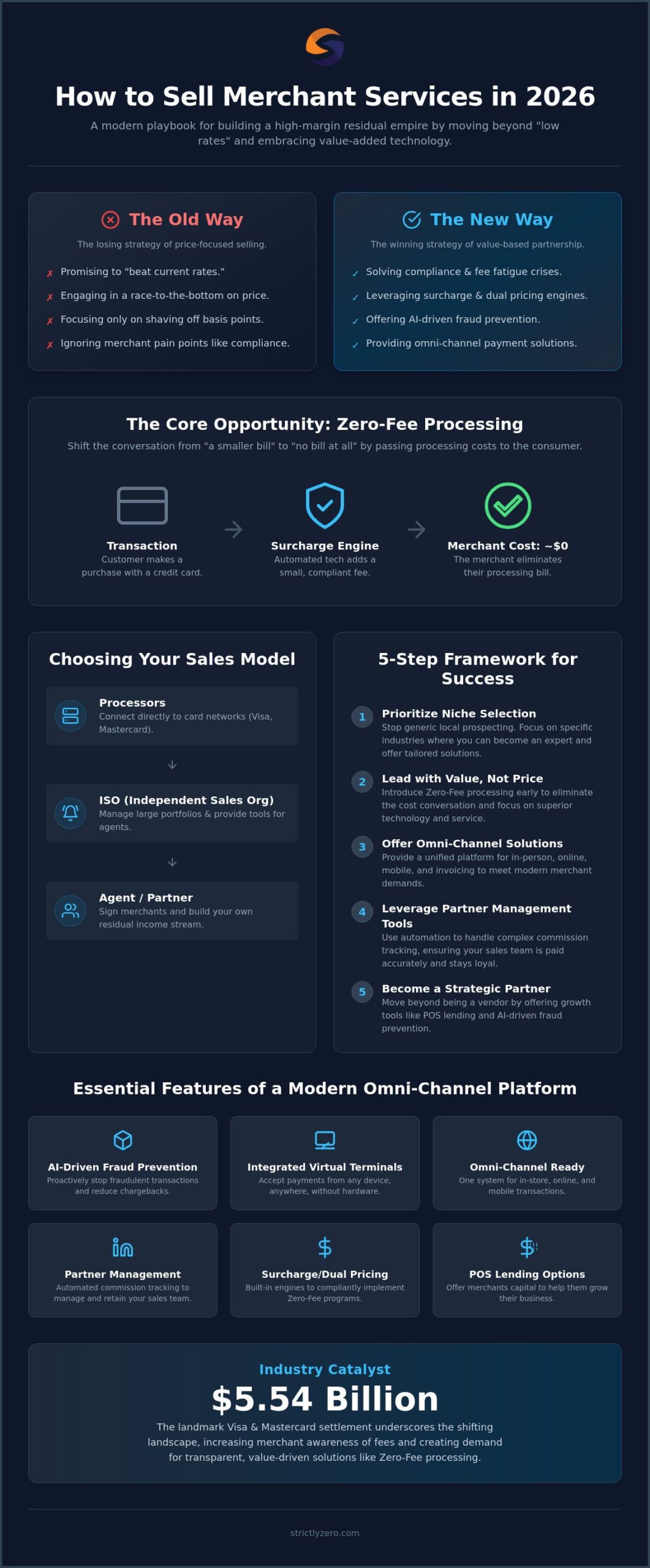
Deciding which path to take in the payment industry is the first hurdle in learning how to sell merchant services successfully. The hierarchy is straightforward but essential to understand. At the top are the processors that connect directly to the card networks. Below them, Independent Sales Organizations (ISOs) manage large portfolios and provide the tools agents need. As an agent or sub-agent, you work under an ISO to sign merchants and build your own residual stream. In 2026, the most profitable agents aren’t just selling a service; they’re selling an omni-channel experience. You must be equipped to handle online checkout, in-person mobile payments, and virtual invoicing through a single, unified interface that simplifies the merchant’s daily operations.
Your credibility is your currency. Aligning with a platform that values trust as a payment processor allows you to walk into any business with confidence. It’s about more than just a merchant account. You should provide a robust ecosystem including AI-driven fraud prevention and POS lending options that help your clients grow. When you offer a comprehensive suite of tools, you move from being a vendor to a strategic partner.
The Power of Zero-Fee Surcharging
The market has shifted away from the “cheap rate” wars. Merchants don’t want a slightly smaller bill; they want no bill at all. This is where zero fee credit card processing changes the conversation. A smart pricing engine automates the complex task of staying compliant with varying state laws regarding surcharges. This technology allows businesses to pass the cost of acceptance to the customer legally and transparently. In an era where inflation squeezes margins, businesses are desperate for this relief. You aren’t just selling a tool. You’re giving them their profit back.
Evaluating a Partner Platform
Your success depends entirely on the technology backing you. An API-first approach is no longer optional. Developers and enterprise-level clients want solutions that integrate with their existing software without friction. This is why ecommerce payment processing has become the fastest-growing sector for new ISOs. If you want to master how to sell merchant services at scale, you need a partner that provides automated residual tracking to ensure your commissions are accurate and paid on time. Disputes over residuals are the fastest way to kill an agency’s momentum. Choose a partner that offers transparent partner management tools to keep your business running smoothly while providing the high-margin residuals you deserve.
The 5-Step Process to Sell Merchant Services Effectively
Brute force cold calling is a relic of the past. While some still suggest making 100 calls a day to “hit the pavement,” modern professionals know that mastering how to sell merchant services requires a consultative, surgical approach. You don’t need more prospects; you need better ones. By following a structured five-step framework, you can move from being a cold caller to a trusted advisor who solves a major financial pain point.
- Step 1: Prospecting and Niche Selection. Selling to everyone is the fastest way to fail. Focus on specific industries like HVAC, legal services, or high-ticket retail. When you specialize, you understand the specific software integrations and pain points of that industry, making your pitch far more credible.
- Step 2: The Initial Approach. Stop saying “I can save you money.” Every salesperson says that. Instead, lead with “I can eliminate your credit card processing fees entirely.” This reframes the conversation from a minor discount to a significant operational improvement.
- Step 3: The Statement Analysis. Request a recent processing statement. Look for “junk fees” like PCI non-compliance charges, monthly minimums, or padded interchange markups. Identifying these hidden costs proves your expertise and builds immediate trust.
- Step 4: The Proposal. Present a clear comparison between their current “Low-Fee” model and your Surcharge and Dual Pricing Engine. Show them exactly how much profit they’ll reclaim by passing those costs to the consumer.
- Step 5: Closing and Onboarding. A signed contract is just the start. Ensure the transition is seamless by setting up their virtual terminal and training their staff. A smooth onboarding process is the best way to prevent early churn and secure your long-term residuals.
Effective Prospecting in a Digital Age
Ditch the phone book and use LinkedIn or local business directories to identify high-volume merchants. Target service-based businesses that often take payments over the phone or via email. For these clients, a virtual gateway is a game-changer. It allows them to send secure invoices and manage recurring billing without needing physical hardware. By solving their administrative headaches first, the payment processing sale becomes a natural secondary benefit.
Handling the #1 Objection: “My Customers Will Hate Surcharges”
This is the most common hurdle when learning how to sell merchant services. Address it with data. Industry reports consistently show that 95% or more of customers don’t switch brands over a small transaction surcharge, especially when they’re given a choice. If a merchant is still hesitant, offer the Dual Pricing alternative. This model displays both a cash price and a card price, giving the customer the power to choose. Our Smart Pricing Engine further protects the merchant by automatically detecting debit cards and preventing surcharges on those transactions, ensuring the business stays 100% compliant with network rules and state laws.
Using Technology to Scale: ClearSplit™ and ChurnIQ™
ClearSplit™ solves the biggest headache for multi-agent organizations: automated partner compensation. In the past, ISOs frequently lost high-performing agents due to payment delays or opaque reporting. This platform ensures every partner in the chain gets paid accurately and on time. It removes the friction from your administrative processes, letting you focus on recruitment and sales strategy rather than accounting disputes. When your sales team can see their earnings in real-time, their loyalty to your ISO increases exponentially.
Retention is just as important as acquisition for building a residual empire. ChurnIQ™ uses AI-driven intelligence to monitor transaction patterns and predict when a merchant might be considering a move to a competitor. Simultaneously, you can position AI-Driven Fraud Prevention as a core security feature of your processing service. Merchants in 2026 are increasingly worried about chargebacks and sophisticated data breaches. Providing built-in security and fraud monitoring makes your offering indispensable and builds long-term trust.
Intelligence Over Intuition
Managing merchant services for small business requires a unified dashboard that provides real-time visibility into every account. ChurnIQ™ identifies “at-risk” accounts by flagging sudden drops in processing volume or changes in transaction behavior. Instead of waiting for a cancellation notice to arrive, you can proactively reach out to solve problems before they escalate. This data-driven approach replaces guesswork with actionable insights, ensuring your portfolio remains stable and profitable month after month.
Automating Your Back Office
ClearSplit™ is a game-changer for those managing complex hierarchies and multi-layered sales teams. It reduces administrative overhead by automating the split of every transaction fee across your entire organization. By integrating with secure, high-performance virtual gateways, the platform creates a seamless experience from the moment a transaction occurs to the moment the residual hits an agent’s account. This level of automation allows you to scale your ISO without the need to hire a massive back-office staff. To see how these systems can transform your business, explore the partner management tools available at Strictly.
Start Your Journey: Partnering with a Payment Processing Platform
Your sales strategy is only as strong as the infrastructure supporting it. Selecting the right payment processing platform for ISOs is the most critical decision you’ll make this year. A legacy processor might give you a basic merchant account, but a modern partner provides a growth engine. In 2026, an omni-channel, API-first approach is the baseline requirement. This allows you to offer clients everything from virtual terminals and invoicing to complex e-commerce integrations through a single partner. It makes your value proposition much harder for competitors to beat.
The journey to your first residual check with Strictly is designed to be frictionless. After your application is processed, you immediately gain access to the partner management tools and AI-driven fraud prevention systems we’ve covered. Success in how to sell merchant services depends on having a back office that works as hard as you do. Our onboarding process is built to get you into the field quickly with the confidence that your commission tracking is fully automated.
Before you launch, use this final checklist to ensure you’re ready to scale:
- Identify a specific industry niche where you have existing knowledge or contacts.
- Confirm your partner platform offers a compliant surcharge and dual pricing engine.
- Build a prospecting list of 50 high-volume merchants using digital directories.
- Review the latest PCI DSS v4.0 compliance standards to ensure you can speak authoritatively on security.
- Set up your virtual terminal for live demos with prospects.
Why Strictly is the Modern Choice for ISOs
Strictly is the only platform built specifically to handle the Zero-Fee revolution at scale. While other processors try to retro-fit old systems for surcharging, our Smart Pricing Engine was designed for it from day one. This ensures automated compliance with state-by-state laws and card network rules. It’s a true partnership model designed for long-term residual growth rather than short-term gains. Learning how to sell merchant services effectively means having the right tools to back up your promises.
Next Steps for Aspiring Sales Leaders
The transition from agent to sales leader requires consistent action. Start by scheduling a demo of the Strictly platform to see the technology in action. Once you understand the interface, identify your first 10 “Zero-Fee” prospects and prepare your pitch using the 5-step process outlined in this guide. Apply to become a partner today at Strictly Zero and start building the residual empire you’ve planned.
Build Your Residual Empire Starting Today
The landscape of payment processing has shifted permanently. Success in 2026 isn’t found in a race to the bottom on rates. It’s found in providing merchants with genuine financial relief through a Compliant Surcharge & Dual Pricing Engine. By mastering how to sell merchant services through a consultative, technology-first approach, you move from a simple vendor to a strategic business partner. This transition is what separates the top earners from those who struggle with high rejection rates.
Ready to take the next step and join the zero-fee revolution? Partner with Strictly: Scale Your Payments Business and start building a portfolio that pays you for years to come. It’s time to go out and build your empire.
Frequently Asked Questions
How much can you make selling merchant services?
Your income potential is primarily determined by the volume of transactions processed by your merchant portfolio. Earnings typically consist of upfront bonuses for new account activations and recurring monthly residuals. While individual success varies based on effort and niche selection, agents who build a consistent portfolio of mid-to-large-market businesses can develop a six-figure annual residual stream that continues to pay out as long as those merchants remain active.
Is it hard to sell payment processing services?
The difficulty depends entirely on your value proposition. If you are only competing on price, you will face high rejection rates and low margins. However, mastering how to sell merchant services by leading with a compliant surcharge engine makes the process much smoother. When you offer a way for a business to eliminate their processing costs entirely, you aren’t just another salesperson; you’re a consultant providing a direct boost to their bottom line.
What is the difference between an ISO and a PayFac?
An Independent Sales Organization (ISO) partners with a processor to provide customized merchant accounts and dedicated support. A Payment Facilitator (PayFac) typically uses a large aggregator platform to board thousands of small merchants under a single master account. While PayFacs offer quick setup, ISOs generally provide higher residual splits for agents and more robust, tailored solutions for established businesses that require higher processing limits.
Are credit card surcharges legal in all states in 2026?
As of 2026, surcharging is legal in the vast majority of the United States, though specific disclosure rules and registration requirements vary by jurisdiction. Some states have historically maintained restrictions that require precise implementation to remain compliant. This is why using a platform with an automated pricing engine is vital; it ensures your merchants stay within the legal bounds of both state laws and card network regulations without manual intervention.
What is a residual in merchant services sales?
A residual is a recurring commission paid to you every month based on the processing volume of your signed merchants. It represents your share of the profit from every transaction that passes through their system. This compounding income model allows you to earn money for years based on the work you did to sign the account once, making it one of the most effective ways to build long-term wealth in the financial services sector.
Do I need a license to sell credit card processing?
There is no specific state-issued professional license required to enter this field, but you must be registered as an authorized agent. This process involves being vetted by a registered ISO and the card networks to ensure you adhere to industry standards for security and ethical sales practices. This registration ensures that you can legally represent the processor and offer merchant accounts to business owners.
How do I handle the “I already have a processor” objection?
Instead of trying to beat their current rate, ask if their provider has helped them implement a zero-fee model. Most merchants are still paying thousands in monthly fees because their current processor relies on traditional pricing structures. By shifting the focus to how they can legally pass those costs to the consumer, you differentiate yourself from the dozens of other sales reps who have likely called them that same week.
What tools do I need to start an ISO business?
Success requires a combination of sales intelligence and back-office automation. You will need a partner management platform to track your residuals and an omni-channel processing gateway that supports virtual terminals. Utilizing advanced retention software to monitor merchant health and automated splitting tools for your sales team will allow you to scale your business without being buried in administrative paperwork as your portfolio grows.