
Interchange Plus vs Flat Rate: Which Processing Model Wins in 2026?
Published:

The “simple” flat rate you chose to avoid headaches might actually be the most expensive mistake on your balance sheet. While a 2.9% plus $0.30 rate looks predictable, it often ignores the reality that the average credit card processing fee in 2026 sits between 1.5% and 3.5%. Choosing between interchange plus vs flat rate usually feels like a choice between confusing complexity and expensive simplicity. You’re likely tired of seeing shrinking margins and those “PCI non-compliance” charges that seem to appear out of nowhere.
It’s understandable to feel frustrated when premium rewards cards and the latest Mastercard fee updates eat into your profits. You deserve a clear understanding of exactly what you’re paying for and a scalable model that grows alongside your volume. This article uncovers the hidden costs buried in both popular pricing structures to find your most profitable path. We’ll compare the latest 2026 interchange rates against flat-rate benchmarks and introduce a compliant surcharge strategy that can eliminate these processing costs entirely.
Key Takeaways
- Identify the three core components of processing fees to pinpoint exactly where your current provider’s markup is hurting your bottom line.
- Evaluate the interchange plus vs flat rate debate by finding the specific break-even point where transparency saves you more than simplicity.
- Uncover why flat-rate models often lead to shrinking margins on basic debit transactions compared to the latest regulated interchange caps.
- Explore how a compliant surcharge and dual pricing engine can effectively eliminate your processing costs for a “zero-fee” business model.
- Learn to use AI-driven fraud prevention to secure your transactions and maintain profitability across all your payment channels.
Table of Contents
- Understanding Credit Card Processing Fees: The Foundation of Your ROI
- Flat Rate Pricing: The Pros and Cons of Simplicity
- Interchange Plus Pricing: The Gold Standard for Transparency
- Head-to-Head: Which Model Saves Your Business More Money?
- Beyond the Debate: Eliminating Fees with Strictly’s Zero-Fee Model
Understanding Credit Card Processing Fees: The Foundation of Your ROI
To maximize your profitability, you have to look past the single percentage on your monthly statement. Every credit card transaction you process is built on three distinct pillars: interchange fees, assessment fees, and the processor’s markup. Understanding how these interact is the first step in the interchange plus vs flat rate comparison. While the first two components are non-negotiable costs set by the financial industry, the markup is the only part where you have room to negotiate. Your choice of pricing model determines whether these costs are transparently listed or bundled into one opaque fee. If you can’t see the markup, you can’t manage your margins effectively.
Your effective rate acts as the ultimate truth in payment processing. This metric is calculated by dividing your total monthly fees by your total sales volume. It’s the only number that reveals the true cost of your processing agreement. When you use a transparent model, you can see exactly how much of that rate is going to the banks versus your service provider. This clarity allows you to identify if a specific card type or transaction method is dragging down your ROI.
What is Interchange? The Non-Negotiable Core
When a customer taps or types their card details, the bank that issued that card takes a cut for the risk they’re assuming. This is the Interchange fee. It’s not a single number. Instead, it’s a massive matrix of hundreds of variables including the card type, your industry category, and the entry method. For instance, a high-tier rewards card carries a much higher cost than a basic consumer card. In 2026, regulated debit cards remain the cheapest to process due to federal caps, while premium credit cards continue to see rate adjustments. Put simply, interchange is the wholesale cost of a credit card transaction.
Assessment Fees and Processor Markups
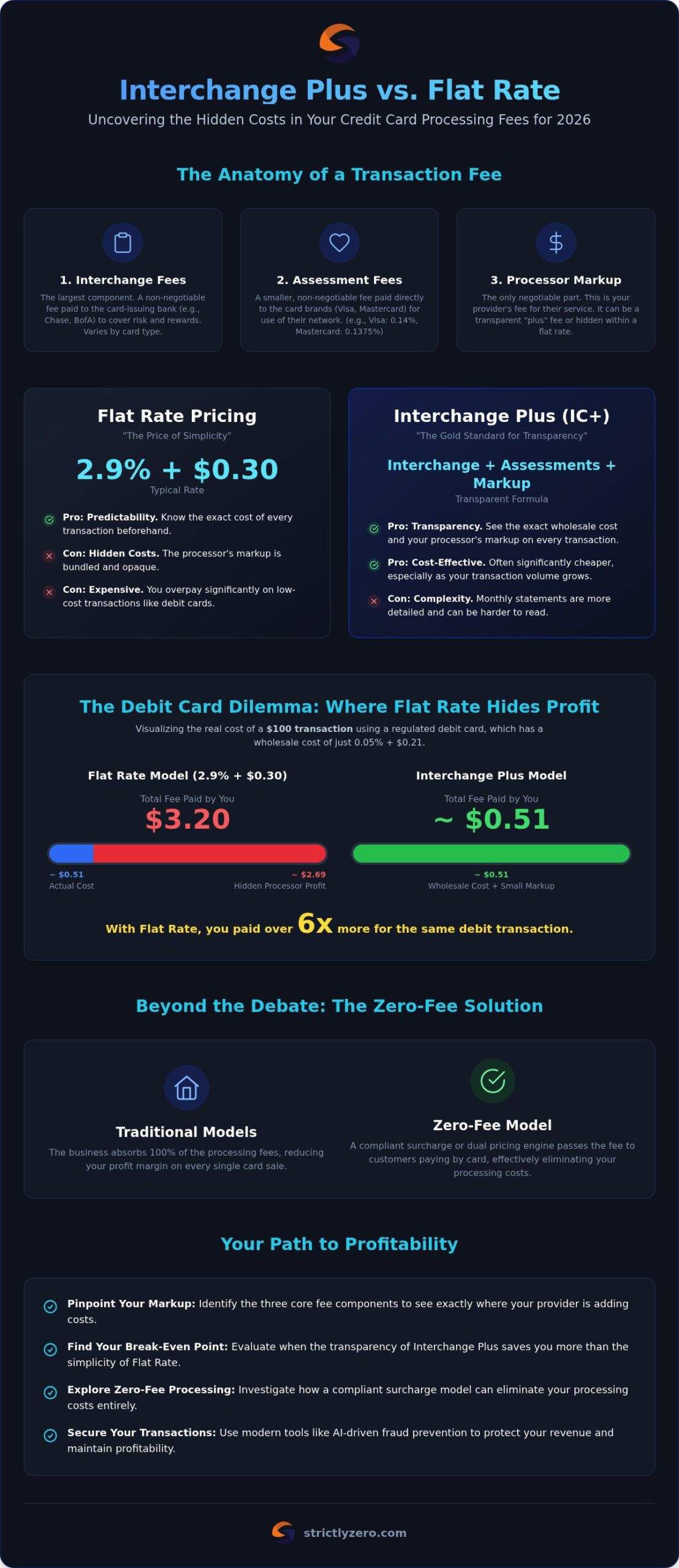
Assessment fees are the small percentages paid directly to the card brands like Visa or Mastercard for the use of their networks. In 2026, Visa’s assessment fee is 0.14% for credit transactions, while Mastercard’s sits at 0.1375%. These are fixed costs that no processor can change. The processor’s markup, however, is where the profit lives. This is where flat-rate processors often hide significant margins by charging you a high “one-size-fits-all” price that covers their costs and a healthy profit. Mastering credit card processing for small business requires looking at your statement to see where the wholesale costs end and the processor’s profit begins. In an interchange plus vs flat rate environment, the former exposes this markup, while the latter keeps it hidden behind a curtain of simplicity.
Flat Rate Pricing: The Pros and Cons of Simplicity
Flat rate pricing is built on a single promise: predictability. You pay a set percentage and a fixed per-transaction fee, often around 2.9% + $0.30, regardless of whether your customer uses a basic debit card or a high-end corporate rewards card. This model is the standard entry point for ecommerce payment processing because it removes the guesswork from accounting. You know exactly what each sale will cost before it happens. However, this simplicity comes with a significant “convenience tax” that often goes unnoticed by growing businesses comparing interchange plus vs flat rate options.
The main draw is the lack of monthly “statement fees” or complex line items. For a small business owner wearing five different hats, not having to decipher a 10-page merchant statement is a massive relief. But that relief has a price. Because the processor charges you the same rate for every card, they have to set that rate high enough to cover the most expensive rewards cards while still making a profit. This means you’re effectively subsidizing the processor’s risk every time a customer pays with a low-cost card.
The Hidden Margin in Flat Rate Models
The processor takes on the risk of fluctuating interchange rates, but they price their flat rate high enough to ensure they almost always win. When a customer uses a regulated debit card, the actual cost to the processor is just 0.05% + $0.21. If you’re on a 2.9% + $0.30 flat rate, you’re paying $3.20 on a $100 sale. Under an interchange-plus model, that same transaction might cost you closer to $0.50 total. That $2.70 difference is pure profit for the processor. Some providers offer a “tiered” version of this, labeling transactions as “qualified” or “non-qualified,” which is often just a way to hide even higher markups on certain card types.
Who Should Choose Flat Rate?
This model isn’t always the wrong choice. It’s often the most logical path for micro-merchants or side hustles processing less than $3,000 to $5,000 per month. If your average ticket is very small, like a $5 coffee, the fixed per-transaction fee matters more than the percentage. But as your volume grows, that simple rate becomes a “growth tax” that eats into your scaling margins. You might find that switching to a more transparent partner helps you keep more of every dollar as your business matures. Staying on a flat rate when you’re processing $20,000 a month is essentially leaving thousands of dollars on the table every year.
Interchange Plus Pricing: The Gold Standard for Transparency
Interchange plus pricing is often referred to as the “cost-plus” accounting method of the payments world. Unlike the bundled nature of flat-rate models, this structure separates the wholesale cost of the transaction from the processor’s profit. You pay the exact interchange fee set by the issuing bank and the assessment fees from the card networks, plus a small, fixed markup for your provider. A typical markup might look like 0.20% + $0.10 per transaction. This level of detail allows you to see exactly what the banks are taking versus what your processor keeps. When debating interchange plus vs flat rate, the primary advantage here is that you’re never paying more than the actual cost of the specific card your customer uses.
This model becomes particularly powerful for B2B merchants through a process called interchange optimization. By providing additional transaction details, known as Level 2 and Level 3 data, businesses can qualify for significantly lower interchange rates on corporate and government cards. A standard payment processor using a flat-rate model won’t pass these savings on to you; they’ll simply keep the extra margin created by your data entry. With interchange plus, those savings go directly back into your business’s pocket.
Transparency and Cost Savings as You Scale
One of the most compelling reasons to choose this model is how it handles industry-wide changes. For example, the 2025 Visa and Mastercard settlement reduced average credit card interchange rates by 0.10%. If you’re on a flat-rate plan, your processor likely pocketed that reduction. If you’re on interchange plus, your costs dropped automatically. Your effective rate naturally decreases as your business volume increases because the fixed monthly fees are spread across more transactions. You benefit from every regulatory cap and network fee reduction the moment they happen, ensuring your margins stay protected as you grow.
The Complexity Barrier: Reading Your Statement
The only real downside to this model is the learning curve. Because every card type has its own line item, your monthly statements can easily reach dozens of pages. This “statement shock” is often what drives merchants back to the expensive simplicity of flat rates. Finding the best credit card processing for small business means finding a partner that provides clear, actionable analytics. Strictly’s platform simplifies this reporting by distilling complex interchange data into intuitive dashboards. You get the financial benefits of the interchange plus vs flat rate winner without having to spend hours every month acting as your own forensic accountant.
Head-to-Head: Which Model Saves Your Business More Money?
Choosing between interchange plus vs flat rate often comes down to your monthly processing volume and average ticket size. While flat rate offers a “sticker price” that is easy to remember, it rarely results in the lowest total cost for a growing company. To determine which model wins for your specific needs, you must audit your current setup using the Effective Rate formula: (Total Monthly Fees ÷ Total Monthly Sales) x 100. If your effective rate is consistently higher than 3%, you’re likely overpaying for the convenience of a flat-rate plan.
| Feature | Flat Rate Pricing | Interchange Plus Pricing |
|---|---|---|
| Total Cost | Higher (includes “convenience tax”) | Lower (wholesale rates) |
| Transparency | Low (fees are bundled) | High (detailed line items) |
| Predictability | High (same rate every time) | Low (varies by card type) |
| Scalability | Poor (costs grow with volume) | Excellent (margins improve) |
The break-even point where the complexity of interchange plus pays for itself typically occurs when a business processes more than $5,000 per month. At this stage, the savings on debit transactions and basic consumer cards far outweigh the small monthly subscription or statement fees associated with transparent pricing models. You can see how your current rates compare to modern transparent standards by running a quick audit of last month’s statement.
Scenario Analysis: Retail vs. E-Commerce
In a retail environment, card-present transactions have lower risk and lower interchange rates. Interchange plus allows you to keep those savings. However, in the world of ecommerce payment processing, card-not-present (CNP) transactions are inherently riskier and more expensive. Flat-rate providers often charge 3.5% or more for online sales to cover this risk. By using an interchange-plus model paired with AI-driven fraud prevention, you can lower your risk profile and access better rates even for digital sales. This ensures that high-risk or international cards don’t skew your margins into the red.
The 2026 Growth Factor: Level 2 and Level 3 Data
For B2B and government-facing businesses, the interchange plus vs flat rate debate has a clear winner. Level 2 and Level 3 processing allows you to send extra data with each transaction, such as tax amounts or purchase order numbers. In exchange, card networks offer massive discounts on interchange fees. Flat-rate models are incapable of passing these specific savings to you because they only see a single “bundled” transaction. Strictly’s virtual terminal automates this data entry, ensuring you qualify for the lowest possible rates on corporate cards without adding extra work for your accounting team.
Beyond the Debate: Eliminating Fees with Strictly’s Zero-Fee Model
The traditional debate over interchange plus vs flat rate pricing assumes that the merchant must always bear the cost of credit card processing. In 2026, that assumption is no longer the standard. While choosing a transparent interchange-plus model can save you money, it doesn’t solve the core problem: processing fees still eat into your net profit. Strictly offers a modern alternative through its Surcharge and Dual Pricing Engine, allowing businesses to create a $0 processing fee environment. Instead of arguing over whether 2.9% or a wholesale markup is better, you can effectively eliminate those costs from your balance sheet entirely.
Operating a zero-fee model requires more than just a line item on a receipt; it requires sophisticated technology to stay compliant with evolving state and federal regulations. Strictly’s Smart Pricing Engine handles the technical heavy lifting by automatically identifying the card type and the merchant’s location in real-time. This ensures that your business follows state-specific rules without your staff having to manually check every transaction. By shifting the cost of credit card rewards and processing back to the consumer, you protect your margins regardless of which card network or bank is involved in the sale.
Surcharging vs. Dual Pricing: The 2026 Standard
Understanding the difference between surcharging and dual pricing is essential for maintaining customer trust. Surcharging adds a small fee specifically to credit card transactions to cover the processing cost. Dual pricing, on the other hand, presents two distinct prices to the customer: a standard price and a discounted price for those paying with cash or other low-cost methods. Strictly’s engine automatically excludes debit cards from surcharges to maintain compliance with federal law. This real-time card detection prevents accidental violations and ensures that your customers always receive a fair, compliant checkout experience whether they are shopping online or in-person.
Partner Opportunities: Scaling with Strictly
This “Zero Fee” revolution isn’t just for merchants; it provides a powerful platform for ISOs and MSPs to offer genuine value to their clients. Partners can move beyond selling on price alone and instead provide a unified omni-channel solution that solves the merchant’s biggest pain point: high overhead. Strictly’s ClearSplit™ tool automates partner compensation, managing residuals and splits with precision regardless of the specific pricing model the merchant chooses. Whether you want to scale your payments business or eliminate your fees with Strictly today, the focus shifts from managing costs to driving growth. By removing the friction of processing fees, you can focus on building a more profitable, scalable business in the competitive 2026 landscape.
Future-Proof Your Processing Strategy for 2026
The debate between interchange plus vs flat rate usually ends when a business hits its growth ceiling. While flat rate offers a simple entry point, the transparency of interchange plus reveals the margins you’ve been losing. However, the most profitable businesses in 2026 aren’t just choosing a lower fee; they’re choosing to pay no fees at all. You don’t have to choose between simplicity and transparency when you can have both alongside a zero-fee environment.
By leveraging a Smart Pricing Engine for automated debit detection and staying compliant in all 50 states, you can reclaim your margins. ISO partners also gain total transparency through ClearSplit™ to manage their residuals with ease. It’s time to stop settling for “predictable” costs and start demanding zero costs. Your business deserves a pricing model that scales as fast as you do.
Eliminate your processing fees today with Strictly’s Zero-Fee Program.
Take control of your revenue and build a foundation for lasting growth today.
Frequently Asked Questions
Is interchange plus always cheaper than flat rate?
Interchange plus is usually more cost-effective for businesses processing over $5,000 per month. While flat rate looks cheaper for side hustles with very low volume, it becomes a burden as you scale. This is because flat-rate providers must set their prices high enough to cover the most expensive cards. In the interchange plus vs flat rate comparison, the transparent model wins on volume because it passes through wholesale rates directly to the merchant.
What is a good interchange plus margin in 2026?
A competitive markup in the current market typically ranges from 0.10% to 0.30% plus a small per-transaction fee. This margin represents the only part of the fee that stays with your processor. For high-volume businesses, this rate can be even lower. You should look for a provider that offers transparency regarding these markups rather than bundling them into hidden costs. Always verify if additional monthly subscription fees apply to your specific agreement.
Can I switch from flat rate to interchange plus without changing my hardware?
Most modern payment terminals can support a switch in pricing models without a hardware replacement. If your current equipment is unlocked or uses a universal gateway, your new processor can simply reprogram the device. However, some proprietary flat-rate providers lock their hardware to their own ecosystem. In these cases, you might need to use a virtual terminal or mobile app until you can transition to a more flexible, omni-channel system.
How does surcharging work with interchange plus pricing?
Surcharging works by adding a compliant fee to credit card transactions to cover the processing costs. When paired with interchange plus, the surcharge covers both the wholesale interchange fee and the processor’s markup. This allows you to maintain your margins regardless of whether the customer uses a basic card or a premium rewards card. Strictly’s engine automates this process to ensure the surcharge is only applied to eligible credit transactions and never to debit.
Are there states where surcharging is still illegal in 2026?
Most states have overturned outright bans on surcharging, but specific disclosure rules and restrictions remain in a few jurisdictions. Navigating these state-by-state rules requires a dynamic solution rather than a manual check. Strictly’s Smart Pricing Engine automatically checks the merchant’s location and the customer’s card type to ensure every transaction remains compliant with local laws. This prevents legal risks while helping you eliminate processing overhead in supported regions across the country.
What is the ‘effective rate’ and how do I calculate it?
The effective rate is the single most important metric for auditing your processing costs. You calculate it by dividing your total monthly fees by your total sales volume and multiplying by 100. For example, if you paid $300 in fees on $10,000 in sales, your effective rate is 3%. This number reveals the true cost of your interchange plus vs flat rate plan by accounting for all bundled fees and hidden statement charges.
Why do some processors only offer flat rate pricing?
Many processors prefer flat rate pricing because it allows them to hide significant profit margins behind a simple interface. By charging a single high rate, they pocket the difference when a customer uses a low-cost debit card. While they market this as simplicity, it’s often a strategy to maximize their own revenue at the merchant’s expense. These providers target smaller businesses that don’t have the time to audit complex monthly statements.
Does Strictly support both interchange plus and zero-fee models?
Strictly provides a unified platform that supports transparent interchange plus pricing as well as compliant zero-fee models. This flexibility allows you to choose the structure that best fits your business goals. You can start with a transparent markup model and transition to a surcharge or dual pricing engine as your volume grows. The platform includes tools like ClearSplit to ensure all partners and stakeholders have full visibility into transaction data and automated compensation.