
Interchange Plus vs Surcharge Program: Which Saves You More in 2026?
Published:

In a year where Visa and Mastercard swipe fees recently topped $118.8 billion, paying for your customers’ credit card rewards shouldn’t be your business’s biggest expense. You’re likely tired of squinting at opaque billing statements and wondering why your margins feel thinner every month despite steady sales. It’s frustrating to feel like you’re losing a chunk of every hard-earned dollar to fees you can’t even decode, especially with the 2026 settlement changing the landscape of card acceptance.
Deciding between an interchange plus vs surcharge program is the most important financial move you’ll make this quarter. We’ll help you discover the structural differences between wholesale processing rates and zero-fee models to determine the best fit for your bottom line. You’ll gain a clear understanding of the ROI for both models, learn how to stay compliant with varying state laws in places like Connecticut or Maine, and find out how to finally eliminate unnecessary merchant service fees. It’s time to stop paying for the privilege of getting paid and start choosing a model that protects your profit.
Key Takeaways
- Compare the structural differences of an interchange plus vs surcharge program to decide if wholesale transparency or cost elimination is better for your business.
- Learn how a smart pricing engine handles the complex web of state-level restrictions and card network caps to ensure your business remains fully compliant.
- Discover the “zero-fee” math that allows you to offset processing costs while maintaining clear, itemized records for every transaction.
- Evaluate the impact of card fees on customer psychology and cart abandonment to implement a pricing strategy that protects your margins without losing sales.
- Understand why an omni-channel, API-first platform is necessary to integrate these payment models seamlessly across virtual terminals and invoicing tools.
Table of Contents
- What Are Interchange Plus and Surcharge Programs?
- The Mechanics of Interchange Plus Pricing
- How Modern Surcharge Programs Eliminate Processing Costs
- Head-to-Head: Which Model Fits Your Business Strategy?
- Choosing a Compliant, Omni-Channel Partner
What Are Interchange Plus and Surcharge Programs?
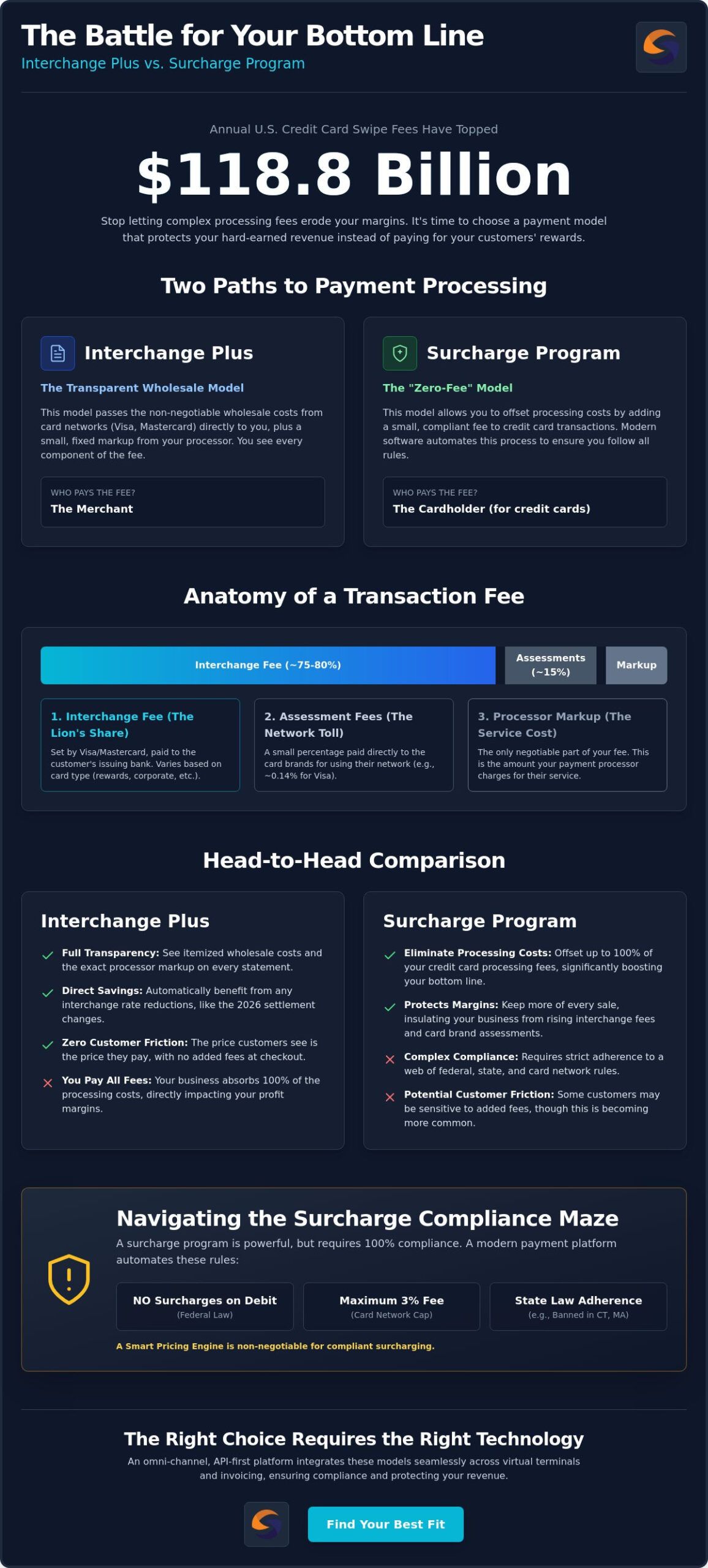
Choosing the right way to handle credit card fees requires a look at the fundamental mechanics of your merchant statement. When you weigh an interchange plus vs surcharge program, you’re essentially deciding who covers the cost of convenience. Interchange Plus is the industry standard for transparency; it passes through the wholesale costs of the card networks with a clear, fixed markup added by your processor. In contrast, a surcharge program allows you to bypass these costs entirely by adding a compliant fee to credit transactions, effectively moving the expense from your ledger to the cardholder’s.
The year 2026 marks a turning point for this decision. Following the June 2026 settlement that capped standard consumer credit interchange at 1.25% for eight years, the “wholesale” cost has become more predictable. However, even with these caps and a 10-basis point reduction in average rates, the cumulative impact of swipe fees remains a heavy burden for high-volume businesses. This environment has pushed many companies toward “Zero Fee” models to protect their margins from being eroded by non-negotiable network assessments.
To better understand how these wholesale costs are structured, watch this helpful video:
The Three Pillars of Processing Fees
Every transaction fee consists of three distinct layers. The first is the Interchange fee, which is set by card networks like Visa and Mastercard. This fee goes to the bank that issued the customer’s card and accounts for the majority of your costs. The second layer involves assessment fees, which are charges paid directly to the card brands for using their network. In 2026, these sit around 0.14% for Visa and 0.1375% for Mastercard. Finally, there’s the processor markup. This is the only portion of the fee that is negotiable for the merchant, representing the service provider’s profit for handling the transaction.
The Evolution of the Surcharge Model
Surcharging has evolved from clunky manual processes into sophisticated, automated systems. Modern software now uses a Surcharge & Dual Pricing Engine to instantly distinguish between credit and debit cards. This distinction is vital because federal law and card network rules in 2026 strictly prohibit surcharges on debit and prepaid card transactions nationwide. As inflation has normalized the concept of service fees across many industries, consumer resistance has faded. Today’s customers often accept a small fee as a standard part of credit card use, provided the business offers clear disclosure and follows the 3% cap set by major card networks.
The Mechanics of Interchange Plus Pricing
The “plus” in this pricing model is the most important part for your transparency. It represents the fixed markup your processor adds to the wholesale costs set by the card networks. Unlike flat-rate models that hide costs behind a single percentage, interchange plus provides an itemized view. You see exactly what the card brands charge and exactly what your processor earns. This level of detail is why high-volume businesses often prefer it when comparing an interchange plus vs surcharge program.
Wholesale rates aren’t static. They fluctuate based on the type of card your customer swipes. A basic debit card carries a much lower cost than a premium rewards card or a corporate credit card. For B2B merchants, this model unlocks the ability to pass Level 2 and Level 3 data. Providing this extra information, like sales tax or invoice numbers, can significantly lower the interchange rate for business-to-government or corporate transactions. With credit card purchase volume projected to reach $6.3 trillion in 2026 according to the Nilson Report, these small percentage differences add up to thousands of dollars in annual savings.
Pros and Cons of Wholesale Pricing
One major advantage is that you benefit immediately when interchange rates drop. For instance, the June 2026 settlement that reduced average effective credit rates by 10 basis points is passed directly to you. There’s also zero risk of customer friction at the point of sale. You won’t have to worry about state-level surcharge prohibitions in places like Massachusetts or Maine. The downside is simple: you’re still paying 100% of the fees. Even with the best wholesale rates, you’re losing a portion of every sale to the networks.
Who Should Choose Interchange Plus?
This model is often the best fit for luxury retailers or professional service providers with high average tickets. If you’re selling a $10,000 engagement ring, a 3% surcharge might feel like a significant penalty to the customer. In these cases, it’s usually better to bake the processing costs into your MSRP. If you want to see how your current rates stack up against these wholesale benchmarks, you can evaluate your processing costs with a transparent audit. It’s the most effective way to ensure your processor isn’t padding the “plus” with hidden fees and keeping the extra margin for themselves.
How Modern Surcharge Programs Eliminate Processing Costs
While Interchange Plus focuses on providing transparency for the fees you pay, a surcharge program shifts the focus toward eliminating those fees entirely. The math is straightforward: if your effective processing rate is 3%, adding a compliant 3% surcharge to credit transactions brings your net cost for that sale to zero. This model has gained significant traction following the June 2026 settlement, as businesses look for ways to offset the $118.8 billion in swipe fees collected by card networks annually. When comparing an interchange plus vs surcharge program, the primary question isn’t about the cost of the markup, but whether you want to pay for the customer’s rewards at all.
Some legacy processors claim that surcharging is an administrative nightmare. They argue that tracking varying state laws on credit card surcharges and network rules creates too much risk. However, modern technology has rendered these concerns obsolete. A sophisticated Surcharge & Dual Pricing Engine handles the heavy lifting by using real-time BIN lookups to identify card types. This is critical because federal law and card network rules strictly prohibit surcharging debit or prepaid cards. If a customer swipes a debit card, the system automatically recognizes it and suppresses the fee, ensuring you stay compliant without manual intervention.
Achieving $0 Processing Fees Compliantly
Moving to a zero-fee model requires a structured approach to satisfy both legal and card network requirements. First, you must notify card brands like Visa and Mastercard of your intent to surcharge at least 30 days before starting. Second, your software must calculate the fee in real-time and display it as a separate line item on the receipt. Finally, you must ensure the fee never exceeds your actual cost of acceptance. In 2026, the practical limit for most merchants is 3%, as this aligns with Visa’s maximum cap and keeps you within the limits of states like Colorado, which caps surcharges at 2%.
The “Dual Pricing” Alternative
For businesses operating in states with strict prohibitions, such as Connecticut, Maine, or Massachusetts, standard surcharging isn’t an option. This is where Dual Pricing becomes the preferred alternative. Unlike a surcharge, which adds a fee at the end of a transaction, Dual Pricing presents two distinct prices to the consumer: a “Card Price” and a “Cash Price.” This model is often viewed more favorably by customers because it frames the lower price as a discount for cash rather than a penalty for credit. It provides the same result for your bottom line while maintaining compliance in jurisdictions where traditional surcharges are banned.
Head-to-Head: Which Model Fits Your Business Strategy?
The fear that surcharging hurts brand loyalty is largely a myth in 2026. With Visa and Mastercard swipe fees totaling $118.8 billion in 2025, service fees have become a common sight at everything from local cafes to law firms. Data suggests that consumers are rarely surprised by these fees anymore. As long as you provide clear signage and itemized receipts, most customers accept the fee as a standard part of using credit. The friction only occurs when fees are hidden or applied to debit cards, which is why automated software is superior to manual reconciliation. Modern systems ensure you never accidentally surcharge a debit user, protecting both your reputation and your compliance status.
B2B vs B2C Considerations
In the B2B world, corporate buyers are often indifferent to surcharges. These clients frequently operate on 30 or 60-day credit terms; they view a 3% fee as a small price to pay for the convenience of using a corporate card and the float it provides their own cash flow. For B2C retailers, the strategy shifts toward clear communication. You can use Zero Fee Credit Card Processing to fund business growth by reinvesting those saved fees into loyalty programs or better equipment. If you’re unsure which path maximizes your ROI, you can compare your potential savings with a side-by-side statement analysis.
The Hybrid Approach
Some businesses find that a one-size-fits-all model doesn’t work for their specific industry standards. You might choose to use interchange plus for your e-commerce store to keep the checkout process friction-free, while implementing surcharging for in-person services where your staff can explain the policy. This hybrid approach allows you to balance competitive online pricing with cost-offsetting in your physical locations. Modern credit card processing for small business has shifted toward fee-offsetting models to combat the rising complexity of network assessments. By evaluating what your competitors are doing, you can decide if being the “fee-free” option is a marketing advantage or if your margins require the protection of a surcharge engine.
Choosing a Compliant, Omni-Channel Partner
Choosing between an interchange plus vs surcharge program is a vital first step, but the technology behind that choice is what determines your long-term success. A processor that lacks a robust, automated engine will leave you vulnerable to non-compliance fines and customer disputes. You need an omni-channel payment processing partner that can deploy your chosen model across every sales channel simultaneously. An API-first platform is essential for this; it allows for seamless integration with your existing software while ensuring the compliance logic remains uniform across every transaction.
At Strictly, we position trust as a payment processor at the core of everything we do. We don’t just provide a way to take payments; we offer a built-in compliance engine that handles the complexities of the 2026 regulatory environment. For merchants looking to scale, our proprietary tools like ClearSplit™ and ChurnIQ™ help manage growth and partner payouts with precision. This level of automation directly counters the idea that surcharging is a manual burden. By combining our Surcharge & Dual Pricing Engine with AI-driven fraud prevention, we protect your revenue from both high fees and malicious transactions.
Omni-Channel Surcharging
Your business likely operates across multiple platforms, from in-person service to your virtual gateway for online orders. A siloed surcharge solution that only works on one device is a liability. You need the ability to enable compliant fees on mobile payments, SMS payment links, and professional invoicing. This ensures a consistent customer experience and prevents the accounting headaches that come with mixed pricing models. When your technology automatically detects card types and applies the correct rules in real-time, you eliminate the risk of human error and ensure you never surcharge a debit card by mistake.
Getting Started with Strictly
The shift toward fee-offsetting models is accelerating as businesses look to reclaim the billions lost to swipe fees annually. Our Smart Pricing Engine automates the entire process, including the mandatory card network notifications and real-time BIN identification. You can transition from a traditional, opaque fee structure to a transparent, zero-cost model in about 24 hours. Don’t let the complexity of an interchange plus vs surcharge program keep you from taking action. Your bottom line deserves the protection that only a modern, compliant partner can provide. Ready to eliminate your fees? Explore our Surcharge and Dual Pricing programs today.
Take Control of Your Processing Strategy
Navigating the choice between an interchange plus vs surcharge program is about more than just numbers; it’s about reclaiming the capital your business needs to thrive. You now understand that while Interchange Plus provides the transparency required for high-ticket transactions, a modern surcharge model offers a direct path to zero-fee processing. The right decision depends on your unique customer base and whether you prefer to bake costs into your pricing or pass them to the cardholder. Both models offer significant advantages over opaque, flat-rate pricing structures.
Success in 2026 requires a partner that simplifies these complexities. You need a system that handles real-time debit detection and state-by-state compliance across every channel you use. Whether you’re processing in-person, on mobile, or through a web portal, your technology should work as hard as you do to protect your bottom line. It’s time to stop letting swipe fees dictate your growth and start choosing a model that puts your profit first.
Eliminate your processing fees with Strictly’s Smart Surcharge Program. Our Smart Pricing Engine ensures automated state-by-state compliance and real-time debit detection with omni-channel support for web, mobile, and in-person sales. Take the first step toward a more profitable future today.
Frequently Asked Questions
Is it legal to surcharge credit card transactions in all 50 states?
No, credit card surcharges are not legal in every state. As of June 2026, Connecticut, Maine, and Massachusetts explicitly prohibit the practice. Puerto Rico also maintains a ban. If you operate in these regions, you should consider a Dual Pricing model instead to remain compliant while still offsetting your processing costs.
What is the maximum amount I can charge as a surcharge fee in 2026?
The maximum surcharge is generally capped at 3% for most merchants. While Mastercard allows up to 4%, Visa’s 3% limit creates a practical ceiling for businesses accepting both brands. Additionally, state laws impose lower caps in some areas; for example, Colorado limits surcharges to 2% of the transaction amount to stay within local legal boundaries.
Does a surcharge program apply to debit cards or prepaid cards?
Surcharging does not apply to debit or prepaid cards under any circumstances. Federal law and card network regulations strictly forbid adding fees to these transaction types nationwide. A compliant system must use real-time BIN detection to identify debit cards and automatically suppress the surcharge at the point of sale to avoid heavy penalties.
How do I notify my customers that I am implementing a surcharge program?
You must provide clear disclosure through signage at your entrance and at the point of sale. Additionally, the surcharge must appear as a distinct, itemized line item on the customer’s receipt. Before you begin, you’re also required to notify Visa and Mastercard of your intent to surcharge at least 30 days in advance to meet network requirements.
Can I switch from Interchange Plus to a Surcharge Program later?
Yes, you can transition between an interchange plus vs surcharge program at any time. Switching requires updating your processing software to handle real-time fee calculations and ensuring your signage meets legal requirements. Most businesses make this change to eliminate the monthly processing fees that eat into their profit margins as they scale.
What is the difference between a surcharge and a convenience fee?
A surcharge is a fee added specifically for the use of a credit card, whereas a convenience fee is charged for using a non-standard payment channel. For instance, a theater might charge a convenience fee for online ticket purchases but not for in-person sales. Surcharges are broader but have much stricter state-level restrictions and network caps.
Do I need special hardware to run a surcharge program in my store?
You don’t necessarily need entirely new hardware, but your current devices must support software with automated surcharge capabilities. The system needs to perform real-time BIN lookups to differentiate between credit and debit cards instantly. If your current terminal is outdated, upgrading to a modern system is the most efficient way to maintain compliance across all channels.
How does surcharging affect my PCI DSS compliance requirements?
Surcharging doesn’t fundamentally change your PCI DSS compliance level, but it does require using certified software. Your payment processor must ensure that the fee calculation and itemization processes don’t compromise cardholder data. Choosing an interchange plus vs surcharge program through a trusted provider ensures that your security protocols remain robust and fully compliant with current industry standards.