
Mastering Payment Gateway API Integration: The 2026 Developer’s Guide
Published:

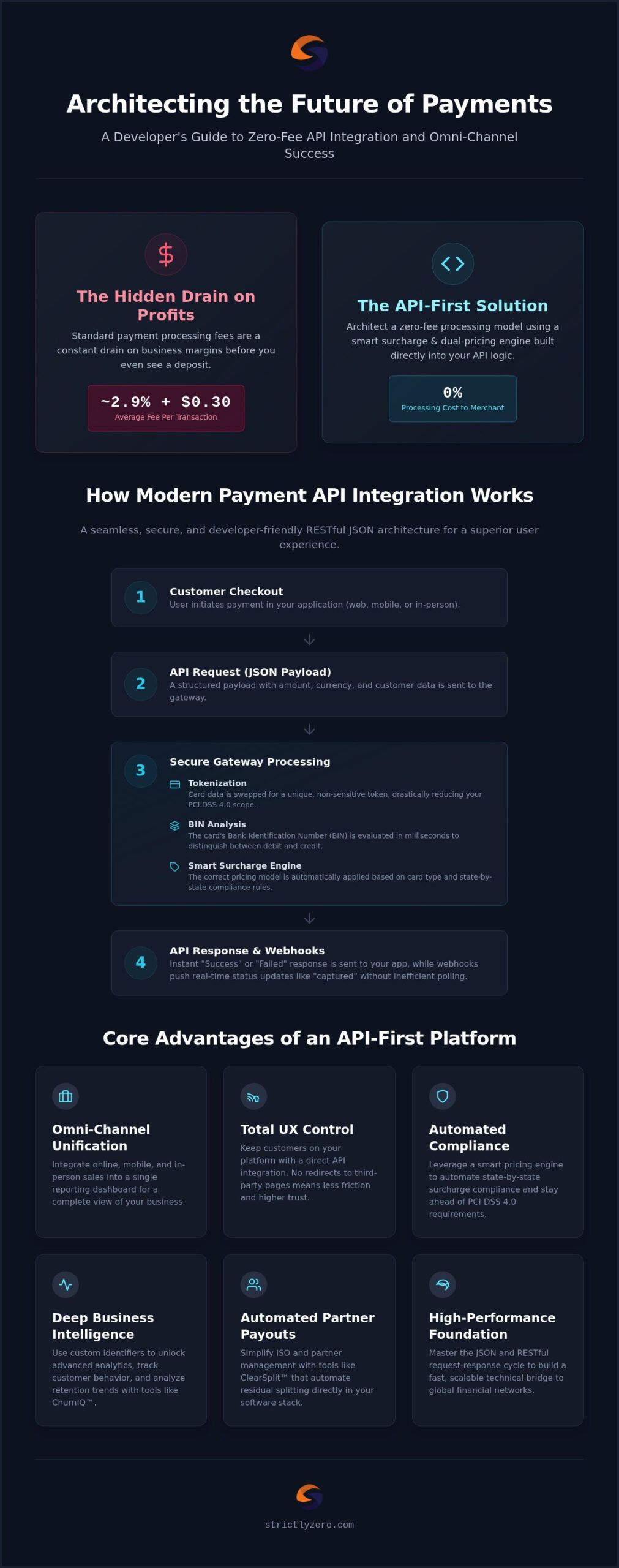
What if every line of code you wrote for a checkout flow actually paid for itself? While standard payment gateway api integration usually focuses on simply getting a “success” response from a server, savvy developers in 2026 are thinking bigger. You already know that high transaction fees, which still average around 2.9% plus $0.30 per transaction, are a constant drain on business margins. It’s frustrating to build a high-performance application only to have the profit margins eroded by the processor before the merchant even sees the deposit.
This guide will teach you how to architect a secure, omni-channel payment experience that eliminates those processing fees through a smart surcharge and dual-pricing engine built directly into your API logic. We’ll show you how to move beyond basic transactions to create a unified system for online, mobile, and in-person sales. You’ll learn how to automate PCI DSS 4.0 compliance and leverage an API-first platform to deliver a zero-fee processing model and unified reporting for every sales channel. By the end of this article, you’ll be able to deploy a payment architecture that protects margins while providing a seamless user experience.
Key Takeaways
- Master the JSON and RESTful request-response cycle to build a high-performance technical bridge between your application and global financial networks.
- Discover how to architect a payment gateway api integration that uses a smart pricing engine to automate state-by-state surcharge compliance.
- Learn the differences between hosted pages and direct post methods to balance user experience control with PCI DSS 4.0 security requirements.
- Streamline your operations by unifying online, mobile, and in-person sales into a single reporting dashboard through an omni-channel API.
- Explore how ClearSplit™ simplifies partner management by automating residual compensation directly within your software stack.
Table of Contents
- What is a Payment Gateway API and Why Does Your 2026 Strategy Need One?
- The Technical Architecture: How Gateway Integration Works
- Choosing Your Integration Method: Hosted vs. Direct Post vs. SDKs
- Step-by-Step: A Developer’s Checklist for Successful Integration
- Why Strictly is the Preferred API for Zero-Fee Merchant Services
What is a Payment Gateway API and Why Does Your 2026 Strategy Need One?
A payment API is the technical bridge that connects your custom software to the complex web of global financial networks. In 2026, a successful payment gateway api integration isn’t just about moving money from point A to point B. It’s about building a scalable infrastructure that handles refunds, manages recurring subscriptions, and facilitates complex payouts through a single entry point. Developers are moving away from simple “buy now” buttons toward sophisticated systems that manage the entire lifecycle of a transaction.
The shift from hosted payment pages to integrated experiences is driven by the need for better user retention. Redirecting a customer to a third-party site often creates friction and distrust. By using an API, you keep the customer on your platform, maintaining brand consistency while securing the data behind the scenes. This control is especially vital for businesses adopting zero-fee models, as the API logic must handle real-time calculations for surcharge and dual pricing programs based on the customer’s location and card type.
How a Payment API Differs from a Standard Gateway
To understand the nuances, we first need to look at What is a Payment Gateway in its traditional sense. While a gateway acts as a secure tunnel for data, an API provides the granular “controls” that allow developers to customize the flow. API-first platforms enable you to build deep logic into your checkout process, ensuring that your ecommerce payment processing is as efficient as possible. You aren’t just sending data; you’re orchestrating an experience that includes fraud checks, tax calculations, and fee management in milliseconds.
The Business Impact of API-Driven Payments
The real power of an API-first approach lies in its ability to solve the biggest pain point for modern businesses: rising transaction costs. By integrating a surcharge engine directly into the code, you can automate the shift of processing fees away from the merchant. This logic needs to be consistent across every touchpoint. A well-designed payment gateway api integration ensures that whether a customer pays on a mobile app, through a web portal, or via a virtual terminal, the pricing rules remain identical.
Beyond the customer-facing side, APIs automate the heavy lifting of the financial backend. For partners and ISOs, tools like ClearSplit™ allow for automated residual splitting. This eliminates the need for manual spreadsheets and reduces the risk of human error in compensation. By automating these tasks, you transform payments from a simple utility into a strategic asset that drives growth and operational efficiency.
The Technical Architecture: How Gateway Integration Works
The foundation of a modern payment gateway api integration rests on a RESTful architecture using JSON. This setup ensures that your application communicates seamlessly with the processing server in a predictable request-response cycle. When a customer clicks “pay,” your application transmits a structured payload. Instead of waiting for a browser redirect, the system handles the transaction in the background, maintaining a smooth user experience. Real-time updates are managed through webhooks. These push status changes like “captured” or “failed” to your server immediately, which eliminates the need for inefficient and resource-heavy polling.
Tokenization is the centerpiece of this architecture. It allows you to handle sensitive data without actually storing it. When a user enters their card details, the information is swapped for a unique, non-sensitive token. This token is what you use for future charges or subscription management. By keeping raw card data out of your database, you drastically reduce your security liability while still providing a “one-click” checkout experience for returning customers.
The Anatomy of a Payment Request
A standard request includes the amount, currency, and card metadata. However, advanced integrations leverage custom fields for deeper business intelligence. Including unique identifiers allows for ChurnIQ™ analysis to track retention trends and customer behavior. The Strictly API specifically evaluates the Bank Identification Number (BIN) to distinguish between debit and credit cards in milliseconds. This distinction is critical. It triggers the surcharge and dual pricing engine, ensuring the correct pricing model is applied automatically based on the card type and the merchant’s specific geographic location.
Security and PCI DSS Compliance in API Integrations
Security is a legal requirement that dictates how you build your stack. Since the March 31, 2025 deadline passed, all organizations must adhere to PCI DSS compliance version 4.0. To reduce your infrastructure’s exposure, use client-side encryption libraries. These ensure that cardholder data is encrypted in the user’s browser and sent directly to the secure vault. This process significantly minimizes the scope of your PCI DSS compliance audit, as the sensitive data never touches your servers. Managing your secret API keys with environment variables rather than hard-coding them is another vital step in protecting your environment. If you’re ready to build a more secure stack, you can explore our developer documentation to see these security features in action.
Choosing Your Integration Method: Hosted vs. Direct Post vs. SDKs
Similarly, for high-volume ecommerce platforms offering digital goods, ensuring a frictionless checkout is key to maintaining customer trust; for instance, you can learn more about Night Bazar™ to see how they optimize their digital storefront.
When you’re designing a custom payment gateway api integration for a large enterprise, you must consider back-office needs. Not all payments happen in a web browser. Your software might need to handle phone orders, mail orders, or administrative tasks without needing a separate physical device. By integrating virtual gateway features into your CRM or internal business tools, you create a seamless workflow for your staff. Strictly’s platform unifies these virtual terminal transactions with your web and mobile sales. This means your reporting is always synchronized and accurate, regardless of where the payment originated.
Embedding the Smart Pricing Engine
A modern API should do the heavy lifting of fee management instead of just passing data. Strictly’s Smart Pricing Engine integrates surcharge and dual pricing logic directly into the transaction flow. It presents two totals to the customer at checkout: one for credit cards and a discounted total for cash or debit. The engine uses automated geolocation to ensure state-by-state compliance in real-time. If a transaction originates in a state where surcharging is restricted, such as Connecticut or Massachusetts, the API adjusts the logic instantly to remain compliant. You don’t need to maintain a complex database of local laws because the API handles the legal logic for you.
Step-by-Step: A Developer’s Checklist for Successful Integration
Successful payment gateway api integration requires a disciplined approach that balances technical performance with strict regulatory compliance. You can’t just plug in a library and hope for the best. Instead, follow a structured sequence to ensure your application remains secure and profitable from day one. By following a clear roadmap, you’ll avoid the common pitfalls that lead to failed transactions or security vulnerabilities.
- Obtain Credentials: Secure your API keys and configure your Sandbox environment. Never use production keys during the development or testing phase.
- Implement Tokenization: Use the secure vault to swap card data for tokens. This keeps your system out of PCI scope and protects sensitive cardholder data.
- Configure Webhooks: Set up listeners for asynchronous events like
charge.succeededorsubscription.deletedto keep your database in sync without manual polling. - Run Edge Case Tests: Simulate declined cards, expired tokens, and high-risk fraud triggers to see how your UI responds to various failure states.
- Deploy and Monitor: Transition to production and use ChurnIQ™ to analyze transaction success rates and customer retention patterns in real-time.
Testing and Sandboxing Best Practices
Your test environment must mirror the real world as closely as possible. Use a variety of test card numbers to verify that your logic correctly identifies debit versus credit cards. This is vital for the Smart Pricing Engine to apply the correct surcharge or dual-pricing totals. In 2026, compliance is more granular than ever. You should specifically test transactions from different zip codes to ensure the API respects state-level restrictions. For instance, verify that the surcharge is automatically suppressed for customers in Connecticut, Maine, Massachusetts, or New York. Measuring API response times during these tests ensures your checkout remains frictionless even during complex logic calculations.
Error Handling and Troubleshooting
A robust integration anticipates failure. Your code should gracefully interpret HTTP status codes to provide actionable feedback. A 401 error usually points to an authentication issue, while a 400 error indicates a malformed request. When a transaction is declined, don’t just show a generic “Error” message. Use the API response to tell the user if they should try a different card or check their billing address. Logging every API call in your development environment allows for faster debugging when unexpected issues arise. If you want to streamline this process, sign up for a developer account to access our full suite of testing tools and documentation.
Why Strictly is the Preferred API for Zero-Fee Merchant Services
Strictly stands apart from traditional processors by offering an API-first platform that solves the margin problem at the source. Most developers view processing fees as a fixed cost of doing business, but Strictly changes that narrative. By integrating surcharge and dual-pricing logic directly into the code, you can build applications that offer zero fee merchant services without manual intervention. This isn’t just a secondary tool; it’s a fundamental part of your payment gateway api integration that works in real-time to protect merchant profits.
The platform provides AI-driven fraud prevention that analyzes every transaction as it happens. This layer of security works alongside the tokenization methods discussed earlier to protect both the merchant and the end consumer. As your client base grows, the omni-channel nature of the API allows you to scale from a single e-commerce site to a multi-channel enterprise. You can manage web, mobile, and virtual terminal payments through one unified interface, ensuring that reporting and compliance remain consistent across the board.
The Developer-First Ecosystem at Strictly
Building on Strictly means you’re never starting from scratch. The documentation is designed for rapid deployment, providing clear endpoints for everything from simple authorizations to complex subscription billing. Beyond the code, Strictly offers dedicated support for enterprise-level custom integrations. This ensures that even the most complex business logic is supported by a stable and high-uptime infrastructure. You can also future-proof your software by leveraging built-in POS lending options, giving your merchants more ways to close high-ticket sales without taking on additional financial risk themselves.
Partnering for Growth
For ISOs and software partners, the platform offers tools that go beyond simple processing. ClearSplit™ is a vital tool for managing residual compensation. It automates the splitting of partner residuals, removing the administrative burden of manual calculations and reducing the risk of human error. This allows you to focus on attracting and retaining high-volume merchants rather than managing spreadsheets. By providing a payment gateway api integration that actually saves the merchant money, you create a stickier product with higher lifetime value.
If you’re ready to stop losing margins to transaction fees, it’s time to switch to a platform built for the modern developer. You can Integrate with Strictly and eliminate your processing fees today to start building a more profitable future for your business and your clients.
Build a More Profitable Payment Infrastructure
Mastering your payment gateway api integration is no longer just a technical requirement; it’s a strategic move to reclaim your business margins. By shifting to a RESTful architecture that prioritizes tokenization and automated webhook responses, you’ve already secured your data and improved the user experience. The final step is moving beyond the standard fee-heavy models of the past to embrace a system that optimizes every cent.
Strictly empowers you to deploy a compliant Surcharge and Dual Pricing Engine that eliminates processing costs at the code level. Whether you’re managing complex residuals with ClearSplit™ or protecting transactions with AI-driven fraud prevention, our platform scales with your ambition. You now have the technical roadmap to build an omni-channel experience that is both secure and cost-effective. You don’t have to settle for high transaction fees when the technology exists to bypass them entirely.
Start Your Zero-Fee API Integration with Strictly and take control of your financial stack today. You’re ready to build a system that drives growth without sacrificing profit. The future of payments is integrated, automated, and fee-free.
Frequently Asked Questions
What is the difference between a payment gateway and a payment API?
A payment gateway is the underlying service that authorizes and processes transactions, while a payment API is the technical interface developers use to connect their software to that service. Think of the gateway as the financial infrastructure and the API as the control panel. Modern payment gateway api integration allows for a fully customized checkout experience, whereas traditional gateways often rely on simple redirects to external hosted pages.
How long does it typically take to integrate a payment gateway API?
Integration timelines depend on the method you select, but a basic setup using hosted pages can often be completed in just a few days. A custom, direct post integration for a complex enterprise application typically requires two to four weeks of development. This timeframe includes setting up your sandbox environment, implementing secure tokenization, and thoroughly testing webhooks to ensure they correctly handle asynchronous transaction events before you go live.
Is a payment API integration secure for my customers?
Yes, these integrations are highly secure when they follow PCI DSS 4.0 standards. By using client-side encryption and tokenization, sensitive cardholder data is swapped for a non-sensitive token before it ever reaches your server. This process minimizes your security liability and protects customers from data breaches. Strictly also incorporates AI-driven fraud prevention to monitor every transaction for suspicious activity in real-time, providing an extra layer of defense.
Can I use a payment API to eliminate credit card processing fees?
You can eliminate merchant fees by using an API that supports a compliant surcharge or dual-pricing program. This logic is built directly into the transaction flow, which automatically calculates and applies a surcharge to credit card transactions while offering a lower price for debit or cash. This allows your business to shift the cost of processing to the customer in a way that remains compliant with diverse state laws and regulations.
What programming languages are supported for payment gateway APIs?
Most modern APIs use RESTful architecture, which means they support any programming language capable of making HTTP requests and handling JSON. Common choices include Node.js, Python, Ruby, PHP, and Java. Strictly provides comprehensive documentation and SDKs for these languages to streamline the payment gateway api integration process. This flexibility ensures your development team can work in the environment they’re already most comfortable using while maintaining high performance.
How does a payment API handle recurring billing and subscriptions?
Recurring billing is managed by securely vaulting customer tokens and associating them with specific subscription logic. The API automates the charging process at defined intervals, such as monthly or annually, without requiring the customer to re-enter their card details. You can use webhooks to receive instant notifications for successful payments or failed attempts. This allows your system to automatically manage user access or trigger automated dunning emails for any failed transactions.
Do I need a merchant account before I can integrate an API?
You do need a merchant account to accept payments, but many modern providers act as both the payment processor and the gateway. When you sign up for a platform like Strictly, you’re usually setting up your merchant account and API access at the same time. This unified approach simplifies the onboarding process. It allows you to move from the sandbox environment to live processing without needing to coordinate between multiple different financial institutions.
What is the cost of integrating a payment gateway API in 2026?
Industry data for 2026 shows that development labor for a basic integration using standard SDKs typically costs between $5,000 and $10,000. For custom API development on complex web platforms, businesses should budget between $10,000 and $30,000. Mobile applications often require a higher investment, ranging from $15,000 to $50,000 depending on complexity. These figures represent the technical labor involved in building the checkout flow, rather than the ongoing transaction fees charged by the processor.