
Mastering the Shift: Getting Buy-in for a Surcharge Program in 2026
Published:

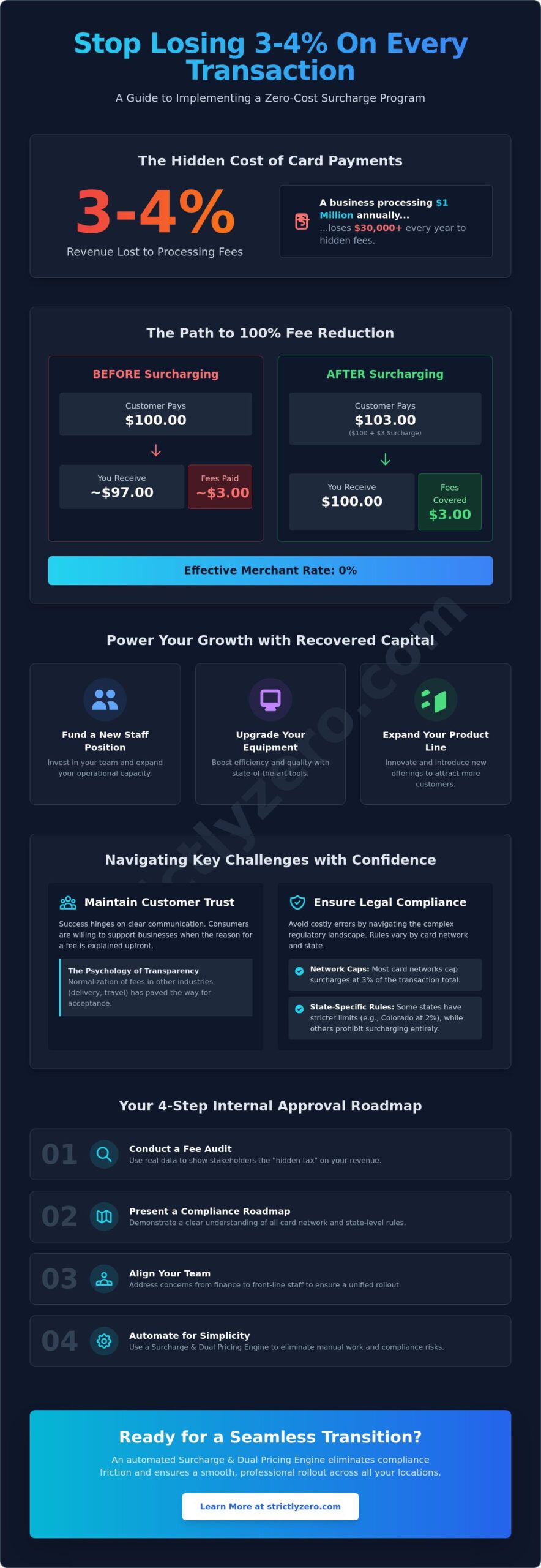
What if the 3% to 4% your business loses on every credit card transaction wasn’t an unavoidable cost of doing business, but a reinvestment fund for your company’s growth? In 2026, interchange fees continue to squeeze margins, leaving many leaders feeling stuck between rising operational costs and the fear of driving loyal customers away. Learning how to implement a surcharge program is no longer just a financial calculation; it’s a strategic shift that requires balancing technical compliance with human psychology.
We know the hesitation you’re feeling. It’s common to worry about customer churn or the complexity of managing different rules in states like Colorado, where caps are strictly set at 2%. You’ll learn the exact strategies to secure internal stakeholder approval and maintain customer loyalty while implementing a zero-cost processing model. We’ll preview the roadmap for a smooth transition, showing you how to leverage a surcharge and dual pricing engine to automate compliance across all locations. By the end of this guide, you’ll have a clear path to 100% fee reduction without risking your brand’s reputation.
Key Takeaways
- Discover how to reclaim 3% to 4% of your revenue by shifting processing costs away from your bottom line and back into business growth.
- Learn how to address the top concerns of CFOs and front-line staff to ensure a unified internal front before your rollout.
- Master the psychology of transparency to maintain customer trust while learning how to implement a surcharge program that feels fair and professional.
- Navigate the complex 2026 regulatory landscape, including state-specific prohibitions and the critical 3% network cap, to avoid costly compliance errors.
- See how an automated Surcharge & Dual Pricing Engine can eliminate the manual friction of managing multi-state rules and card network requirements.
Table of Contents
- The Business Case: Why Surcharge Programs are Essential in 2026
- Securing Internal Buy-in: From Finance to Front-line Staff
- Winning Over Your Customers: Transparency and Psychology
- Navigating the Compliance Landscape to Reduce Friction
- Implementing a Seamless Surcharge Program with Strictly
The Business Case: Why Surcharge Programs are Essential in 2026
Traditional fee structures that once felt like a minor cost of doing business have morphed into a significant barrier to profitability. In 2026, many U.S. businesses find themselves paying 3% to 4% or more for every card transaction once all fees are settled. These rising costs aren’t just a nuisance; they’re unsustainable for merchants operating on thin margins. To understand the fundamentals of this shift, many merchants first look at what is a surcharge program to see how these fees have evolved from a niche practice into a mainstream financial strategy. Learning how to implement a surcharge program effectively allows you to stop absorbing these costs and start protecting your bottom line.
The economic pressure of 2026 has made margin recovery a top priority for small to mid-sized enterprises. By shifting the cost of acceptance to the cardholder, you gain a competitive advantage that can be used to hedge against inflation or reinvest in your team. Watch this demo to see how compliant surcharging works in practice:
The Math of Margin Recovery
Market Trends: The Normalization of Convenience Fees
Securing Internal Buy-in: From Finance to Front-line Staff
Success doesn’t just come from the software you choose. It starts with your team. Many business owners worry about how to implement a surcharge program without causing internal friction or losing customers. To win, you must align three key groups: the finance team, store management, and your front-line customer service staff. Each group has different priorities. Your CFO wants to see the margin recovery, while your managers want to ensure that checkout lines keep moving without complaints.
The primary concern across all levels is usually the fear of a sales volume drop. Address this by showing that when fees are presented clearly, customer churn is typically negligible. Aligning the shift with long-term goals, like avoiding price hikes on products or services, helps everyone see the surcharge as a protective measure rather than a penalty. If you want to see how this works in a live environment, exploring a Surcharge & Dual Pricing Engine can help visualize the automated transparency that puts these fears to rest.
The 4-Step Internal Approval Process
- Step 1: Conduct a fee audit. Show exactly how much interchange fees cost the company last year. Use real data to illustrate the “hidden tax” on your revenue.
- Step 2: Present a compliance roadmap. Use resources like the National Conference of State Legislatures for Navigating the Compliance Landscape to show that your plan is legally sound and follows card network rules.
- Step 3: Run a pilot program. Test the new model in one location or a specific sales channel. Gather data on customer reactions and transaction times to prove the concept works.
- Step 4: Formalize the rollout. Create a clear internal communication plan. Ensure every department knows the timeline and their specific role in the launch.
Training Your Front-Line Staff
Your cashiers are the face of this change. They shouldn’t feel like they’re “defending” a fee. Instead, empower them with scripts that focus on choice. For example, a cashier might say, “Our prices reflect a cash discount. There’s a small service fee for credit card use to cover processing costs, but you can avoid it by using a debit card or cash.” This shifts the narrative from a penalty to a consumer choice.
Role-playing is essential. Practice common scenarios where a customer might be surprised by the line item on their receipt. When staff understand the “Why” (that this allows the business to keep base prices stable despite rising costs), they speak with more confidence. Teaching your team how to implement a surcharge program at the point of sale is just as important as the technical setup. When they’re confident, your customers will be too.
Winning Over Your Customers: Transparency and Psychology
Customer perception is the biggest hurdle when deciding how to implement a surcharge program. Most shoppers understand that businesses face rising operational costs, especially with inflation and high interchange rates. Transparency builds a bridge of trust that hidden price hikes simply can’t. If you bury the cost of processing inside a 5% increase across your entire inventory, you’re penalizing cash and debit users. By being upfront, you provide a choice. This honesty is central to The Business Case for Surcharging, where clarity outweighs the risk of a slightly higher total at checkout.
Signage is your first line of defense. It shouldn’t look like a warning; it should look like a standard business disclosure. Best practices suggest placing notices at every entrance and at the point of sale. This ensures there are no surprises when the receipt is printed. You must also handle the debit card exception carefully. Surcharging is strictly for credit cards. Charging a fee on a debit transaction, even if processed through a “run as credit” method, is a violation of network rules that can lead to heavy fines and merchant account termination.
Crafting the Perfect Customer Notice
The language you choose matters. Using the term “Credit Card Surcharge” is often more effective than “Convenience Fee” because it clearly identifies what the fee covers. It sounds institutional and fair. Even if your state doesn’t mandate a 30-day notice period, providing one is a smart move for brand loyalty. It gives your regular customers time to adjust their payment habits. Linking the fee to the actual cost of acceptance educates the consumer on why the fee exists, turning a potential point of friction into a moment of shared understanding.
Leveraging Dual Pricing for Maximum Buy-in
If you’re worried about the “penalty” feel of a surcharge, dual pricing is the gold standard. Instead of adding a fee at the end, you display two prices for every item: a Cash Price and a Card Price. This makes the discount feel like a reward for cash users rather than a punishment for credit users. Modern technology makes this seamless. A Surcharge & Dual Pricing Engine can automate these calculations at the terminal level, ensuring your staff doesn’t have to do manual math. Understanding how to implement a surcharge program through a dual pricing lens is often the easiest way to get customer buy-in. For a deeper look at this model, read our comprehensive guide on Zero Fee Credit Card Processing: The 2026 Merchant Guide to $0 Fees. This approach ensures 100% compliance while keeping the customer experience smooth and positive.
Navigating the Compliance Landscape to Reduce Friction
Compliance is the most daunting part of learning how to implement a surcharge program. It isn’t just about turning on a feature; it’s about following a patchwork of state laws and card network rules that change frequently. In 2026, the regulatory environment remains complex. Connecticut, Massachusetts, and Puerto Rico still prohibit credit card surcharges entirely. If your business operates across state lines, you must also account for regional caps, such as Colorado’s strict 2% limit. Failing to respect these boundaries doesn’t just lead to fines; it erodes the trust you’ve built with your customers and stakeholders.
The card networks have their own set of non-negotiable rules. As of 2026, the critical cap for Visa is the lesser of your cost of acceptance or 3%. Exceeding this limit is the fastest way to trigger an audit or lose your processing privileges. You’re also required to provide your acquirer with 30 days’ advance written notice before you flip the switch. Managing these details manually is nearly impossible for a growing business, which is why many leaders turn to a Surcharge & Dual Pricing Engine to handle the heavy lifting of regional compliance and network registration automatically.
The Legal Pillars of a Compliant Program
A legally sound program distinguishes between brand-level and product-level surcharges. A brand-level surcharge applies to all credit cards from a specific network, like Visa or Mastercard, while a product-level surcharge applies only to specific types of cards within that network. For most merchants, brand-level is the standard approach because it’s easier for customers to understand. Regardless of the level you choose, every surcharge must appear as a separate line item on the customer’s receipt. This isn’t just a rule; it’s your best defense against chargebacks. When a customer sees the fee clearly labeled, they’re much less likely to dispute the transaction later. For more on managing these operational details, see our Credit Card Processing for Small Business: The 2026 Essential Guide.
The Role of the Smart Pricing Engine
Modern surcharging requires real-time intelligence. You cannot legally surcharge a debit card, even if the customer chooses “credit” at the terminal. Manual detection is a high-risk strategy that often leads to accidental violations and massive fines. AI-driven tools now solve this by detecting the card type instantly through the Bank Identification Number (BIN) before the transaction is finalized. These systems ensure that the fee is only applied when it’s legal to do so. Automated state-by-state compliance updates protect the merchant from shifting legal landscapes without requiring constant manual oversight. This level of automation allows you to focus on growth while the software ensures you stay on the right side of the law in every jurisdiction where you do business.
Implementing a Seamless Surcharge Program with Strictly
Choosing the right technology partner is the final piece of the puzzle when you’re deciding how to implement a surcharge program. Strictly’s platform is designed to take the heavy lifting of compliance and stakeholder buy-in off your plate through high-level automation. By integrating a Surcharge & Dual Pricing Engine directly into your workflow, you eliminate the risk of human error that often leads to network fines or customer disputes. Our platform ensures that your business remains 100% compliant across all 50 states; it automatically adjusts for the specific prohibitions in Connecticut or the 2% caps in Colorado without your staff needing to lift a finger.
Omni-channel flexibility is a core strength of the Strictly ecosystem. Your business isn’t limited to a single point of sale. You can apply compliant surcharging across in-person transactions, online checkouts, and even via mobile payment links sent directly to customers. This consistency ensures that your margin recovery strategy is uniform across every sales channel. For partners and ISOs, our Partner Management Tools offer the ability to scale these zero-fee programs across entire portfolios, providing a transparent and reliable way to help merchants reclaim their revenue. When the technical hurdles are automated, the conversation shifts from if we should do this to how quickly we can start.
Beyond the Terminal: A Unified Payment Ecosystem
Surcharging shouldn’t be a siloed feature. It works best when it’s part of a unified payment ecosystem. Strictly allows you to integrate surcharging into your existing virtual terminal and invoicing workflow, making it easy for B2B companies or service providers to manage fees on professional invoices. While you’re recovering margins, our AI-Driven Fraud Prevention works in the background to protect those recovered funds from chargebacks and unauthorized transactions. This dual layer of protection ensures that your zero-fee model is both profitable and secure. For those looking to support other businesses in this transition, check out The Ultimate Payment Processing Platform for ISOs: Scale in 2026.
Next Steps: Launching Your Zero-Fee Future
The transition to a zero-fee future is a journey, but it doesn’t have to be a difficult one. Most businesses can expect a smooth transition within their first 90 days as they move through the notification and setup phases. We recommend starting with a customized Strictly surcharge audit to identify exactly where your current fees are eating your profits. This audit provides the data-driven proof needed to finalize internal buy-in and set your rollout in motion. Don’t let interchange fees dictate your growth potential any longer. You can eliminate fees with Strictly’s Smart Surcharge Program today and start reinvesting that 3% to 4% back into what matters most: your business.
Secure Your Margins and Your Future
The transition to a zero-cost processing model is a defining move for any merchant looking to thrive in the 2026 economy. You now have the roadmap to reclaim that 3% to 4% in interchange fees while keeping your internal teams and customers aligned. By prioritizing transparency and using data-driven audits, you turn a technical change into a strategic win for your brand’s long-term financial health. Learning how to implement a surcharge program is about more than just software; it’s about shifting your business culture toward efficiency and growth.
Execution is much simpler when you have the right tools in place. Our Smart Pricing Engine manages automated compliance across all 50 states, while ClearSplit™ handles partner residuals without the manual headache. Whether you’re operating in retail or e-commerce, our omni-channel support ensures a seamless experience for every transaction. It’s time to stop letting fees eat your profits and start reinvesting in your company’s potential.
Ready to eliminate fees? Explore Strictly’s Smart Surcharge Program and take the first step toward a more profitable future today. You’ve got the strategy; now it’s time to launch.
Frequently Asked Questions
Is getting buy-in for a surcharge program difficult in 2026?
Buy-in is easier than it was in previous years because surcharging has become a normalized part of the digital economy. Most internal stakeholders and board members approve the shift once they see how it prevents the need for across-the-board price hikes. The key is presenting the program as a tool for margin protection rather than a simple fee increase.
What is the most common objection from customers regarding surcharges?
The most common objection is the feeling of being “penalized” for their payment choice at the very end of a transaction. You can avoid this friction by using clear signage and teaching your staff how to implement a surcharge program as a transparent choice. When customers understand that they can avoid the fee by using a debit card or cash, the objection usually fades.
Can I apply a surcharge to debit card transactions if the customer agrees?
No, you cannot surcharge a debit card under any circumstances. Federal law and card network rules strictly prohibit adding a surcharge to debit or prepaid card transactions, even if the customer chooses to run the card as “credit” at the terminal. Doing so is a major compliance violation that can lead to heavy fines or the loss of your merchant account.
How do I explain a surcharge program to my board of directors?
Focus your explanation on margin recovery and the immediate impact on the company’s bottom line. Show the board that the 3% to 4% currently lost to interchange fees can be redirected into capital projects or employee retention. When they see how to implement a surcharge program as a way to reclaim tens of thousands of dollars in lost revenue, the business case becomes undeniable.
What happens if I implement a surcharge without notifying the card brands?
Implementing a surcharge without notification puts your business at risk for immediate fines and account suspension. Visa and Mastercard require 30 days’ advance written notice to your acquirer before you can legally begin surcharging. Skipping this step is a fast way to trigger an audit and lose your ability to process credit cards entirely.
Does a surcharge program affect my PCI DSS compliance status?
A surcharge program doesn’t change your required PCI DSS level, but it does require that your technology is secure. You must ensure that your surcharge software is fully integrated with your processor and doesn’t store sensitive card data. Using a compliant Surcharge & Dual Pricing Engine helps maintain your security standards while automating the fee calculations.
Is dual pricing better for customer buy-in than surcharging?
Dual pricing is often better for customer buy-in because it frames the lower price as a cash discount rather than a credit penalty. Psychologically, customers respond more positively to receiving a “reward” for using cash or debit than they do to seeing an extra fee added to their total. This model often leads to lower churn and higher overall satisfaction.
How much can a business actually save with a surcharge program?
Most businesses save their entire cost of credit card acceptance, which typically ranges from 2.5% to 4% of their annual credit volume. For a company processing $1 million in credit cards, this results in roughly $30,000 to $40,000 in annual savings. These funds go directly back into the business’s operating budget instead of being paid out to banks.