
Merchant Account Reconciliation: Complete 2026 Guide
Published:

Why does your bank deposit never match your daily sales report, and what if that discrepancy wasn’t an inevitable part of doing business? It’s frustrating to watch unexplained merchant fees eat into your margins while you spend hours on manual merchant account reconciliation every month. You aren’t alone in your confusion over how chargebacks and processing costs appear on your statements, often leaving you with a sense of revenue leakage you can’t quite pin down.
This 2026 guide will help you master the art of matching every cent of your sales to your actual bank deposits. You’ll learn how to leverage zero-fee processing models and smart pricing engines to eliminate the fee discrepancy headache once and for all. We’ll explore automated compliance, unified reporting for omni-channel sales, and the specific steps to turn a complex closing process into a streamlined, transparent workflow that gives you complete visibility into your processing costs.
Key Takeaways
- Learn how to identify revenue leakage and fraud by mastering the 5-step process for merchant account reconciliation.
- Understand the three pillars of financial statements, including how to align internal POS records with your processor’s gross volume.
- Explore how surcharge and dual pricing models help your bank deposits match your gross sales perfectly.
- Discover the benefits of using a Smart Pricing Engine to automate compliance and eliminate the headache of fee discrepancies.
- Determine the exact point when your business should move from manual spreadsheets to automated omni-channel reporting for faster monthly closing.
Table of Contents
- Why Merchant Account Reconciliation is Critical for Cash Flow
- The Three Pillars of Merchant Statement Reconciliation
- Manual Spreadsheets vs. Automated Reconciliation Software
- How to Reconcile Your Merchant Account: A 5-Step Process
- Simplifying Reconciliation with Zero-Fee Processing Models
Why Merchant Account Reconciliation is Critical for Cash Flow
At its core, merchant account reconciliation is the process of comparing your internal sales records from your Point of Sale (POS) or e-commerce platform against the actual deposits appearing in your bank account. While it sounds like a standard administrative task, it’s actually the most effective way to verify that every dollar earned is a dollar received. This practice is a specialized form of accounting reconciliation that focuses specifically on the complex lifecycle of a digital payment.
Neglecting this process often leads to revenue leakage, where small discrepancies in fees or unrecorded chargebacks quietly drain your margins. It acts as a vital early warning system. If you notice a sudden spike in unmatched transactions, you might be facing a wave of fraud or a technical glitch in your checkout flow. Maintaining clean books isn’t just about catching errors; it’s also a prerequisite for securing reliable credit card processing for small business. Lenders and processors want to see that you have total control over your cash flow before they offer higher volume limits or better terms.
The “Gap” Problem: Gross Sales vs. Net Deposits
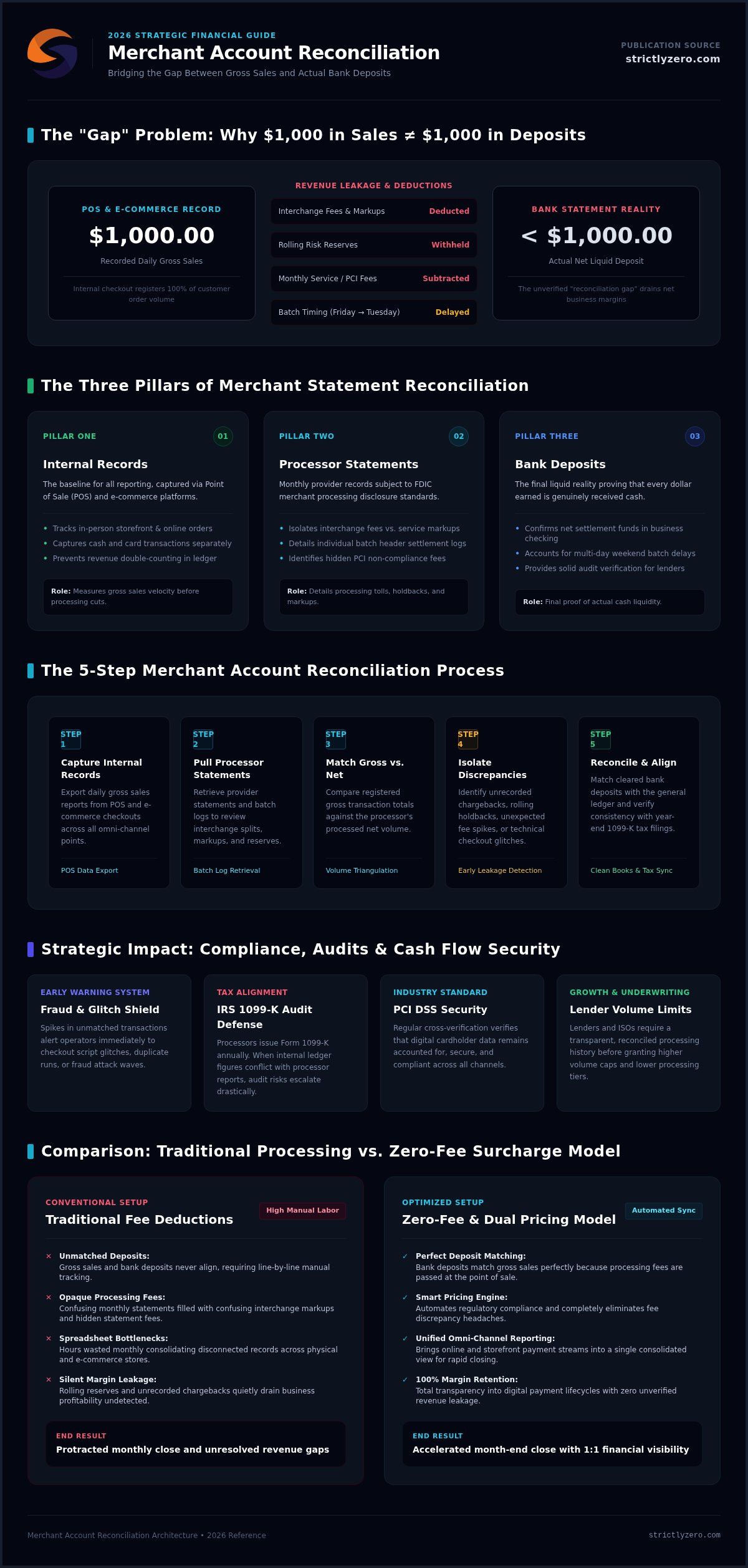
Many business owners are surprised to find that $1,000 in daily sales rarely results in a $1,000 bank deposit. This discrepancy occurs because of several moving parts, including interchange fees, monthly service charges, and rolling reserves that processors might hold to mitigate risk. Batch timing also plays a role; a sale made on Friday night might not hit your bank until Tuesday. The reconciliation gap is the delta between recorded revenue and liquid cash.
Reconciliation as a Compliance Requirement
Regularly matching your records supports PCI DSS compliance by ensuring all transaction data is accounted for and secure. It also simplifies your annual tax reporting. Your merchant processor will issue a 1099-K form at the end of the year, and if your internal records don’t align with this document, you could face an IRS audit. If you operate in the UK and need to ensure your bookkeeping meets statutory compliance standards, check out Mazuma for professional accountancy and Making Tax Digital support. For businesses looking to scale through partner programs or ISO opportunities, having a transparent history of processing volume is essential. Using a platform with unified reporting makes this much easier, as it brings all your omni-channel data into one view, reducing the manual labor required to stay compliant.
The Three Pillars of Merchant Statement Reconciliation
To achieve a successful merchant account reconciliation, you must align three distinct data sources into a single version of truth. Relying on just one report leaves your business vulnerable to errors or fraud that could go unnoticed for months. By triangulating your internal sales, processor data, and bank deposits, you create a closed-loop system where every penny is accounted for. This structural approach is the only way to ensure your financial health remains intact as you scale.
Internal Records: Capturing Every Transaction
Your internal records serve as the baseline for all financial reporting. For modern businesses, this often involves managing ecommerce payment processing alongside physical storefront sales. An omni-channel reporting system is essential here. It allows you to see how data flows from different sources into your general ledger without manual intervention. You should ensure your system captures cash and credit transactions separately but within the same reporting period. This prevents the “double-counting” of revenue that often plagues businesses using disconnected tools for online and in-person sales.
Processor Statements: Decoding the Fees
The second pillar is the monthly statement provided by your merchant service provider. These documents can be notoriously difficult to read, especially when trying to differentiate between interchange fees and service markups. Understanding FDIC merchant processing guidelines can help you grasp the regulatory framework that processors must follow when reporting these costs. You need to look beyond the total “net deposit” and identify batch headers, PCI non-compliance fees, or hidden statement charges that might be eroding your profits.
If you use a surcharge or dual pricing model, your statement will look different. Instead of a long list of deducted fees, you’ll see deposits that more closely align with your gross sales because the processing costs were passed to the customer at the point of sale. This significantly simplifies the merchant account reconciliation process. To streamline this even further, consider using omni-channel unified reporting that integrates directly with your accounting workflow. Finally, your bank statements act as the ultimate verification. They confirm that the funds the processor claimed to send actually cleared and became liquid capital for your business.
Manual Spreadsheets vs. Automated Reconciliation Software
For many startups, the “Excel Era” is a rite of passage. Manual merchant account reconciliation works when you have low transaction volumes and a single sales channel. It’s cost-effective and provides a granular look at every line item. However, as you scale, this manual approach quickly hits a breaking point. Signs you’ve outgrown your spreadsheet include spending entire weekends on data entry or failing to spot discrepancies until they’ve already impacted your cash flow. While basic integrations with tools like QuickBooks or Xero help, they often struggle with complex mapping when multiple payment methods or surcharge models are involved.
The Limitations of Manual Reconciliation
Manual processes are inherently prone to human error. A single transposition mistake or a missed chargeback notification can throw off your entire month-end close. There’s also a significant “time-to-insight” delay. If you only reconcile every 30 days, you might discover a recurring billing error or a fraud spike long after it’s too late to dispute the transactions. High-growth merchants or those with multiple locations find that manual data entry simply doesn’t scale; it becomes a bottleneck that prevents real-time financial decision-making and increases the risk of revenue leakage. For self-employed professionals and small business owners who dislike conventional accounting, you can discover Hate Ledger to simplify bookkeeping with a plain-English approach.
The Benefits of API-First Payment Platforms
Modern API-first platforms solve these issues by automating the data syncing process. You no longer have to spend hours downloading and formatting CSV exports from different portals. Instead, your sales data, processor fees, and bank deposits are unified in one dashboard. This provides real-time visibility into your zero fee credit card processing performance, ensuring your surcharge or dual pricing model is working exactly as intended. These platforms also align with FDIC merchant processing compliance guidelines, giving you peace of mind during audits.
Advanced tools like ChurnIQ™ even allow you to analyze customer behavior during the merchant account reconciliation process, turning a routine accounting task into a strategic growth opportunity. By integrating AI-driven fraud prevention directly into your reporting, you reduce the manual workload and protect your revenue simultaneously. This automated approach doesn’t just save time, it provides the clean, transparent data required to scale a modern business without the friction of traditional merchant services.
How to Reconcile Your Merchant Account: A 5-Step Process
Executing a consistent merchant account reconciliation process prevents small errors from snowballing into major financial headaches. By following a structured five-step workflow, you can ensure your books stay balanced without wasting hours in spreadsheets. While previous sections explored the structural pillars of this task, this section provides the practical roadmap your finance team needs to succeed.
- Step 1: Gather your documents. Collect your internal sales data from your POS or virtual terminal, your merchant processor reports, and your bank statements for the specific period you’re reviewing.
- Step 2: Match gross volume. Compare your total internal sales to the gross volume reported by your processor. These figures should align perfectly before any fees or deductions are applied.
- Step 3: Account for deductions. Subtract processing fees, service charges, and any chargebacks from the gross total to calculate your “expected deposit” for the batch.
- Step 4: Verify bank entries. Compare that expected deposit figure to the actual credits appearing on your bank statement.
- Step 5: Investigate and adjust. Record any necessary adjustments for timing or fees and immediately investigate any discrepancies that don’t have an obvious explanation.
Investigating Common Discrepancies
Timing differences are the most frequent culprit for unmatched records. Sales made on a Friday or Saturday often won’t settle until Tuesday, creating a temporary gap in your weekend reporting. Chargeback management also adds complexity. When a customer disputes a charge, the processor pulls those funds back immediately, often alongside a separate penalty fee that you must account for. You should also watch for partial refunds. These reduce your final batch totals and can make it difficult to match individual transactions if your system doesn’t log the refund against the original sale date.
Streamlining the Review Process
Creating a standardized reconciliation checklist ensures your finance team follows the same logic every time, reducing the risk of human error. For high-volume merchants, moving from monthly to daily reviews is a game-changer. Daily reconciliation reduces the “closing window” at month-end by 70%. This proactive approach allows you to spot fraud, double-billing, or technical errors within 24 hours rather than discovering them weeks later during a month-end crunch. If you’re tired of chasing pennies and want a cleaner workflow, switch to Strictly’s automated reporting to see your sales and deposits align effortlessly.
Simplifying Reconciliation with Zero-Fee Processing Models
Traditional credit card processing often feels like a daily math puzzle. You start with your gross sales, subtract various interchange rates, and then account for processor markups. By the time the money hits your bank, the numbers rarely look like the ones in your POS system. This complexity is why merchant account reconciliation takes so much time. However, switching to a surcharge or dual pricing model changes the fundamental logic of your accounting. In these models, the processing fee is passed to the customer at the point of sale, meaning your bank deposit finally matches your gross sales amount.
The primary advantage here is the elimination of the “fee math” headache. You don’t have to spend hours calculating complex interchange rates or wondering why a specific transaction cost more than expected. Our Smart Pricing Engine automates the compliance aspect of this process by staying updated on state-by-state regulations. This ensures that your business remains compliant while providing the cleanest possible audit trail. By using zero fee merchant services that utilize this model, you can focus on growth rather than forensic accounting.
Reconciling Surcharges and Dual Pricing
When you implement a surcharge model, your reporting needs to reflect the “service fee” as a distinct line item. It’s vital to ensure your POS system and your processor’s dashboard are perfectly in sync. You’ll track surcharge revenue as a direct offset to your processing expenses, which keeps your profit and loss statement accurate. Strictly’s unified reporting provides full transparency into these transactions. You can see exactly how much was collected in service fees and how those funds covered the processing costs, making it simple to verify that your revenue leakage has been eliminated.
Moving Toward a $0 Processing Fee Future
Transitioning from a traditional fee structure to a surcharge model is simpler than most business owners expect. It doesn’t require breaking your existing accounting flow; instead, it refines it. The psychological and operational benefit of seeing your bank statement match your sales reports every morning cannot be overstated. It provides a level of financial clarity that traditional models simply can’t offer. You’ll spend less time on merchant account reconciliation and more time serving your customers. Ready to simplify your books? Learn more about our Zero Fee Merchant Services and see how our surcharge engine can transform your monthly closing process.
Take Control of Your Monthly Close
Mastering merchant account reconciliation is no longer just a task for the accounting department; it’s a strategic move that protects your margins and provides a clear window into your business health. By moving away from the manual “Excel Era” and embracing automated workflows, you can eliminate the data entry errors that lead to costly revenue leakage. The transition to an omni-channel approach ensures that whether you sell online or in-person, every transaction is accounted for without the frustration of unexplained fee discrepancies.
The path to a cleaner audit trail starts with transparency and better technology. With our compliant Smart Pricing Engine and unified omni-channel reporting, you can finally stop chasing pennies and start scaling with confidence. Our no hidden fees promise ensures that your bank deposits match your sales records perfectly. It’s time to stop letting complex processing math drain your time and your profits.
Eliminate processing fees and simplify your reconciliation with Strictly. You’ve built a great business; let’s make sure your financial processes are just as strong.
Frequently Asked Questions
How often should I reconcile my merchant account?
You should perform merchant account reconciliation daily if you have a high transaction volume. While a monthly check is the bare minimum, daily reviews allow you to catch errors or fraud before they compound. This practice reduces your month-end closing time significantly. If your business is smaller, a weekly schedule might suffice, but consistency is the key to preventing revenue leakage and maintaining a healthy cash flow.
What are the most common causes of reconciliation discrepancies?
Discrepancies usually stem from timing differences, processing fees, or unrecorded chargebacks. Weekend batches often settle on different days than weekday sales, creating a temporary gap in your records. Other common issues include hidden statement fees or technical glitches in your POS system that fail to log a refund correctly. Identifying these variables early ensures your internal ledger stays aligned with the actual liquid cash sitting in your bank account.
How do I handle chargebacks during the reconciliation process?
You should treat chargebacks as immediate deductions from your expected deposits. When a customer disputes a charge, the processor pulls the funds back along with a penalty fee, often before you’ve had a chance to respond. Record these as separate line items in your ledger rather than simply lowering your total sales figure. This keeps your gross revenue data accurate while accounting for the specific loss in your bank balance.
Does a surcharge program make reconciliation harder or easier?
A surcharge program makes merchant account reconciliation significantly easier for most businesses. Since the processing fees are passed to the customer at the point of sale, your net bank deposits will match your gross sales figures. You won’t have to spend hours calculating complex interchange rates or markups. Strictly’s Smart Pricing Engine handles the automated compliance, ensuring that your audit trail remains clean and transparent without manual math.
What is the difference between a merchant statement and a bank statement?
A merchant statement provides a detailed breakdown of your processing activity, including gross volume, interchange fees, and batch totals. In contrast, a bank statement only shows the final amount of money that was actually deposited into your account. Reconciliation is the act of matching these two documents to ensure the processor sent exactly what your sales reports predicted, accounting for any fees or reserves held along the way.
Why do my weekend sales take longer to appear in my bank account?
Weekend sales take longer to appear because banks and settlement networks generally don’t process transactions on Saturdays, Sundays, or federal holidays. While your processor might batch your sales every night, the banking system’s legacy infrastructure creates a delay. Most Friday and Saturday transactions won’t hit your bank account until Tuesday morning. Understanding this settlement gap is essential for accurate cash flow forecasting and avoiding unnecessary panic during your weekly reviews.
Can I automate merchant account reconciliation with Strictly?
Yes, you can automate the process using Strictly’s API-first platform and unified omni-channel reporting. Our system syncs your sales data from online and in-person channels directly into a single dashboard. This eliminates the need for manual CSV exports and spreadsheet entry. By using our surcharge engine, you further simplify the process because your deposits naturally align with your sales, removing the need for complex fee calculations during your monthly close.
What should I do if I find a discrepancy I cannot explain?
You should contact your payment processor’s support team immediately if you find a discrepancy that doesn’t resolve after checking batch headers and timing. Start by verifying if there were any unannounced reserve holds or annual compliance fees. If the numbers still don’t add up, provide your internal POS logs and the corresponding merchant statement to your provider. Don’t wait until the next billing cycle to resolve these issues, as disputes are time-sensitive.