
Merchant Retention Strategies for ISOs: The 2026 Guide to Protecting Your Residuals
Published:

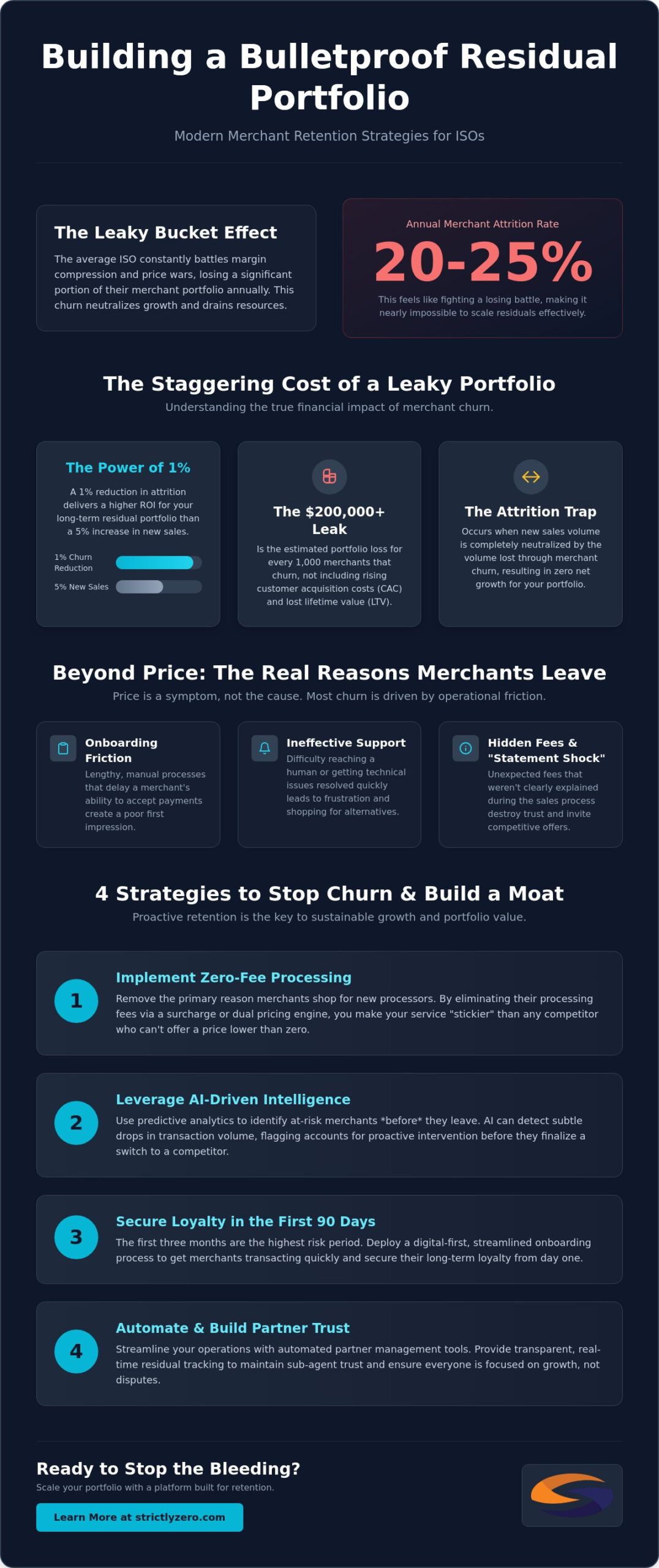
Did you know that the average ISO loses up to a quarter of its merchant portfolio every single year? When you’re facing a 20% to 25% annual attrition rate, it feels like you’re constantly fighting a losing battle against margin compression and aggressive price wars. Implementing modern merchant retention strategies for ISOs has become a survival necessity rather than a luxury. You’ve likely felt the sting of losing a high-volume account just because a competitor offered a slightly lower rate, even if your service was superior. It’s a cycle that drains your resources and makes it nearly impossible to scale your residuals effectively.
We understand that the complexity of state-by-state regulations, like the Illinois Interchange Fee Prohibition Act taking effect this July, only adds to the pressure. This guide promises to show you how to stop the bleeding and build a bulletproof residual portfolio. You’ll learn how to leverage AI-driven retention intelligence to identify at-risk merchants before they leave and how zero-fee processing models can eliminate the price conversation entirely. We will also walk through automating your reporting to catch errors and using a surcharge engine to stay compliant in a shifting legal landscape.
Key Takeaways
- Learn why a 1% reduction in attrition delivers a higher ROI than a 5% increase in new sales for your long-term residual portfolio.
- Discover how to deploy surcharge and dual pricing engines as powerful merchant retention strategies for ISOs to remove the burden of processing fees.
- Identify the high-risk “first 90 days” window and use digital-first onboarding to secure long-term merchant loyalty from day one.
- Use AI-driven predictive intelligence to detect transaction volume drops and intervene before merchants finalize a switch to a competitor.
- Streamline your operations and maintain sub-agent trust with automated partner management tools and transparent residual tracking.
Table of Contents
- The Economics of Merchant Attrition for ISOs in 2026
- Zero-Fee Processing: The Ultimate Retention Strategy
- Optimizing the Merchant Onboarding Journey
- Leveraging AI and Predictive Intelligence for Retention
- Scaling Your Portfolio with the Strictly Partner Platform
The Economics of Merchant Attrition for ISOs in 2026
Merchant attrition is the percentage of businesses that stop using your processing services over a specific period. In 2026, the math has shifted significantly. A 1% reduction in churn now provides a much higher return than a 5% increase in new sales because the cost of acquisition has skyrocketed. When you retain a merchant, you’re preserving high-margin residuals that haven’t been eroded by the aggressive pricing required to win new accounts in a hyper-competitive market. Effective merchant retention strategies for ISOs rely on data and proactive engagement rather than just reactive discounts. Traditional rate matching is a race to the bottom that ultimately kills your portfolio’s value; it’s a defensive move that signals you have no other value to offer. Focusing on customer retention ensures that your growth is cumulative rather than just replacing what you’ve already lost.
To better understand how these dynamics impact your portfolio value and overall scale, watch this helpful video:
The $200,000 Leak in Your Portfolio
While some industry benchmarks suggest a $200,000 loss for every 1,000 merchants lost, that number is likely higher today when you factor in the rising Customer Acquisition Cost (CAC). Every time a merchant leaves, you don’t just lose their monthly residual; you lose the total lifetime value (LTV) and the marketing dollars spent to bring them in. High attrition rates also damage the multiple used to value your ISO during a future exit. Investors look for stability, and a leaky bucket suggests a fundamental flaw in your merchant retention strategies for ISOs. The Attrition Trap occurs when your new sales volume is completely neutralized by the volume lost through merchant churn.
Why Merchants Leave: Beyond the Lowest Rate
It’s a common mistake to assume price is the only factor. While merchants care about costs, they often leave due to friction in these three areas:
- Onboarding: Lengthy, manual processes that delay their ability to take payments.
- Support: Difficulty reaching a human or getting technical issues resolved quickly.
- Hidden Fees: Statement shock from fees that weren’t clearly explained during the sales process.
You’re also competing with integrated SaaS platforms that offer processing as a secondary feature of their software. This means providing credit card processing for small business requires a more holistic approach than it did five years ago. If you aren’t solving their operational headaches, a lower rate from a competitor will eventually pull them away.
Zero-Fee Processing: The Ultimate Retention Strategy
Many ISOs treat churn as a customer service issue. In reality, it’s usually a pricing issue. When a merchant receives a monthly statement full of complex fees, they immediately look for ways to cut costs. By implementing zero fee credit card processing, you remove the primary reason merchants entertain calls from your competitors. A merchant paying nothing to process payments isn’t just satisfied; they’re essentially locked in. It’s incredibly difficult for a rival ISO to win an account when they can’t offer a lower price than zero. This shift is one of the most effective merchant retention strategies for ISOs because it transforms your relationship from a monthly expense to a strategic savings partnership.
Understanding the economics of customer loyalty shows that long-term retention is driven by the value you provide relative to the cost. When the cost is eliminated, the loyalty ceiling rises. A smart pricing engine protects your residuals by ensuring you aren’t forced into margin-crushing price wars. Instead of shaving off basis points to keep a merchant, you provide a platform that automates their savings and stabilizes your own revenue stream.
Surcharging vs. Dual Pricing as Retention Moats
Choosing between surcharging and dual pricing depends on the merchant’s industry and location. Dual pricing is often seen as stickier because it’s legal in all 50 states and presents a clear choice to the consumer. In contrast, surcharging is prohibited in Connecticut, Maine, and Massachusetts as of June 2026. For merchants in high-volume retail, the psychological impact of seeing a $0.00 processing fee on their monthly statement is a massive retention tool. It changes how they perceive your value. You’re no longer just another vendor taking a cut; you’re the partner who helped them reclaim their margins.
Automated Compliance: Keeping the Moat Secure
A retention strategy based on zero-fee models only works if it stays compliant. If a merchant gets fined because your program didn’t follow the latest state laws or card network rules, they’ll leave immediately. For example, Oklahoma law caps credit card surcharges at 3%, and Visa generally maintains a 3% limit even if processing costs are higher. Your platform must handle these nuances automatically. Utilizing a compliant surcharge and dual pricing engine ensures that these rules are updated in real time without merchant intervention. These systems also detect debit cards instantly. Since the Durbin Amendment prohibits surcharging on debit transactions, failing to filter these can lead to major compliance headaches and merchant frustration. Keeping the program legal is the only way to maintain successful merchant retention strategies for ISOs over the long haul.
Optimizing the Merchant Onboarding Journey
The first 90 days of a merchant’s lifecycle are the most volatile. This period represents the highest risk for churn because the merchant hasn’t yet seen the full value of your service. If the setup process is clunky or slow, they’ll regret their decision before the first month ends. Successful merchant retention strategies for ISOs start with a digital-first application process. Moving away from paper forms and manual signatures reduces friction and sets a professional tone from the start. You want to get them approved and processing as quickly as possible to build early momentum and trust.
The Power of the Virtual Terminal
Waiting for physical hardware to arrive is a major bottleneck that can stall a new relationship. By providing immediate access to a virtual terminal, you allow the merchant to take payments over the phone or via email the moment they’re approved. This significantly reduces the “time-to-first-transaction,” which is a key indicator of long-term loyalty. When you integrate ecommerce payment processing tools instantly, you eliminate the hardware delay and prove your platform’s versatility. It builds immediate confidence that they made the right choice.
Proactive Support vs. Reactive Troubleshooting
Industry data suggests that only about 58% of merchants describe their onboarding as smooth. To beat this average, you must monitor transaction data from day one. If a merchant hasn’t processed a transaction within 48 hours of approval, your team should reach out immediately. This isn’t just about technical support; it’s about showing the merchant you’re invested in their success. Understanding The Economics of Merchant Attrition helps clarify why a simple “Welcome Call” can drastically improve retention metrics. It creates a feedback loop that identifies friction points in the sales-to-boarding handoff before they become permanent problems.
Once the first deposit is confirmed, the work continues. Training the merchant on their dashboard increases platform engagement. If they know how to run reports, manage refunds, or use invoicing features, they’re far more likely to stay. Automated follow-ups at the 30, 60, and 90-day marks keep the relationship warm. These touchpoints allow you to catch small frustrations before they turn into reasons to leave. Building these merchant retention strategies for ISOs into your workflow ensures no account slips through the cracks during the most sensitive phase of their journey.
Leveraging AI and Predictive Intelligence for Retention
Waiting for a merchant to call and cancel is a losing strategy. By the time they reach out, they’ve likely already signed a contract with a competitor. Modern merchant retention strategies for ISOs now rely on ChurnIQ™ to analyze transaction patterns and flag exit intent before it’s too late. This AI driven approach looks at more than just total volume; it monitors transaction density, frequency, and even the types of support queries being submitted. If a merchant’s processing volume drops by 15% outside of their normal seasonal patterns, the system triggers an automated “Save” workflow. This allows your sales agents to intervene with a proactive rate adjustment or a feature upgrade while the merchant is still in the “consideration” phase of leaving.
Identifying the ‘Quiet Churner’
Omni-Channel Data as a Retention Tool
The more features a merchant uses, the less likely they are to leave. Data indicates that merchants utilizing three or more features of your platform, such as virtual terminals, invoicing, and mobile processing, have 50% higher retention rates. Cross-selling best credit card processing for small business features acts as a defensive strategy. When a merchant relies on your omni-channel tools for their daily operations, the cost of switching becomes too high. Monitoring usage across all channels gives you a complete picture of account health and highlights opportunities to deepen the relationship. Explore our AI-driven retention tools to start protecting your residuals today.
Scaling Your Portfolio with the Strictly Partner Platform
Scaling an ISO in 2026 requires more than just a large sales team. It requires a unified ecosystem that manages the delicate balance between acquiring new accounts and protecting your existing residuals. The Strictly Partner Platform acts as the central nervous system for your business, integrating the AI-driven insights and zero-fee models discussed earlier into a single interface. A modern payment processing platform for ISOs must be API-first to ensure it can connect with the various software tools your merchants already use. This connectivity makes your service indispensable and is a cornerstone of effective merchant retention strategies for ISOs. When your technology is embedded in their daily workflow, the friction of switching to a competitor becomes a significant deterrent.
The platform’s Smart Pricing Engine also plays a vital role in maintaining merchant satisfaction. It automatically adjusts to ensure the merchant is always on the most cost-effective compliant program available. This proactive optimization means you don’t have to wait for a merchant to complain about their bill to offer them a better deal. You’re already providing it.
Automating Residuals with ClearSplit™
There’s a direct, often overlooked link between agent turnover and merchant turnover. When a sub-agent feels their residuals are inaccurate or delayed, they lose trust and eventually leave your ISO. When they go, they often take their best merchant relationships with them. ClearSplit™ eliminates this “residual anxiety” by providing real-time, transparent reporting for your entire sales team. You can scale your portfolio without adding back-office headcount to manage complex manual spreadsheets. Automated, accurate splits keep your agents loyal, which in turn keeps your merchant portfolio stable and growing.
Future-Proofing Your Portfolio
The regulatory environment for payments is shifting faster than ever. Between the Illinois Interchange Fee Prohibition Act and varying surcharge caps in states like Oklahoma, staying compliant is a full-time job. Strictly provides compliance-as-a-service, ensuring that your portfolio stays on the right side of the law without you needing to monitor every legislative update. This protection extends to your brand through white-labeling options. You can offer a high-end, user-friendly platform that merchants actually enjoy using, all while keeping your brand at the forefront of the relationship. By combining superior technology with automated compliance and agent transparency, you create a business that is built to last. Partner with Strictly to build a churn-proof portfolio today and secure your residuals for the long term.
Secure Your Portfolio’s Future Today
Protecting your residuals in 2026 requires a shift from reactive service to proactive intelligence. You’ve seen how zero-fee models create a pricing moat that competitors can’t touch, and how optimizing the first 90 days of onboarding sets the stage for long-term loyalty. By integrating these merchant retention strategies for ISOs, you transform your business from a transaction processor into an essential growth partner. The combination of predictive data and automated compliance ensures that your portfolio remains stable even as regulations shift.
Don’t let manual reporting or hidden attrition drain your hard-earned profits. With ChurnIQ™ providing predictive retention alerts and ClearSplit™ handling automated residual management, you can focus on high-level growth while our fully compliant Zero-Fee pricing engine keeps your merchants satisfied. It’s time to build a portfolio that scales effortlessly without the constant threat of churn. Scale your ISO with Strictly’s retention-focused platform and start protecting your lifetime residuals now. Your path to a bulletproof portfolio is just one step away.
Frequently Asked Questions
What is the average merchant attrition rate for ISOs in 2026?
The average annual merchant attrition rate for ISOs currently sits between 20% and 25%. This means many organizations lose nearly a quarter of their portfolio every twelve months. Implementing data-driven merchant retention strategies for ISOs is the only way to counteract this trend. By focusing on retention, you preserve high-margin residuals that are much harder to replace through new sales alone.
How does zero-fee processing help with merchant retention?
Zero-fee processing eliminates the merchant’s primary pain point: the monthly processing bill. When a business owner pays $0 in fees, they have almost no incentive to entertain offers from competing processors. This model creates a powerful “pricing moat” around your portfolio. It’s difficult for a rival to win an account when they can’t offer a lower price than zero.
Do I need a technical background to use ChurnIQ™ for my ISO?
You don’t need a technical background to use ChurnIQ™ because the AI handles the heavy lifting of data analysis. The system automatically monitors transaction patterns and flags merchants showing signs of exit intent. You receive clear alerts when an account is at risk, allowing your team to focus on relationship management rather than digging through complex spreadsheets or raw data logs.
What is the biggest reason merchants switch processors?
Cost remains the top reason merchants switch, but friction during support and onboarding is a close second. Many merchants feel abandoned after the initial sale or get frustrated by hidden fees on their statements. Providing a transparent, omni-channel experience helps solve these issues. When you combine great service with merchant retention strategies for ISOs like zero-fee models, you remove the two biggest reasons for churn.
How can automated residual payments help reduce merchant churn?
Automated residual payments through tools like ClearSplit™ keep your sub-agents loyal, which directly protects your merchant accounts. Sub-agents often hold the strongest personal relationships with merchants. If an agent leaves your ISO due to “residual anxiety” or payment errors, they’re likely to take their merchants with them. Transparent, real-time reporting ensures your sales team stays put and keeps their accounts stable.
Is surcharging legal in all 50 states for my merchants?
Surcharging is not legal in every state. As of June 2026, it’s prohibited in Connecticut, Maine, and Massachusetts. Additionally, Oklahoma law caps surcharging at 3%, and the Durbin Amendment prohibits surcharging on all debit card transactions nationwide. Many ISOs use dual-pricing engines instead, as these models are legal in all 50 states and avoid many of these specific regulatory hurdles.
How often should I check in with my merchants to prevent attrition?
You should reach out at least once every quarter, but the first 90 days require much higher frequency. Automated check-ins at the 30, 60, and 90-day marks are critical for catching technical friction early. Beyond these scheduled touches, you should only intervene when your data flags a drop in volume or an unusual spike in support queries that suggests a merchant is unhappy.
What are the best industries for high merchant retention?
Industries that require integrated tools like virtual terminals and invoicing, such as B2B professional services and specialty retail, typically have higher retention. These merchants rely on your platform for more than just swiping cards. When processing is embedded in their omni-channel workflow, the “cost of switching” becomes much higher. This operational dependency makes them far less likely to move to a competitor for a slightly lower rate.