
Omni-Channel Payment Processing: The Complete 2026 Merchant Guide
Published:

What if your monthly merchant statement wasn’t a source of dread, but a roadmap to $0 in transaction fees? For many businesses, high interchange fees reduce net profit by up to 20%, leaving owners frustrated by complex, unpredictable costs. Modern omni-channel payment processing should bridge the gap between your online and in-store sales; however, siloed data often makes it impossible to see the full picture of your customer journey. You’ve likely felt the sting of rising costs and the headache of managing fragmented systems that don’t talk to each other.
We agree that you shouldn’t have to sacrifice your margins just to accept a credit card. This guide promises to help you master the mechanics of unified payment systems and discover how to eliminate transaction fees entirely using compliant surcharge and dual pricing strategies. We’ll explore the latest 2026 standards, from PCI DSS v4.0 compliance to the legality of dual pricing in all 50 states. You’ll learn how to implement an API-first infrastructure that provides a unified view of every transaction while scaling your business for future growth.
Key Takeaways
- Learn how modern omni-channel payment processing synchronizes online and in-person data into a single stream to eliminate siloed reporting.
- Understand the 2026 interchange landscape and how the latest Visa and Mastercard rate adjustments impact your business’s net profit.
- Discover the legal framework for reaching $0 in processing fees through compliant surcharge programs and nationwide dual pricing strategies.
- Get up to speed on mandatory PCI DSS v4.0 requirements and how AI-driven fraud prevention filters transactions in real-time.
- Identify the benefits of an API-first platform for seamless developer integration and automated partner residual management.
Table of Contents
- What is Omni-Channel Payment Processing? The 2026 Perspective
- The Anatomy of a Transaction: How Funds Move in 6 Steps
- The Reality of Processing Fees and Margin Erosion
- Reclaiming Revenue: Surcharging and Dual Pricing Models
- Choosing a Partner: Why Strictly is the Modern Choice
What is Omni-Channel Payment Processing? The 2026 Perspective
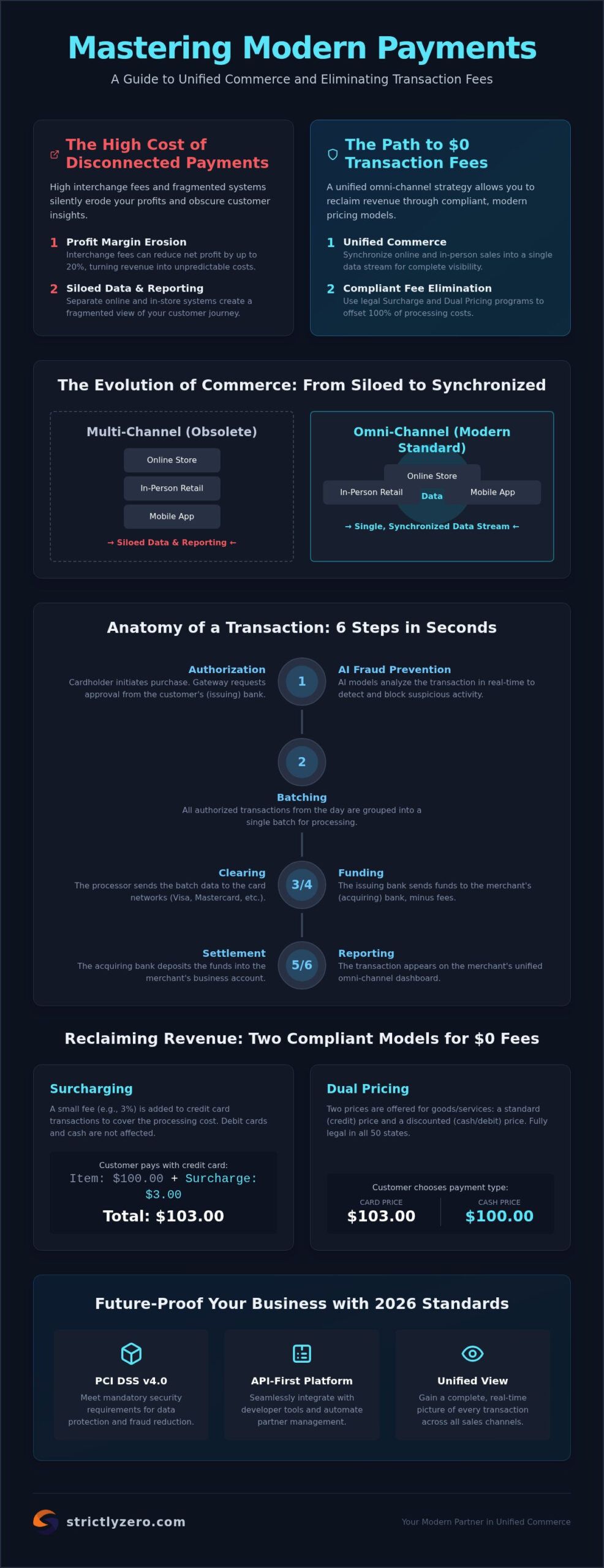
In 2026, the definition of success for a merchant relies on a unified infrastructure that synchronizes every transaction point. Omni-channel payment processing isn’t just about accepting cards in multiple places; it’s the technical synchronization of online, in-person, and mobile payments into a single data stream. While older “multi-channel” models kept your e-commerce sales separate from your retail storefront, modern commerce demands a holistic omni-channel business strategy. This shift makes multi-channel obsolete because siloed data prevents you from seeing the true lifetime value of a customer who shops both on your website and at your physical location.
The mechanics of this setup rely on two distinct components: the payment gateway and the processor. Think of the gateway as the digital courier that safely encrypts and transmits data from the point of sale to the networks. The processor is the engine behind the scenes that actually moves the money and ensures compliance. In an omni-channel environment, these roles must be perfectly aligned to provide real-time inventory updates and customer insights across all touchpoints, ensuring your stock levels on your site match what’s actually on your shelves.
To better understand how these channels converge, watch this helpful video:
The Rise of Unified Commerce
Unified commerce is the evolution of the shopping experience. It’s driven by customer expectations for flexibility, such as the ability to buy an item on a mobile app and return it at a physical counter. APIs serve as the bridge here, connecting your virtual terminal to your e-commerce storefront without requiring manual data entry. By maintaining a single merchant account for all sales channels, you eliminate the nightmare of reconciling different monthly statements and varying fee structures. It’s about creating a frictionless environment where the technology fades into the background, allowing you to focus on growth rather than administrative friction.
Core Players in the Payment Lifecycle
Every transaction involves a specific “triangle of trust” between the Cardholder, the Merchant, and the Issuing Bank. The cardholder initiates the purchase, while the issuing bank (the customer’s bank) verifies available funds and card validity. On the other side, the Acquiring Bank is your partner, responsible for receiving funds from the networks and handling the final settlement into your business account. The Payment Processor acts as the central conductor, orchestrating data flow and security protocols like AI-driven fraud prevention to keep the entire lifecycle moving in seconds. Understanding these roles is the first step toward mastering omni-channel payment processing and reclaiming your profit margins.
The Anatomy of a Transaction: How Funds Move in 6 Steps
Every time a customer taps a card at your counter or clicks “buy” on your website, a sophisticated sequence of events triggers across the global financial network. While the customer only sees an “Approved” message, your omni-channel payment processing system is hard at work behind the scenes. This lifecycle ensures that data is secure, funds are available, and your business actually receives the capital from the sale. Understanding these six steps helps you troubleshoot delays and recognize where your profit margins might be at risk from hidden fees.
Authorization and Fraud Prevention
The process begins with authorization and authentication. Authorization is the process of verifying a cardholder has sufficient credit or funds. This digital handshake occurs between your payment gateway and the customer’s issuing bank in milliseconds. Simultaneously, 2026 AI models detect suspicious patterns before the transaction is finalized by analyzing behavioral data and historical trends. This AI-driven fraud prevention is critical because it stops fraudulent charges at the point of entry, reducing the likelihood of costly chargebacks later. Once the bank confirms the funds are there and the AI gives the green light, the transaction is authorized, though no money has moved yet.
After the sale is complete, the transaction enters the batching phase. At the end of each business day, your system compiles all authorized transactions into a single file. This “batch” is sent to your processor to initiate the transfer of funds. If you’re looking to streamline this daily workflow while protecting your bottom line, you can explore how a unified engine simplifies your daily settlement.
Settlement: When Do You Get Paid?
The final stages involve clearing and settlement. Once your batch is received, the card networks, such as Visa, Mastercard, and Amex, route the data to the appropriate issuing banks. These banks then send the funds to your acquiring bank. Clearing is the exchange of information, while settlement is the actual movement of capital into your merchant bank account.
Merchants often wonder about the timeline from “Pending” to “Funded.” In a standard setup, this usually takes 24 to 48 hours. However, omni-channel platforms provide faster reconciliation than siloed systems. Because all sales from your virtual terminal, mobile app, and physical store flow into one data stream, you don’t have to wait for multiple providers to sync their records. You get a single, clear view of your cash flow, making it easier to manage inventory and plan for future growth without the headache of manual data entry.
The Reality of Processing Fees and Margin Erosion
Many merchants look at a 3% processing fee and see a small cost of doing business. However, when you look at your net profit, the math becomes alarming. If your business operates on a 15% profit margin, that 3% fee effectively erodes 20% of your take-home pay. This “profit tax” is why understanding the mechanics of omni-channel payment processing is vital for long-term sustainability. Most of these costs stem from three main areas: interchange fees, assessment fees, and the processor markup. While the first two are largely set by the networks, the third is where traditional processors hide their profit margins, often through complex tiered structures that obscure the true cost of each swipe.
Interchange fees represent the non-negotiable base costs set by card networks like Visa and Mastercard. These are paid to the bank that issued the customer’s card. Assessment fees are smaller percentages paid directly to the card brands for using their network infrastructure. Traditional processors often bundle these with their own markup, making it difficult for you to see exactly how much you’re being overcharged for “convenience.” Over time, these small percentages act as a slow leak in your business’s financial health, siphoning off capital that could be used for inventory or expansion.
Decoding Pricing Models
Choosing between flat-rate and interchange-plus pricing can make or break your bottom line. Flat-rate models offer simplicity but usually charge a premium to cover the risk of high-cost cards. For high-volume merchants, interchange-plus is almost always cheaper because it passes through the actual cost of the transaction with a transparent, fixed markup. You also need to watch for “junk fees” that bloat your monthly statement. These include PCI non-compliance penalties, monthly minimums, and statement fees that add zero value to your operations. For a deeper dive into these structures, see our guide on understanding credit card processing fees in 2026.
The Impact on Small Business Growth
The burden of these fees isn’t distributed equally across all sectors. High-ticket service providers, such as contractors or luxury retailers, suffer most from percentage-based fees because a single large transaction can result in hundreds of dollars lost to the processor. Similarly, low-margin retail businesses find it increasingly difficult to survive as interchange costs rise. Interchange fees are determined by card type, industry, and transaction risk. This means a premium rewards card used at a boutique will cost you significantly more than a standard debit card used at a hardware store. Without a strategy to reclaim these costs, your omni-channel payment processing setup might be efficient at moving data, but it’s simultaneously draining your growth capital.
Reclaiming Revenue: Surcharging and Dual Pricing Models
Traditional processors often treat transaction fees as an unavoidable tax on your success. However, in 2026, savvy business owners use omni-channel payment processing to reclaim that lost revenue. A surcharge program allows you to legally pass the cost of credit card processing to the customer at the point of sale. This isn’t about penalizing the shopper; it’s about protecting the base price of your goods and services. Alternatively, dual pricing involves displaying both a “cash” and “card” price for every item. This method offers the highest level of transparency and is currently legal in all 50 states. Framing these programs correctly is essential for customer satisfaction. When you explain that these options allow you to keep your primary prices low despite rising interchange costs, most consumers appreciate the honesty.
Surcharging vs. Dual Pricing
The technical differences between these two models impact your daily operations and your compliance strategy. Surcharging adds a specific fee at the checkout screen only when a credit card is used. Dual pricing presents two distinct price points upfront, giving the customer a clear choice before they even reach the terminal. Compliance is the most critical factor here. You must adhere to strict signage requirements and provide clear receipt disclosures to stay within card network rules. As of September 2026, surcharging remains prohibited in Connecticut, Maine, and Massachusetts. Furthermore, card networks have implemented strict caps: Visa limits surcharges to 3%, while Mastercard allows up to 4%. To see how these rules apply to your specific business model, read our guide on Zero Fee Credit Card Processing: The 2026 Merchant Guide to $0 Fees.
Achieving $0 Processing Fees
A compliant program can bring your effective processing rate to zero, but you can’t manage this manually. You need a Smart Pricing Engine to automate state-by-state compliance and handle real-time debit detection. Surcharging debit cards is prohibited by federal law nationwide, so your system must distinguish between card types instantly to avoid heavy fines. This level of automation is a core benefit of modern omni-channel payment processing. For instance, a high-ticket merchant recently saved $25,000 annually by switching to a dual pricing model. They moved those funds from the processor’s pocket back into their own marketing and inventory budget. If you’re ready to stop losing your net profit to interchange fees, you can calculate your potential savings with a zero-fee engine today.
Choosing a Partner: Why Strictly is the Modern Choice
Selecting a partner for your omni-channel payment processing infrastructure requires balancing technical flexibility with financial efficiency. Strictly stands out as the modern choice because it doesn’t force you into a closed-loop system. Instead, our API-first architecture allows developers to build custom integrations that fit your specific business logic. Whether you’re connecting a legacy e-commerce site or a bespoke mobile app, the platform provides the agility needed for the fast-moving 2026 market. This developer-centric approach ensures that your payment stack evolves alongside your business rather than becoming a bottleneck.
Security remains a top priority, especially with the mandatory requirements of PCI DSS v4.0 now in full effect. Strictly ensures excellence through AI-driven fraud prevention that analyzes transactions in real-time. This proactive approach reduces the risk of chargebacks while maintaining high approval rates for legitimate customers. By combining unified commerce data with a built-in surcharge and dual pricing engine, we offer a unique advantage: the ability to scale your operations while simultaneously bringing your processing costs down to zero. It’s a comprehensive solution that prioritizes both the technical health and the financial profitability of your merchant account.
Tools for Partners and Developers
For ISOs and MSPs, scaling a payment brand often involves significant manual administrative hurdles. Strictly solves this through a robust partner ecosystem designed for transparency and speed. ClearSplit™ automates complex residual compensation, ensuring that partners are paid accurately and on time without the need for manual spreadsheets. Additionally, ChurnIQ™ uses predictive intelligence to identify at-risk merchants before they leave, allowing you to intervene and improve retention. You can learn more about these specialized features in our guide to the ultimate payment processing platform for ISOs.
Getting Started with Strictly
The transition to a unified system is designed to be frictionless for merchants of all sizes. Your onboarding journey begins with comprehensive API documentation, moving quickly from integration to your first live transaction. For businesses that need to handle card-not-present sales immediately, our Virtual Terminal provides a secure way to invoice clients and process payments over the phone or via email. This flexibility ensures that no matter how your customers choose to pay, your omni-channel payment processing data remains synchronized and your margins remain protected. If you’re ready to reclaim your profit, you can eliminate your processing fees today with Strictly.
Future-Proof Your Business with Unified Commerce
The 2026 merchant landscape doesn’t have room for siloed data or eroded profit margins. By implementing a robust omni-channel payment processing strategy, you’ve learned how to synchronize every transaction into a single, manageable stream. This guide has shown that high interchange fees aren’t an unavoidable tax. Instead, they’re costs you can reclaim through compliant surcharge and dual pricing engines. You now have the roadmap to move from fragmented systems to a unified commerce model that protects your bottom line.
Choosing the right partner is the final step in this journey. With an API-first architecture designed for seamless integration and advanced ChurnIQ™ retention tools, Strictly provides the infrastructure you need to scale. Our platform remains compliant in all 50 states, giving you the peace of mind to focus on growth while we handle the complexities of transaction security and state-by-state regulations. It’s time to stop letting processing fees eat your profit and start building a more resilient, transparent business.
Eliminate your processing fees today with Strictly and take full control of your financial future. You’ve got the tools and the knowledge; now it’s time to put them into action.
Frequently Asked Questions
Is it legal to charge a credit card processing fee to customers in 2026?
Yes, it is legal in 47 states, with exceptions in Connecticut, Maine, and Massachusetts. Merchants must follow card network rules, such as capping fees at 3% for Visa and 4% for Mastercard. You must also provide clear signage at the entrance and point of sale. While surcharging is restricted in a few areas, dual pricing remains a legal alternative in all 50 states for businesses looking to offset costs.
What is the difference between a payment processor and a payment gateway?
A payment gateway is the digital tunnel that encrypts and sends transaction data, while the payment processor is the engine that actually moves the money between banks. In a modern omni-channel payment processing setup, these two functions often work together within a single platform. The gateway handles the initial handshake at the virtual terminal or storefront, and the processor manages the backend clearing and settlement to your bank account.
How long does it take for card processing funds to reach my bank account?
Most funds reach your merchant bank account within 24 to 48 hours after the daily batch is closed. The timeline depends on your processor’s cut-off times and the clearing speed of the involved financial institutions. Some platforms offer accelerated settlement options for a fee, but a standard unified system typically provides faster reconciliation by consolidating all sales channels into a single, synchronized data stream for easier daily management.
Can I surcharge debit card transactions?
No, surcharging debit cards is prohibited by federal law and card network regulations nationwide. This restriction applies even if the customer chooses to run the debit card as “credit” without a PIN. To stay compliant, you need a system with automated debit detection that identifies the card type instantly. A Smart Pricing Engine ensures that fees are only applied to credit transactions, protecting your business from potential legal penalties and fines.
What are the average credit card processing fees for small businesses in 2026?
Average online processing fees typically hover around 2.9% plus a fixed $0.30 per transaction, while in-person fees usually range from 2.4% to 2.7%. These totals include interchange fees, which average 1.97% for Visa and 1.79% for Mastercard, along with assessment fees and processor markups. Because these costs vary based on card type and industry, many merchants adopt dual pricing to reach an effective rate of zero.
What is PCI compliance and why do I need it?
PCI compliance is a set of security standards designed to protect cardholder data, and it is mandatory for any business that accepts credit cards. As of 2026, all merchants must adhere to PCI DSS v4.0 requirements, which focus on continuous security validation and robust encryption. Failing to maintain compliance can lead to heavy monthly penalties, data breaches, and the loss of your ability to process payments through major card networks.
How does a dual pricing program differ from a surcharge?
A surcharge is a fee added to a credit card transaction at the final checkout, whereas dual pricing displays a cash price and a card price for every item upfront. Dual pricing is generally considered more transparent and is legal in every state, including those that prohibit surcharging. By showing both price points on your menu or price tags, you give customers a clear choice while fully covering your omni-channel payment processing costs.
What should I look for in an omni-channel payment processing agreement?
Look for transparency in pricing models, such as interchange-plus, and ensure there are no hidden junk fees like statement or non-compliance charges. A strong agreement should offer an API-first architecture for easy integration and tools for fraud prevention. Prioritize partners that provide automated compliance for surcharge programs and specialized intelligence tools like ChurnIQ™ to help you manage merchant retention and long-term business health without restrictive long-term contracts.