
Omni-Channel Zero Fee Payment Processing: The 2026 Profitability Guide
Published:

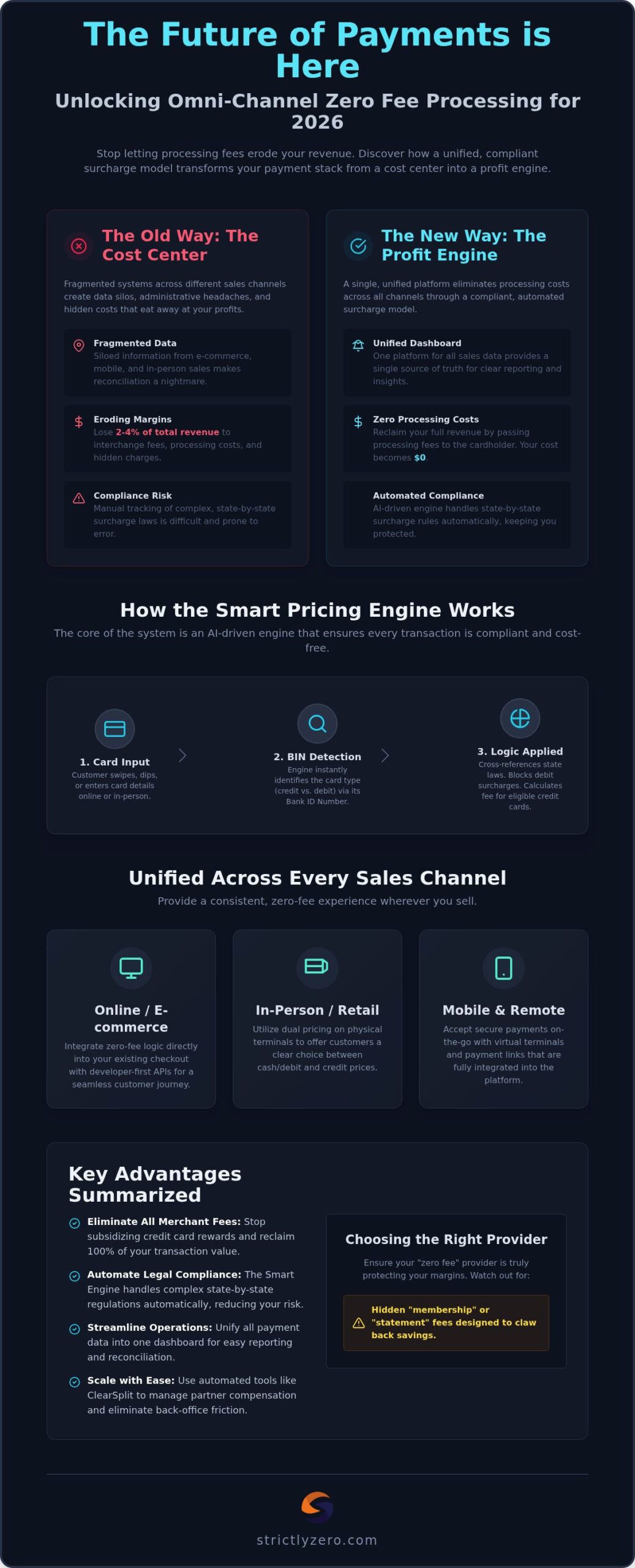
It’s time to move past the headache of manual compliance and disconnected reporting. This guide will show you how to unify your e-commerce, mobile, and virtual terminal payments into a single, cohesive ecosystem. We’ll explain how a Smart Pricing Engine handles the complexity of state-by-state regulations automatically. This ensures your business stays protected while you eliminate merchant processing costs. From AI-driven fraud prevention to streamlined partner management, you’re about to discover how to turn your payment stack from a cost center into a powerful engine for profitability.
Key Takeaways
- Unify your e-commerce, mobile, and in-person sales into a single dashboard to eliminate fragmented data and streamline reporting.
- Learn how omni-channel zero fee payment processing uses a compliant surcharge model to pass credit card costs directly to the cardholder.
- Automate state-by-state legal compliance and prevent illegal debit card surcharging with an AI-driven Smart Pricing Engine.
- Identify hidden “membership” or “statement” fees to ensure your chosen merchant service provider is truly protecting your margins.
- Scale your operations or partner network by using automated tools like ClearSplit to eliminate back-office friction and manual compensation tracking.
Table of Contents
- What is Omni-Channel Zero Fee Payment Processing?
- How the Zero Fee Omni-Channel Model Works
- Automating Compliance: The Smart Pricing Engine
- Choosing the Best Zero Fee Merchant Services
- The Strictly Advantage: Scaling for Merchants and ISOs
What is Omni-Channel Zero Fee Payment Processing?
Imagine a retail environment where every transaction, whether swiped in-store or entered on a smartphone, nets your business exactly what you charged. This is the core of omni-channel zero fee payment processing. It’s a unified infrastructure designed to eliminate the traditional burden of interchange fees and processing costs by passing them to the cardholder through a compliant surcharge model. This system rests on three essential pillars:
- Online: Seamless e-commerce checkouts that apply logic-based pricing.
- In-person: Processing for physical points of sale that unifies store data with web sales.
- Mobile: Virtual terminals and payment links that allow for secure, remote billing.
Traditional omni-channel models often come with a hidden convenience tax. Merchants typically pay roughly 3% on every integrated transaction just to keep their data in one place. This model is failing modern businesses that need to protect their margins against rising operational costs. The shift in 2026 moves away from simply accepting payments toward a strategy of maximizing every cent of revenue through zero-fee technology. It isn’t just about being everywhere; it’s about being everywhere profitably.
The Problem with Fragmented Payment Systems
Managing different vendors for your website, your storefront, and your mobile sales creates a data nightmare. Siloed information makes it nearly impossible to track customer behavior or reconcile books without hours of manual labor. Beyond the administrative burden, maintaining multiple gateway relationships often leads to tiered fee structures that are difficult to audit. The omni-channel gap is the space where businesses lose 2-4% of revenue to friction and unoptimized processing fees.
How Zero-Fee Models Bridge the Gap
A unified platform using a compliant surcharge or dual pricing program solves these issues simultaneously. By integrating a Smart Pricing Engine across all touchpoints, you can automate the process of passing costs to the customer. While some worry about consumer reaction, the reality is a psychological shift toward transparency. Customers often prefer knowing the true cost of their payment method choice, especially when businesses are upfront about the costs of credit card rewards. This transition turns a major expense line item into $0, allowing those funds to be reinvested into growth or product development. By adopting omni-channel zero fee payment processing, you ensure that your business stops subsidizing the banking industry and starts prioritizing its own bottom line.
How the Zero Fee Omni-Channel Model Works
The core of omni-channel zero fee payment processing is a sophisticated Smart Pricing Engine. This engine acts as the central brain for every transaction, whether it happens through a browser, a mobile app, or at a physical counter. It functions by identifying the Bank Identification Number (BIN) of a card the moment it’s entered or swiped. This instant detection allows the system to distinguish between credit cards and debit cards immediately. Since surcharging debit cards is strictly prohibited, the engine ensures that only eligible credit transactions trigger the fee-passing logic. It also cross-references state laws on credit card surcharges in real-time to ensure the transaction remains compliant with the buyer’s local regulations.
E-commerce and API Integration
For online merchants, the goal is to eliminate fees without disrupting the customer’s journey. Developer-first APIs allow you to embed zero-fee logic directly into your existing checkout page. This means the system calculates the surcharge and presents the required disclosures before the customer clicks “pay.” It’s a seamless experience that maintains your brand’s look and feel while protecting your margins. For a deep dive into the technical specifications and setup, you can explore our Ecommerce Payment Processing Pillar. This integration ensures that your web sales data flows directly into the same dashboard as your other channels, creating a single source of truth for your business finances.
In-person logic often utilizes dual pricing. This approach presents two distinct prices to the customer: a lower price for cash or debit, and a standard price for credit cards. It provides transparency and gives the buyer the power to choose their preferred payment method. Because the system is unified, these price adjustments are reflected in your inventory and accounting software automatically. You won’t have to manually reconcile different price points at the end of the day.
Virtual Terminals and Payment Links
Mobile and remote sales require a different kind of flexibility. Virtual terminals allow you to process payments over the phone or via email by entering card details into a secure web portal. The system pre-calculates the surcharge, so you can inform the customer of the total cost before the transaction is finalized. Payment links take this further by allowing you to send a secure, one-time URL to a customer’s phone or inbox. These links are particularly effective for high-ticket items or service-based businesses. They notify the customer of the surcharge upfront, which significantly reduces the likelihood of “fee-related” chargebacks. If you want to see how these tools can simplify your billing, you might consider how an automated surcharge engine fits into your current workflow. These links also support recurring billing, ensuring that subscription-based revenue remains fee-free month after month.
Automating Compliance: The Smart Pricing Engine
Attempting to manage credit card surcharges manually across multiple sales channels is a recipe for legal disaster. The regulatory landscape is a moving target. What’s legal in one state today might change by next quarter. A merchant might be compliant in their physical storefront but inadvertently violate laws through their online checkout because they didn’t update their digital logic. This complexity makes manual surcharging a massive legal liability. You can’t afford to guess when it comes to state and federal regulations.
Navigating State Surcharge Laws in 2026
The US legal landscape for surcharging remains a patchwork of shifting requirements. While most states allow merchants to pass on the cost of credit card acceptance, the specific rules regarding disclosure, fee caps, and registration vary significantly. The Smart Pricing Engine solves this by updating in real-time as state regulations change. It uses the customer’s billing address to adjust fees dynamically, ensuring you never exceed local limits. Relying on automated “set it and forget it” compliance is the only way to scale an omni-channel business without hiring a full-time legal team to monitor payment statutes.
Debit vs. Credit Detection Technology
Distinguishing card types instantly is the greatest technical challenge in omni-channel zero fee payment processing. Federal law is clear: you can never surcharge a debit card, even if it’s processed as “credit” without a PIN. If your system fails to detect a debit card and applies a fee, you’re in immediate violation of the Durenberger Amendment. Our technology uses advanced BIN (Bank Identification Number) detection to identify the card type the moment the first few digits are entered.
AI-driven fraud prevention and card detection work together to protect the merchant from both legal risk and financial loss. While the system identifies the card type to ensure compliance, it simultaneously scans for fraudulent patterns. This dual-layered approach ensures the customer is only charged the exact cost of the credit transaction, never a penny more. Security remains the foundation of this entire model. Maintaining strict PCI DSS compliance within a zero-fee framework ensures that sensitive cardholder data is encrypted and protected across every touchpoint. This creates a secure environment where you can prioritize your margins without compromising on safety or trust.
Choosing the Best Zero Fee Merchant Services
Selecting a partner for omni-channel zero fee payment processing requires looking far beyond the marketing “free” labels. Many providers lure businesses in with promises of zero costs, only to hide the true expense in monthly “membership” fees, inflated statement fees, or high per-transaction hurdles. You need a processor that prioritizes your margins through genuine transparency. This means evaluating their technical flexibility, compliance automation, and whether they offer a unified dashboard for all your sales data. A true partner acts as a trust-focused processor, helping you protect your business from the volatility of the payment industry while ensuring your data remains your own.
Framework for Evaluating Omni-Channel Providers
Start by asking if the provider truly offers a Zero Fee Credit Card Processing model across every touchpoint. You should avoid “black box” systems that are difficult to integrate or customize. An API-first platform allows you to tailor the payment experience to your specific brand without sacrificing functionality. Look for intelligence tools that go beyond basic transaction history. For instance, systems that include retention intelligence like ChurnIQ help you understand customer behavior and reduce attrition before it impacts your bottom line. Data unity is also non-negotiable. If you can’t manage your e-commerce and in-person sales from one screen, you aren’t actually using an omni-channel solution; you’re just managing multiple silos.
The ROI of Switching to Zero Fee
The financial impact of switching to a zero-fee model is often immediate and substantial. For a business processing $1,000,000 annually, traditional fees can easily consume $30,000 or more. By eliminating these costs through a compliant surcharge program, you effectively increase your net profit without the need to raise prices or cut overhead. You can then reinvest these savings into aggressive customer acquisition or faster product development. While some processors compete on being “cheap” by offering slightly lower percentages, they’re still taking a cut of every sale you make. Only a zero-fee model allows you to keep 100% of your listed price. If you’re ready to stop paying for your customers’ credit card rewards and reclaim your revenue, you can start building your zero-fee stack today.
Reliable support is the final piece of the puzzle. When a transaction fails or a compliance question arises, you don’t want to be stuck in a generic support queue. A dedicated payment partner provides the specialized tools and expertise needed to manage both merchant operations and partner ecosystem friction. This level of support ensures that your payment infrastructure remains a growth engine rather than a technical burden. By focusing on these criteria, you’ll find a provider that doesn’t just process payments but actively works to maximize your profitability.
The Strictly Advantage: Scaling for Merchants and ISOs
Strictly provides more than just a dashboard; it offers a competitive edge by redefining the relationship between processors and businesses. By prioritizing merchant margins, the platform delivers “Trust as a Payment Processor” in an industry often clouded by hidden costs. This shift is essential for omni-channel zero fee payment processing to succeed at scale. It moves the conversation beyond simple transactions to a model of “Trust as a Service,” where the processor’s success is directly tied to the merchant’s profitability. This alignment ensures that every feature developed is designed to keep more money in the business owner’s pocket.
Tools for ISOs and Developers
For ISOs and developers, the challenge has always been managing scale without drowning in administrative tasks. The Payment Processing Platform for ISOs addresses this by providing a robust API-first architecture. This allows for the creation of custom merchant experiences that fit specific industry needs. Tools like ClearSplit™ eliminate back-office friction by automating partner compensation and residuals in real-time. Additionally, ChurnIQ™ provides vital retention intelligence, allowing partners to monitor the health of their portfolios and intervene before a merchant leaves. This automation ensures that as your portfolio grows, your manual workload doesn’t grow with it.
Getting Started with a Zero Fee Strategy
Implementing a zero-fee strategy doesn’t have to be a complex overhaul. The onboarding process is designed to be efficient, moving you from the initial application to your first live transaction quickly. The key to a smooth transition lies in how you communicate the new pricing model to your customers. Most buyers appreciate transparency. When you explain that the surcharge is a direct reflection of the cost of credit card rewards programs, it builds a sense of fairness. By offering a cash or debit alternative, you give them the power of choice. This approach preserves your margins without alienating your base.
If you’re ready to eliminate processing costs and unify your sales data, you can scale your payments business with Strictly today. Transitioning to omni-channel zero fee payment processing is the most significant step you can take toward securing your margins for the future. By combining unified data with a $0 processing fee model, you aren’t just staying competitive; you’re setting a new standard for your business’s financial health.
Secure Your Future Profitability with Unified Payments
Scaling a business in 2026 requires a shift from simply accepting payments to strategically managing every cent of your revenue. You’ve seen how unifying your sales channels doesn’t just simplify your data; it provides the foundation for a more profitable operation. By implementing omni-channel zero fee payment processing, you can stop losing thousands of dollars to credit card networks every year. You don’t have to choose between a unified customer experience and protecting your margins.
Our API-first platform and unified dashboard for web, mobile, and in-person payments give you total control over your financial ecosystem. With the Smart Pricing Engine handling 100% of the automated compliance, you can focus on growth while we handle the legal complexity of surcharge regulations. It’s time to build a business where your listed price is exactly what you keep. Take the first step toward a fee-free future and see how much more your business can achieve when you own your margins.
Start Eliminating Your Processing Fees with Strictly
Frequently Asked Questions
Is omni-channel zero fee payment processing legal in all 50 states?
Surcharging legality depends on the specific state where the transaction occurs. While the vast majority of states allow these programs, local regulations regarding caps and disclosures are constantly evolving. Our Smart Pricing Engine monitors these 2026 legal maps in real-time. This automation ensures your business remains compliant without requiring you to track individual legislative changes across the country manually.
How does the system distinguish between credit and debit cards?
Our technology utilizes instant Bank Identification Number (BIN) detection. The system scans the first few digits of the card to determine if it is a credit or debit product before the transaction is finalized. This is a critical safeguard because federal law prohibits surcharging debit cards. By automating this identification, the platform prevents accidental non-compliance and protects your merchant account from regulatory scrutiny.
Can I use my existing website and POS with Strictly?
Strictly is an API-first platform, which means it’s built to work with your existing digital infrastructure. You can integrate our zero-fee logic into your current e-commerce site or virtual terminal setup. While we don’t sell physical POS hardware, our software is designed to bridge the gap between your various sales touchpoints. This allows you to maintain your current workflow while eliminating unnecessary processing expenses.
What is the difference between surcharging and dual pricing?
Surcharging is the practice of adding a specific percentage to a credit card transaction at the point of sale. Dual pricing presents two separate prices for every item: a lower price for cash or debit and a standard price for credit. Both methods are effective for cost elimination. However, dual pricing is often preferred in retail settings because it provides maximum transparency to the consumer.
Will my customers be upset if I pass the processing fees to them?
Transparency is the most effective way to manage customer expectations. Most shoppers are already aware that credit card rewards are funded by merchant fees. When you explain that passing on these costs allows you to keep your base prices stable, they usually accept the change. Providing a “no-fee” option like cash or debit ensures that every customer has a way to avoid the surcharge.
What technical skills are needed to integrate an omni-channel zero fee platform?
The level of technical skill required depends on your specific setup. For businesses using virtual terminals or payment links, the platform is essentially “plug and play” with no coding needed. Developers can leverage our API-first architecture to integrate omni-channel zero fee payment processing into custom e-commerce checkouts. This flexibility allows for a tailored user experience that aligns perfectly with your brand’s digital presence, and Noveriq Studio can assist by creating the modern, responsive website required to host such a sophisticated checkout system.
How much can a typical small business save with zero fee processing?
Savings are directly proportional to your credit card transaction volume. While every business is different, some industry professionals report that a company processing $1,000,000 annually can reclaim approximately $30,000 in lost revenue. These savings represent a direct increase in net profit. By turning a major expense into a $0 line item, you gain significant capital to reinvest into your company’s long-term growth.
Does Strictly provide a unified dashboard for all my sales channels?
Yes, our platform offers a unified dashboard that serves as a single source of truth for your business. It aggregates data from e-commerce, virtual terminals, and mobile payment links into one clear interface. You’ll no longer need to log into multiple portals or manually export spreadsheets to see your total revenue. This centralized reporting makes accounting faster and provides better insights into customer buying patterns.