
Omnichannel Surcharge Compliance: The 2026 Guide to Zero-Fee Processing
Published:

If you’re still manually guessing which transactions can legally carry a fee, you’re likely one audit away from a $5,000 monthly fine from the card brands. You’ve probably realized that trying to protect your margins shouldn’t feel like a high-stakes legal gamble. It’s frustrating to juggle conflicting rules, like New York’s cost-only limits versus the 2% cap in Colorado, all while trying to ensure you never accidentally surcharge a debit card.
Achieving total omnichannel surcharge compliance doesn’t have to be a technical nightmare that keeps you up at night. You can legally eliminate credit card processing fees across your website, virtual terminal, and in-store systems without the constant fear of non-compliance. This guide will show you how to master the latest 2026 regulations and implement a unified system that handles everything automatically. We’ll explore the impact of the recent Visa-Mastercard settlement, the necessity of real-time BIN detection, and the steps you need to take to ensure your business stays protected and profitable.
Key Takeaways
- Navigate the 2026 regulatory landscape by understanding state-specific surcharge caps and the nationwide 3% ceiling mandated by card networks.
- Solve the technical challenge of omnichannel surcharge compliance using real-time BIN detection to automatically identify and exclude debit cards from fees.
- Follow a clear framework for implementation, including the mandatory 30-day card brand notification and the deployment of compliant signage.
- Synchronize your web store and virtual terminal through unified API integrations to ensure consistent fee application across every sales channel.
- Leverage automated pricing engines that update in real-time as state laws shift, protecting your business from costly non-compliance audits.
Table of Contents
- The Reality of Omnichannel Surcharge Compliance in 2026
- The Regulatory Landscape: State Laws and Card Network Mandates
- The Technical Challenge: Synchronizing Compliance Across Channels
- Building a Compliant Framework: Disclosure, Signage, and Automation
- Strictly’s Smart Pricing Engine: Automated Compliance for Every Channel
The Reality of Omnichannel Surcharge Compliance in 2026
Omnichannel surcharge compliance is the practice of maintaining legal standards across every customer touchpoint, including web, mobile, and in-person transactions. It ensures that any fee passed to the consumer follows federal law, state statutes, and card network mandates simultaneously. To understand the foundation of these rules, it helps to look at the history of the payment systems surcharge and how legal precedents have shifted over the last decade.
To better understand the fundamentals of this concept, watch this helpful video:
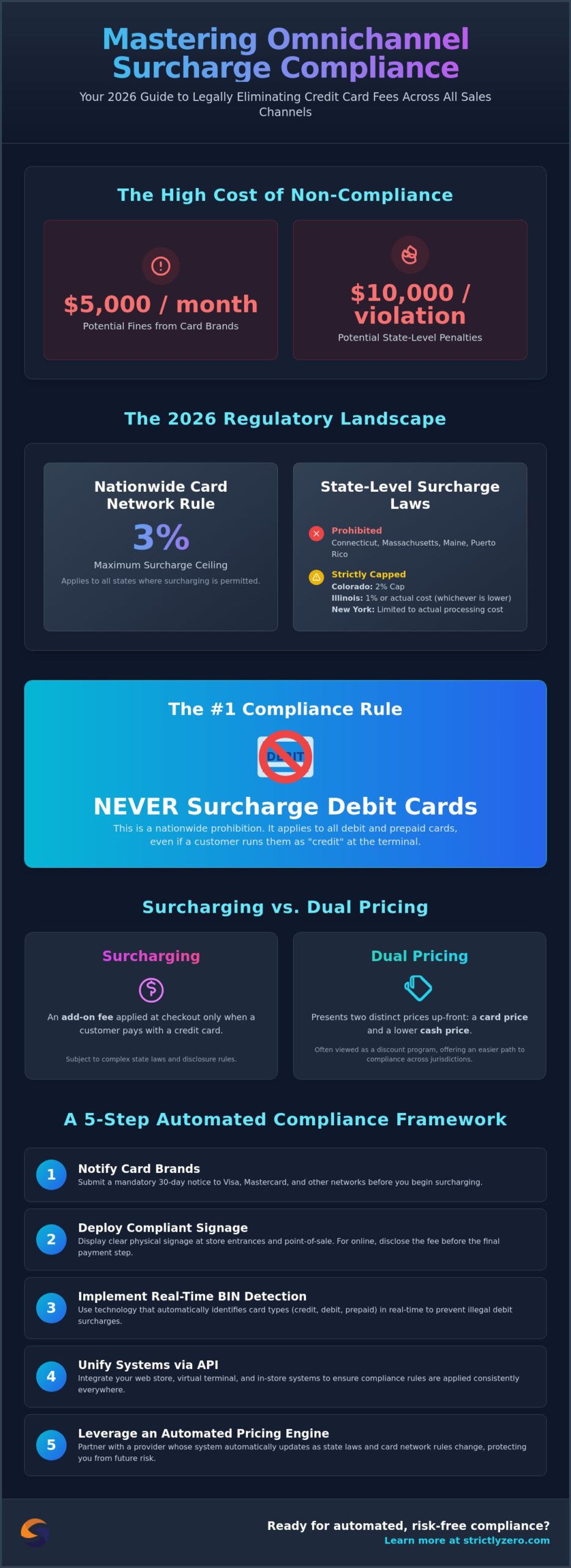
Many merchants fall into the trap of a “set it and forget it” mentality. This is a dangerous path in 2026. The regulatory climate has grown increasingly strict following the Visa-Mastercard settlement on June 9, 2026. Card networks have ramped up audits to ensure merchant transparency, and the financial stakes are high. You’re looking at potential fines of $5,000 per month from card brands, while state-level penalties can hit $10,000 per violation. Balancing fee elimination with customer trust requires more than just a sticker on a door; it requires a unified technical strategy.
The Difference Between Surcharging and Dual Pricing
Surcharging functions as an add-on fee applied at the moment of checkout when a customer chooses a credit card. Dual pricing, however, presents two distinct prices: one for cash and one for card. While both aim to offset processing costs, the legal nuances vary. States like New York and New Jersey permit surcharges only up to the actual cost of processing. For omnichannel merchants, dual pricing often offers the path of least resistance because it’s frequently viewed as a discount program rather than a penalty, making it easier to manage across different jurisdictions.
Why One-Size-Fits-All Compliance No Longer Works
Using retail-only logic for your e-commerce store is a recipe for disaster. Card-Not-Present (CNP) transactions through a virtual gateway have different disclosure requirements than a physical terminal. In a brick-and-mortar setting, you need physical signage at the point of entry and the point of sale. Online, that disclosure must happen before the final “pay” button is clicked. Achieving true omnichannel surcharge compliance requires a system that recognizes these differences in real-time. Your Merchant Service Provider must enforce these rules technically, as manual overrides can’t reliably prevent the prohibited surcharging of debit and prepaid cards.
The Regulatory Landscape: State Laws and Card Network Mandates
Understanding the legal boundaries of omnichannel surcharge compliance requires a dual focus on state statutes and card network rules. As of June 2026, the landscape is more fragmented than ever. While federal courts have opened doors in states like California and Texas by ruling bans unconstitutional, other regions have doubled down on consumer protections. You can’t apply a blanket policy across your entire business if you operate in multiple regions. Instead, you need a strategy that respects the most restrictive local laws while staying within the lines drawn by Visa and Mastercard.
State-level restrictions vary significantly. Currently, credit card surcharges are expressly prohibited in Connecticut, Massachusetts, Maine, and Puerto Rico. In states where surcharging is legal, many jurisdictions impose strict caps. Colorado limits fees to 2% of the transaction value, while Illinois caps them at 1% or the actual processing cost, whichever is lower. For a comprehensive look at these variables, reviewing State-by-state surcharge laws is essential for any merchant moving toward a zero-fee model.
The “No Debit” rule remains the most critical mandate to follow. It’s prohibited nationwide to apply a surcharge to debit or prepaid card transactions, even if the customer chooses to process the card as “credit” at the terminal. Violating this rule is the fastest way to lose your merchant account. Because card brands like Visa set a maximum surcharge of 3%, even if Mastercard allows 4%, your effective ceiling is 3% to remain compliant with both networks. You’re also required to notify both your processor and the card networks at least 30 days before you start your program.
Navigating State-Specific Nuances (NY, CT, MA)
Economic hubs like New York and New Jersey permit surcharges but only up to the actual cost you incur for processing the transaction. When handling interstate e-commerce, the legal landscape gets even cloudier. Generally, the rules of the merchant’s physical location apply, but many businesses choose to follow the customer’s state laws to avoid litigation. Implementing Zero Fee Credit Card Processing frameworks can help you automate these decisions so you don’t have to manually check every zip code.
Card Network Compliance Checklists
Transparency is the card networks’ top priority. Your omnichannel surcharge compliance strategy must include specific disclosures to avoid the $5,000 monthly fines that card brands can impose for violations.
- Mandatory Signage: You must display clear notice at the point of entry and the point of sale. For online stores, this means a disclosure on the checkout page before the transaction is finalized.
- Itemization: The surcharge must appear as a separate line item on every receipt, whether it’s a printed slip or a digital invoice.
- Registration: You can’t just flip a switch. You must register your intent to surcharge with the networks 30 days in advance.
If you’re unsure if your current setup meets these 2026 standards, you can consult with a payment expert to audit your workflow and ensure your systems are correctly identifying card types before fees are applied.
The Technical Challenge: Synchronizing Compliance Across Channels
The biggest hurdle in 2026 isn’t just knowing the law; it’s enforcing it across every digital and physical register. Most merchants treat their website and physical store as separate silos. This disconnect is where compliance failures happen. If your e-commerce site allows a surcharge on a debit card but your POS terminal blocks it, you’re failing at omnichannel surcharge compliance. You need a technical engine that synchronizes these rules in real-time across your entire business footprint.
Real-time Bank Identification Number (BIN) detection is the heart of this engine. When a customer enters their card details, the system must instantly identify if the card is credit, debit, or prepaid. This isn’t just about efficiency. It’s about following Mastercard’s official surcharge rules, which demand that merchants never surcharge debit products. A unified API ensures that whether the transaction happens via a smartphone or a counter-top terminal, the logic remains identical. This prevents the “accidental” surcharging that leads to heavy fines.
Automated Debit Detection in E-commerce
Online checkouts are high-risk zones for “accidental” surcharging. Without an integrated virtual gateway, your website might apply a fee to every card entered. Modern systems use BIN lookups to disable the surcharge field the moment a debit card is detected. This also improves the user experience. You can inform customers exactly why a fee was removed, building trust while staying within the legal boundaries of the June 2026 regulations.
Syncing POS Terminals with Virtual Terminals
Your customer experience should be identical whether they pay in person or via a remote payment link. This consistency is vital for credit card processing for small business owners who need to maintain a professional brand image. Centralized management ensures that disclosure language on a printed receipt matches the text on a digital invoice perfectly. It removes the guesswork for your staff and provides peace of mind for your legal team by ensuring every channel speaks the same compliance language.
Building a Compliant Framework: Disclosure, Signage, and Automation
Creating a foolproof strategy for omnichannel surcharge compliance requires a blend of legal notification, physical signage, and digital precision. You can’t simply start charging fees on a Monday morning without following a specific sequence of events. The first and most vital step is notifying the card brands at least 30 days before you implement the program. This window allows the networks to update your merchant profile and ensures you aren’t flagged for unauthorized fee collection during a routine audit.
Once the notification period is active, you must address your physical and digital environments. You’re required to place clear, conspicuous signage at your store’s entrance and at every point of sale. The text must state the exact surcharge percentage and clarify that the fee does not exceed your cost of acceptance. In the digital world, this means updating your checkout flow to ensure the fee is visible long before the customer hits the final “Pay” button. Following these steps helps you maintain omnichannel surcharge compliance while protecting your merchant account from termination.
- Automate your Gateway: Configure your system to use real-time BIN detection so debit cards are automatically excluded from the surcharge.
- Audit Receipts: Check that your receipts, both printed and digital, list the surcharge as a distinct line item rather than a hidden cost.
- Train Your Team: Your staff should be able to explain that the fee is a “Credit Card Surcharge” and that customers can avoid it by using a debit card or cash.
Digital Disclosure Standards for 2026
Receipt Itemization: The Audit Trail
Properly labeling your fees is your best defense against chargebacks and card network fines. Never “bundle” the surcharge into the item price or a generic “service fee” category. Clear labels like “Surcharge” or “Credit Card Fee” are mandatory and easily understood by consumers. Using the best credit card processing for small business tools allows you to automate this reporting, ensuring every receipt serves as a verifiable audit trail. If you’re ready to modernize your checkout experience, get started with an automated compliance engine today to eliminate manual errors across your sales channels.
Strictly’s Smart Pricing Engine: Automated Compliance for Every Channel
The Smart Pricing Engine replaces the need for manual rule-setting or static fee tables that become obsolete the moment a state legislature meets. It’s a dynamic, automated system that adjusts in real-time based on the specific card type and the customer’s geographic location. This level of precision is the only reliable way to maintain omnichannel surcharge compliance without slowing down your checkout process. Instead of your team worrying about whether a customer is in Maine or Texas, the engine handles the heavy lifting behind the scenes.
The system stays current with the shifting legal landscape automatically. As the number of states with surcharge restrictions grew to 22 in 2026, many merchants were caught off guard by sudden regulatory changes. Strictly’s engine updates as laws evolve. It ensures you never exceed the 3% Visa cap or the specific 2% limit in Colorado. By connecting our payment processing platform for ISOs directly to merchant-facing tools, we’ve created a seamless bridge between legal safety and business profitability.
ClearSplit™ and ChurnIQ™: Partner-Level Compliance Tools
Managing a large portfolio of merchants requires more than just a spreadsheet. Strictly provides ISOs with advanced tools like ClearSplit™ and ChurnIQ™ to maintain oversight at scale. ClearSplit™ automates the distribution of residuals, ensuring that partners are paid accurately while verifying that the merchant stays within legal surcharge limits. ChurnIQ™ uses data intelligence to monitor the health of your portfolio. It flags any merchants who might be drifting away from compliant practices, allowing you to intervene before a card brand audit occurs. It’s a proactive approach to risk management that keeps your business and your merchants protected from the $10,000 fines some states now impose.
Getting Started with a Compliant Zero-Fee Model
Transitioning to a zero-fee processing model shouldn’t be a months-long project that drains your resources. Our onboarding process is designed for speed. You can move from application to “Go Live” in just a few days, not weeks. Once you’re set up, you’ll have immediate access to a compliance-ready Virtual Terminal and secure Payment Links. These tools are built with omnichannel surcharge compliance at their core. They’ll automatically detect debit cards and apply the correct disclosures every time. It’s time to stop paying for your customers’ rewards points and start keeping more of your revenue. You can eliminate your processing fees today with Strictly and join the zero-fee revolution.
Secure Your Margins with a Future-Proof Payment Strategy
Mastering your payment strategy in 2026 requires moving beyond manual processes. You’ve seen how state-specific caps and card network mandates make a static approach impossible. By leveraging automated systems that update as laws change, you remove the burden of legal research from your daily operations. Real-time BIN detection ensures you never accidentally surcharge a debit card, keeping your merchant account safe from termination and high-cost audits.
Achieving total omnichannel surcharge compliance allows you to protect your margins without sacrificing the customer experience. Whether you’re selling in-person, online, or through a mobile app, a unified platform provides the consistency your brand needs. You can finally stop worrying about conflicting regulations and focus on growing your business. Eliminate your processing fees with a 100% compliant surcharge program from Strictly. Our Smart Pricing Engine and real-time detection tools take the guesswork out of zero-fee processing. It’s time to reclaim your revenue and build a more profitable future today.
Frequently Asked Questions
Is omnichannel surcharge compliance legal in all 50 states?
No, surcharging is not legal in every state as of June 2026. Credit card surcharges are expressly prohibited in Connecticut, Massachusetts, and Maine, along with Puerto Rico. While 22 states now have significant restrictions, others like New York and Colorado allow surcharges but impose strict caps. You must verify local statutes in every jurisdiction where you have a physical or digital presence.
Can I apply a surcharge to debit card transactions if they are processed as “credit”?
No, you cannot legally surcharge a debit or prepaid card transaction under any circumstances. This nationwide rule applies even if the customer chooses “credit” at the terminal or checkout screen. Surcharging a debit card is a violation of card network rules and is the leading cause of merchant account termination and heavy fines from Visa and Mastercard.
What is the maximum percentage I can charge as a surcharge in 2026?
The effective maximum surcharge is 3% for merchants who accept both Visa and Mastercard. Although Mastercard has a 4% ceiling, Visa’s 3% cap serves as the functional limit to stay compliant with both networks. Some states impose even lower limits, such as Colorado at 2% and Illinois at 1% or the actual cost of the transaction.
How do I notify Visa and Mastercard about my surcharge program?
You must submit a written notification to your payment processor and the card networks at least 30 days before you implement a surcharge. Most modern processors offer a digital registration portal to streamline this step. Skipping this 30-day notice period puts your business at risk of immediate audits and monthly penalties of up to $5,000 from the card brands.
Does omnichannel compliance require different software for online and in-store sales?
No, achieving true omnichannel surcharge compliance is actually easier when you use a unified payment platform. Using separate software for your website and physical store often leads to inconsistent disclosures and fee errors. A single, integrated engine ensures that your debit-exclusion rules and state-specific caps remain synchronized across every sales channel you use.
What happens if a merchant is found to be non-compliant with card network rules?
Non-compliant merchants face escalating fines and the potential loss of their ability to accept credit cards. Card brands can levy fines of $5,000 per month for ongoing violations. At the state level, penalties can reach up to $10,000 per violation in certain jurisdictions. Beyond the financial cost, repeated non-compliance usually results in your merchant account being permanently closed.
Can I use a “Cash Discount” model instead of a surcharge for my omnichannel business?
Yes, the cash discount model is a viable alternative that is generally legal in all 50 states. Unlike surcharging, which adds a fee to a base price, a cash discount involves posting a price that includes card costs and then offering a lower price for cash or low-cost payments. This model is often easier to implement across multiple channels without triggering complex state surcharge bans.
How does automated BIN detection prevent surcharge errors at checkout?
Automated BIN detection uses the first several digits of a card number to identify the card type in real-time. This technology is a critical component of omnichannel surcharge compliance because it instantly distinguishes between credit, debit, and prepaid cards. The system automatically removes the surcharge field if a debit card is detected, preventing illegal fees before the transaction is finalized.